CROATOAN on a post, 1590: John White returns to Roanoke

TL;DR — In 1590 John White found CROATOAN carved on a post at Roanoke, three years after his 1587 colonists, including his newborn granddaughter Virginia Dare, disappeared.
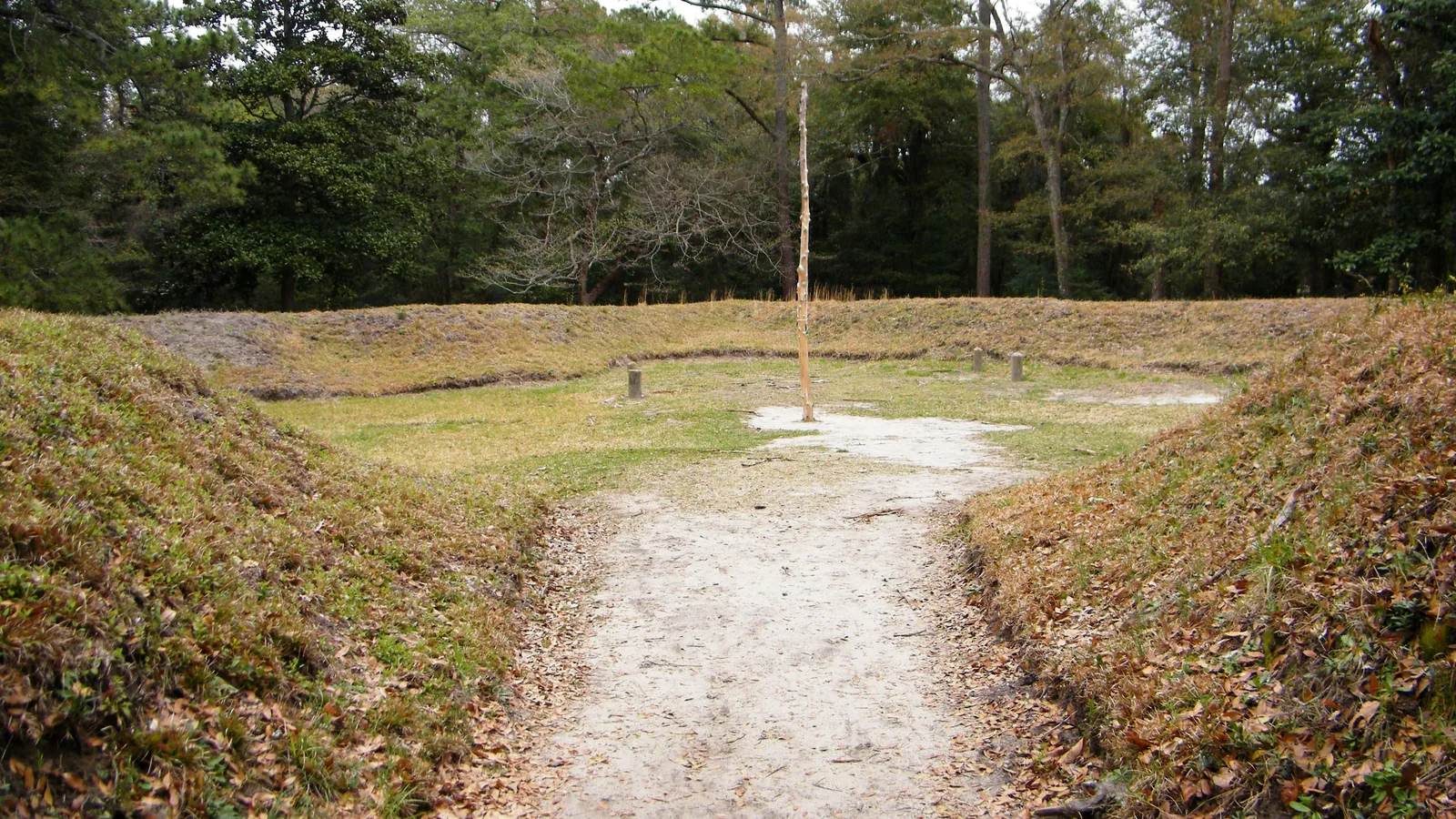
John White found the word cut five feet from the ground, in “fayre Capitall letters,” on a main post of the palisade his colonists had built: CROATOAN, “without any crosse or signe of distresse,” he wrote in his own account of the 1590 voyage, printed by Richard Hakluyt. He read it as a sign that his people were safe. White had left them on Roanoke Island in August 1587, after the pilot of his own fleet refused to carry them any further up the coast to the Chesapeake Bay site they had sailed to settle. When he came back three years later, the settlement stood empty.
Quick facts
- When
- April 1587 (colonists sail for the Chesapeake Bay) · August 13, 1587 (Manteo's christening) · August 18, 1587 (Virginia Dare born) · August 27, 1587 (White departs for England) · August 17-18, 1590 (White's return; boat accident and landing) · 2012 (British Museum map patch leads to Site X)
- Where
- Roanoke Island and the Chesapeake Bay, in present-day North Carolina and Virginia; England; Bertie County, North Carolina (Site X and Site Y)
- Who
- Governor John White; his daughter Eleanor Dare and granddaughter Virginia Dare; Manteo of Croatoan; pilot Simon Fernandes; the First Colony Foundation
- Outcome
- White found the settlement abandoned in 1590, with "CRO" carved on a tree and "CROATOAN" on a post and no cross marking distress. A storm stopped him from sailing on to Croatoan, and the colonists' fate was never confirmed. In 2012 the First Colony Foundation traced a hidden fort symbol on White's own map to Site X and Site Y in Bertie County.
John White lands with settlers at Roanoke, 1587
In April 1587, the National Park Service’s Fort Raleigh site states, White led a group of 117 men, women and children to the New World, sent to build a settlement called the City of Raleigh on the Chesapeake Bay. The First Colony Foundation counts the same voyage at 118, including White’s daughter Eleanor and her husband, Ananias Dare. Simon Fernandes, the master pilot in command of the ships, refused to sail them further up the coast. The Park Service records that Fernandes argued it was too late in the year to continue and that the colonists had to stay at Roanoke Island. The colonists took over the fortification the 1585 expedition had built there, and by the end of July had made substantial progress rebuilding it, the Park Service states.
Soon after the landing, Native people killed a colonist named George Howe. White and his men struck back at those they believed responsible, but hit friendly Croatoan people instead. The Park Service records that the attack stopped only when Manteo, a Croatoan man working with the colonists, intervened.
August 13 to 27, 1587: a christening, a birth, a departure
On August 13, by order of Sir Walter Raleigh, Manteo was christened at Roanoke and made Lord of Roanoke and Dasamonguepeuk, in reward, White wrote, for his “faithfull seruices.” Five days later Eleanor, White’s daughter and the wife of Ananias Dare, gave birth to a daughter. White recorded that the child, baptized the following Sunday, was named Virginia because she was the first Christian born in Virginia. Another family, the Harvies, had a child born about the same time; White’s own roster of “Children borne in Virginia” lists both infants.
On August 25 the colonists signed a written petition urging White to sail home for supplies, closing with a promise that they would “assure ourselues by these presents” of their request. White left Roanoke on the morning of August 27 and reached England on November 8, Hakluyt’s account and the Park Service agree. Before he sailed, White told the colonists that if they moved fifty miles inland, as they were already prepared to do, they should carve the name of their new location into a tree or post, and cut a cross above it only if they were in distress.
Seven men drown off Roanoke, August 1590
White’s return took three years, not the few months he had planned. The Spanish Armada was the cause, the Park Service states: Queen Elizabeth I ordered English vessels to stay near home in the fleet’s defense, and the fighting delayed White’s voyage while Raleigh’s own attention shifted to Ireland, forcing White to find other backers. He finally sailed for the West Indies with a small fleet of privateers in 1590.
On the night of August 17, White’s men tried to land at Roanoke through heavy surf. Two boats overturned, and White wrote that seven of the eleven men aboard drowned: Edward Spicer, Ralph Skinner, Edward Kelly, Thomas Bevis, Hance the surgeon, Edward Kelborne and Robert Coleman. The rest landed the next day, August 18, the date the Park Service gives, three years to the day after Virginia Dare’s birth. They found the settlement gone.
"CROATOAN," carved without a cross
On a tree at the edge of the abandoned site, White found “these faire Romane letters C R O” cut into the bark. At one of the main posts of the palisade, the bark had been stripped away and the full word CROATOAN was cut into it in capital letters, “without any crosse or signe of distresse.” White wrote that he “greatly ioyed” at what he took as a token that the colonists were safe at Croatoan, the island where Manteo was born and whose people were friendly to the English. A storm kept him from sailing there to check, and he returned to England without learning what had become of the settlers. White is thought to have died in Ireland around 1606; both the Park Service and the First Colony Foundation use qualified language, “possibly” and “likely,” about his death.
The Park Service’s own survey of the case, “Major Theories of the Lost Colony,” lists a hurricane that struck the Outer Banks in 1586, a famine severe enough to end trade with the Algonquian, a Spanish raid recorded by a captain who found a boat slip on Roanoke Island but no English colonists, and moves toward the Chesapeake Bay or inland to the Albemarle Sound. The agency states that no one has proven what happened to the colony.
A paper patch on the Virginea Pars map
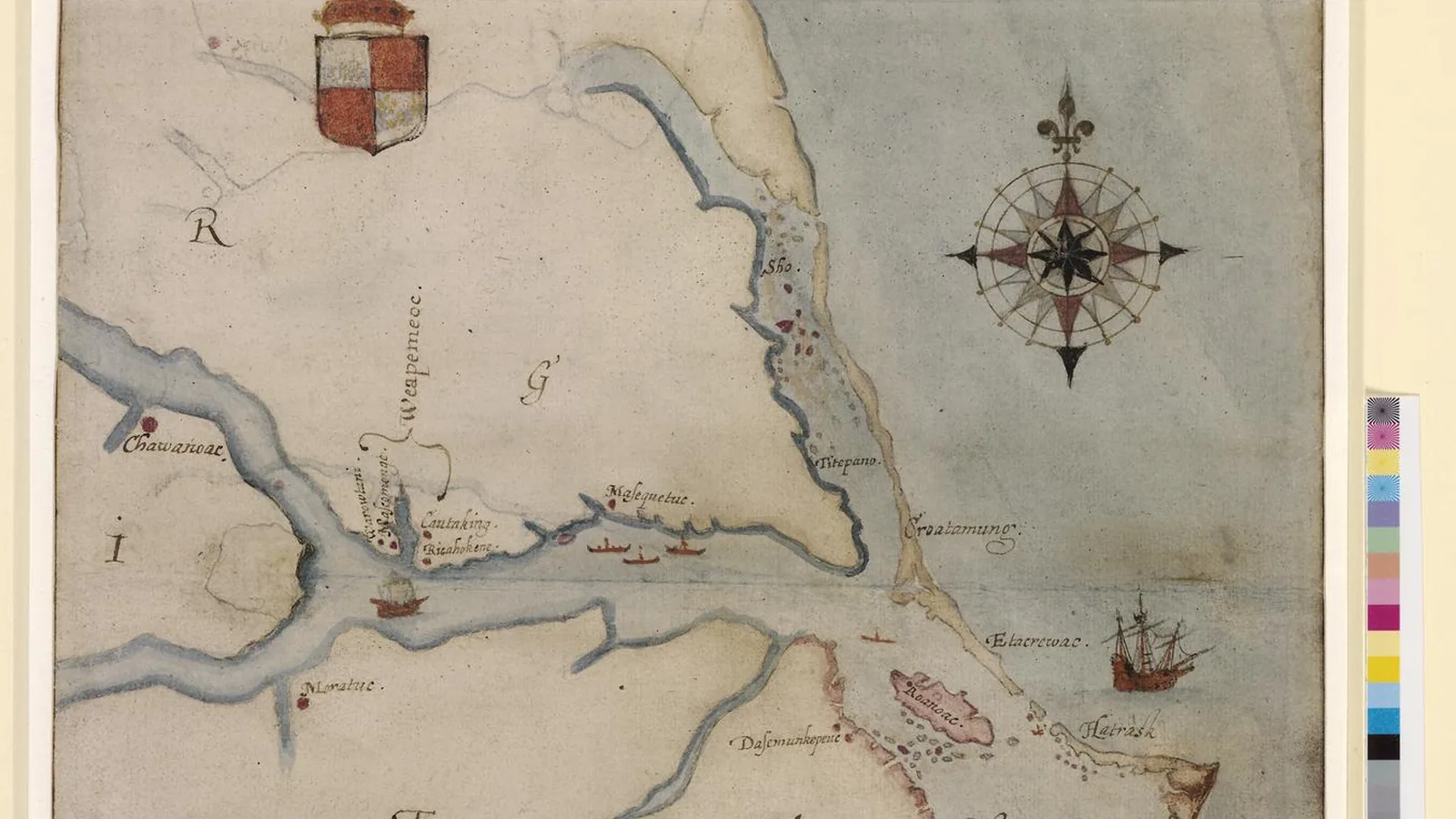
In 2012 the First Colony Foundation asked the British Museum to examine two small paper patches on the Virginea Pars map, the map of the Carolina coast that White himself had drawn. Under the patch covering the west end of the Albemarle Sound, in what is now Bertie County, was a Renaissance-style fort symbol. Archaeologists who searched the spot found English pottery sherds mixed with later artifacts and named the location Site X, which the foundation calls the first Elizabethan-era site found on the mainland of the United States. A lead cloth seal stamped in Augsburg, Germany, recovered there, pointed to civilian colonists rather than the soldiers of the earlier 1585 expedition, the foundation states. A second, larger location upstream, Site Y, produced more Elizabethan artifacts than Site X. The First Colony Foundation, a nonprofit founded in 2003, describes both sites as parts of a larger, scattered settlement of farms along the Chowan River, where, by its own count, 117 immigrants built their homes in the New World.

Key facts
- In April 1587 John White led a group the National Park Service counts at 117 and the First Colony Foundation at 118, intended for the Chesapeake Bay.
- Pilot Simon Fernandes refused to sail the colonists past Roanoke Island.
- Manteo was christened Lord of Roanoke and Dasamonguepeuk on August 13, 1587.
- Virginia Dare was born on Roanoke Island on August 18, 1587, and baptized the following Sunday.
- White left Roanoke on August 27, 1587, and reached England on November 8.
- On the night of August 17, 1590, seven men drowned when two boats capsized off Roanoke.
- White found “CRO” carved on a tree and “CROATOAN” carved on a post, with no cross marking distress, on landing August 18, 1590.
- In 2012 the First Colony Foundation traced a fort symbol hidden under a paper patch on White’s own map to Site X in Bertie County.
FAQ
How many colonists did John White bring to Roanoke in 1587?
The National Park Service counts 117 men, women and children; the First Colony Foundation counts 118. Both agree the group had planned to settle the Chesapeake Bay instead of Roanoke Island.
What did John White find when he returned to Roanoke in 1590?
He found the settlement abandoned, with "CRO" carved on a tree and "CROATOAN" carved on a gatepost, without the cross the colonists had agreed to cut if they were in distress.
What happened to the Roanoke colonists?
No source proves it. The National Park Service lists a hurricane, a famine, a Spanish raid and moves toward the Chesapeake Bay or the Albemarle Sound among unproven theories, while the First Colony Foundation's 2012 discovery of Site X and Site Y in Bertie County produced sixteenth-century English artifacts well inland from Roanoke Island.
Sources
- National Park Service, Fort Raleigh National Historic Site, "1587: The Lost Colony"
- National Park Service, Fort Raleigh National Historic Site, "1590 Rescue Voyage"
- National Park Service, Fort Raleigh National Historic Site, "Major Theories of the Lost Colony"
- First Colony Foundation, "The Roanoke Colonies" (James Horn)
- First Colony Foundation, "The Lost Colony is Found! How We Did It."
- Richard Hakluyt, The Principal Navigations, Voyages, Traffiques and Discoveries of the English Nation, vol. 13, Project Gutenberg ebook #25645
Cite this article
- APA
- LETTER. (2026, September 28). CROATOAN on a post, 1590: John White returns to Roanoke. Our Earth's History. https://ourearthshistory.com/americas/early-modern/roanoke-1587-john-white-croatoan-1590-virginia-dare/
- Chicago
- LETTER. “CROATOAN on a post, 1590: John White returns to Roanoke.” Our Earth's History, September 28, 2026. https://ourearthshistory.com/americas/early-modern/roanoke-1587-john-white-croatoan-1590-virginia-dare/.
- MLA
- LETTER. “CROATOAN on a post, 1590: John White returns to Roanoke.” Our Earth's History, 28 Sep. 2026, https://ourearthshistory.com/americas/early-modern/roanoke-1587-john-white-croatoan-1590-virginia-dare/.
Text licensed CC BY-NC-ND 4.0. Found an error? Tell us.