January 1, 1863: what the Emancipation Proclamation freed and left out
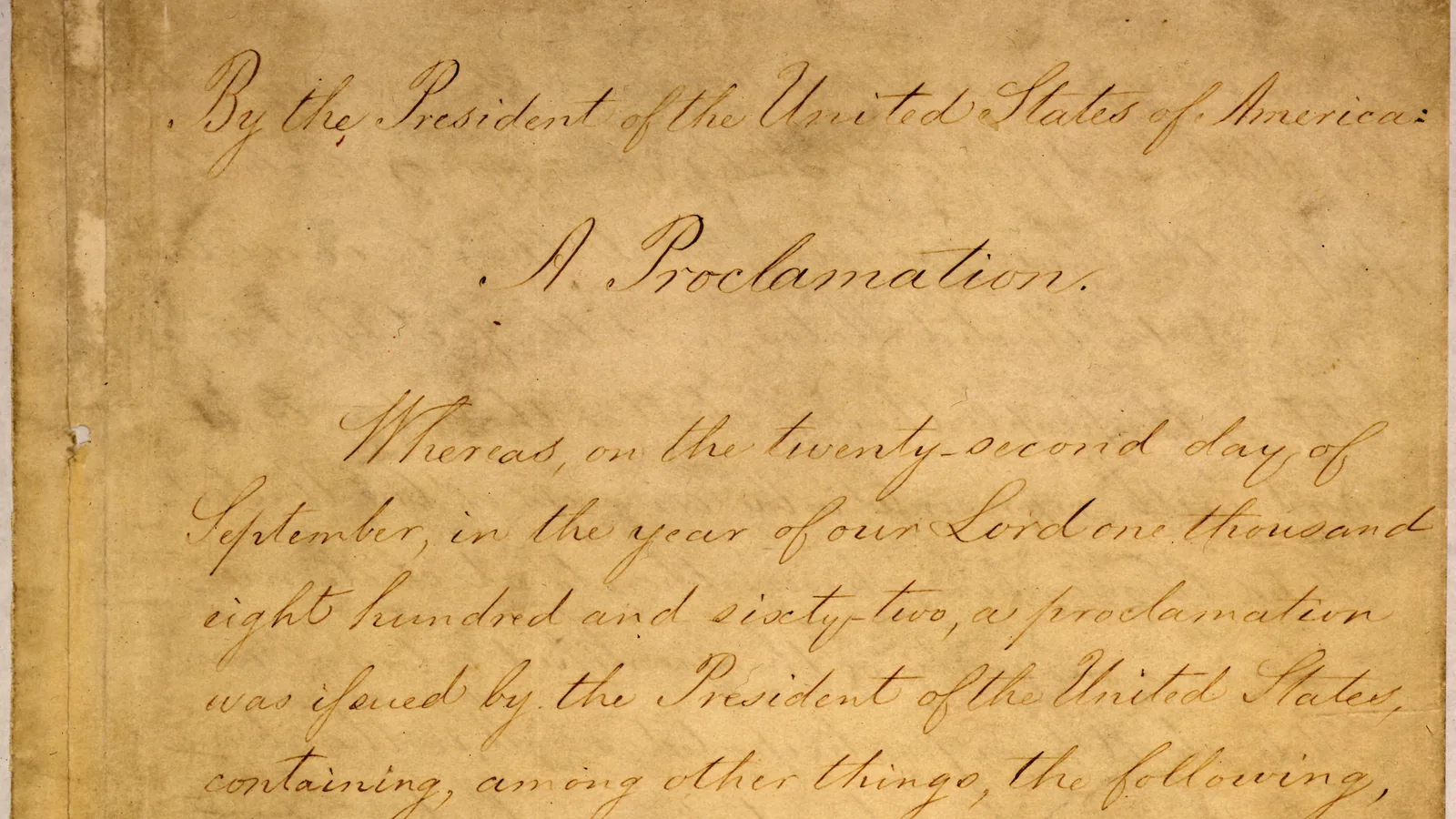

TL;DR — The proclamation of January 1, 1863, freed the enslaved in ten rebel states as a war measure, exempted districts and the border states, and needed the 13th Amendment to finish.
Thirteen parishes of Louisiana, including the city of New Orleans, the 48 counties designated as West Virginia, seven more Virginia counties and the cities of Norfolk and Portsmouth: the Emancipation Proclamation of January 1, 1863, named these and left them “precisely as if this proclamation were not issued.” Abraham Lincoln signed it in Washington “as a fit and necessary war measure for suppressing said rebellion,” and it declared “all persons held as slaves” in ten named Confederate states “are, and henceforward shall be free.” The four slave states that stayed in the Union, Kentucky, Missouri, Maryland and Delaware, were not covered at all. Nearly 200,000 Black soldiers and sailors carried it into the South, and the 13th Amendment, ratified by December 6, 1865, ended slavery where the proclamation had not.
Quick facts
- When
- September 22, 1862 (preliminary proclamation) · December 23, 1862 (Davis's proclamation on Black prisoners) · January 1, 1863 (Emancipation Proclamation) · March 21, 1863 (Douglass's broadside) · August 26, 1863 (Conkling letter) · April 4, 1864 (Hodges letter) · April 12, 1864 (Fort Pillow) · January 31, 1865 (House passes the 13th Amendment) · June 19, 1865 (General Order No. 3, Galveston) · December 6, 1865 (ratification complete)
- Where
- Washington, D.C.; the ten Confederate states named in the proclamation, from Arkansas to Virginia; the exempted parishes of southern Louisiana and counties of Virginia; the border states of Kentucky, Missouri, Maryland and Delaware; Galveston, Texas
- Who
- Abraham Lincoln; William H. Seward, who countersigned; Albert G. Hodges, editor of the Frankfort Commonwealth; James C. Conkling of Springfield; Frederick Douglass; Jefferson Davis; Nathan B. Forrest; Gordon Granger; about 179,000 Black soldiers and 19,000 Black sailors counted by the National Archives
- Outcome
- The proclamation declared the enslaved free where the Union army did not yet rule, left the border states and the exempted districts untouched, opened the army and navy to Black men, and was completed by the 13th Amendment, passed by the House 119 to 56 on January 31, 1865, and ratified by December 6, 1865
The text: a war measure with a map of exceptions
Lincoln invoked his power “as Commander-in-Chief, of the Army and Navy of the United States in time of actual armed rebellion” and designated Arkansas, Texas, Louisiana, Mississippi, Alabama, Florida, Georgia, South Carolina, North Carolina and Virginia as the states in rebellion. Then came the exceptions. In Louisiana: the parishes of St. Bernard, Plaquemines, Jefferson, St. John, St. Charles, St. James, Ascension, Assumption, Terrebonne, Lafourche, St. Mary, St. Martin and Orleans, “including the City of New Orleans.” In Virginia: “the forty-eight counties designated as West Virginia, and also the counties of Berkley, Accomac, Northampton, Elizabeth City, York, Princess Ann, and Norfolk, including the cities of Norfolk and Portsmouth.” Tennessee, under Union occupation, was not on the list at all.
The National Archives, which holds the signed original, describes the logic: as a military measure the proclamation “applied only to states that had seceded from the Union, leaving slavery untouched in the loyal border states,” and “expressly exempted parts of the Confederacy that had already come under Union control.” The text also announced that freed men “of suitable condition” would be received into the armed service. William H. Seward countersigned as secretary of state.
September 22, 1862: the hundred days
On September 22, 1862, five days after the Union victory at Antietam, Lincoln issued a preliminary proclamation: on January 1, 1863, the enslaved in any state “then in rebellion” would be “then, thenceforward, and forever free.” Any state represented in Congress on that day “in good faith” would be deemed not in rebellion. On January 1 Lincoln wrote that he acted on a purpose “publicly proclaimed for the full period of one hundred days.”
The border states had been offered a different deal. On May 19, 1862, according to the chronology kept by the Freedmen and Southern Society Project at the University of Maryland, Lincoln nullified General David Hunter’s emancipation order in South Carolina, Georgia and Florida and urged Kentucky, Missouri, Maryland and Delaware “to embrace gradual, compensated emancipation.” Congress had already let the president employ “persons of African descent” in military service, in the Militia Act of July 17, 1862.
Lincoln explains himself: the Conkling and Hodges letters
On August 26, 1863, Lincoln wrote to James C. Conkling for a Union rally at Springfield, Illinois. To those who called the proclamation unconstitutional he answered that as law it “either is valid, or is not valid. If it is not valid, it needs no retraction. If it is valid, it can not be retracted, any more than the dead can be brought to life.” To those who would not fight to free the enslaved: “Fight you, then exclusively to save the Union.” Of the Black soldiers already in the field: “the promise being made, must be kept.”
The letter of April 4, 1864, to Albert G. Hodges, editor of the Frankfort Commonwealth, put the moral position first: “I am naturally anti-slavery. If slavery is not wrong, nothing is wrong.” It then explained that he had forbidden General John C. Frémont’s and Hunter’s military emancipations because he “did not then think it an indispensable necessity,” and that when the border states declined compensated emancipation the choice was “either surrendering the Union, and with it, the Constitution, or of laying strong hand upon the colored element.” The measure had brought “a gain of quite a hundred and thirty thousand soldiers, seamen, and laborers.” The letter closed: “I claim not to have controlled events, but confess plainly that events have controlled me.” Both arguments sit in the same letter, and Lincoln did not rank them.
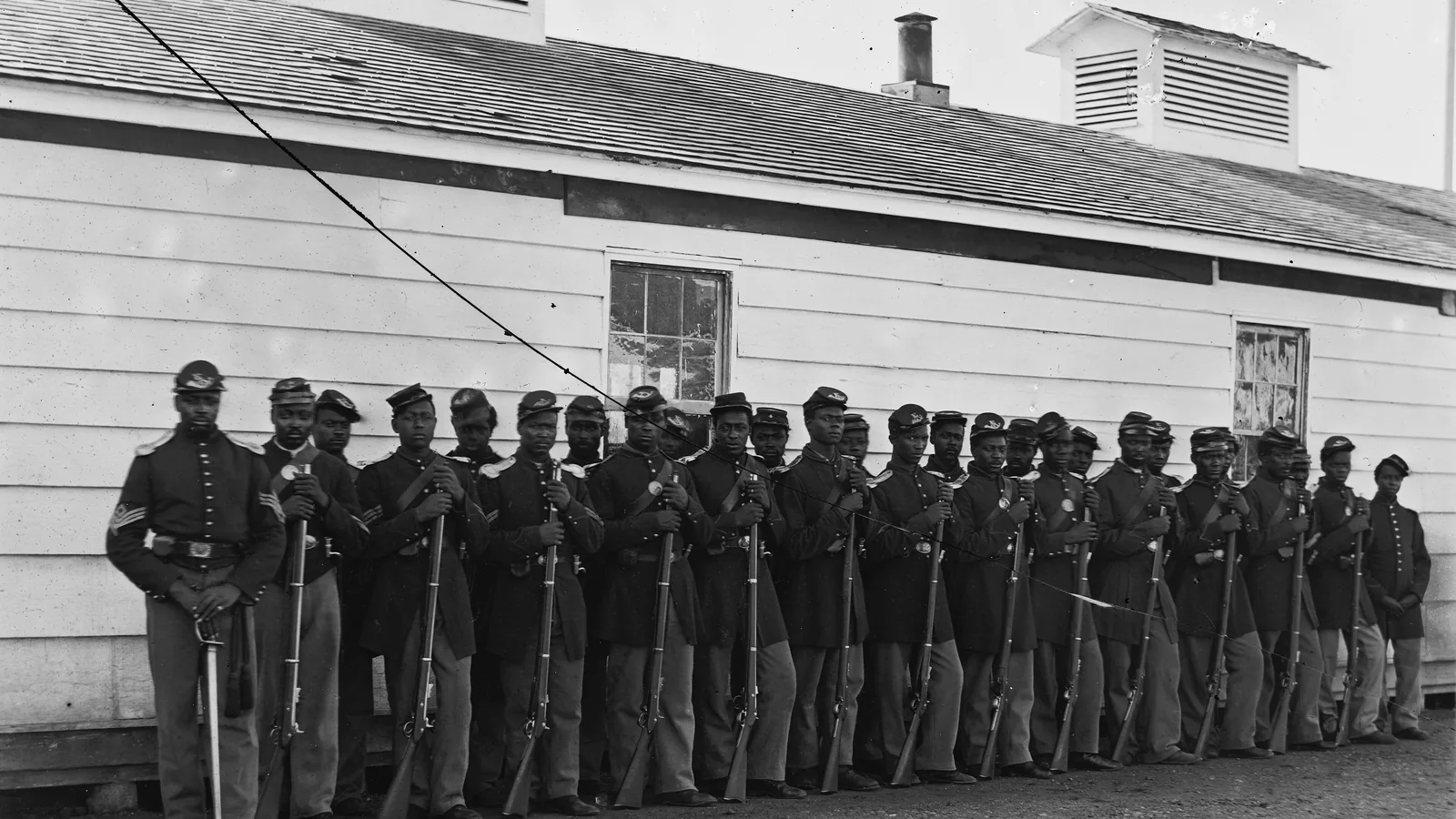
Nearly 200,000 in uniform
In a broadside dated March 21, 1863, Frederick Douglass wrote that “the arm of the slave was the best defense against the arm of the slaveholder” and urged men to fill “the first colored regiment from the North,” promising “the same wages” and “the same bounty, secured to the white soldiers.” The wages part failed at first. Black soldiers drew $10 a month less $3 for clothing, against $13 for white soldiers, until Congress equalized pay on June 15, 1864, and made the change retroactive.
By the war’s end, in the National Archives’ count, roughly 179,000 Black men had served as soldiers, and another 19,000 in the Navy. Nearly 40,000 died, 30,000 of them from infection or disease. The Confederacy had already answered: on December 23, 1862, Jefferson Davis ordered that captured Black soldiers and their officers were not to be treated as prisoners of war but handed to state authorities. At Fort Pillow, Tennessee, on April 12, 1864, Confederate soldiers under Nathan B. Forrest shot Black Union soldiers who had been captured; Forrest, the Archives account says, “witnessed the massacre and did nothing to stop it.”

Galveston, June 19, 1865, and the amendment that finished it
Enslaved people had been reaching Union lines since the war’s first weeks: the Freedmen and Southern Society Project’s chronology records that on May 24, 1861, fugitives at Fortress Monroe, Virginia, were received and put to work by General Benjamin F. Butler, who declared them “contraband of war.” The National Archives writes that “from the first days of the Civil War, enslaved people had acted to secure their own liberty.”
On June 19, 1865, at Galveston, Major General Gordon Granger read General Order No. 3: “The people of Texas are informed that, in accordance with a proclamation from the Executive of the United States, all slaves are free.” The order advised the freed “to remain quietly at their present homes and work for wages.” Texans celebrated the date from 1866; it became a state holiday in 1980 and a federal one on June 17, 2021.
The Senate had approved a constitutional amendment abolishing slavery in April 1864; the House passed it on January 31, 1865, by 119 votes to 56. The three fourths of the states needed for ratification were reached by December 6, 1865, and the secretary of state announced the ratification on December 18. The first section reads: “Neither slavery nor involuntary servitude, except as a punishment for crime . . . shall exist within the United States.” Slavery in the United States ended as a matter of law on December 6, 1865, less than six months after Granger’s order at Galveston and 35 months after the proclamation of January 1, 1863.
Key facts
- The proclamation named ten states in rebellion and exempted 13 Louisiana parishes with New Orleans, the 48 counties of West Virginia, seven other Virginia counties and the cities of Norfolk and Portsmouth (National Archives transcript).
- The four loyal slave states, Kentucky, Missouri, Maryland and Delaware, were outside its scope; Lincoln had urged them toward compensated emancipation on May 19, 1862 (Freedmen and Southern Society Project).
- The preliminary proclamation of September 22, 1862, came five days after Antietam and gave the rebel states 100 days to return.
- Lincoln to Hodges, April 4, 1864: “If slavery is not wrong, nothing is wrong”; the same letter counts “a hundred and thirty thousand soldiers, seamen, and laborers” gained.
- About 179,000 Black soldiers and 19,000 sailors served; nearly 40,000 died, 30,000 of disease; pay was $7 net against $13 until June 1864 (National Archives).
- Jefferson Davis ordered captured Black soldiers denied prisoner-of-war status on December 23, 1862; the Fort Pillow massacre followed on April 12, 1864.
- General Order No. 3 was read at Galveston on June 19, 1865; the House passed the 13th Amendment 119 to 56 on January 31, 1865, and ratification was complete by December 6, 1865.
FAQ
Did the Emancipation Proclamation free all enslaved people?
No. It applied to the ten states named as in rebellion, minus the listed Louisiana parishes and Virginia counties, and it did not touch Kentucky, Missouri, Maryland, Delaware or Tennessee. Slavery in those places ended by state action or by the 13th Amendment in December 1865.
Why did Lincoln call it a war measure?
The text says so: he acted as commander in chief "in time of actual armed rebellion" and "as a fit and necessary war measure." In the Conkling letter of 1863 he argued that the law of war let a commander take enemy property when needed, and in the Hodges letter of 1864 he wrote that measures "otherwise unconstitutional, might become lawful, by becoming indispensable to the preservation of the constitution."
What is the connection between the proclamation and Juneteenth?
General Order No. 3, read at Galveston on June 19, 1865, told Texans that "in accordance with a proclamation from the Executive of the United States, all slaves are free." It was the proclamation of January 1, 1863, arriving with the army two and a half years later; the date has been celebrated in Texas since 1866 and became a federal holiday on June 17, 2021.
Sources
- U.S. National Archives and Records Administration — "Emancipation Proclamation (1863)," Milestone Documents, with transcript (page reviewed May 10, 2022).
- Yale Law School, Lillian Goldman Law Library, Avalon Project — "Emancipation Proclamation; January 1, 1863."
- U.S. National Archives and Records Administration, Educator Resources — Elsie Freeman, Wynell Burroughs Schamel and Jean West, "Black Soldiers in the U.S. Military During the Civil War," Social Education 56, no. 2 (February 1992), revised 1999 by Budge Weidman.
- Abraham Lincoln Online — "Letter to Albert G. Hodges," April 4, 1864, text from The Collected Works of Abraham Lincoln, ed. Roy P. Basler et al.
- Abraham Lincoln Online — "Letter to James C. Conkling," August 26, 1863, text from The Collected Works of Abraham Lincoln, ed. Roy P. Basler et al.
- Freedmen and Southern Society Project, Department of History, University of Maryland — "Chronology of Emancipation during the Civil War," adapted from Free at Last (revised April 9, 2026).
- Freedmen and Southern Society Project, Department of History, University of Maryland — project home page, on the 50,000 documents selected from the National Archives.
- Teaching American History (Ashbrook Center) — Frederick Douglass, "Men of Color, To Arms!" (March 21, 1863).
- Texas State Library and Archives Commission — "Texas Observes Juneteenth," with the text of General Order No. 3 (page modified July 10, 2026).
- U.S. National Archives and Records Administration — "Juneteenth," National Archives News special topics page (reviewed February 13, 2025).
- U.S. National Archives and Records Administration — "13th Amendment to the U.S. Constitution: Abolition of Slavery (1865)," Milestone Documents, with transcript.
Cite this article
- APA
- Our Earth's History. (2026, September 21). January 1, 1863: what the Emancipation Proclamation freed and left out. Our Earth's History. https://ourearthshistory.com/americas/modern/emancipation-proclamation-1863-what-it-freed/
- Chicago
- Our Earth's History. “January 1, 1863: what the Emancipation Proclamation freed and left out.” Our Earth's History, September 21, 2026. https://ourearthshistory.com/americas/modern/emancipation-proclamation-1863-what-it-freed/.
- MLA
- “January 1, 1863: what the Emancipation Proclamation freed and left out.” Our Earth's History, 21 Sep. 2026, https://ourearthshistory.com/americas/modern/emancipation-proclamation-1863-what-it-freed/.
Text licensed CC BY-NC-ND 4.0. Found an error? Tell us.