How did a canal dug by Egyptians end up owned by Britain and France?
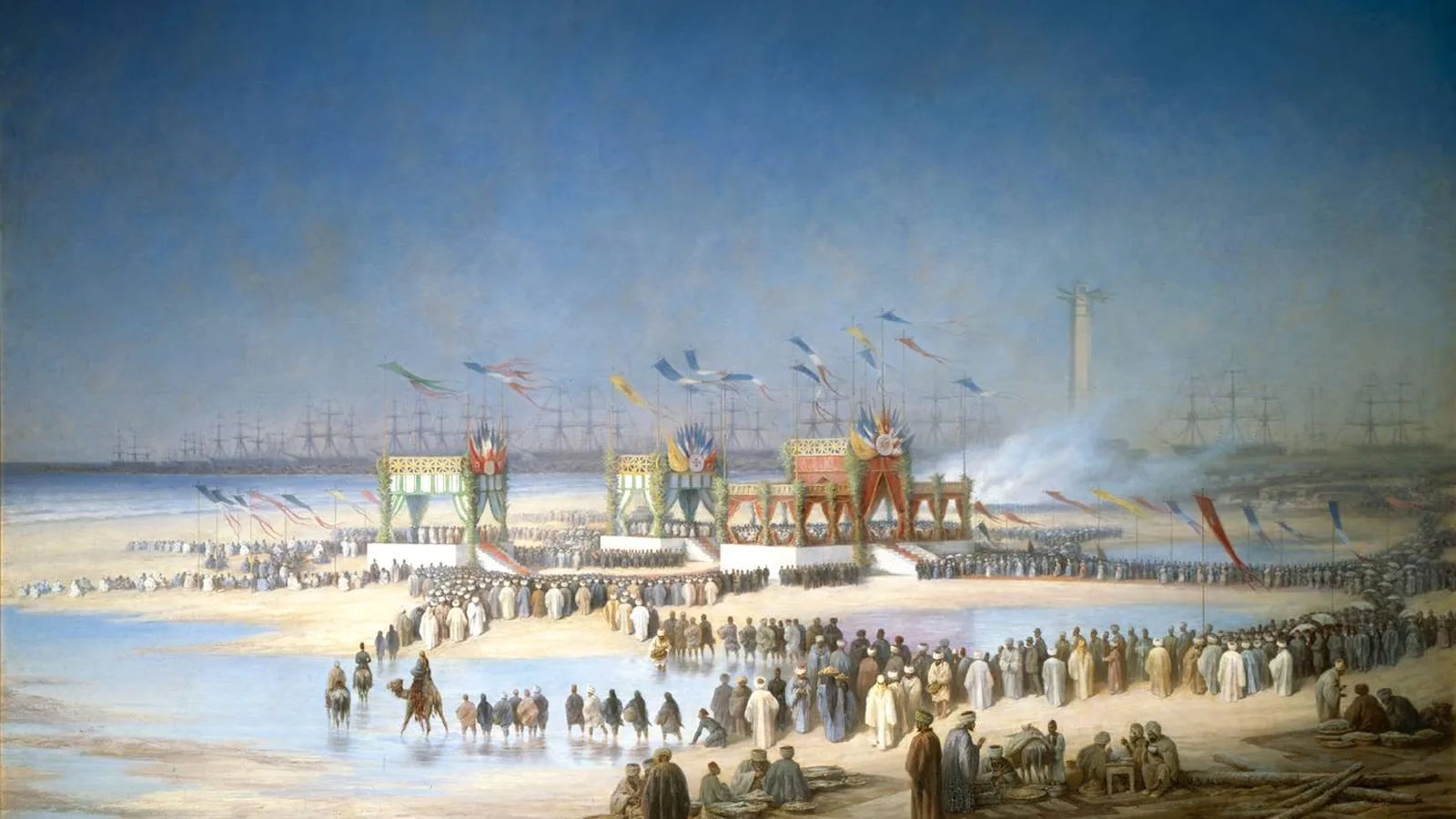

TL;DR — Egypt granted the concession, bought 44 percent of the shares and dug it; French investors held the rest, and in 1875 a bankrupt khedive sold Egypt’s stake to Britain.
Egypt sold its stake in the Suez Canal to Britain in November 1875, when the khedive Ismail needed four million pounds in days to avoid default. The canal had been an Egyptian project from the start: Said Pasha, the viceroy, granted the concession in 1854, took up the shares that Britain and other powers refused in 1858 and supplied the diggers under the country’s forced-labor custom. The company was French, seated in Paris. When Ismail’s credit collapsed, Benjamin Disraeli’s cabinet bought his 176,602 shares for £3,976,582 with money advanced by the Rothschild bank. British troops took the canal zone in 1882, a convention fixed its neutrality in 1888, and Egypt took the company back by decree in July 1956.
Quick facts
- When
- November 30, 1854 (first concession) · December 5, 1858 (company founded) · April 25, 1859 (digging begins) · August 18, 1869 (the two seas meet) · November 17, 1869 (opening) · November 25, 1875 (Egypt's shares sold to Britain) · October 29, 1888 (Constantinople convention) · July 26, 1956 (nationalization)
- Where
- The Isthmus of Suez between Port Said and Suez, in Egypt, then a semi-independent province of the Ottoman Empire; Cairo; Paris, where the company had its seat; London and Windsor
- Who
- Said Pasha and his successor Ismail, viceroys (khedives) of Egypt; Ferdinand de Lesseps, the French promoter; Emperor Napoleon III as arbiter; Benjamin Disraeli and Sir Stafford Northcote in London; the Rothschild bank; Gamal Abdel Nasser in 1956
- Outcome
- Egypt paid for about half the company and most of the labor, then sold its 176,602 shares to Britain for £3,976,582 in 1875; British troops held the canal from 1882; the 1888 convention opened it to all flags; Egypt nationalized the company in 1956
A viceroy's tent in the desert, November 1854
Ferdinand de Lesseps, who had served in the French consulates in Egypt, landed at Alexandria on November 7, 1854, a few months after his old friend Said Pasha became viceroy. Lesseps’s diary records the decision in a desert camp on November 15. At sunset he laid out the plan in Said’s tent, and the viceroy answered, “I am convinced; I accept your plan.” Said called in his generals, and everyone ate soup from the same tureen.
The first concession, dated November 30, 1854, let Lesseps form a company. According to the Suez Canal Authority, Egypt’s state operator, it ran for 99 years from the opening, gave the Egyptian government 15 percent of net profit and returned the waterway to Egypt at the end. A second concession of January 5, 1856 declared the canal “open forever, as neutral passages, to every merchant vessel.” In Parliament and the London press the project was mocked as a “stagnant ditch.”
Who bought the shares in 1858, and who refused
The Universal Company of the Maritime Canal of Suez was founded on December 5, 1858, with 400,000 shares of 500 francs each. Egypt took 92,136 shares. Another 85,506, reserved for Britain, the United States, Austria and Russia, went unsold when those governments refused to take part. At Lesseps’s urging, Egypt borrowed 28 million francs at high interest and took those too, ending with 177,642 shares, about 44 percent of the company. The rest sat with French subscribers.
In 1876 the Chancellor of the Exchequer, Sir Stafford Northcote, told the Commons what that commitment had grown into. Beyond the shares, the viceroy had supplied the company with nearly ten million pounds in money or money’s worth: cash for a shortfall of about £5.2 million, land worth some £4 million and forced labor he valued at roughly £400,000, advantages “from which he gets no return.”
Ten years of digging, 1859 to 1869
Digging began on April 25, 1859 at Al-Farama, the site of Port Said, where the Suez Canal Authority counts 20,000 Egyptians on the first day. A London magazine, All the Year Round, described the workforce in January 1876: Said “supplied him with fellahs by the thousand, according to the custom of forced labor in the country.” Said died less than five years after the start, and his successor Ismail declined to send more forced labor. Lesseps appealed to Napoleon III, whose award, by the magazine’s account, obliged the pasha to keep supplying labor under a rearranged concession. Northcote told the Commons instead that the labor was withdrawn “in consequence of objections taken to the system” and that Egypt paid the company compensation under the emperor’s award. None of the pages read for this article dates the award beyond the 1860s or counts the men or the dead.
Dredgers finished what the fellahin had begun. The Suez Canal Authority dates the meeting of the two seas to August 18, 1869, after 74 million cubic meters of excavation, at a cost of 433 million francs, double the estimate. The opening on November 17, 1869 drew 6,000 guests behind Empress Eugénie of France aboard the L’Aigle, at the head of 77 ships, 50 of them warships. Ismail paid the bill, about one and a half million Egyptian pounds.
Why Ismail sold, November 1875
By 1875 the canal was earning: Northcote reported a surplus of £322,343 for 1874, after a deficit in 1870, with British ships carrying 73 percent of the tonnage. Ismail, though, had already pledged the dividend coupons on his shares for 25 years to settle a 30 million franc debt to the company, so the shares paid him nothing. Then the Ottoman Empire defaulted in October 1875, Egyptian credit fell with it, and Ismail had to find three to four million pounds by December 1 for the coupons on his own public debt. French syndicates, Disraeli’s biographers Monypenny and Buckle wrote, offered loans at 18 percent against the shares.
On November 15 the journalist Frederick Greenwood warned the Foreign Office that the shares were about to go to French financiers, and the cabinet decided on November 17 to buy. Ismail then offered the shares for four million pounds with 5 percent interest until the coupons were freed. Parliament was not sitting, so Disraeli’s secretary went to Lionel de Rothschild, who advanced the sum for a commission of 2.5 percent. Disraeli wrote to Queen Victoria on November 24, “It is just settled: you have it, Madam,” and the contract was signed at Cairo the next day. On completion the shares proved to be 176,602, not 177,642, and the price fell to £3,976,582; the Suez Canal Authority gives £3,976,580. Northcote told the Commons on February 14, 1876 that had the shares passed to a foreign country “we should have been reproached by England.” Egypt also sold its 15 percent of the profits to the Crédit Foncier de France for 22 million francs, and was left with nothing in the company.
Occupation in 1882 and the convention of 1888
Ownership of shares became control of the ground seven years later. The Suez Canal Authority states that between May and September 1882, after the Urabi revolt, Britain occupied Egypt, seized the company’s facilities and halted traffic for a time. Lord Cromer, who governed Egypt for Britain afterward, wrote in 1908 that in 1882 “the army was in a state of mutiny; the treasury was bankrupt.”
The convention signed at Constantinople on October 29, 1888 by nine powers, Britain, France and the Ottoman Empire among them, set the rule that outlasted the company. Article 1 declared the canal open to every vessel “without distinction of flag,” in war as in peace, and never subject to blockade. The concession’s promise of 1856 had become treaty law, with a British garrison on the banks.
From company to state, 1956
On July 26, 1956, Gamal Abdel Nasser signed a decree whose first article read: “The Suez Maritime Canal Company, S.A.E. is nationalized. All money, rights and obligations of the company are transferred to the State.” The Suez Canal Authority records that Egypt completed the compensation, at the Paris closing price of the previous day, on January 1, 1963: 28.3 million Egyptian pounds for 800,000 shares.
The chain of title is short. Egypt granted the concession, bought nearly half the company on credit, dug the channel and paid for the party. French investors owned the other half from the first day. Britain bought Egypt’s half in ten days in 1875 because Egypt’s debts had come due, then held the ground with soldiers from 1882. What the sources leave open is the human cost of the digging.
Key facts
- The first concession of November 30, 1854 ran 99 years from the opening and gave Egypt 15 percent of net profit; the canal was to revert to Egypt afterward (Suez Canal Authority).
- The company of December 5, 1858 had 400,000 shares of 500 francs; Egypt took 177,642 after Britain, the United States, Austria and Russia refused their allotment of 85,506.
- Northcote told the Commons that Egypt had supplied the company with nearly ten million pounds in cash, land and forced labor beyond its shares (Hansard, February 14, 1876).
- The two seas met on August 18, 1869; the canal opened on November 17, 1869 at a cost of 433 million francs, twice the estimate.
- Britain bought 176,602 shares for £3,976,582, contract signed at Cairo on November 25, 1875, with money advanced by Rothschild at 2.5 percent commission.
- The Constantinople convention of October 29, 1888 opened the canal to all flags in war and peace.
- Nasser’s decree of July 26, 1956 nationalized the company; compensation was completed on January 1, 1963.
FAQ
How much did Britain pay for the Suez Canal shares in 1875?
The agreed price was four million pounds for 177,642 shares. When the shares were counted at 176,602, the price was reduced to £3,976,582, according to the Chancellor of the Exchequer's statement to the Commons. The Rothschild bank advanced the money and charged £99,414 in commission.
Why did Egypt sell its Suez Canal shares?
The khedive Ismail had to meet the coupons on Egypt's public debt by December 1, 1875, weeks after the Ottoman default of October 1875. His shares already carried no dividend, because he had pledged their coupons for 25 years to settle a 30 million franc debt to the company. Selling outright to Britain was faster than the French loans on offer.
Who actually dug the Suez Canal?
Egyptian peasants, the fellahin, conscripted under the corvée custom in the early years, and then steam dredgers after Ismail withdrew the forced labor in the 1860s. The Suez Canal Authority gives 74 million cubic meters excavated between April 1859 and August 1869.
Sources
- Suez Canal Authority (Egypt) — "Suez Canal... A Historical Evolution" (Canal History), official page with the concessions of 1854 and 1856, the 1858 share allotment, the 1869 opening, the 1875 sale and the 1956 nationalization.
- Suez Canal Authority (Egypt) — text of the Convention respecting the free navigation of the Suez Maritime Canal, signed at Constantinople, October 29, 1888.
- Suez Canal Authority (Egypt) — text of the Nationalization Decree of July 26, 1956, signed by Gamal Abdel Nasser.
- UK Parliament, Historic Hansard — House of Commons, "Supply—The Suez Canal Shares," February 14, 1876, Series 3, vol. 227, cc. 266–300 (the Chancellor of the Exchequer's statement on the purchase).
- William Flavelle Monypenny and George Earle Buckle, The Life of Benjamin Disraeli, Earl of Beaconsfield, vol. 5 (New York: Macmillan, 1920), chapter 12, "Suez Canal and Royal Title, 1875–1876," with Disraeli's letters to Queen Victoria of November 18 to 24, 1875 (Internet Archive full text).
- Ferdinand de Lesseps, Recollections of Forty Years, translated by C. B. Pitman, vol. 1 (London: Chapman and Hall, 1887), chapter 4, "The Origin of the Suez Canal," diary entries of November 1854 (Internet Archive full text).
- Internet Islamic History Sourcebook (Fordham University) — "The Story of the Suez Canal," from All the Year Round, January 8, 1876.
- Internet Modern History Sourcebook (Fordham University) — The Earl of Cromer, "Why Britain Acquired Egypt in 1882," from Modern Egypt, vol. 1 (New York: Macmillan, 1908), pp. 326–330.
Cite this article
- APA
- Our Earth's History. (2026, September 20). How did a canal dug by Egyptians end up owned by Britain and France? Our Earth's History. https://ourearthshistory.com/west-asia/modern/suez-canal-1869-who-owned-it/
- Chicago
- Our Earth's History. “How did a canal dug by Egyptians end up owned by Britain and France?” Our Earth's History, September 20, 2026. https://ourearthshistory.com/west-asia/modern/suez-canal-1869-who-owned-it/.
- MLA
- “How did a canal dug by Egyptians end up owned by Britain and France?” Our Earth's History, 20 Sep. 2026, https://ourearthshistory.com/west-asia/modern/suez-canal-1869-who-owned-it/.
Text licensed CC BY-NC-ND 4.0. Found an error? Tell us.