Why do the Māori and English texts of the Treaty of Waitangi differ?
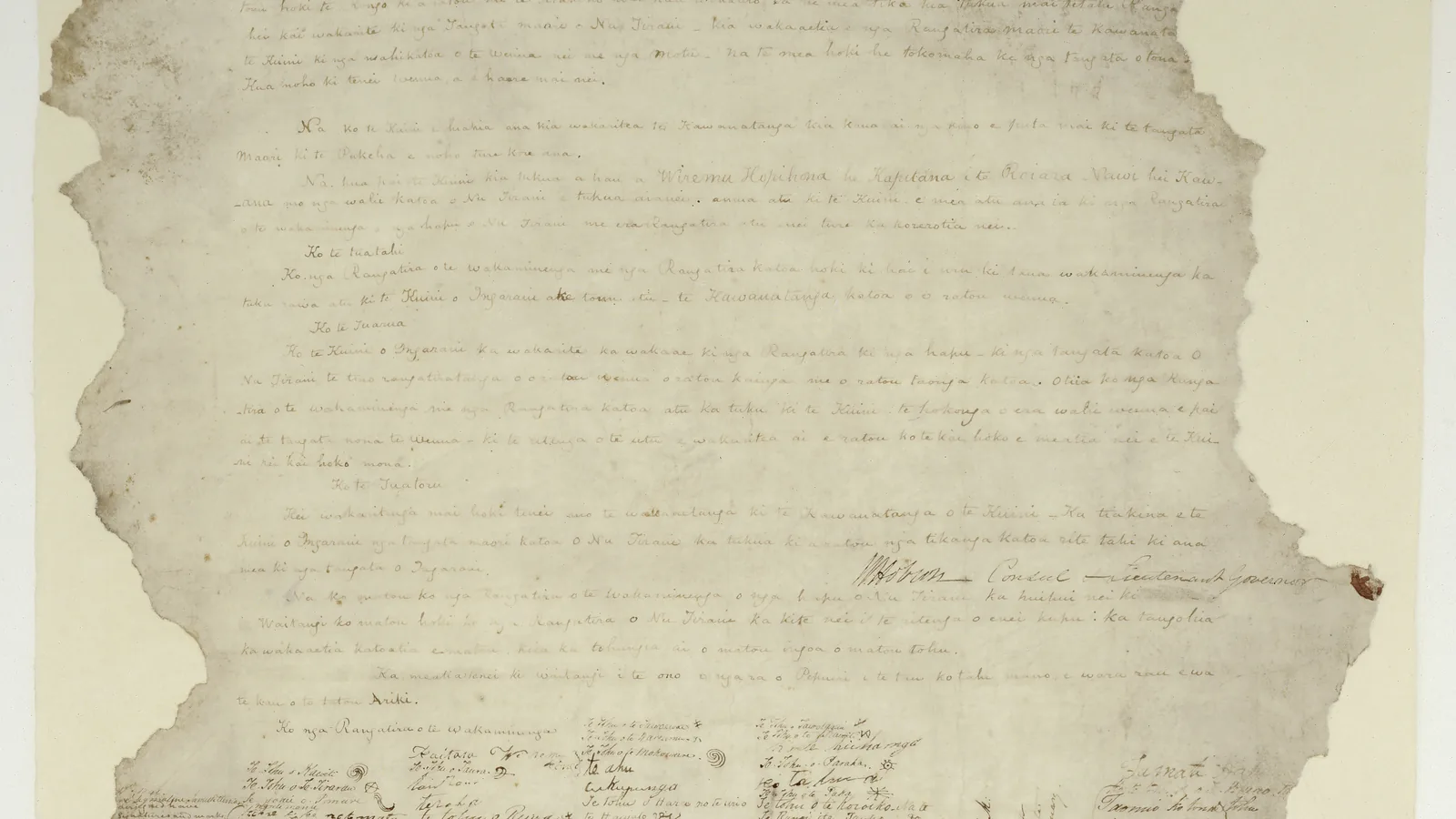
_-_Waitangi_Sheet_.jpg)
TL;DR — Henry Williams turned Hobson’s English draft into Māori in one night, February 4, 1840. It gave the Queen kāwanatanga, governance, and kept tino rangatiratanga; the English ceded sovereignty.
The texts differ because the missionary Henry Williams turned William Hobson’s English draft into Māori overnight on February 4, 1840, using words that did not match the English. In the English text, the chiefs ceded “all the rights and powers of Sovereignty” and were guaranteed “undisturbed possession” of their lands. In the Māori text, which nearly every rangatira signed, they gave the Queen “te Kawanatanga katoa,” complete government, and kept “te tino rangatiratanga,” the full exercise of chieftainship, over their lands and all their taonga. Since 1975 the Waitangi Tribunal has had the job of deciding “issues raised by the differences between them.” The historian and lawyer Ned Fletcher argued in 2022 that the two texts reconcile after all.
Quick facts
- When
- October 28, 1835 (He Whakaputanga signed) · February 4, 1840 (Henry Williams translated the draft overnight) · February 5 (debate at Waitangi) · February 6, 1840 (signing) · May 21, 1840 (Hobson's proclamation of sovereignty) · September 3, 1840 (last signature) · 1975 (Treaty of Waitangi Act) · November 14, 2014 (Te Paparahi o Te Raki stage 1 report)
- Where
- Waitangi, on the Bay of Islands in the north of New Zealand's North Island; copies then carried around both islands; both sheets now at He Tohu, National Library of New Zealand, Wellington
- Who
- William Hobson, the British consul; James Busby, the British Resident; the missionary Henry Williams and his son Edward; Tāmati Wāka Nene; between 43 and 46 rangatira on the first day and more than 500 by year's end; Sir Hugh Kawharu; Ned Fletcher
- Outcome
- Two texts that do not say the same thing; a judge called the treaty a legal nullity in 1877; the Waitangi Tribunal, created in 1975, was given the job of deciding issues raised by the differences between them
Waitangi before the treaty, 1831 to 1835
In 1831 Te Whakaminenga, the Confederation of United Tribes, wrote from the Bay of Islands to the British Crown asking for protection and for help with the settlers arriving on their land. The Crown sent James Busby as British Resident in 1832, and he settled at Waitangi. There, on October 28, 1835, 34 northern rangatira signed He Whakaputanga o te Rangatiratanga o Nu Tireni, the Declaration of Independence, which Busby drafted and Henry Williams of the Church Missionary Society put into Māori. It declared Nu Tireni an independent state whose sovereign power lay with the chiefs together; 52 had signed by July 1839. The word it used for that independence was rangatiratanga, the word Williams would reach for again five years later.
Three days at Waitangi, February 4 to 6, 1840
Hobson arrived in the Bay of Islands in January 1840 with orders to make a treaty with Māori, and drafted the English text, which Busby amended. On the afternoon of February 4, Williams later recalled, “Captain Hobson came to me with the Treaty of Waitangi in English, for me to translate into Māori.” He worked overnight with his son Edward and wrote that his aim was to keep “the spirit and tenor of the Treaty” while finding Māori words to match. No Māori helped him.
Hundreds of Māori gathered at Waitangi on February 5 and chiefs spoke for and against signing until late in the night; Te Papa’s account records Tāmati Wāka Nene asking Hobson to stay as “a father, a judge, a peacemaker.” On February 6 Hobson, several English residents and between 43 and 46 rangatira signed, by the Tribunal’s count.
On May 21, 1840, with copies of the sheet still traveling the country, Hobson proclaimed “the full Sovereignty of the Islands of New-Zealand” for Queen Victoria. The last signature went on near Kāwhia on September 3. More than 500 rangatira had signed by then, 13 of them women, by the Tribunal’s count; the Waitangi Treaty Grounds gives about 540. Only 39 chiefs, at Waikato Heads and Manukau, signed a sheet in English.
Article by article: what each text says
The first article carried the largest gap. In English the chiefs “cede to Her Majesty the Queen of England absolutely and without reservation all the rights and powers of Sovereignty.” In Māori they “ka tuku rawa atu ki te Kuini o Ingarani ake tonu atu te Kawanatanga katoa o o ratou wenua,” which Sir Hugh Kawharu, a former Tribunal member, rendered as “give absolutely to the Queen of England for ever the complete government over their land.” The Tribunal’s guide explains that sovereignty had no equivalent in Māori society, where rangatira held mana, full authority over land and people, and that kāwanatanga was a transliteration of governance, a word Māori knew from the New Testament and from the Governor of New South Wales. Kawharu’s footnote states that the signatories could have had no understanding of government “in the sense of ‘sovereignty.’”
The second article gave the chiefs different things in each language. The English text guaranteed “the full exclusive and undisturbed possession of their Lands and Estates Forests Fisheries and other properties.” The Māori text guaranteed “te tino rangatiratanga o o ratou wenua o ratou kainga me o ratou taonga katoa,” which Kawharu translated as “the unqualified exercise of their chieftainship over their lands, villages and all their treasures.” He wrote that taonga covered everything a tribal group held, material and not, from heirlooms and sacred places to ancestral lore. The same article let the Queen buy land: “the exclusive right of Preemption” in English, and in Māori hokonga, which Kawharu glossed as sale and purchase. The Tribunal states that Māori and the Crown read this clause differently.
The third article came closest to agreement. The Queen gave Māori “all the Rights and Privileges of British Subjects” in English and, in Māori, the same tikanga, or rights and duties, as the people of England. Even the closing lines diverged. The English signatories entered the treaty “in the full spirit and meaning thereof”; the Māori signatories, in Kawharu’s version, signed “having seen the shape of these words.”
How the gap was read, 1840s to 1975
The Waitangi Treaty Grounds records that in the five years after the signing war began at Kororāreka and then returned in other districts for decades. In 1860 Governor Thomas Gore Browne called some 200 Māori leaders to Kohimarama in Auckland, had the treaty read again, and got a pledge to do nothing “inconsistent with their declared recognition of the Queen’s sovereignty”; Te Papa’s account adds that the rangatira took the meeting as recognition of their own mana. By 1867, with much of their land gone, Māori were given four seats in Parliament.
In 1877 a judge called the treaty a “legal nullity,” in the Tribunal’s account of its own history. Protest over unresolved grievances grew through the 1970s, and in 1975 Parliament passed the Treaty of Waitangi Act.
The Tribunal since 1975
The Act created the Waitangi Tribunal, printed both texts in its first schedule, and gave the Tribunal the authority to decide what the treaty meant for Māori claims. In 1985 Parliament let it reach back to 1840, and by 2015 it had registered 2,501 claims and issued 123 final reports.
The Northland inquiry, Te Paparahi o Te Raki (Wai 1040), took the two texts as its first subject. Stage 1 hearings ran from May 2010 to February 2011, and the report, He Whakaputanga me te Tiriti, was handed over at Te Tii Marae, Waitangi, on November 14, 2014. The Tribunal describes it as the first inquiry to focus on Māori and Crown understandings of the 1835 declaration and the 1840 treaty. The stage 2 report, Tino Rangatiratanga me te Kāwanatanga, followed on December 9, 2023.
What remains open
Fletcher’s 736-page study, published by Bridget Williams Books in 2022, turned to the English text. He concluded that its framers, Busby, Hobson and the Colonial Office official James Stephen, meant Māori to keep self-government and their land, and that the two texts reconcile. Justice Sir Joe Williams wrote in the foreword that “contestation is the Treaty’s only consistent companion.”
Both sheets lie in He Tohu at the National Library in Wellington. One says the chiefs gave up sovereignty; the other says they gave governance and kept chieftainship. Williams wrote the second in a night, and New Zealand has been reading the space between them since.
Key facts
- He Whakaputanga, the Declaration of Independence, was signed by 34 rangatira at Waitangi on October 28, 1835, and by 52 in all by July 1839 (Waitangi Treaty Grounds).
- Henry Williams and his son Edward translated Hobson’s draft on the night of February 4, 1840; no Māori assisted (Te Papa).
- On February 6, 1840, between 43 and 46 rangatira signed at Waitangi; more than 500 had signed by year’s end, 13 of them women (Waitangi Tribunal); about 540 by the Treaty Grounds’ count.
- Only 39 rangatira, at Waikato Heads and Manukau, signed a sheet in English (Waitangi Tribunal).
- Article 1: English “Sovereignty,” Māori “Kawanatanga”; Article 2: English “undisturbed possession,” Māori “tino rangatiratanga” over lands, villages and taonga (Tribunal texts, Kawharu translation).
- Hobson proclaimed British sovereignty on May 21, 1840, while copies were still collecting signatures; the last was added near Kāwhia on September 3 (Te Papa).
- The Treaty of Waitangi Act 1975 created the Waitangi Tribunal; by 2015 it had registered 2,501 claims and issued 123 final reports (Waitangi Tribunal).
FAQ
What is the difference between kāwanatanga and tino rangatiratanga?
Kāwanatanga is a transliteration of governance, and in article 1 the chiefs gave it to the Queen. Tino rangatiratanga, in article 2, is the full exercise of chieftainship, which the Queen agreed to protect. The English text uses sovereignty and possession in those places.
Who translated the Treaty of Waitangi into Māori?
The Church Missionary Society missionary Henry Williams, with his 21-year-old son Edward, on the night of February 4, 1840. Hobson had drafted the English and James Busby had amended it.
Which text did the chiefs sign?
Nearly all signed the Māori text. A single sheet in English was signed by 39 rangatira at Waikato Heads and Manukau. Both texts are printed in the first schedule to the Treaty of Waitangi Act 1975.
Sources
- Waitangi Tribunal — "Māori and English texts," the two texts from the first schedule to the Treaty of Waitangi Act 1975 and Sir Hugh Kawharu's translation of the Māori text with footnotes.
- Waitangi Tribunal — "About the treaty," signing at Waitangi, signings around the country, and a guide to the meaning of the preamble, articles and epilogue.
- Waitangi Tribunal — "The Waitangi Tribunal," history of the Tribunal from 1975, the 1985 and 2008 changes, and the 2015 figures.
- Waitangi Tribunal — "The Tribunal and the treaty," how panels determine the meaning and principles of the treaty.
- Waitangi Tribunal — "Te Paparahi o Te Raki (Northland)," Wai 1040 inquiry page with the stage 1 and stage 2 report handovers.
- Waitangi Treaty Grounds — "History of Waitangi," the British Residency, the 1834 flag, He Whakaputanga and the 1840 signing.
- Te Papa, Museum of New Zealand — "The content of the Treaty of Waitangi," Henry Williams on the overnight translation, the word choices, Tāmati Wāka Nene and Bishop Pompallier (Treaty2U content, 2008, reviewed 2020).
- Te Papa, Museum of New Zealand — "Two parties, two understandings: What does the Treaty of Waitangi mean?" (Treaty2U content, 2008, reviewed 2020).
- Te Papa, Museum of New Zealand — "The Treaty of Waitangi trail," the signing journey, the May 21, 1840 proclamation and the last signature (Treaty2U content, 2008, reviewed 2020).
- Bridget Williams Books — Ned Fletcher, The English Text of the Treaty of Waitangi (2022), publisher's page with the foreword by Justice Sir Joe Williams and reviews.
Cite this article
- APA
- Our Earth's History. (2026, September 20). Why do the Māori and English texts of the Treaty of Waitangi differ? Our Earth's History. https://ourearthshistory.com/oceania/modern/treaty-of-waitangi-1840-two-texts/
- Chicago
- Our Earth's History. “Why do the Māori and English texts of the Treaty of Waitangi differ?” Our Earth's History, September 20, 2026. https://ourearthshistory.com/oceania/modern/treaty-of-waitangi-1840-two-texts/.
- MLA
- “Why do the Māori and English texts of the Treaty of Waitangi differ?” Our Earth's History, 20 Sep. 2026, https://ourearthshistory.com/oceania/modern/treaty-of-waitangi-1840-two-texts/.
Text licensed CC BY-NC-ND 4.0. Found an error? Tell us.