Why did France fail at Panama, and who paid for the canal of 1914?
_NARA_185-G-0882.jpg)
TL;DR — France chose a sea-level cut and lost to fever and debt; the United States built locks, beat yellow fever and took a zone in perpetuity, dug by West Indians.
France failed at Panama because Ferdinand de Lesseps held to a sea-level canal through fever country until his company’s money ran out in 1889. The United States finished a lock canal in 1914 after William Crawford Gorgas cleared yellow fever from the isthmus, but first it recognized a breakaway Panama and signed, with a Frenchman acting for the new republic, a treaty granting a ten-mile zone in perpetuity for $10 million and $250,000 a year. Barbadians and other West Indians did most of the digging. The Panama Canal Authority counts 5,609 dead in the American years and cites Gorgas’s estimate of about 25,000 across both efforts. Panama took the canal back on December 31, 1999, under treaties signed in 1977.
Quick facts
- When
- May 1879 (Paris congress votes for a sea-level canal) · March 12, 1881 (French work begins) · May 15, 1889 (French work stops) · November 3, 1903 (Panama declares independence) · November 18, 1903 (Hay-Bunau-Varilla Treaty) · August 15, 1914 (SS Ancon makes the first official transit) · September 7, 1977 (Torrijos-Carter Treaties) · December 31, 1999 (handover)
- Where
- The Isthmus of Panama, a province of Colombia until 1903, between Colón on the Caribbean and Panama City on the Pacific; Culebra Cut through the continental divide; Gatun; Paris; Washington and the Waldorf Astoria in New York
- Who
- Ferdinand de Lesseps and the Compagnie Universelle; Philippe Bunau-Varilla, French engineer and Panama's envoy; Theodore Roosevelt and John Hay; William Crawford Gorgas, chief sanitary officer; contract laborers from Barbados and the other West Indian islands; Jimmy Carter and Omar Torrijos
- Outcome
- The French company dissolved in 1889; the United States paid $10 million to Panama and $40 million to the French company for a zone held in perpetuity, spent about $375 million and opened the canal on August 15, 1914; hospital records count 5,609 dead in the American years; Panama took the canal on December 31, 1999
Lesseps's second canal, 1881 to 1889
Lesseps came to Panama from Suez, the Egyptian-dug canal whose shares Britain had bought in 1875. At the Paris congress of May 1879, according to the Panama Canal Authority’s history, Baron Godin de Lépinay, the only French delegate who had built in the tropics, proposed dams and locks. The congress voted 74 to 8 for a sea-level canal; Lépinay and Gustave Eiffel voted no.
Work began on the isthmus on March 12, 1881, and the force peaked above 19,000 in 1884, drawn from the West Indies. Lesseps, in the Authority’s words, “stubbornly stuck to his guns” until lock work started on January 15, 1888. Shareholders dissolved the company in January 1889, all work stopped on May 15, 1889, and a French court gave Ferdinand and Charles de Lesseps five-year sentences for fraud and maladministration.
What killed the workers
Gorgas wrote in 1915 that “the hospital records show that in the nine years of construction under the old French Company, twelve hundred patients died in Ancon Hospital from yellow fever. These were mostly Frenchmen.” The French did not know that a mosquito carried the disease, “nor did we know it then,” he added of 1884. Totals differ by source: the Panama Canal Authority cites Gorgas’s estimate of about 25,000 dead across both efforts, and the State Department’s history puts the French toll alone near 20,000.
Gorgas arrived as chief sanitary officer in 1904. The first chief engineer, John F. Wallace, did not believe in the mosquito; his successor in 1905, John F. Stevens, funded the fumigation and screening in full. The last yellow fever case in Panama City was reported on November 11, 1905. Malaria stayed: the Authority gives a death rate of 7.45 per thousand employees in 1906 and 0.30 in 1913.
1903: a republic and a treaty in fifteen days
Colombia’s congress rejected the Hay-Herrán treaty in 1903. Philippe Bunau-Varilla, once the French company’s manager, wrote that Manuel Amador Guerrero, the junta’s envoy, took a written program for revolt from Room 1162 of the Waldorf Astoria on October 20, and that he promised $100,000 “out of my own pocket” if no bank would lend it. Commander Hubbard of the Nashville, in a report Roosevelt sent to Congress, recorded a Colombian gunboat landing 400 to 500 troops at Colón on the morning of November 3 and those troops, “474 all told,” sailing home on November 4. Panama declared independence on November 3. Roosevelt’s message of December 7, 1903 reproduced the telegram ordering the consul to treat the new government “as the responsible government of the territory”; Bunau-Varilla dated formal recognition to November 13.
Bunau-Varilla, whom the State Department describes as acting “without formal consent from the Panamanian government” after seventeen years away from Panama, wrote that he told John Hay, “So long as the delegation has not arrived in Washington, I shall be free to deal with you alone.” He signed at 6:40 p.m. on November 18, 1903; by his account Amador and Federico Boyd reached Washington about two hours later. Article II granted the United States “in perpetuity the use, occupation and control” of a zone ten miles wide. Article XIV set the price: “ten million dollars ($10,000,000) in gold coin” on exchange of ratifications and “two hundred and fifty thousand dollars ($250,000)” a year, “beginning nine years after.” Ratifications were exchanged on February 26, 1904; Panama received its $10 million, and Bunau-Varilla resigned. On January 4, 1904 Roosevelt told Congress that the United States held “a mandate from civilization.”
Locks, Culebra, and the men on the rolls
The Isthmian Canal Commission’s report for the year ending June 30, 1914 lists 45,107 contract laborers brought in from 1904 to 1913: 31,071 West Indians, of whom 19,900 came from Barbados, and 11,873 Europeans, 8,298 of them Spaniards. The Authority calls the belief that Jamaicans built the canal an error, since Jamaica’s government refused recruiters. The commission kept two payrolls: in March 1914 its mechanical division had “1,126 on the gold roll and 2,779 on the silver roll.” The pages read do not say who went on which roll. The same report ran “white schools” and “colored schools,” and its health tables set white employees from the United States, dead of disease at 2.06 per thousand in 1914, against all employees at 5.17. The 1913 report described most laborers in the central division, which dug Culebra Cut, as West Indians.
Culebra Cut fought back. On October 4, 1907 the Cucaracha slide sent some 500,000 cubic yards into the cut, and the cut’s estimate rose from 78 million cubic yards in 1908 to 100 million in 1913, mostly because of slides. The force peaked at 44,733 on March 26, 1913.
August 15, 1914
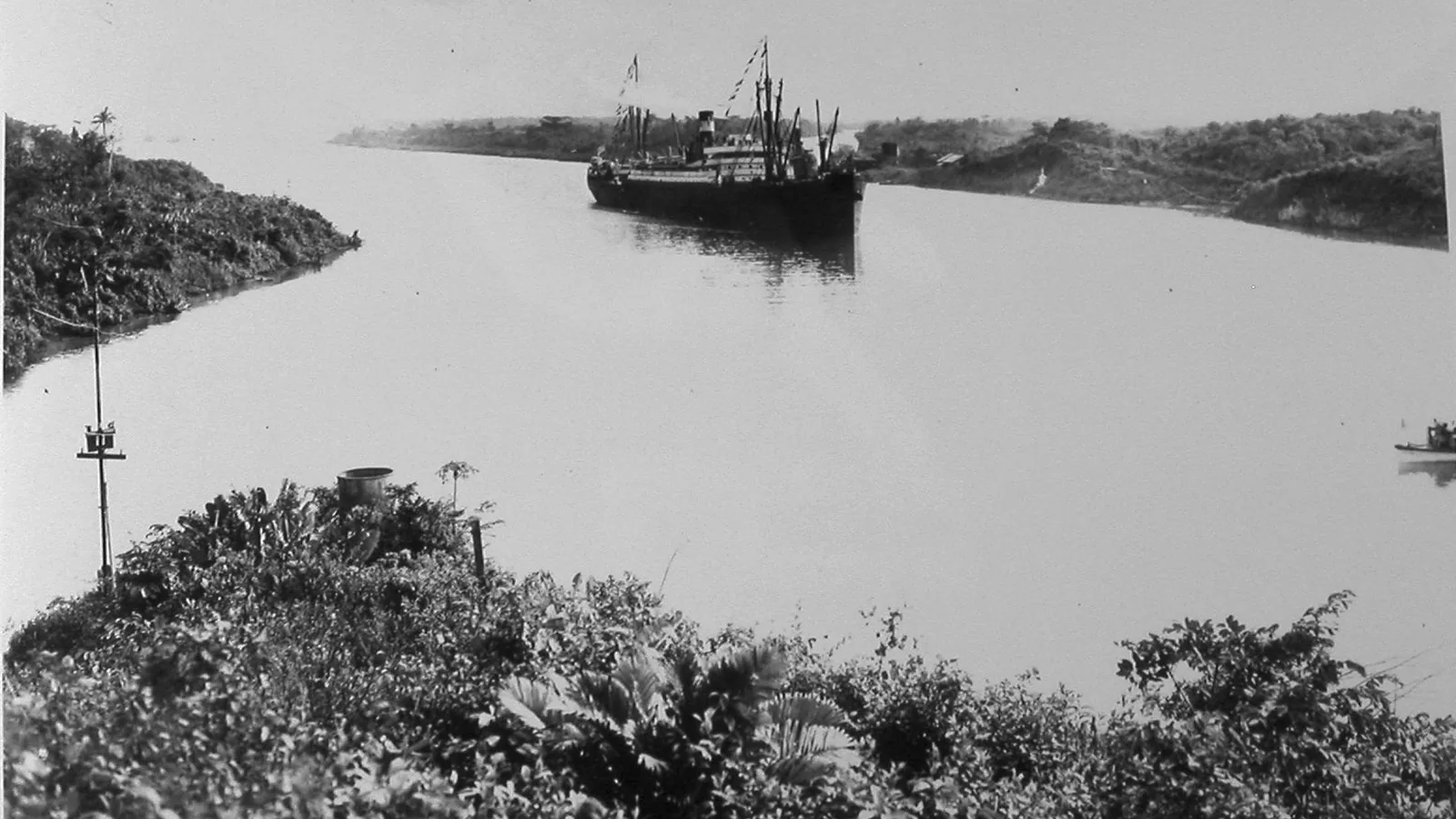
The Alexandre La Valley, an old French crane boat, made the first complete passage on January 7, 1914. On August 15 the cement boat Ancon, Captain John A. Constantine at the helm, made the first official transit. No foreign dignitaries came; the war in Europe canceled the planned fleet review. The Authority puts the American cost at about $375 million, including the $10 million to Panama and the $40 million paid to the French company, and counts 5,609 dead from disease and accident in the hospital records.
Who owned it, 1977 to 1999
Henry Kissinger told President Ford in 1975, according to the State Department’s history, “If these [Canal] negotiations fail, we will be beaten to death in every international forum and there will be riots all over Latin America.” Jimmy Carter and Omar Torrijos signed two treaties on September 7, 1977: a Neutrality Treaty letting the United States defend the canal’s neutrality by force, and a Panama Canal Treaty ending the Canal Zone on October 1, 1979 and passing the canal to Panama on December 31, 1999. The Senate approved each by 68 to 32, on March 16 and April 18, 1978.
France lost to its plan and to a mosquito nobody had yet blamed. The United States won with locks and screens, under a treaty signed before Panama’s own delegates reached Washington. The bill fell on the Treasury and on Panama’s sovereignty, and on West Indian men whose deaths in the French years were counted only when they reached a hospital bed.
Key facts
- The Paris congress of May 1879 voted 74 to 8 for a sea-level canal; Lépinay and Eiffel voted no (Panama Canal Authority).
- French work ran from March 12, 1881 to May 15, 1889; the company dissolved in January 1889.
- Gorgas wrote in 1915 that Ancon Hospital records showed 1,200 yellow fever deaths in the French years; the Authority cites his estimate of about 25,000 dead across both efforts.
- The Hay-Bunau-Varilla Treaty of November 18, 1903 granted a ten-mile zone “in perpetuity” for $10 million and $250,000 a year (Avalon Project text).
- The Isthmian Canal Commission counted 45,107 contract laborers, 1904 to 1913, with 19,900 from Barbados (1914 annual report).
- The SS Ancon made the first official transit on August 15, 1914; American cost about $375 million; 5,609 dead in hospital records.
- The Torrijos-Carter Treaties of September 7, 1977 ended the Canal Zone in 1979 and set the handover for December 31, 1999.
FAQ
Why did the French fail to build the Panama Canal?
The Panama Canal Authority's history gives three causes: a sea-level design that the 1879 congress chose over Lépinay's lock plan, yellow fever and malaria among a force that reached 19,000 in 1884, and money, spent on the railroad and on excavation that slides refilled, until the shareholders dissolved the company in January 1889.
How much did the United States pay for the Panama Canal?
About $375 million by the Authority's count, including $10 million to Panama under Article XIV of the 1903 treaty and $40 million to the French company for its works and equipment. Panama also received $250,000 a year, beginning nine years after ratification.
Who dug the Panama Canal?
Contract laborers recruited by the Isthmian Canal Commission, 45,107 of them between 1904 and 1913 by its own table, with Barbados the largest source at 19,900. Spain sent 8,298. Americans working for the canal averaged a little over 5,000, by the Authority's count.
Sources
- Panama Canal Authority (Panama), "A History of the Panama Canal": Early Plans; The French Canal Construction; American Canal Construction; Work Force; Culebra Cut; Design of the Locks; End of the Construction (official history pages, read September 2026).
- Annual Report of the Isthmian Canal Commission and the Panama Canal for the Fiscal Year Ended June 30, 1914 (Washington: Government Printing Office, 1914), including Exhibit 4, "Contract laborers brought to the Isthmus," and the health department report (Internet Archive full text).
- Annual Report of the Isthmian Canal Commission for the Fiscal Year Ended June 30, 1913 (Washington: Government Printing Office, 1913), central division and disbursing reports (Internet Archive full text).
- Yale Law School, The Avalon Project: Convention for the Construction of a Ship Canal (Hay-Bunau-Varilla Treaty), November 18, 1903, Articles II and XIV.
- The Panama Canal and Our Relations with Colombia, Senate Document presented by Henry Cabot Lodge, April 23, 1914, with Roosevelt's messages of December 7, 1903 and January 4, 1904 and Commander Hubbard's report (Internet Archive full text).
- Philippe Bunau-Varilla, Panama: The Creation, Destruction, and Resurrection (New York: McBride, Nast and Company, 1914), chapters 28 and 29 (Internet Archive full text).
- William Crawford Gorgas, Sanitation in Panama (New York: D. Appleton, 1915), on the Ancon Hospital records of the French period (Internet Archive full text).
- U.S. Department of State, Office of the Historian, Milestones: "Building the Panama Canal, 1903–1914."
- U.S. Department of State, Office of the Historian, Milestones: "The Panama Canal and the Torrijos-Carter Treaties."
Cite this article
- APA
- Our Earth's History. (2026, September 20). Why did France fail at Panama, and who paid for the canal of 1914? Our Earth's History. https://ourearthshistory.com/americas/contemporary/panama-canal-1914-who-paid/
- Chicago
- Our Earth's History. “Why did France fail at Panama, and who paid for the canal of 1914?” Our Earth's History, September 20, 2026. https://ourearthshistory.com/americas/contemporary/panama-canal-1914-who-paid/.
- MLA
- “Why did France fail at Panama, and who paid for the canal of 1914?” Our Earth's History, 20 Sep. 2026, https://ourearthshistory.com/americas/contemporary/panama-canal-1914-who-paid/.
Text licensed CC BY-NC-ND 4.0. Found an error? Tell us.