William Eve's diary and the war diaries disagree on 1914 football
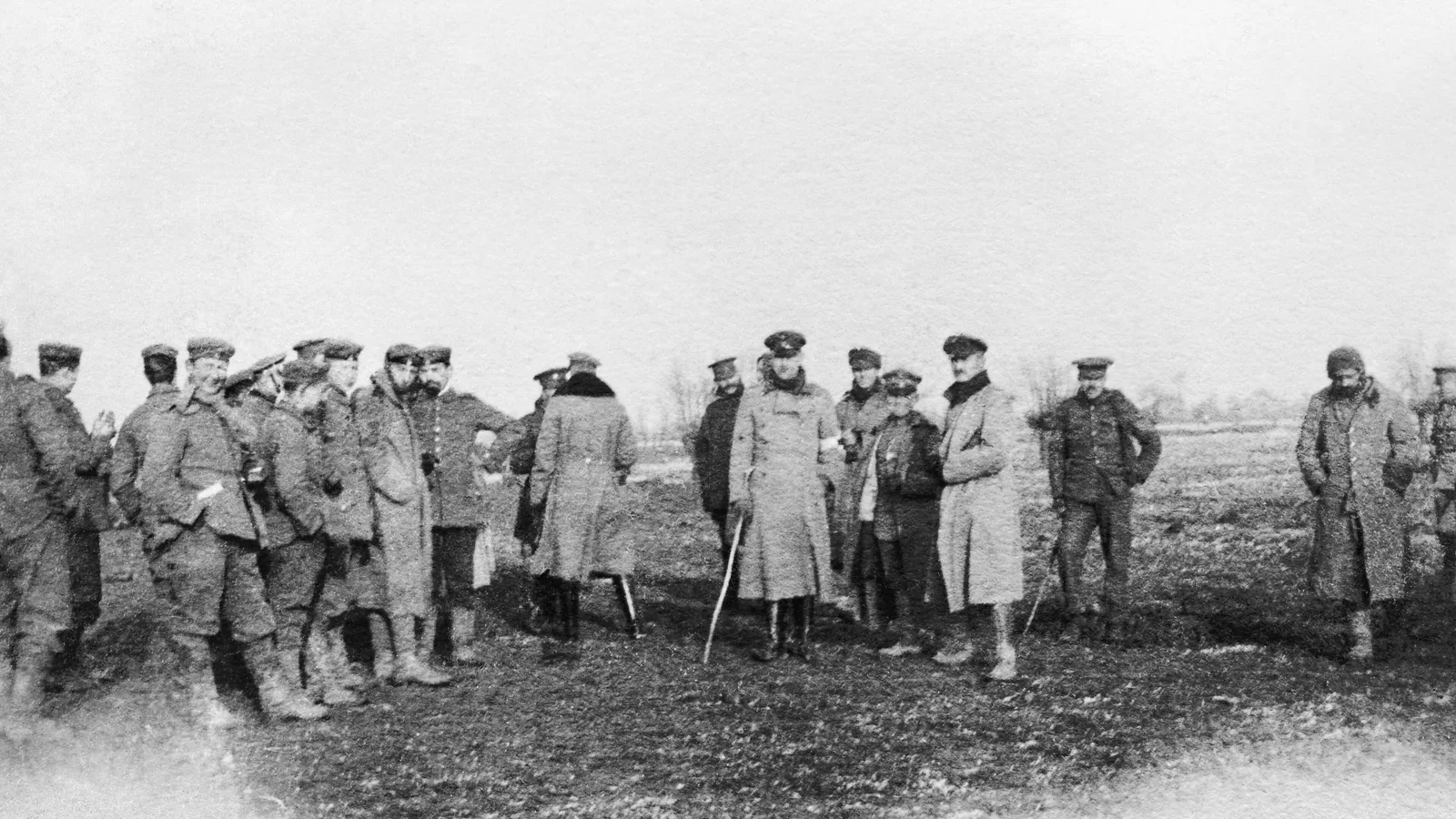

TL;DR — A rifleman’s diary and an IWM oral account describe football on December 25, 1914; the National Archives’ review of unit war diaries records none.
Rifleman William Eve wrote in his diary for December 25, 1914: “At beginning of day respect for Xmas shown. On both sides fellows stood on the parapet and shouted across greetings to each other. When it got light everybody strolled about conversed with the Germans, exchanged souvenirs, played football, and not a shot fired all day or night.” His diary is held by the National Army Museum, which describes the truce it recorded as one of a series of unofficial pauses along parts of the Western Front between December 24 and 26, 1914, not a single co-ordinated event.
Quick facts
- When
- December 24-26, 1914 (unofficial truces along parts of the Western Front); December 25, 1914 (William Eve's diary entry); December 31, 1914 (Lieutenant-Colonel Schoolbred's diary entry); January 1, 1915 ('Cuthbert''s' letter)
- Where
- Sectors of the Western Front named by the National Army Museum, the National Archives and Imperial War Museums, including La Petite Douve Farm near the Norfolk and Cheshire Regiments' trenches (5th Division, 15th Brigade) and Ploegsteert, Belgium, held by the London Rifle Brigade (4th Division)
- Who
- Rifleman William Eve; Lieutenant-Colonel Schoolbred; Brigadier-General Gleichen; Captain A. S. Bates, 1/5th London Regiment; 'Cuthbert'; Ernie Williams; the unnamed war diary clerks of the Norfolk, Cheshire, Royal Warwickshire and Grenadier Guards units
- Outcome
- Along several Western Front sectors, soldiers exchanged greetings, carols, cigarettes and souvenirs and buried the dead between December 24 and 26, 1914; the National Archives' review of unit war diaries found no record of a football match, while a rifleman's diary and an Imperial War Museums oral testimony describe one; high commands moved to prevent a repeat, and later local truces recorded by Imperial War Museums were not tied to Christmas
December 24, 1914: chaff across the wire at La Petite Douve Farm
The National Archives’ review of unit war diaries, held in series WO 95, states that “the first attempts to enter into an unofficial truce began during Christmas Eve,” quoting the 5th Division diary’s report from Brigadier-General Gleichen of the 15th Infantry Brigade: “a good deal of shouting and chaff between our right trenches (Norfolks) and the Germans about La Petite Douve Farm, each inviting the other to come over.” Not every sector went quiet. The 2nd Battalion Grenadier Guards, in trenches the diary describes as “waist deep in water,” recorded sniping and mortar fire on Christmas Eve, four officers and 53 other ranks as casualties, and 17 men killed.
Captain Bates and 'Cuthbert' write home
Captain A. S. Bates, commanding No. 4 Company of the 1/5th London Regiment, wrote to his sister on December 24, 1914, describing “both sides singing” and adding, “My orders to the Coy. are not to start firing unless the Germans do,” a letter now held by Imperial War Museums. The same war diaries the National Archives reviewed record that on Christmas Day the Norfolk sector’s truce included “talking and fraternizing and accepting each others’ cigars and cigarettes,” and that Gleichen found the German soldiers “very friendly and appeared to have no evil intention of any sort.” Officers of the 6th Battalion Cheshire Regiment recorded German soldiers saying they “wished the War was over and that there was a peace conference taking place in Berlin.” The same diaries record that the 10th Infantry Brigade buried its dead in no man’s land together with German units, 15 British and German soldiers in one instance. A letter written January 1, 1915, by a soldier signing himself ‘Cuthbert’ to his grandmother, Mrs. Godward of Wimbledon, also held by Imperial War Museums, called it “silly” to be “fighting men you have no quarrel with personally,” while adding that he hated what German forces had done to Belgium.
'Played football': one diary against the war diaries
The National Archives writes: “While the unit war diaries do not record such matches as having taken place, they do record another significant act of compassion between the opposing forces,” referring to the burials described above. Eve’s diary, by contrast, names football directly among the day’s events. Imperial War Museums holds an oral account from Ernie Williams describing a ball that “appeared” after soldiers shared cigarettes: “It was a proper football. But we didn’t form a team, it wasn’t a team game in any sense of the word.” Williams estimated “at least a couple of hundred” men took part. Another IWM interviewee, Harold Lewis, who did not reach France until March 1915, called the wider truce story doubtful in scale, saying it “borders on the fairy tale.”
Fraternization orders and a French sector's account
Imperial War Museums states that after 1914 “the High Commands on both sides tried to prevent any truces on a similar scale happening again.” An IWM interviewee identified as “Mr Rickner,” describing a French-German sector, recalled soldiers meeting at the wire “with champagne and cigarettes in their hands,” then said: “That lasted only two days - one and a half really - and then strict order came that no fraternisation was allowed, and we had to stay back in our trenches.”
Local truces continued after 1914
Imperial War Museums records that “there were some isolated incidents of soldiers holding brief truces later in the war, and not only at Christmas.” It describes these under what it calls the “Live and Let Live” system: in quiet sectors, brief pauses were “sometimes tacitly agreed, allowing both sides to repair their trenches or gather their dead.”
Key facts
- National Army Museum: the 1914 truce was “not a single co-ordinated affair, but a series of unofficial truces along parts of the Western Front.”
- National Archives review of the 15th Infantry Brigade diary (WO 95/1566/1): between 200 and 400 British and German troops “conversed and sung hymns together” for about ninety minutes near the Norfolk trenches.
- 5th Division diary (WO 95/1510/4): fraternizing included “accepting each others’ cigars and cigarettes.”
- National Archives, on unit war diaries generally: “the unit war diaries do not record such matches as having taken place,” referring to football.
- William Eve’s diary, December 25, 1914 (National Army Museum): “played football, and not a shot fired all day or night.”
- Ernie Williams, Imperial War Museums oral testimony: “It was a proper football,” with “at least a couple of hundred” men present.
- 2nd Battalion Grenadier Guards diary (WO 95/1342/1): 17 men killed on Christmas Eve in a sector where no truce occurred.
- Imperial War Museums: “there were some isolated incidents of soldiers holding brief truces later in the war, and not only at Christmas.”
FAQ
Did soldiers really play football during the 1914 Christmas truce?
Accounts differ. The National Archives says the unit war diaries it reviewed do not record a match. Rifleman William Eve's diary and an Imperial War Museums oral account from Ernie Williams both describe one, with Williams estimating "a couple of hundred" participants.
What do the unit war diaries record instead of football?
The National Archives cites diary entries describing carol singing, exchanges of cigars and cigarettes, and the joint burial of dead soldiers in no man's land, including 15 British and German dead buried together by the 10th Infantry Brigade.
Did a Christmas truce happen again after 1914?
Imperial War Museums states that high commands on both sides tried to prevent a repeat and records only later, isolated local truces under a "Live and Let Live" system, not tied to Christmas. No source consulted here documents a Christmas truce in 1915.
Sources
- National Army Museum, London, "The Christmas Truce" (December 22, 2014): Rifleman William Eve's diary entry for December 25, 1914, and Lieutenant-Colonel Schoolbred's diary entry for December 31, 1914.
- The National Archives (UK) blog, "The Christmas truce, 1914" (December 20, 2018, David Langrish), Internet Archive snapshot of April 13, 2025 (the live page returns a captcha): unit war diaries WO 95/1510/4, WO 95/1566/1, WO 95/1477/5, WO 95/1342/1 and WO 95/1341/1.
- Imperial War Museums, "The Real Story Of The Christmas Truce Of 1914": oral testimony of Ernie Williams and the "Mr Rickner" account, and commentary by Anthony Richards, IWM Head of Documents and Sound.
- Imperial War Museums, Collections, "Captain A S Bates Christmas Truce Letter, 1914" (object 1030009930).
- Imperial War Museums, Collections, "Letter describing the 1914 Christmas Truce" (object 1030015028), written by 'Cuthbert' to his grandmother, January 1, 1915.
Cite this article
- APA
- Our Earth's History. (2026, September 26). William Eve's diary and the war diaries disagree on 1914 football. Our Earth's History. https://ourearthshistory.com/europe/contemporary/christmas-truce-december-24-26-1914-soldiers-letters-football-legend/
- Chicago
- Our Earth's History. “William Eve's diary and the war diaries disagree on 1914 football.” Our Earth's History, September 26, 2026. https://ourearthshistory.com/europe/contemporary/christmas-truce-december-24-26-1914-soldiers-letters-football-legend/.
- MLA
- “William Eve's diary and the war diaries disagree on 1914 football.” Our Earth's History, 26 Sep. 2026, https://ourearthshistory.com/europe/contemporary/christmas-truce-december-24-26-1914-soldiers-letters-football-legend/.
Text licensed CC BY-NC-ND 4.0. Found an error? Tell us.