Carrington's report of September 1, 1859: two patches of white light

TL;DR — Carrington and Hodgson each saw a white-light flare on September 1, 1859, as Kew’s magnetographs jumped; a great storm began the next morning.
At 11:18 a.m. Greenwich mean time on September 1, 1859, Richard Carrington saw two patches of white light break out over a group of sunspots he was drawing. Five minutes later they were gone. His account and a second one by Richard Hodgson, who observed separately, were printed in volume 20 of the Monthly Notices of the Royal Astronomical Society. At Kew Observatory, self-recording instruments registered an abrupt magnetic disturbance at 11:15 a.m. that morning. At about 5 a.m. on September 2 a far larger one began; auroras were reported from as low a latitude as Cuba, and telegraph lines failed. Modern estimates of the storm’s strength differ by a factor of about two.
Quick facts
- When
- August 28, 1859 (first great magnetic disturbance, from about 10:30 p.m.) · September 1, 1859, 11:18 to 11:23 a.m. Greenwich mean time (white-light flare seen by Carrington) · September 2, 1859, from about 5 a.m. (second great disturbance) · November 21, 1861 (Balfour Stewart's paper read to the Royal Society)
- Where
- Carrington's telescope; Hodgson's house, at Highgate or Holloway (the two printings differ); the Kew Observatory magnetographs near London; auroras seen from as low a latitude as Cuba; telegraph lines worldwide
- Who
- Richard C. Carrington; Richard Hodgson; Balfour Stewart; General Sabine; Joseph Henry of the Smithsonian
- Outcome
- Two independent reports of the flare appeared in the Monthly Notices of the Royal Astronomical Society, vol. 20; Kew's instruments recorded a disturbance at 11:15 a.m. the same morning; the storm that began on September 2 disrupted telegraph lines and brought red auroras to about 18 degrees geomagnetic latitude, and modern estimates of its strength range from about −850 to about −1760 nT
Carrington's sketch and the flash at 11:18
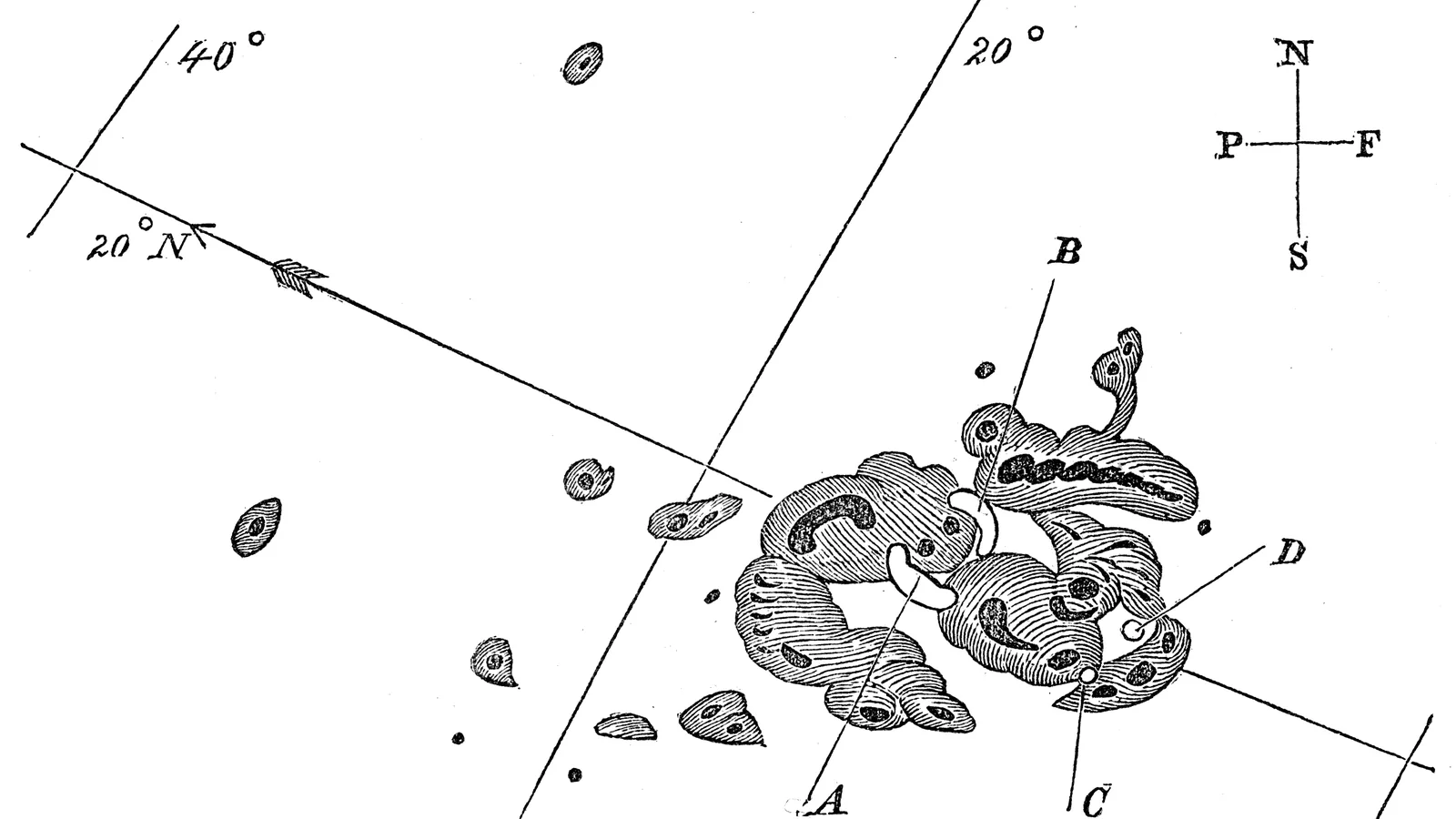
Carrington’s paper, “Description of a Singular Appearance seen in the Sun on September 1, 1859,” opens on routine: “While engaged in the forenoon of Thursday, Sept. 1, in taking my customary observation of the forms and positions of the solar spots.” Within the great north group, he wrote, “two patches of intensely bright and white light broke out,” marked A and B on his diagram, and “the brilliancy was fully equal to that of direct sun-light.”
He timed it. “The instant of the first outburst was not 15 seconds different from 11h 18m Greenwich mean time, and 11h 23m was taken for the time of disappearance.” He missed part of it: “being somewhat flurried by the surprise,” he ran to call a witness, and on returning within 60 seconds found the light “already much changed and enfeebled.” In those five minutes the patches crossed about 35,000 miles, measured on a diagram drawn at 12 inches to the sun’s diameter. Comparing the scene with the sketch he had finished before the outburst, he could recognize no change at all in the spots themselves.
November 11, 1859: Hodgson's star of light
Hodgson’s paper, “On a curious Appearance seen in the Sun,” follows on pages 15 and 16. Watching a group of spots through a 6-inch equatorial refractor, he saw “a very brilliant star of light, much brighter than the sun’s surface, most dazzling to the protected eye.” Then: “It lasted for some five minutes, and disappeared instantaneously about 11.25 a.m.” His last sentence reads, “The magnetic instruments at Kew were simultaneously disturbed to a great extent.” The paper is dated November 11, 1859.
Carrington wrote that he had “carefully avoided exchanging any information with that gentleman,” so that the accounts would be “increased by their entire independence.” The two printings of that paragraph disagree on one word. In the Monthly Notices, Hodgson was observing at his house at Highgate; in Balfour Stewart’s paper of 1861, which reprints the passage, the house is at Holloway.
Self-recording magnetographs at Kew
Stewart’s paper, read to the Royal Society on November 21, 1861, appeared in the Philosophical Transactions, vol. 151. Kew ran “a set of self-recording magnetographs (the property of the Royal Society),” which photographed the declination, the horizontal force and the vertical force of the earth’s magnetism without a break.
The first great disturbance “commenced about half-past ten on the evening of the 28th of August, affecting all the elements simultaneously.” The traces ran off the sensitive paper, and Stewart could only estimate the largest swings, about 2° 20′ in declination. General Sabine, he wrote, had assured him that nothing in “his long and varied experience” had surpassed it.
A day or two after September 1, Carrington called at Kew and learned that the instruments had moved at the moment of his sighting. Stewart gave the time: “This disturbance occurred as nearly as possible at 11h 15m a.m. Greenwich mean time, on September 1, 1859, affecting all the elements simultaneously, and commencing quite abruptly.” At about 5 a.m. on September 2 another abrupt disturbance began, “continuing with great violence until about 4 p.m.,” and the elements “scarcely attained their normal state even on September 7 or 8.”
Stewart was careful about the link. Without a known connection, he wrote, the match would count as “a casual coincidence.” Because Sabine had shown a relation between magnetic disturbances and sunspots, “it is not impossible to suppose that in this case our luminary was taken in the act.”
.jpg)
"Could read a newspaper by": auroras and telegraph lines
Stewart’s paper opens with the damage. “In not a few instances telegraphic communication was interrupted, owing to the current produced in the wires; and in some cases this proved so powerful that it was used instead of the ordinary current, the batteries being cut off and the wires simply connected with the earth.” Stewart also had a description from as low a latitude as Cuba, by the director of the Havana observatory, and recorded that “only four previous displays had been recorded in the traditions of the island.”
James L. Green and Scott Boardsen mapped the reports in Advances in Space Research in 2006. The red aurora reached about 25 degrees geomagnetic latitude on August 28 and 29 and about 18 degrees on September 2 and 3, and observers described it as a blood or deep crimson red so bright one “could read a newspaper by.” A significant portion of the world’s 200,000 km of telegraph lines was affected, the authors wrote, many of them unusable for eight hours or more; their 2005 manuscript had given the network as 125,000 miles.
That manuscript quotes a telegraph operator in the Washington Evening Star of September 2, 1859: Joseph Henry of the Smithsonian “took the statements of all the operators on duty.” NOAA’s account adds that the currents shocked operators and started small fires in some offices.
Between −850 and −1760 nT: two estimates of strength
NOAA’s summary states: “The Carrington Event set off the largest geomagnetic storm ever recorded.” Attempts to size it, as the minimum of the Dst index in nanotesla (nT), did not agree. David Moriña, Isabel Serra and Pedro Puig set the figures side by side. They cited G. Siscoe, N. U. Crooker and C. R. Clauer (2006) for a minimum Dst under −850 nT, and wrote that the event “was first estimated to have a Dst of about −1760 nT,” citing G. S. Lakhina, S. Alex, B. T. Tsurutani and W. D. Gonzalez (2005). The larger figure is about twice the smaller. The three authors did not choose between them and ran their probability calculations on both, in the paper Scientific Reports published on February 20, 2019.
Key facts
- Carrington timed the white-light outburst from 11:18 to 11:23 a.m. Greenwich mean time on September 1, 1859, and wrote that its brilliancy “was fully equal to that of direct sun-light” (Monthly Notices, vol. 20, p. 13).
- In those five minutes the two patches crossed about 35,000 miles on his scaled diagram, and he saw no change in the sunspots themselves.
- Hodgson, observing separately with a 6-inch refractor, saw “a very brilliant star of light” that vanished about 11:25 a.m.; his paper is dated November 11, 1859.
- Carrington’s printed text places Hodgson’s house at Highgate; Stewart’s 1861 reprint of the same passage says Holloway.
- Kew’s magnetographs recorded an abrupt disturbance of all three elements at 11:15 a.m. on September 1 (Stewart, Philosophical Transactions, vol. 151).
- Great disturbances began about 10:30 p.m. on August 28 and about 5 a.m. on September 2, and the instruments had scarcely settled by September 7 or 8.
- Green and Boardsen (2006) traced red auroras to about 25 degrees geomagnetic latitude on August 28 and 29 and about 18 degrees on September 2 and 3.
- Moriña, Serra and Puig (2019) cite minimum Dst estimates of under −850 nT (Siscoe and colleagues) and about −1760 nT (Lakhina and colleagues).
FAQ
Who saw the solar flare of September 1, 1859?
Richard Carrington and Richard Hodgson, each at his own telescope. Carrington wrote that he avoided exchanging any information with Hodgson so that the two accounts would stay independent; both were printed in the Monthly Notices of the Royal Astronomical Society, vol. 20.
How long did the Carrington flare last?
About five minutes. Carrington gave 11:18 a.m. Greenwich mean time for the first outburst and 11:23 for its disappearance; Hodgson wrote that it vanished about 11:25 a.m.
What did the 1859 storm do to the telegraph?
Stewart wrote in 1861 that communication was interrupted "in not a few instances" and that some lines ran on the storm's current alone with the batteries cut off. Green and Boardsen wrote that many lines were unusable for eight hours or more.
Sources
- R. C. Carrington, "Description of a Singular Appearance seen in the Sun on September 1, 1859," Monthly Notices of the Royal Astronomical Society, vol. 20 (1859), pp. 13–15 (scan via NASA ADS).
- R. Hodgson, "On a curious Appearance seen in the Sun," Monthly Notices of the Royal Astronomical Society, vol. 20 (1859), pp. 15–16 (scan via NASA ADS).
- Balfour Stewart, "On the Great Magnetic Disturbance which extended from August 28 to September 7, 1859, as recorded by Photography at the Kew Observatory," Philosophical Transactions of the Royal Society of London, vol. 151 (1861), pp. 423–430 (volume scan at the Internet Archive).
- James L. Green and Scott Boardsen, "Duration and extent of the great auroral storm of 1859," Advances in Space Research 38(2):130–135 (2006), author manuscript at PubMed Central.
- James L. Green, Scott Boardsen, Sten Odenwald, John Humble and Katherine A. Pazamickas, "Eyewitness Reports of the Great Auroral Storm of 1859," manuscript of August 5, 2005, NASA Technical Reports Server 20050210157.
- David Moriña, Isabel Serra and Pedro Puig, "Probability estimation of a Carrington-like geomagnetic storm," Scientific Reports 9:2393 (February 20, 2019).
- National Oceanic and Atmospheric Administration (NOAA), "Five historically huge solar events."
Cite this article
- APA
- Song Letter. (2026, September 29). Carrington's report of September 1, 1859: two patches of white light. Our Earth's History. https://ourearthshistory.com/europe/modern/carrington-event-september-1-1859-white-light-flare/
- Chicago
- Song Letter. “Carrington's report of September 1, 1859: two patches of white light.” Our Earth's History, September 29, 2026. https://ourearthshistory.com/europe/modern/carrington-event-september-1-1859-white-light-flare/.
- MLA
- Song Letter. “Carrington's report of September 1, 1859: two patches of white light.” Our Earth's History, 29 Sep. 2026, https://ourearthshistory.com/europe/modern/carrington-event-september-1-1859-white-light-flare/.
Get the week in history
One email a week: the new articles, and what was happening elsewhere at the same moment. Free, no ads, unsubscribe any time. How we handle your email.
Text licensed CC BY-NC-ND 4.0. Found an error? Tell us.