Mary Rose, July 19, 1545: the warship Henry VIII watched sink
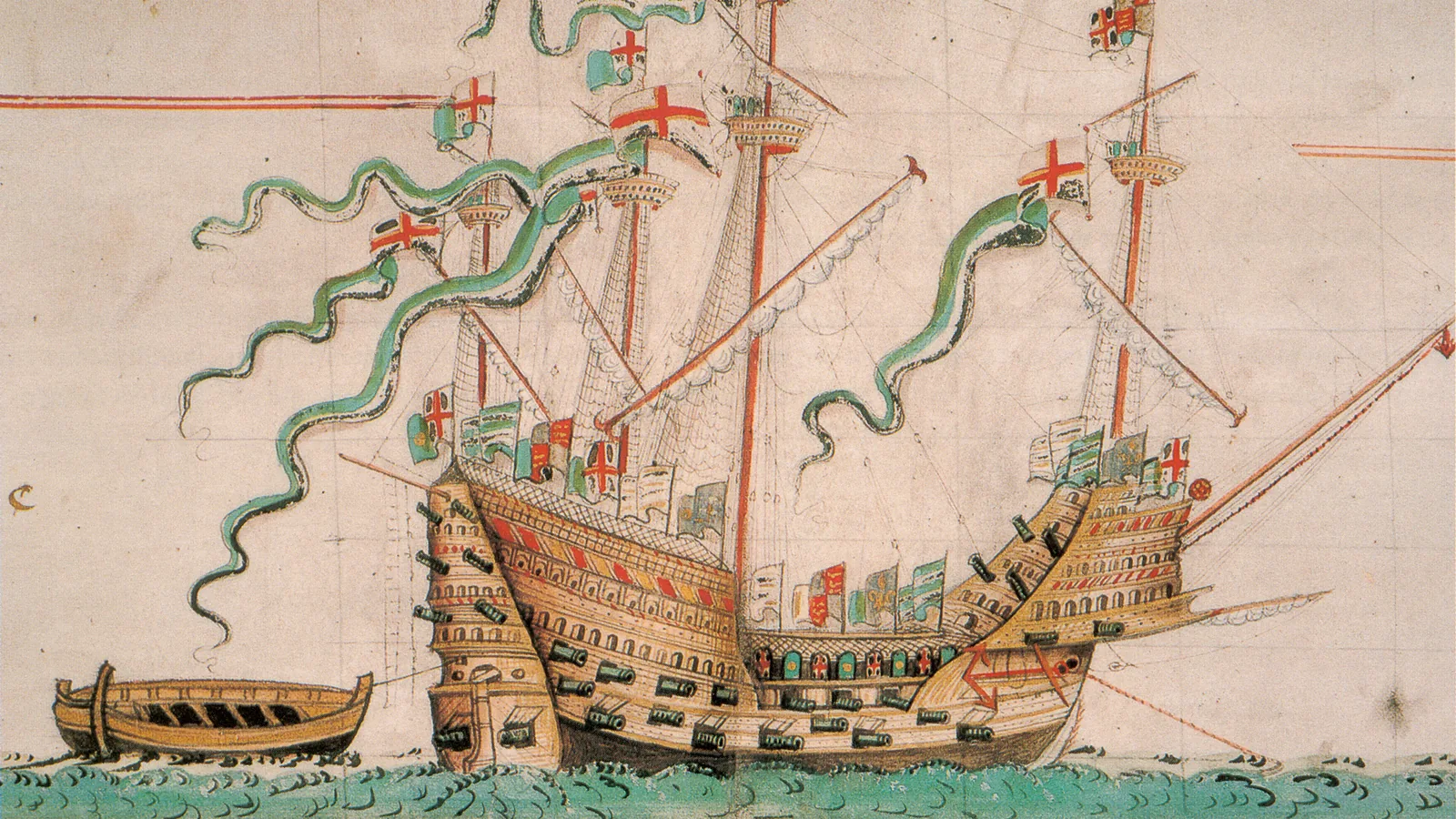

TL;DR — The Mary Rose sank off Portsmouth on July 19, 1545; its cause and death toll are still told differently, and a 2021 study traced where some crew grew up.
On July 19, 1545, Henry VIII’s warship Mary Rose sank in the Solent, between Portsmouth and the Isle of Wight, as the king watched from Southsea Castle. She had been built in 1510–11 and had served for 34 years. Five days later an imperial ambassador reported what a survivor had told him. Two institutions, the Mary Rose Trust in Portsmouth and Royal Museums Greenwich, disagree on whether she had fired her guns and on how many men died. Divers found the wreck on May 1, 1971, the hull was lifted on October 11, 1982, and in 2021 a chemical study of crew members’ teeth suggested where some of them spent their childhoods.
Quick facts
- When
- July 19, 1545 (sinking during the Battle of the Solent); July 24, 1545 (Van der Delft's letter); May 1, 1971 (wreck found); 1979 (Mary Rose Trust formed); October 11, 1982 (hull raised); May 5, 2021 (isotope study published)
- Where
- The Solent, between Portsmouth and the Isle of Wight, England; Southsea Castle; Portsmouth Historic Dockyard
- Who
- King Henry VIII; Sir George Carew, captain of the Mary Rose and vice admiral; John Dudley, Viscount Lisle; Claude d'Annebault; Francois van der Delft; Alexander McKee; Margaret Rule; Percy Ackland; Jessica Scorrer and co-authors
- Outcome
- The Mary Rose capsized and sank with most of her crew; the Mary Rose Trust sets out five explanations without choosing one, while Royal Museums Greenwich gives a different account of the firing and the death toll. The hull was raised in 1982, and a 2021 isotope study suggested that up to three of eight sampled crew members grew up in climates warmer than Britain's
Southsea Castle, July 19, 1545
The French admiral Claude d’Annebault had gathered more than 200 ships, the Trust records, against about 80 English ships. In July his fleet entered the Solent and landed troops on the Isle of Wight. Henry was dining aboard his flagship, the Henry Grace a Dieu, when the French were sighted. With him were the Lord Admiral and the other captains, among them Sir George Carew, captain of the Mary Rose and vice admiral of the fleet. Before going ashore, the king “took off his chain from his neck with a great whistle of gold pendent to the same” and put it on Carew.
At first, lack of wind gave the advantage to the French oared galleys, which could advance, fire and pull back while the English sailing ships sat still. In the afternoon the wind rose, and the Lord Admiral, John Dudley, Viscount Lisle, led out the large ships, the Mary Rose among them.
On July 24, Francois van der Delft, ambassador of the Holy Roman Emperor Charles V, sent his master a report written in code. In the translation printed by the Trust, he wrote: “Towards evening, through misfortune and carelessness, the ship of Vice Admiral George Carew foundered.” A Fleming who survived told him that the crew had not closed the lowest row of gunports on one side. “Having fired the guns on that side, she was turning in order to fire from her other, when the wind caught her sails so strongly as to heel her over, and plunged her open gunports beneath the water, which floored and sank her.”
Open gunports, a gust or a French shot
The Trust’s page on the sinking calls that Flemish sailor “the only confirmed eyewitness” and sets out five explanations without choosing between them. Human error comes first: this was Carew’s first naval command, and a claim that he called out that he had “the sort of men” he “could not rule” comes from his cousin, who, the Trust suggests, may have been protecting the family name. A sudden gust as the ship turned is the second. The third, that her gunports were cut too low, the Trust rejects: “there is no evidence for this,” it states, pointing to scuppers along the main gun deck. On overloading, it cites studies finding the ship’s load of guns “still within the safe limit.” Last comes a French cavalry officer’s statement that French guns sank her. A granite cannonball similar to a type found in France lay on the main gun deck, but it was in a shot locker, and the same stone occurs in the English West Country.
Royal Museums Greenwich gives a different picture. Its page states that the Mary Rose “sank before firing a single shot,” which contradicts the ambassador’s survivor. It also states that “No one is sure exactly why the Mary Rose capsized,” then adds: “We know that it was very overloaded, carrying 700 rather than the 400 crew it was built to carry.” The Trust’s own history adds a report from April 1537, after a refit that added gunports, that “the ship that Mr Carew is in” sailed badly, without claiming it was the Mary Rose. A 2011 Ministry of Defence release stated only that she “listed too steeply and the gun ports flooded.”
Five hundred men, or seven hundred
Van der Delft counted “about 500” aboard, all drowned “with the exception of five and twenty or thirty servants, sailors and the like.” Royal Museums Greenwich states that “Around 700 of her crew, including the captain, Sir George Carew, drowned,” and that “Only about 30 men were rescued.” The two counts agree on the survivors and differ by some 200 on the dead. The remains of at least 179 crew members have since been recovered from the wreck, according to the 2021 study.
May 1, 1971, to October 11, 1982
Royal Museums Greenwich states that people tried to lift the ship soon after she sank but raised only the masts, and the 2021 study cites High Court of Admiralty papers recording that one of the first attempts was made by a West African diver, Jacques Francis.
The modern search was the work of Alexander McKee, the Trust states. In 1965 he started “Project Solent Ships” with the Southsea branch of the British Sub-Aqua Club, joined by the land archaeologist Margaret Rule. In 1966 a chart dated 1841, found in the Navy’s Hydrographic Department, marked three historic wrecks, one of them the Mary Rose. The Trust lists the site as the first in England found by sub-bottom profiling. On May 1, 1971, diver Percy Ackland found three or four frames of a ship, and by evening a row about 30 meters long lay exposed.
The hull lay on her starboard side, and a 1978 trench showed the bow was gone. The Mary Rose Trust was formed in 1979, and more than 500 volunteer divers worked from the salvage vessel Sleipner. On October 11, 1982, a steel lifting frame wired to bolts through the hull moved it into a cradle on the seabed, and the crane barge Tog Mor raised the cradle. In 2011 the Ministry of Defence counted “the 19,000 Tudor artefacts recovered with her in 1982,” as the Trust began a new £35 million museum with £3 million still to raise.
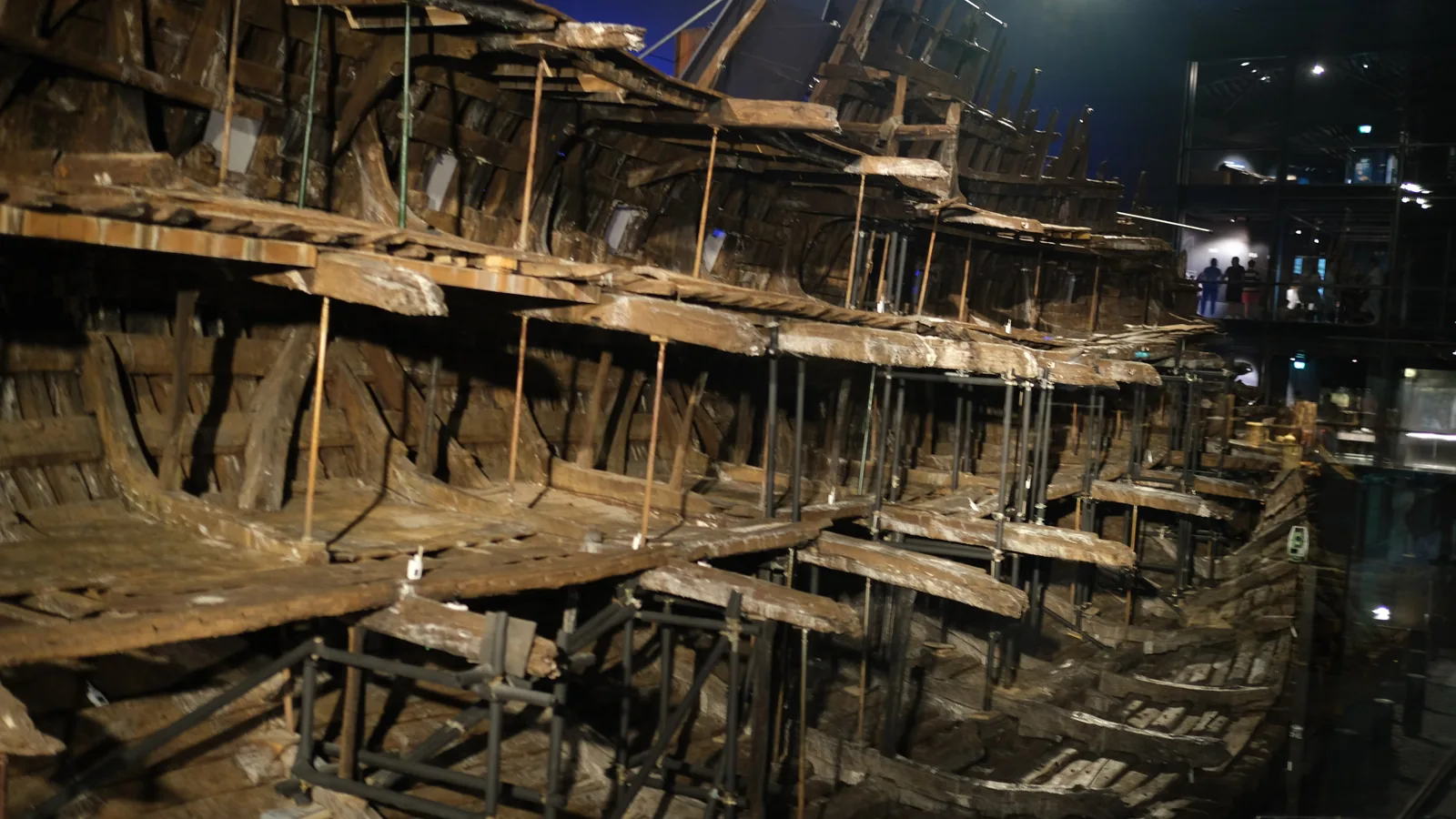

"Diversity aboard a Tudor warship"
That is the title a team from Cardiff University, the Mary Rose Trust and the British Geological Survey gave to its study of eight crew members. The researchers took enamel from each man’s second molar for strontium and oxygen isotopes, and dentine from the first molar root for carbon, nitrogen and sulfur, in order to reconstruct each man’s childhood diet and origins. Seven of the men carry Trust labels such as Cook, Carpenter and Purser, which the authors call “by no means certain.”
The abstract reports that the data “tentatively suggests as many as three of the crew may have originated from warmer, more southerly climates than Britain.” Those three, the men labeled Royal Archer, Carpenter and Gentleman, had oxygen values more than two standard deviations above the British mean. “Five have isotope values indicative of childhoods spent in western Britain, one of which had cranial morphology suggestive of African ancestry.” The paper also notes that an earlier study of 18 crew members, by Bell and colleagues, argued that miscommunication among a multinational crew contributed to the sinking, and that Millard and Schroeder answered that only one of the 18 likely grew up outside Britain. Received on November 19, 2020, the paper by Jessica Scorrer and seven co-authors appeared in Royal Society Open Science on May 5, 2021.
Key facts
- The Mary Rose sank in the Solent on July 19, 1545, during the Battle of the Solent; Henry VIII watched from Southsea Castle (Mary Rose Trust).
- Imperial ambassador Francois van der Delft reported on July 24, 1545, that about 500 men drowned and 25 or 30 escaped, and that the lowest gunports had been left open after firing (Mary Rose Trust).
- Royal Museums Greenwich states that around 700 died, that the ship “sank before firing a single shot,” and that she carried 700 men against a designed crew of 400.
- The Mary Rose Trust lists five explanations for the sinking, human error, a gust, poor design, overloading and French gunfire, and rejects the claim that her gunports were cut too low.
- Diver Percy Ackland found the wreck on May 1, 1971, in a search begun by Alexander McKee in 1965 (Mary Rose Trust).
- The hull was raised on October 11, 1982, by the crane barge Tog Mor (Mary Rose Trust); a 2011 Ministry of Defence release counted 19,000 Tudor artifacts recovered with her.
- A study published on May 5, 2021, in Royal Society Open Science suggested that up to three of eight sampled crew grew up in warmer climates than Britain’s and five in western Britain.
FAQ
Why did the Mary Rose sink?
No single cause is agreed. The one contemporary report, Van der Delft's letter of July 24, 1545, relays a survivor's account that open lower gunports flooded as the ship turned in the wind after firing. The Mary Rose Trust also weighs human error, overloading, design and French gunfire without choosing one, while Royal Museums Greenwich describes the ship as "very overloaded."
How many people died on the Mary Rose?
Van der Delft reported about 500 drowned and 25 or 30 saved. Royal Museums Greenwich gives around 700 dead and about 30 rescued. The remains of at least 179 crew members have been recovered.
When was the Mary Rose raised?
On October 11, 1982. A steel lifting frame attached to bolts through the hull transferred it to a cradle, which the crane barge Tog Mor lifted to the surface and which was then towed ashore at Portsmouth.
Sources
- Mary Rose Trust, "The life of the Mary Rose" (construction, 1536 refit, the Battle of the Solent and the Van der Delft letter).
- Mary Rose Trust, "The Mary Rose in history" (Battle of the Solent and Southsea Castle entries).
- Mary Rose Trust, "Why did the Mary Rose sink?"
- Royal Museums Greenwich, "Mary Rose" (Stories, Maritime history).
- Mary Rose Trust, "Raising the Mary Rose."
- Mary Rose Trust, "Archaeology and the Mary Rose."
- Jessica Scorrer, Katie E. Faillace, Alexzandra Hildred and co-authors, "Diversity aboard a Tudor warship: investigating the origins of the Mary Rose crew using multi-isotope analysis," Royal Society Open Science 8(5): 202106, 2021 (Cardiff University, Mary Rose Trust and British Geological Survey).
- GOV.UK, Ministry of Defence, "Mary Rose immortalised on £2 coin," February 24, 2011.
Cite this article
- APA
- LETTER. (2026, September 29). Mary Rose, July 19, 1545: the warship Henry VIII watched sink. Our Earth's History. https://ourearthshistory.com/europe/early-modern/mary-rose-1545-solent-sinking-raised-1982/
- Chicago
- LETTER. “Mary Rose, July 19, 1545: the warship Henry VIII watched sink.” Our Earth's History, September 29, 2026. https://ourearthshistory.com/europe/early-modern/mary-rose-1545-solent-sinking-raised-1982/.
- MLA
- LETTER. “Mary Rose, July 19, 1545: the warship Henry VIII watched sink.” Our Earth's History, 29 Sep. 2026, https://ourearthshistory.com/europe/early-modern/mary-rose-1545-solent-sinking-raised-1982/.
Text licensed CC BY-NC-ND 4.0. Found an error? Tell us.