Bukhara, 1558: an Englishman finds the Silk Road trade too small
.jpg)
TL;DR — Jenkinson reached Bukhara on December 23, 1558, found merchants “so beggerly and poore” that no trade was “worthy the following,” and got back to Moscow on September 2, 1559.
Anthony Jenkinson arrived at Bukhara on December 23, 1558, and judged the market in one sentence: the merchants “are so beggerly and poore, and bring so little quantitie of wares, lying two or 3 yeeres to sell the same, that there is no hope of any good trade there to be had worthy the following.” He was the agent of the Muscovy Company of London and had come from Moscow by the Volga, the Caspian Sea and the caravan route through Urgench, with letters from Ivan IV. His report, printed by Richard Hakluyt in 1589, makes him, in the words of Yuri Bregel’s entry on the city in the Encyclopaedia Iranica, “the first European to visit Bukhara.”
Quick facts
- When
- April 23, 1558 (leaves Moscow) · July 14 (Astrakhan) · August 10 (enters the Caspian) · September 3 (lands at Mangyshlak) · September 14 (caravan sets out) · October 16 (Urgench) · December 15 (fight with robbers) · December 23, 1558 (Bukhara) · March 8, 1559 (leaves Bukhara) · September 2, 1559 (Moscow)
- Where
- Moscow, the Volga, Astrakhan, the north Caspian, the Mangyshlak peninsula, Urgench on the Amu Darya, Bukhara, in what are now Russia, Kazakhstan, Turkmenistan and Uzbekistan
- Who
- Anthony Jenkinson, agent of the Muscovy Company; Richard Johnson and Robert Johnson; Ivan IV, whose letters he carried; the king of Bukhara, identified by the Hakluyt Society editors of 1886 as Abdullah Khan; the Metropolitan of Bukhara; Richard Hakluyt, who printed the account; Abraham Ortelius, who used the map
- Outcome
- No English trade followed; Jenkinson brought six Central Asian envoys and 25 freed Russian captives back to Ivan IV, and his map of Russia and Tartary, printed in 1562, went into the first atlas of Ortelius in 1570
Moscow to Mangyshlak, April to September 1558
Jenkinson left Moscow by water on April 23, 1558, “hauing with mee two of your seruants, namely, Richard Iohnson, and Robert Iohnson, and a Tartar Tolmach,” an interpreter. He reached Astrakhan on July 14 and entered the Caspian on August 10. A storm drove the boat past the port he wanted, and the party unloaded on the Mangyshlak peninsula on September 3.
The caravan set out on September 14, 1,000 camels strong, and reached Urgench on October 16, a city of earth walls “wonne and lost 4. times within 7. yeeres” in civil wars. “In all that towne I could not sell about 4. kerseis,” he wrote after a month there, a kersey being the coarse English woolen cloth he had brought to sell.
Robbers, four handguns and the walls of Bukhara
On December 15, a week short of Bukhara, 37 armed horsemen rode at the caravan. Jenkinson counted 40 men on his side able to fight. The fight ran “from morning vntil two houres within night,” and “had it not bene for 4. handgunnes which I and my companie had and vsed, we had bene ouercome and destroyed.” Next morning the caravan bought its passage with “20 ninths,” 20 sets of nine articles, and a camel.
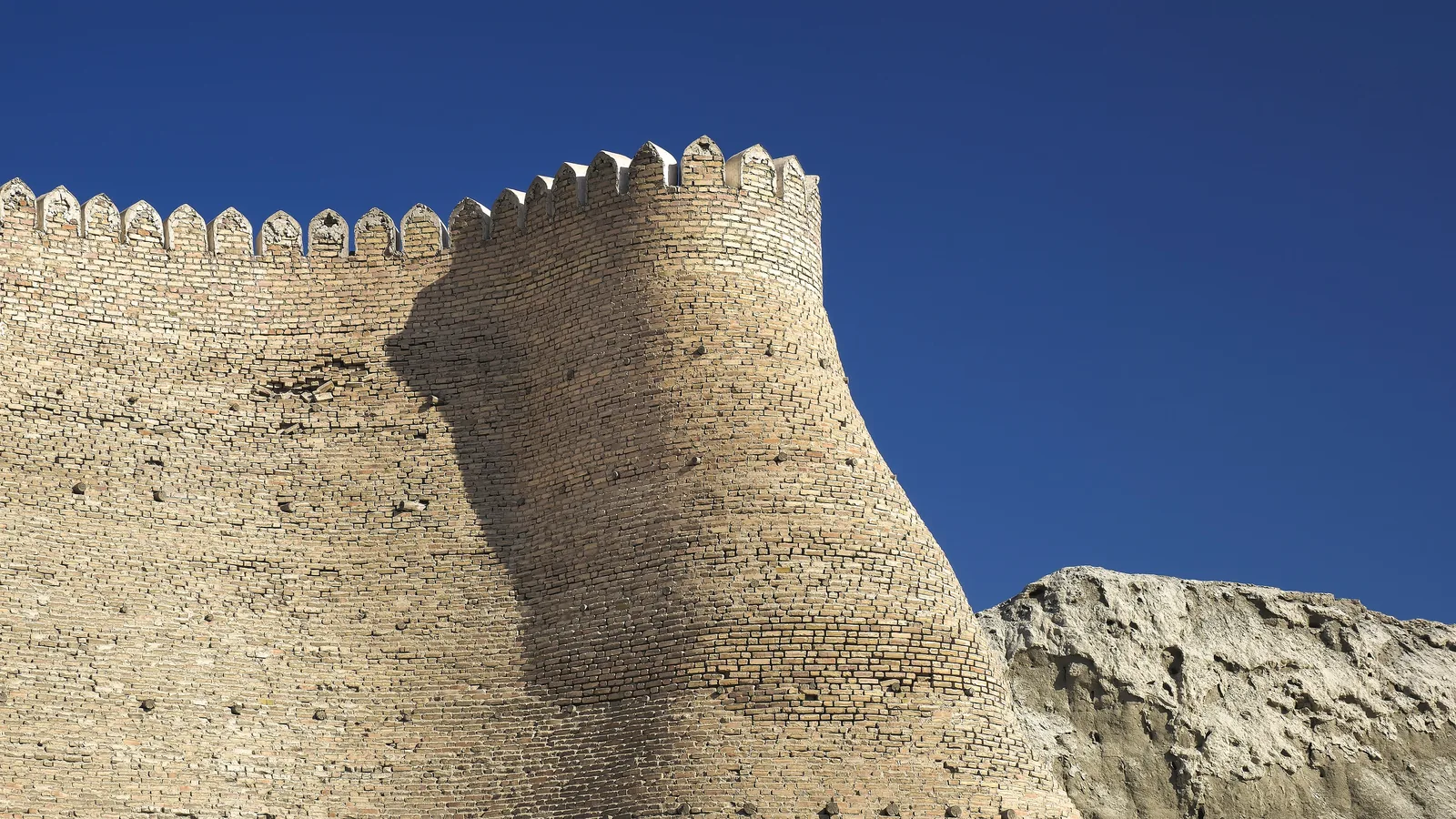
The city he entered on December 23 was walled in earth, two parts for the king and one for merchants and markets. Jenkinson names no king. The Hakluyt Society editors E. Delmar Morgan and C. H. Coote wrote in 1886 that the king, whom they identify as Abdullah Khan, then held Bukhara while his uncle Pir Muhammad was senior khan; Bregel dates Abdullah’s seizure of the city to 1557. On the 26th Jenkinson handed over Ivan’s letters and ate in the king’s presence; the king asked about the Russian emperor, the Ottoman sultan and English religion, and tried a handgun himself.
.jpg)
Kersey nobody wanted, and a king who paid in goods
Caravans came each year from India, Persia, Balkh and Russia, and none from Cathay in three years of war. The Indians brought white cotton cloth, “but golde, siluer, precious stones, and spices they bring none”: that trade, he found, went by sea under Portuguese control. Merchants from Bengal refused kersey in barter. The Persians brought silks, linen and horses and took away red hides and slaves, but bought no cloth, since Aleppo supplied them. The Russians brought hides, sheepskins, woolen cloth, wooden vessels, bridles and saddles, “but there is but smal vtterance,” little sale.
The king had “no great power or riches.” He lived on a tenth of everything sold in the city and, when short of money, took goods from the merchants’ shops. He owed Jenkinson for 19 pieces of kersey, left for a war without paying, and the Englishman was “forced to rebate part, and to take wares as payment for the rest.” The same king sent 100 armed men after the December robbers and hanged the four they caught at his palace gate.
Above the king stood a religious head Jenkinson called the Metropolitan, “more obeyed then the king,” who could depose him and had, he wrote, arranged the killing of the previous ruler in his chamber at night. That man took Ivan’s letters from him, and with them went the plan to return through Persia.
Six envoys, 25 freed Russians and a map printed in 1562
A caravan of 600 camels left Bukhara on March 8, 1559; ten days later, by Jenkinson’s account, the king of Samarkand laid siege to the city. At Urgench he took charge of six envoys, from the kings of Bukhara, Balkh and Urgench, bound for Ivan. On April 23 the party found its boat on the Caspian shore stripped of anchor, cable and sail, and spun a cable from hemp. Aboard were the six envoys and “25 Russes which had bene slaues a long time in Tartaria.” They reached Astrakhan on May 28 and entered Moscow on September 2, 1559. Two days later Jenkinson stood before Ivan with a white yak tail, a Tartar drum, the six envoys and the freed Russians.
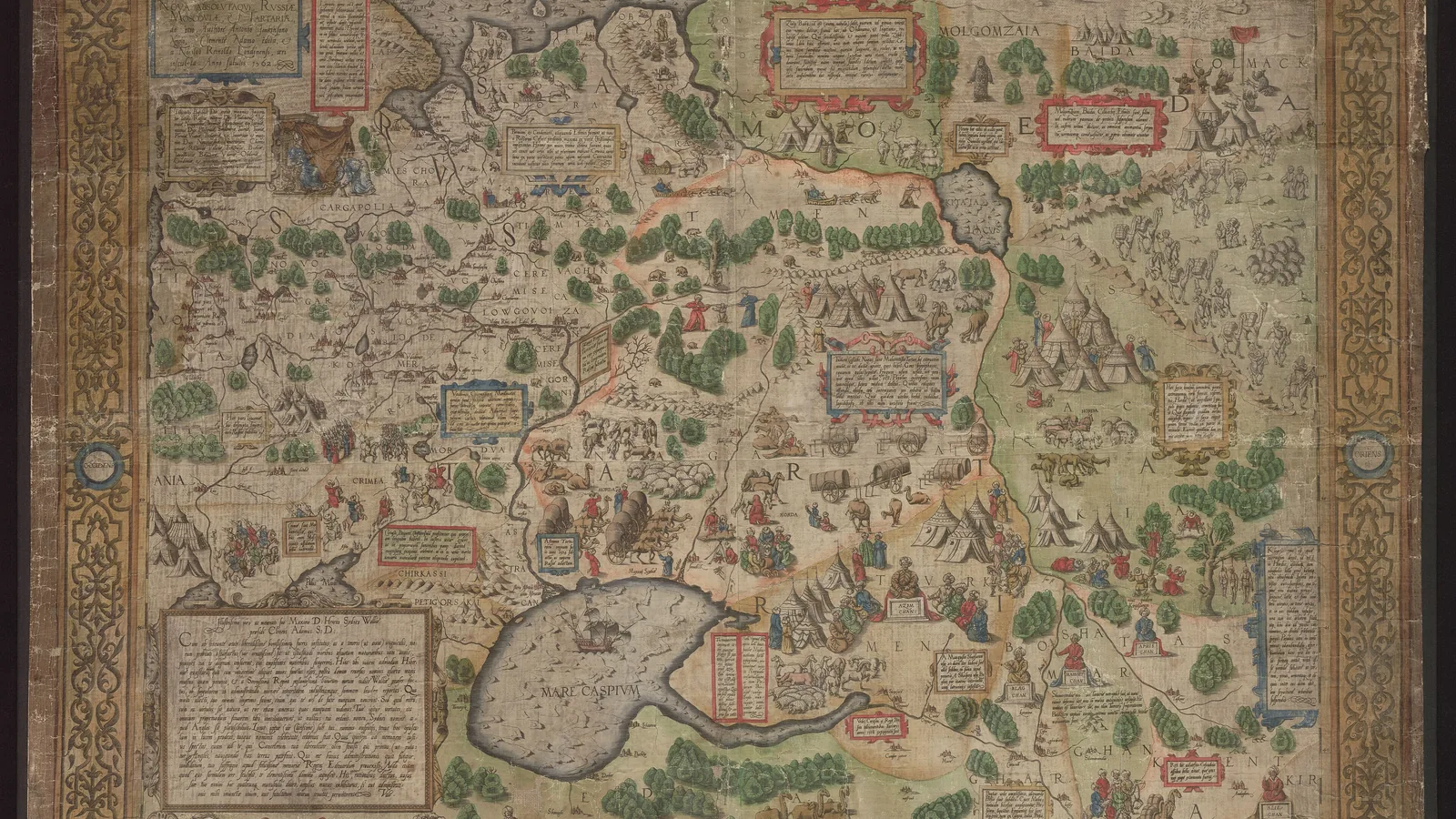
The map came after. Russiae, Moscoviae et Tartariae descriptio, dedicated to Sir Henry Sidney, was published in London in 1562, the year in its own dedication as Morgan and Coote transcribed it, though their introduction elsewhere gives 1561. Abraham Ortelius listed “Antonius Ienkinsonus” and his map of Russia printed in London among the authors of the Theatrum Orbis Terrarum, the atlas he published at Antwerp in 1570. The English kersey stayed unsold in Bukhara; the route survived on paper.
Key facts
- Jenkinson left Moscow on April 23, 1558, reached Astrakhan on July 14, entered the Caspian on August 10 and landed at Mangyshlak on September 3 (Hakluyt, vol. 3).
- The caravan of 1,000 camels left Mangyshlak on September 14 and reached Bukhara on December 23, 1558, after a day-long fight with 37 robbers on December 15 in which four handguns decided the outcome.
- His verdict on the market: the merchants were “so beggerly and poore” that “there is no hope of any good trade there to be had worthy the following.”
- The king of Bukhara, unnamed in the report and identified by Morgan and Coote in 1886 as Abdullah Khan, owed him for 19 pieces of kersey and paid partly in goods; the Metropolitan, “greater then the king,” took Ivan’s letters from him.
- He left Bukhara on March 8, 1559, with 600 camels and reached Moscow on September 2, 1559, with six envoys and 25 freed Russian captives; his map of Russia was printed in 1562 and used by Ortelius in 1570.
FAQ
Why did the Muscovy Company not trade with Bukhara after 1558?
Jenkinson's report gave no reason to. Merchants at Bukhara brought little and took two or three years to sell it, the Indian traders carried no gold, silver, stones or spices, the Persians would not buy English cloth, and Persian cloth sold in Bukhara as cheaply as his own. He wrote that Persia's trade looked "euen like to the trades of Tartaria, that is little vtterance, and small profite."
Who was the king of Bukhara that Jenkinson met?
Jenkinson never names him. The Hakluyt Society editors of 1886, E. Delmar Morgan and C. H. Coote, identified him as Abdullah Khan, son of Iskandar, who then held Bukhara while his uncle Pir Muhammad was senior khan. Yuri Bregel's entries in the Encyclopaedia Iranica date Abdullah's capture of Bukhara to 1557 and his formal accession as khan to 1583.
Sources
- Richard Hakluyt, The Principal Navigations, Voyages, Traffiques and Discoveries of the English Nation, vol. 3 (Glasgow, 1903 reprint): "The voyage of Master Anthony Ienkinson, made from the citie of Mosco in Russia, to the citie of Boghar in Bactria, in the yeere 1558: written by himselfe," Project Gutenberg text on the Internet Archive.
- E. Delmar Morgan and C. H. Coote (eds.), Early Voyages and Travels to Russia and Persia by Anthony Jenkinson and Other Englishmen, vol. I (Hakluyt Society, 1886): introduction, the note identifying the king of Bukhara as Abdullah Khan, and the transcription of the map's dedication; Internet Archive full text.
- The Hakluyt Society — Bibliography of the Hakluyt Society, First Series, Part II: entry 72, Early Voyages and Travels to Russia and Persia, edited by Edward Delmar Morgan and Charles Henry Coote, 1886.
- Abraham Ortelius, Theatrum Orbis Terrarum (Antwerp, 1570), Boston Public Library copy on the Internet Archive: the Catalogus Auctorum entry "Antonius Ienkinsonus, Russiam; Londini" and the Moscovia and Tartaria sheets.
- Encyclopaedia Iranica — Stephan Schmuck, "JENKINSON, ANTHONY," vol. XIV, fasc. 6, pp. 627–629 (December 15, 2008; updated December 5, 2014): the 1562 map, Henry Sidney, and the Ortelius atlas.
- Encyclopaedia Iranica — Yuri Bregel, "ʿABDALLĀH KHĀN B. ESKANDAR," vol. I, fasc. 2, pp. 198–199 (December 15, 1982; updated May 9, 2018).
- Encyclopaedia Iranica — Yuri Bregel, "BUKHARA iii. After the Mongol Invasion," vol. IV, fasc. 5, pp. 515–521 (2000; updated May 6, 2013): Abdallah's capture of Bukhara in 964/1557, the Naqshbandi shaikhs, and Jenkinson as the first European visitor.
Cite this article
- APA
- Our Earth's History. (2026, September 22). Bukhara, 1558: an Englishman finds the Silk Road trade too small. Our Earth's History. https://ourearthshistory.com/central-asia/early-modern/jenkinson-bukhara-1558-muscovy-company/
- Chicago
- Our Earth's History. “Bukhara, 1558: an Englishman finds the Silk Road trade too small.” Our Earth's History, September 22, 2026. https://ourearthshistory.com/central-asia/early-modern/jenkinson-bukhara-1558-muscovy-company/.
- MLA
- “Bukhara, 1558: an Englishman finds the Silk Road trade too small.” Our Earth's History, 22 Sep. 2026, https://ourearthshistory.com/central-asia/early-modern/jenkinson-bukhara-1558-muscovy-company/.
Text licensed CC BY-NC-ND 4.0. Found an error? Tell us.