Tunguska, 1908: where the 80 million trees figure came from

TL;DR — A 2018 NASA workshop put the 1908 Tunguska airburst at 10-20 megatons; a 2025 paper found its famous “80 million trees” figure traces to an uncredited 1930s guess.
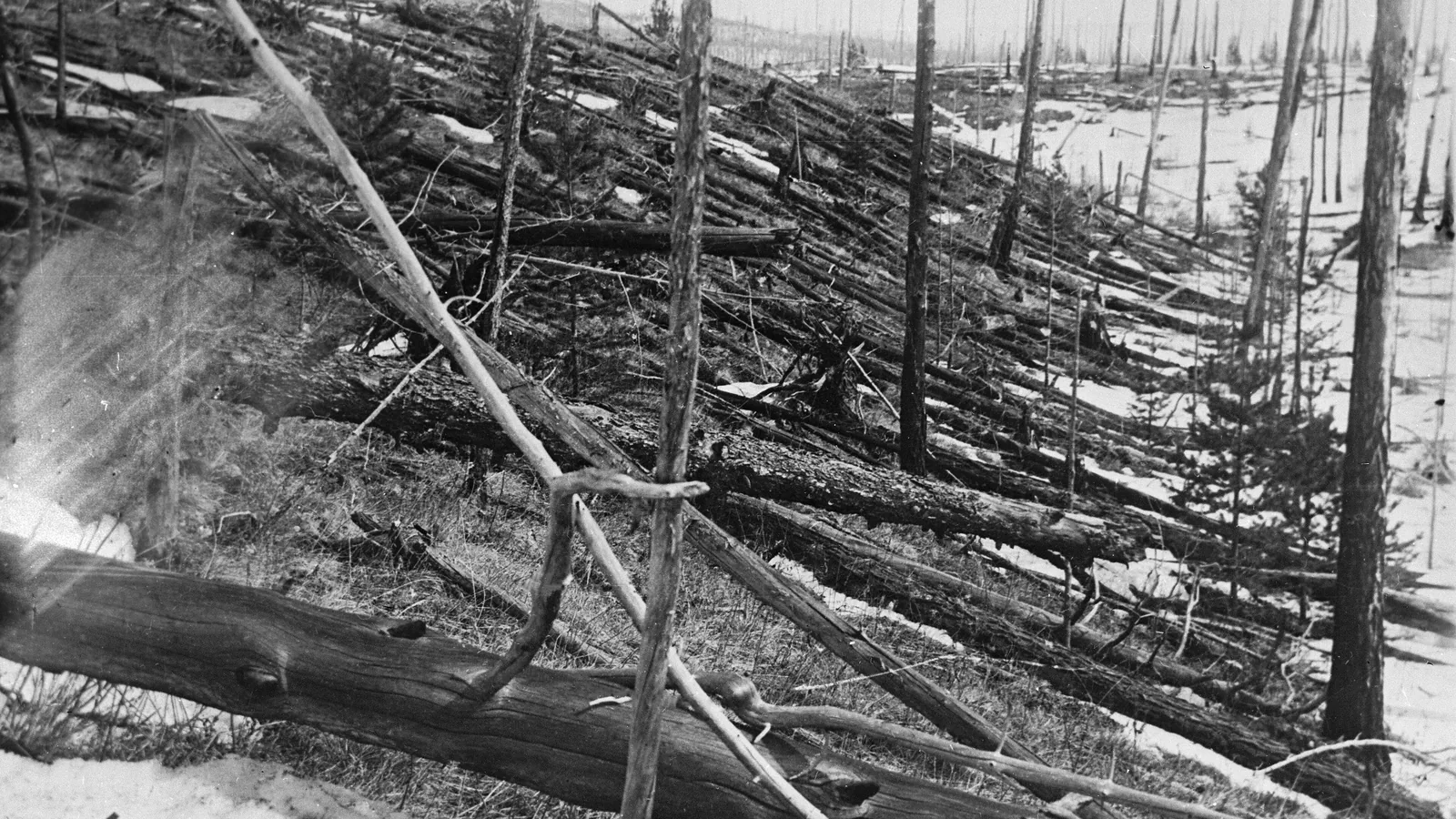
“No fragments of the exploding object have been recovered,” a NASA workshop report on the 1908 Tunguska explosion states, “perhaps because it fell in a boggy area, and there is no impact crater.” The explosion took place on June 30, 1908, over the Podkamennaya Tunguska river basin in central Siberia. NASA researchers Lisa Wheeler and Donovan Mathias write that the resulting airburst “felled trees across more than 2,000 square kilometers of Siberian forest.” No scientific team reached the site until Leonid Kulik arrived in 1927, and the numbers now attached to the event, from the count of fallen trees to the nature of the object itself, have been disputed and revised ever since.
Quick facts
- When
- June 30, 1908 (airburst) · 1927 (Leonid Kulik's first expedition to the site) · 2018 (NASA Tunguska workshop) · 2025 (Boslough and Bruno's paper on the tree-count figure)
- Where
- the Podkamennaya Tunguska river basin, central Siberia
- Who
- Leonid Kulik; David Morrison (NASA Ames Research Center); Mark Boslough and A. Bruno; Luca Gasperini; G. S. Collins and co-authors
- Outcome
- no fragments and no impact crater have been recovered; a 2018 NASA workshop converged on a 10-to-20-megaton airburst at about 10 kilometers; a 2025 paper traced the widely repeated "80 million trees" figure to an unattributed 1930s assumption; whether nearby Lake Cheko is an impact crater remains an open dispute between two named research groups
June 30, 1908: an airburst that left no crater
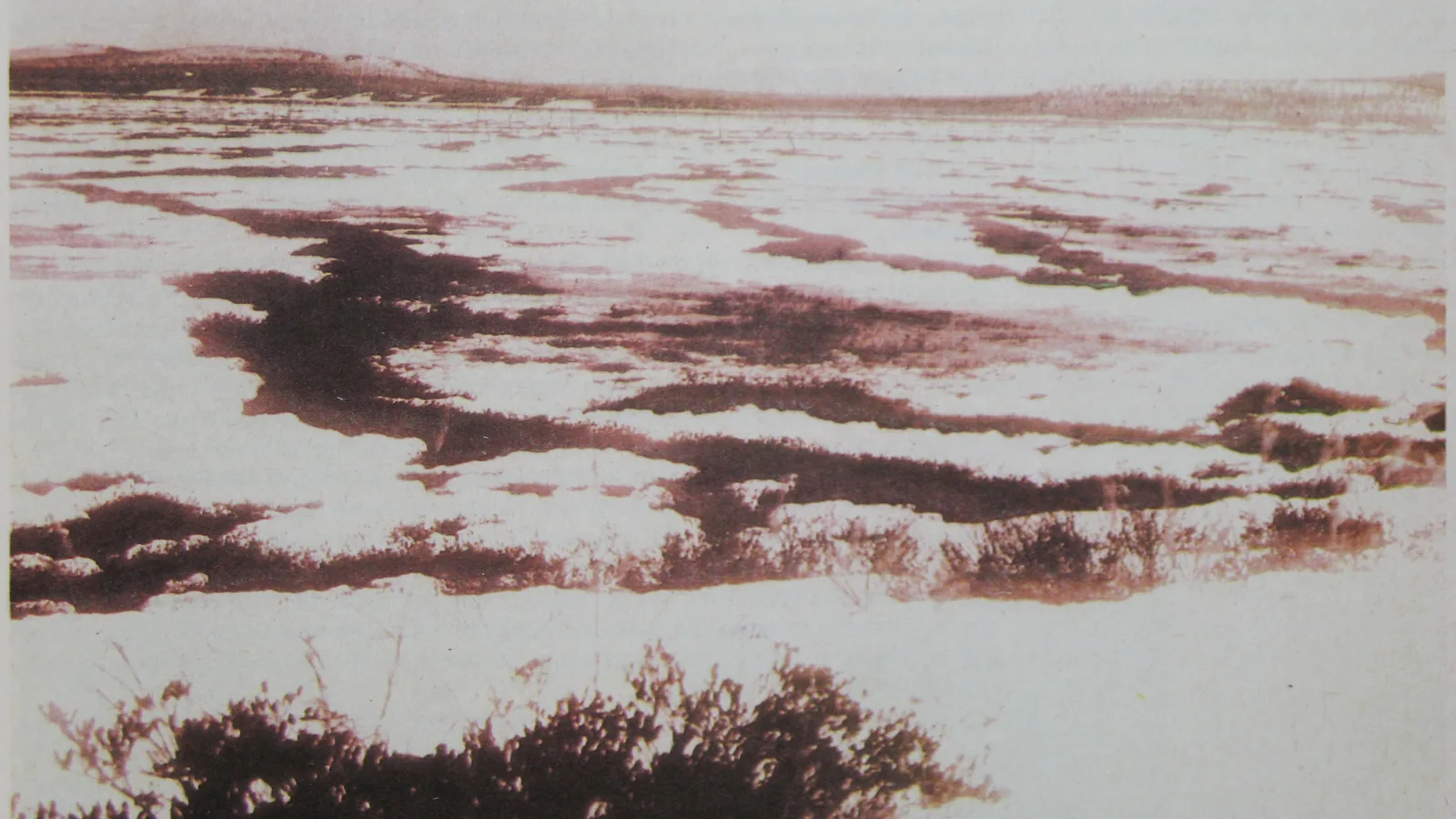
Nineteen years passed between the blast and the first scientific survey of it. Luca Gasperini, writing in Rendiconti Lincei in 2015, records that “in 1927, Leonid Kulik reached the explosion site, a remote region of Central Siberia close to the river Podkamennaya Tunguska, which gave later the name to the event.” Kulik concluded that he had found a large impact crater hidden under a swamp, along with smaller bowl-shaped holes covered by peat. Gasperini writes that other researchers questioned the interpretation, suggesting the circular features came from seasonal freezing and thawing of the ground rather than an impact, and that “all attempts at finding macro-remnants of the cosmic body by digging these circular depressions were unsuccessful; therefore, the hypothesis of an impact with the ground was abandoned.” Later expeditions turned instead to mapping the pattern of fallen trees and searching for microscopic particles of the object, on the assumption that it had exploded in the atmosphere rather than struck the ground.
Leonid Kulik's diary
Kulik’s own first impressions, recorded in Russian in his field diary, describe trees using the phrase Mark Boslough and A. Bruno translate in their 2025 Scientific Reports paper as “ten-to-twenty vershok giants.” Boslough and Bruno write that “careful surveys and measurements of tree diameters did not take place until the 1950s, and the largest trees were found to be close to the lower end of Kulik’s initial visual guess.” According to the Catalog of Fallen Trees compiled from those later surveys, they write, “the largest category of trees includes those that are merely over 30 cm in diameter.” The paper also states that no source in the scientific literature on Tunguska supports “hypervelocity winds” at the surface exceeding three kilometers per second; the actual wind speeds behind the blast waves, it says, were tens of meters per second.

Lake Cheko, an argument without a winner
A small lake about eight kilometers from the inferred blast site has produced a second, separate dispute. Gasperini and his co-authors Enrico Bonatti and Giuseppe Longo argued in a 2008 Terra Nova paper that Lake Cheko formed as a secondary impact crater from the same event. G. S. Collins and his co-authors, publishing a rebuttal in the same journal and year, wrote that they had assembled “several lines of observational evidence that contradicts the impact hypothesis,” pointing to the lake’s shape, the absence of impactor material in or around it, and mature trees standing undamaged nearby. Collins and his co-authors calculated that a crater of that size would require “a tensile strength of 10-40 MPa,” while the tensile strength of large stony meteorites breaking apart in the atmosphere runs 10 to 100 times lower, and concluded that “Lake Cheko is highly unlikely to be an impact crater.” Gasperini, Bonatti and Longo replied in the same volume that they continued “arguing in favour of an impact origin for Lake Cheko.”
"10 to 20 megatons": a 2018 NASA workshop's estimate
A NASA workshop convened in 2018 brought outside estimates of the blast together. Its report states that “the most likely models for Tunguska converged on an energy of 10-20 Megatons, released in an airburst at a height of about 10 km,” and that if the object was a stony asteroid similar to the one that exploded over Chelyabinsk in 2013, its diameter was “roughly 50-80m.” The same report says that a comparison with the known population of asteroids that size indicates the interval between such events is “millennia, not centuries,” a revision of earlier estimates. It also records accounts of deaths in nomad camps roughly 25 kilometers from the epicenter, citing research by Olga Popova, Peter Jenniskens and their co-authors, and notes that broken windows were reported as far as 200 to 300 kilometers away.
Eighty million trees, an unattributed number
The figure most often repeated for the event, that 80 million trees were knocked down, does not come from any count made in 1908. Boslough and Bruno trace it to the Soviet astronomer I. S. Astapovich, who around 1934 wrote, in the course of estimating the blast’s energy, “apparently, it can be assumed that the area of the fallen forest occupies about 8000 km2” and calculated from that assumption that “the work of the windfall of 8·10^7 trees would be 4.4·10^21 ergs.” That 8,000-square-kilometer assumption was roughly four times the area Wheeler and Mathias give for the damage. Boslough and Bruno describe how the figure then passed from Astapovich through the British astronomer John Crommelin, into a 1982 paper by Brazo and Austin that stated “eighty million trees in the taiga were uprooted and blown down” with no citation attached, and finally into a 2021 paper by Bunch and co-authors, who added a “greater than” symbol in front of it “without justification,” in the words of Boslough and Bruno’s 2025 paper.
Key facts
- The airburst occurred on June 30, 1908, over the Podkamennaya Tunguska river basin in central Siberia (NASA/TM-220174).
- No fragments of the object and no impact crater have ever been recovered (NASA/TM-220174).
- The blast felled trees across more than 2,000 square kilometers of forest, according to NASA researchers Lisa Wheeler and Donovan Mathias.
- Leonid Kulik reached the site in 1927 and initially concluded he had found an impact crater, an interpretation later abandoned (Gasperini, 2015).
- Careful tree-diameter surveys did not begin until the 1950s and found the largest trees only just over 30 centimeters across (Boslough and Bruno, 2025).
- A 2018 NASA workshop converged on an airburst energy of 10 to 20 megatons at about 10 kilometers of altitude.
- Whether Lake Cheko is a secondary impact crater remains disputed between Gasperini’s group (2008, for) and Collins’s group (2008, against).
- The “80 million trees” figure traces to a 1934 assumption by I. S. Astapovich that was never re-verified before later authors repeated it as fact (Boslough and Bruno, 2025).
FAQ
Where does the "80 million trees" figure for the Tunguska event come from?
Mark Boslough and A. Bruno's 2025 Scientific Reports paper traces it to a rough 1934 estimate by the Soviet astronomer I. S. Astapovich, who assumed a forest area about four times larger than the damage NASA's later assessments record. The figure was repeated without a citation in a 1982 paper and given a "greater than" symbol in a 2021 paper, according to Boslough and Bruno.
Was the 1908 Tunguska object a comet or an asteroid?
A 2018 NASA workshop report states that the most likely models converged on a stony asteroid similar to the one that exploded over Chelyabinsk in 2013, with an estimated diameter of 50 to 80 meters. The report presents this as the workshop's conclusion rather than as a settled scientific consensus.
Is Lake Cheko an impact crater from the Tunguska event?
Researchers disagree. Luca Gasperini and his co-authors argued in Terra Nova in 2008 that Lake Cheko is a secondary impact crater. G. S. Collins and his co-authors, publishing a rebuttal in the same issue, argued that the lake's shape, its surrounding vegetation and the physics of stony-meteorite breakup make an impact origin unlikely.
Sources
- David Morrison, "Tunguska Workshop: Applying Modern Tools to Understand the 1908 Tunguska Impact," NASA/TM-220174 (December 2018), NASA Technical Reports Server.
- L. Wheeler and D. Mathias, "Probabilistic Assessment of Tunguska-Scale Asteroid Impacts," NASA Ames Research Center, NASA Technical Reports Server.
- Luca Gasperini, "Lake Cheko and the 1908 Tunguska Event," Rendiconti Lincei (Springer, 2015).
- Mark Boslough and A. Bruno, "Misunderstandings about the Tunguska event, shock wave physics, and airbursts have resulted in misinterpretations of evidence at Tall el-Hammam," Scientific Reports 15 (2025).
- G. S. Collins, N. Artemieva, K. Wunnemann, P. A. Bland, W. U. Reimold and C. Koeberl, "Evidence that Lake Cheko is not an impact crater," Terra Nova 20 (2008).
- Luca Gasperini, Enrico Bonatti and Giuseppe Longo, "Lake Cheko and the Tunguska Event: impact or non-impact?," Terra Nova 20 (2008).
Cite this article
- APA
- LETTER. (2026, September 28). Tunguska, 1908: where the 80 million trees figure came from. Our Earth's History. https://ourearthshistory.com/central-asia/modern/tunguska-june-30-1908-80-million-trees-kulik-lake-cheko/
- Chicago
- LETTER. “Tunguska, 1908: where the 80 million trees figure came from.” Our Earth's History, September 28, 2026. https://ourearthshistory.com/central-asia/modern/tunguska-june-30-1908-80-million-trees-kulik-lake-cheko/.
- MLA
- LETTER. “Tunguska, 1908: where the 80 million trees figure came from.” Our Earth's History, 28 Sep. 2026, https://ourearthshistory.com/central-asia/modern/tunguska-june-30-1908-80-million-trees-kulik-lake-cheko/.
Text licensed CC BY-NC-ND 4.0. Found an error? Tell us.