Saint-Pierre, 1902: an election set for May 11, an eruption on May 8
.jpg)
TL;DR — Mount Pelée’s glowing cloud destroyed Saint-Pierre, Martinique, at about 7:50 a.m. on May 8, 1902, three days before an election; two people in the city are known to have survived.
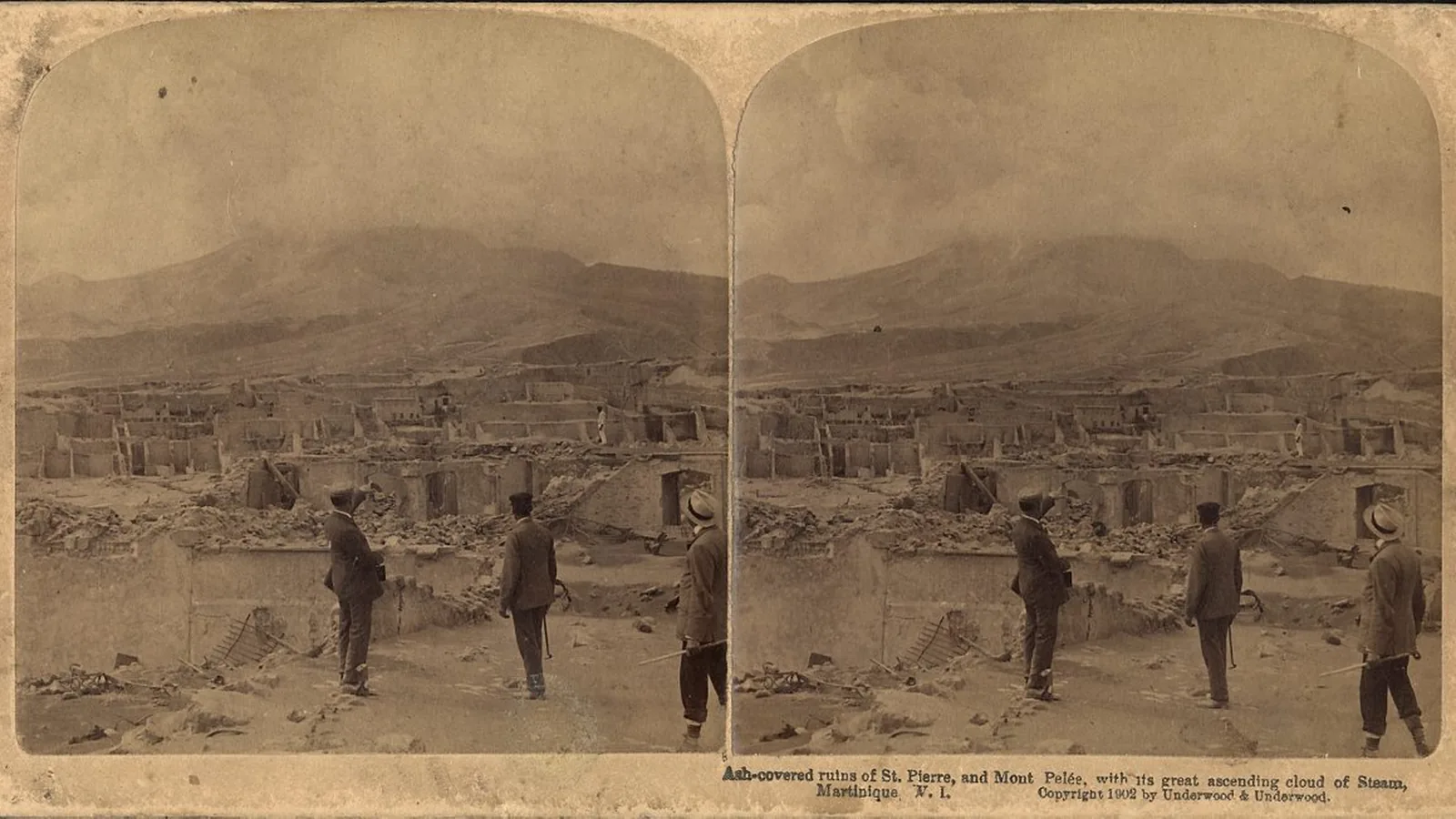
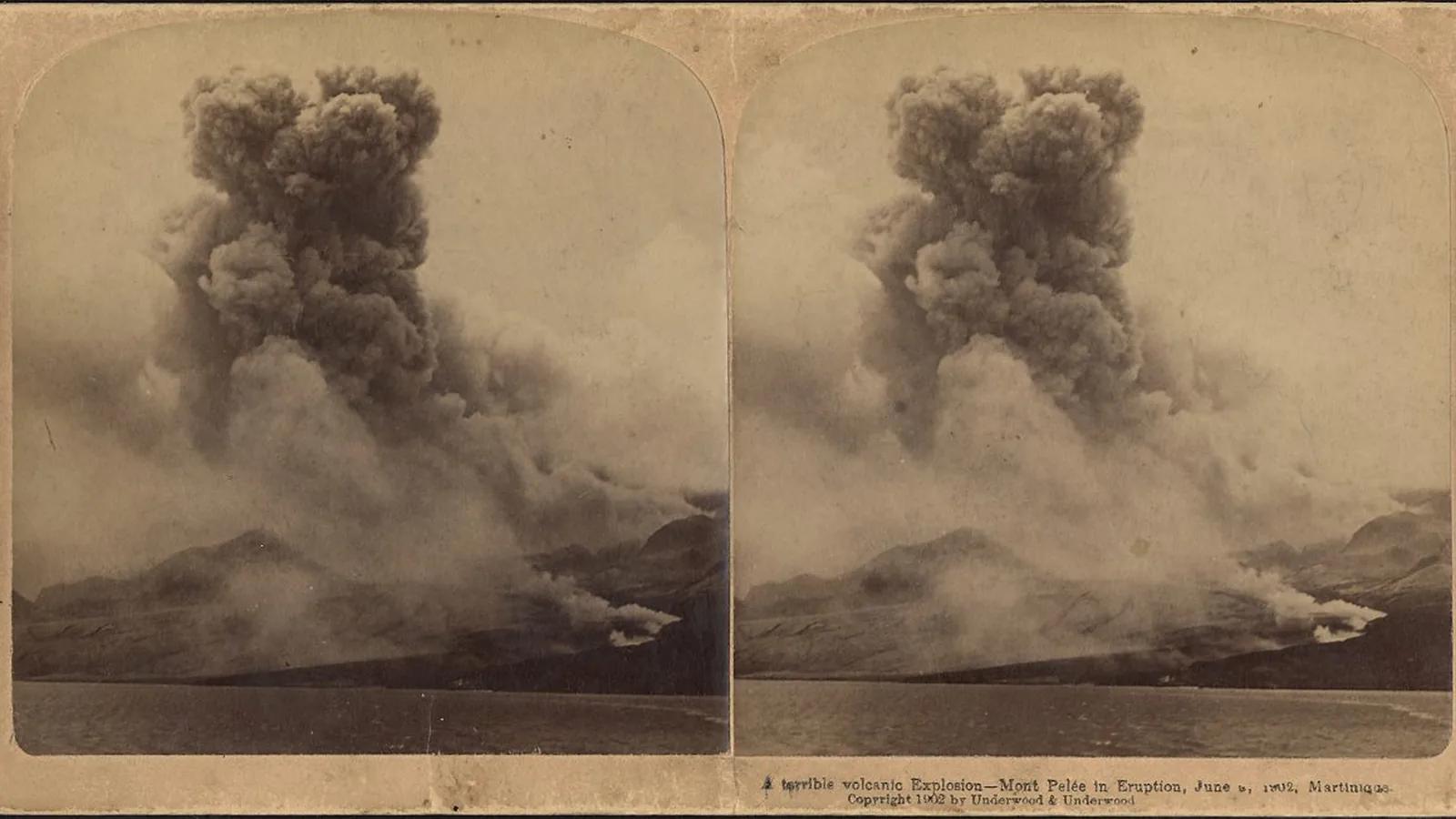
At about 7:50 a.m. on May 8, 1902, a black cloud of superheated gas and rock from Mount Pelée reached the city of Saint-Pierre, Martinique, in less than one minute. San Diego State University’s volcano pages put about 28,000 people in the city that morning and count two known survivors. The U.S. Geological Survey (USGS) gives the dead as 26,000 in one publication and “nearly 30,000” in another. Three days earlier a committee had told the island’s governor, Louis Mouttet, that “the safety of St. Pierre is completely assured,” and an election was set for May 11. Alfred Lacroix, who led a French mission to study the eruption, gave the glowing cloud its French name. An observatory built at his urging led to the one the Institut de Physique du Globe de Paris (IPGP) runs at Saint-Pierre.
Quick facts
- When
- April 23, 1902 (summit explosions begin) · May 5 (lahar down the River Blanche; committee report to the governor) · May 8, about 7:50 a.m. (eruption) · May 11 (the election that did not take place) · 1935, 1946 and 2019 (the observatory moves and changes hands)
- Where
- Mount Pelée and the city of Saint-Pierre on the French Caribbean island of Martinique; the road to Fort-de-France; the harbor of Saint-Pierre; the Morne des Cadets, the Morne Moustin and the Morne la Rosette
- Who
- Governor Louis Mouttet; Léon Compère-Léandre; Louis-Auguste Cyparis, called Samson; Alfred Lacroix of the Muséum national d'Histoire naturelle and his mission; Albert de Lapparent; the Institut de Physique du Globe de Paris
- Outcome
- A glowing cloud reached Saint-Pierre in less than one minute. The USGS gives 26,000 and nearly 30,000 dead in two publications, and San Diego State University about 28,000 people in the city, with two known survivors. Lacroix's study gave volcanology the term nuée ardente, and an observatory built at his urging led to the one that watches the volcano
April 23 to May 5: ash, snakes and a lahar
Saint-Pierre was a French colonial port that European tourists, by the San Diego State account, called the “Paris of the West Indies.” The official census of 1894 counted around 20,000 people there. Mount Pelée stood about four miles above the city, and in January 1902 its fumaroles, the vents that release volcanic gas, became more active.
On April 23 small explosions began at the summit. Over the next few days tremors shook the city, ash fell on it and a cloud of sulfurous gas settled over the streets. Ants, centipedes and snakes driven off the slopes moved into Saint-Pierre. The San Diego State pages estimate that 50 people, most of them children, died of snake bites, along with some 200 animals.
The water in the summit crater lake, the Étang Sec, rose close to boiling. On May 5 the crater rim gave way. Hot water mixed with loose volcanic debris and ran down the River Blanche as a lahar, a volcanic mudflow, moving at nearly 100 kilometers an hour. Near the river mouth, north of the city, it overran a rum distillery and killed 23 workmen. In the sea it raised a wave about three meters high that flooded the waterfront.
Governor Louis Mouttet and the vote set for May 11
On the day of the lahar, the San Diego State account continues, Mouttet received the report of a committee of civic leaders who had climbed the volcano. Its only scientist was a local high school teacher. The report stated that “there is nothing in the activity of Mt. Pelée that warrants a departure from St. Pierre.” The committee missed a V-shaped notch in the cliffs around the summit crater that opened toward the city.
City officials wanted voters to stay for the election of May 11. The same account adds that the only people with money enough to leave were the wealthy, and nearly all of them belonged to Mouttet’s Progressive Party. Mouttet persuaded the conservative editor of the daily Les Colonies to play down the danger and to encourage people to remain. When some residents left anyway, he sent troops to patrol the road to Fort-de-France, the island’s second city, with orders to turn back refugees. Reading the paper’s calm reports, people from the countryside came into Saint-Pierre as the safest place on the island, and the population rose to about 28,000.
The San Diego State pages give no archival reference for the troop patrols or the newspaper arrangement. The USGS and French sources cited below do not mention the election.
Eruption at 7:50 a.m. on May 8, and two known survivors
The notch aimed the cloud at the city. The San Diego State account describes it rolling down the south flank at more than 100 miles an hour and striking Saint-Pierre with hurricane force. Over the harbor the cloud destroyed at least 20 ships at anchor. The steamship Grappler capsized, and the American sailing ship Roraima, which had arrived a few hours earlier, caught fire; most of her passengers and crew died.
No single death count exists. The Hawaiian Volcano Observatory, writing for the USGS in 2005, said the 1902 eruptions destroyed the city “and its 26,000 inhabitants.” A USGS publication on Mount St. Helens gives “nearly 30,000.” San Diego State’s figure of about 28,000 is the population of the city that morning, “nearly all of which would perish.”
The San Diego State pages name two survivors inside the city. Léon Compère-Léandre, a young shoemaker, was sitting on his doorstep when the cloud arrived; his house stood near the edge of the flow. In the English version of his account printed there, he began: “I felt a terrible wind blowing, the earth began to tremble, and the sky suddenly became dark.” He ran to Fonds-Saint-Denis, six kilometers from the city.
Louis-Auguste Cyparis, a 25-year-old roustabout known locally as Samson, had been jailed in early April for wounding a friend with a cutlass. An escape for a night of dancing earned him a week in solitary confinement. On May 8 hot air and ash came through a small grated opening above his cell door. He stayed alive in the ruins for four days until people searching them found him. He was pardoned and later toured with the Barnum & Bailey Circus, billed as the “Lone Survivor of St. Pierre.” The same pages add that other people survived on the outskirts of the town and aboard some of the ships.
.jpg)
"Nuée ardente": Lacroix's mission and the Morne des Cadets
The Académie des Sciences decided on hearing the news to organize a scientific expedition at once, together with the Ministries of the Colonies and of the Navy. Albert de Lapparent set out the story in a review of Lacroix’s work in the Annales de Géographie of March 15, 1905. The mission, he wrote, had Lacroix as its chief, with Rollet de l’Isle, a hydrographic engineer, and Giraud, an assistant geologist. Lapparent granted that the Americans, being closer, would reach the island first, and he called the disaster “un chapitre nouveau,” a new chapter, in the history of volcanoes.
Lacroix studied the 1902 eruption and the ones that followed, and the USGS credits him with coining the French term “nuée ardente,” glowing cloud, for the flows that destroyed Saint-Pierre. The Hawaiian Volcano Observatory wrote in 2005 that most volcanologists prefer the term “pyroclastic flow.”
The IPGP dates its Martinique observatory to that eruption. After May 8, 1902, a first observatory was built facing the volcano on the Morne des Cadets, at the instigation of Lacroix, then a professor at the Muséum national d’Histoire naturelle. A new one opened on the Morne Moustin in 1935, after the eruptions of 1929 to 1932, and in 1946 the watch over the volcano passed to the IPGP. Its duties include seismic monitoring across the Lesser Antilles and an automatic lahar detection system. In 2019 the observatory moved into a new earthquake-resistant and hurricane-resistant building on the Morne la Rosette at Saint-Pierre, built and provided by the Collectivité Territoriale de Martinique.
Key facts
- Small explosions began at the summit of Mount Pelée on April 23, 1902; on May 5 a lahar down the River Blanche killed 23 workmen at a rum distillery (San Diego State University).
- On May 5 a committee told Governor Louis Mouttet that “the safety of St. Pierre is completely assured”; an election was set for May 11 (San Diego State University).
- The eruption began at about 7:50 a.m. on May 8, 1902, and the cloud reached Saint-Pierre in less than one minute (San Diego State University).
- The USGS gives 26,000 dead in one publication and “nearly 30,000” in another; San Diego State University puts about 28,000 people in the city, with two known survivors.
- The survivors named inside the city were the shoemaker Léon Compère-Léandre and the prisoner Louis-Auguste Cyparis, later billed by Barnum & Bailey as the “Lone Survivor of St. Pierre.”
- Alfred Lacroix led the French scientific mission and coined the term “nuée ardente” (USGS); the observatory founded at his urging moved to a new building on the Morne la Rosette in 2019 (IPGP).
FAQ
How many people died when Mount Pelée erupted in 1902?
The figures differ by source. The USGS gives 26,000 in a 2005 Hawaiian Volcano Observatory article and nearly 30,000 in a Mount St. Helens publication. San Diego State University puts about 28,000 people in Saint-Pierre that morning, nearly all of whom died, with two known survivors inside the city.
Who survived the destruction of Saint-Pierre?
San Diego State University names two survivors inside the city: Léon Compère-Léandre, a shoemaker whose house stood near the edge of the flow, and Louis-Auguste Cyparis, a prisoner held in solitary confinement. Cyparis was found after four days, pardoned, and later toured with Barnum & Bailey. Others survived on the outskirts and on some ships.
What is a nuée ardente?
It is the French term, meaning glowing cloud, that the USGS credits Alfred Lacroix with coining for the flows that destroyed Saint-Pierre in 1902. The USGS describes it as a high-speed, high-temperature mixture of volcanic gas and rock fragments that behaves like a fluid, and the same article says most volcanologists prefer the term pyroclastic flow.
Sources
- San Diego State University, Department of Geological Sciences, How Volcanoes Work, "Mt. Pelée Eruption (1902)"
- U.S. Geological Survey, "Pyroclastic flows" (Mount St. Helens general interest publication)
- U.S. Geological Survey, Hawaiian Volcano Observatory, Volcano Watch column "A pioneering volcanologist narrowly beats the Reaper," August 25, 2005
- U.S. Geological Survey, Yellowstone Volcano Observatory, "A brief history of volcanology: from myths and legends to a modern and interdisciplinary science"
- Albert de Lapparent, "La montagne Pelée et ses éruptions," Annales de Géographie 14, no. 74 (March 15, 1905), 97-110 (Persée)
- Institut de Physique du Globe de Paris, "Observatoire volcanologique et sismologique de la Martinique (OVSM-IPGP)"
Cite this article
- APA
- LETTER. (2026, September 29). Saint-Pierre, 1902: an election set for May 11, an eruption on May 8. Our Earth's History. https://ourearthshistory.com/americas/modern/mount-pelee-1902-saint-pierre-nuee-ardente/
- Chicago
- LETTER. “Saint-Pierre, 1902: an election set for May 11, an eruption on May 8.” Our Earth's History, September 29, 2026. https://ourearthshistory.com/americas/modern/mount-pelee-1902-saint-pierre-nuee-ardente/.
- MLA
- LETTER. “Saint-Pierre, 1902: an election set for May 11, an eruption on May 8.” Our Earth's History, 29 Sep. 2026, https://ourearthshistory.com/americas/modern/mount-pelee-1902-saint-pierre-nuee-ardente/.
Text licensed CC BY-NC-ND 4.0. Found an error? Tell us.