Tranquility Base here: the Apollo 11 landing in the transcript
_-_MSC_(S69-38749).jpg)
TL;DR — “Houston, Tranquility Base here. The Eagle has landed,” Armstrong radioed at 102:45:58 on July 20, 1969; the crew walked out of quarantine on August 10.
“Houston, Tranquility Base here. The Eagle has landed.” Neil Armstrong sent those words 102 hours, 45 minutes and 58 seconds into the flight of Apollo 11, on July 20, 1969. Eighteen seconds earlier Edwin “Buzz” Aldrin Jr. had called “Contact Light,” and the Apollo Lunar Surface Journal, the corrected transcript edited by Eric M. Jones, times that call at 20:17:40 UTC. Charlie Duke, the capsule communicator in Houston, answered: “You got a bunch of guys about to turn blue. We’re breathing again.” The lunar module Eagle stood in the Sea of Tranquility with Armstrong and Aldrin aboard; Michael Collins circled overhead in the command module Columbia. The two men spent 2 hours 31 minutes 40 seconds outside and brought back 21.55 kg of rock and soil. On July 24 the three landed in the Pacific, and on August 10 they left quarantine in Houston.
Quick facts
- When
- May 25, 1961 (Kennedy's message to Congress) · July 16, 1969, 9:32 a.m. EDT (launch) · July 20, 20:17:40 UTC (landing) · July 21, 02:56:15 UT (first step) · July 24, 12:50 p.m. EDT (splashdown) · August 10 (release from quarantine)
- Where
- Launch Pad 39A, Kennedy Space Center; the Sea of Tranquility on the Moon; the Pacific Ocean at 13°19′N 169°9′W; the Lunar Receiving Laboratory, Houston
- Who
- Neil Armstrong (commander); Edwin "Buzz" Aldrin Jr. (lunar module pilot); Michael Collins (command module pilot); Charlie Duke (capsule communicator); Steve Bales and Jack Garman (guidance officers in Houston); President Richard M. Nixon
- Outcome
- Eagle landed at 20:17:40 UTC on July 20, 1969, after four program alarms; the crew spent 2 hours 31 minutes 40 seconds outside, hatch open to hatch closed, brought back 21.55 kg of samples, splashed down on July 24 and left a 21-day quarantine on August 10
"Before this decade is out": Kennedy's message, May 25, 1961
On May 25, 1961, President John F. Kennedy told a joint session of Congress, “First, I believe that this nation should commit itself to achieving the goal, before this decade is out, of landing a man on the moon and returning him safely to the earth.” He added that the program would carry “very heavy costs.” NASA’s mission overview names that goal as the primary objective of Apollo 11. The Saturn V carrying the crew left Launch Pad 39A at the Kennedy Space Center at 9:32 a.m. EDT on July 16, 1969; on July 20 Eagle undocked from Columbia at 100 hours 12 minutes and began its powered descent at 102 hours 33 minutes.
Program alarm 1202, 102:38:30 mission time
At 102:38:26 Armstrong said “Program Alarm,” and four seconds later, “It’s a 1202.” The transcript’s editorial note explains the alarm as data overflow in the lunar module’s computer, an unexpected flow of data about rendezvous radar pointing. NASA’s history office places that first 1202 at about 33,000 feet, a second within a minute, a 1201 as Eagle passed 3,000 feet and another 1202 near 1,000 feet. At 102:42:19 Aldrin called “Program Alarm. 1201,” and Duke came back: “Roger. 1201 alarm. We’re Go. Same type.”
The “Go” rested on two men in Houston. Steve Bales, the guidance officer, whom Armstrong later described as 26 years old, decided that the overflow would not jeopardize the landing. In the support room Jack Garman, 25, had prepared a list of alarms in advance. NASA’s 2016 obituary for Garman records that he knew at once that 1202 meant only a temporary overload of the guidance computer, and that his preparation prevented an abort.
At about 600 feet, according to the same history office account, Armstrong took manual control to fly past boulders near West Crater. Duke called “60 seconds” at 102:45:02 and “30 seconds” at 102:45:31. NASA’s own pages give 30 seconds of fuel; the Apollo Lunar Surface Journal’s analysis of the mission report puts it at about 45 seconds including 20 for an abort, and explains Duke’s calls as the time left before a “Bingo” call that would have meant land within 20 seconds or abort. No television camera showed the landing; a silent 16 mm film camera in Aldrin’s window recorded it.
July 21, 02:56:15 UT: one small step
The mission report gives first contact with the surface at 109:24:15, and the National Space Science Data Center converts that to 02:56:15 UT on July 21. Eight seconds later Armstrong spoke the words that NASA’s 55th-anniversary page prints as “That’s one small step for [a] man, one giant leap for mankind.” The transcript’s editor writes that the “a” is not audible on the recording, that Armstrong intended to say it and believed he had, and that a 2006 waveform analysis claiming to find it was not supported by later spectrogram analysis. Aldrin followed 19 minutes later and, at 109:43:24, said “Magnificent desolation.”
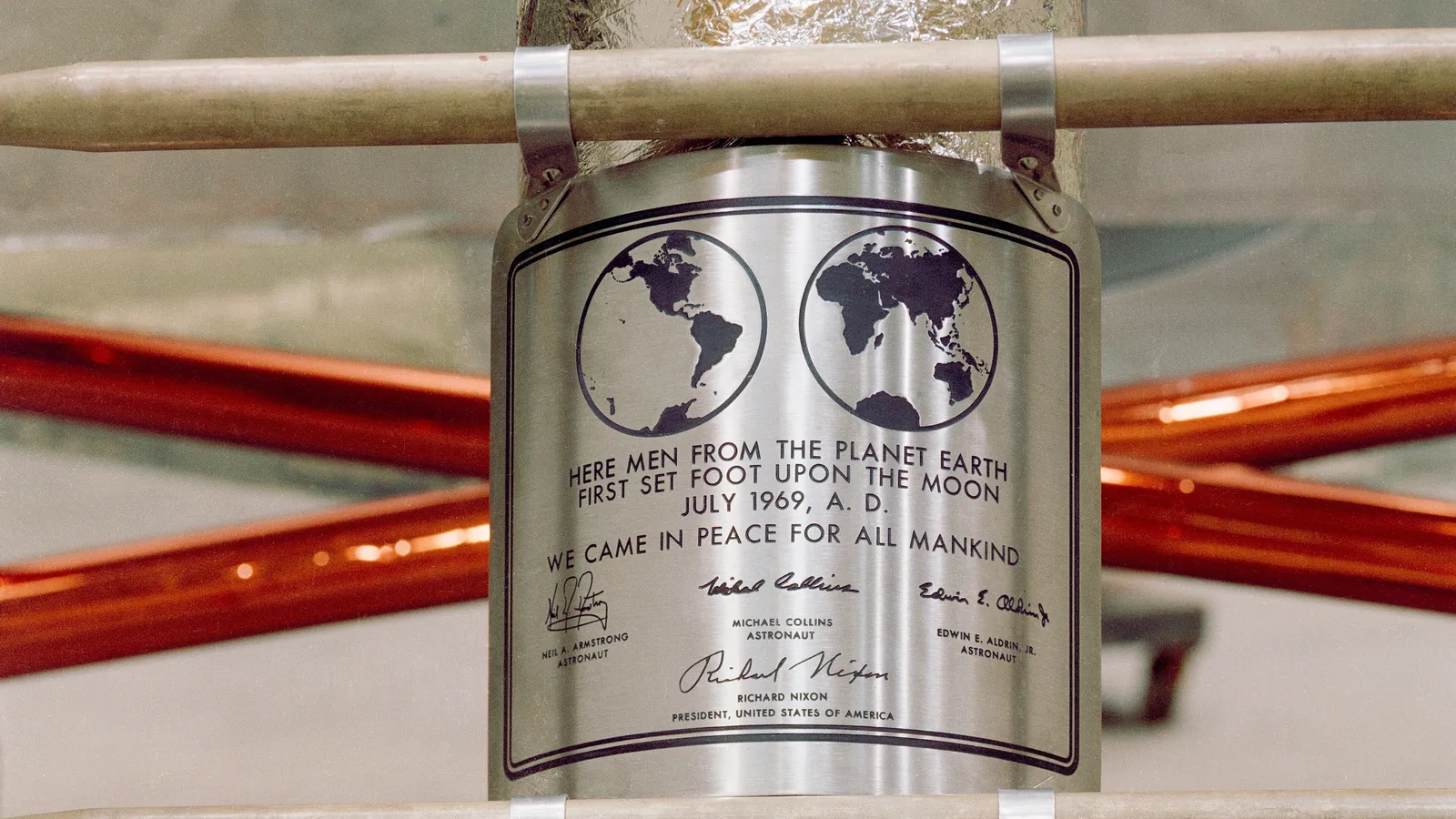
At 109:52:40 Armstrong read the plaque fixed to the ladder of the front landing gear: “Here Men from the planet Earth first set foot upon the Moon, July 1969 A.D. We came in peace for all mankind.” It bore the signatures of the three astronauts and of President Richard M. Nixon. At 110:09:43 Houston reported, “They’ve got the flag up now.” The flag was standard 3-by-5-foot nylon on an 8-foot pole, and the decision to fly it came so late that flag and plaque were fitted to Eagle on launch day.
Aldrin's seismometer and 21.55 kg of rock
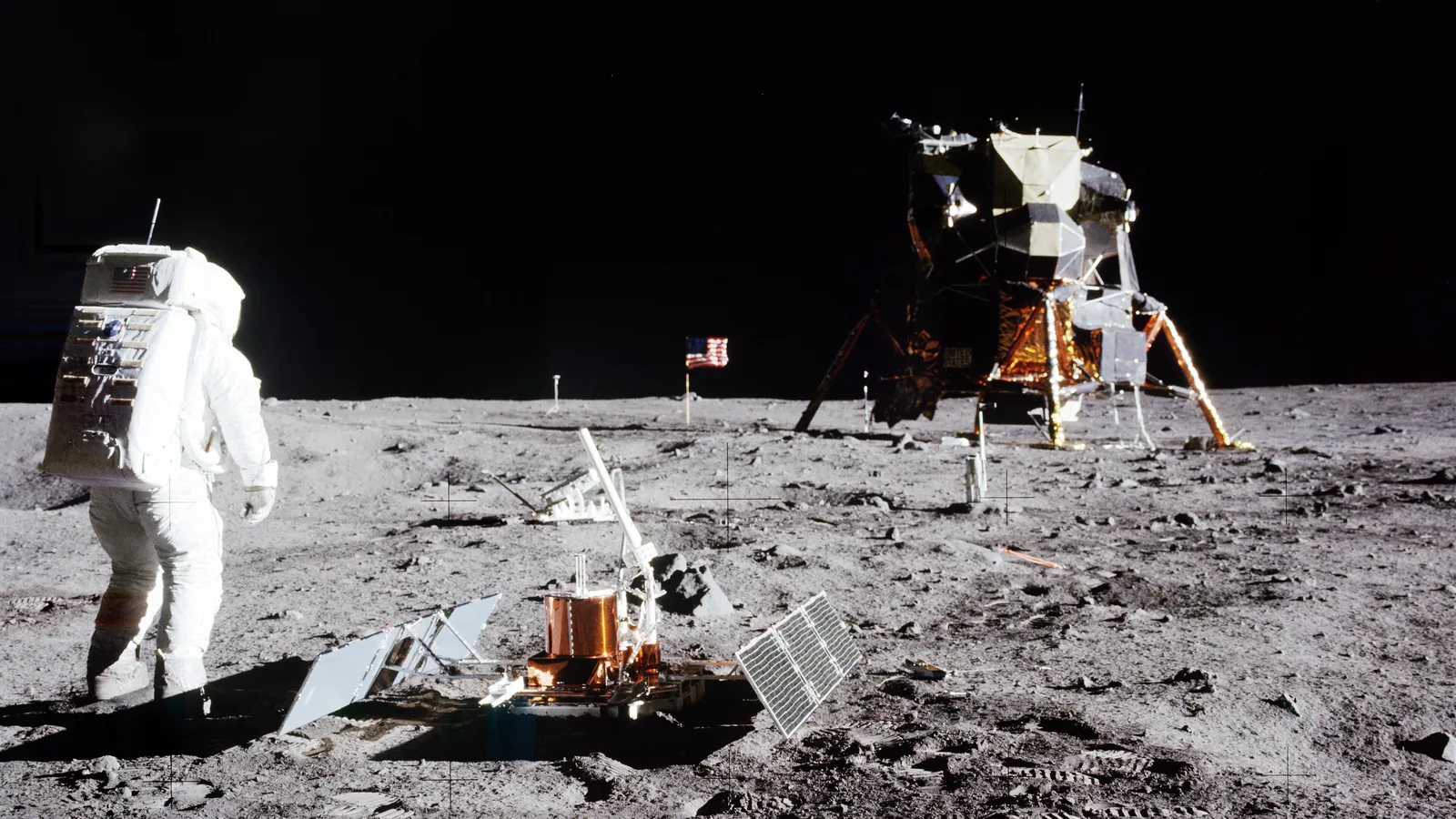
At 110:55:42 Aldrin reported, “Houston, the passive seismometer (PSEP) has been deployed manually.” The seismometer and a laser ranging retroreflector made up the Early Apollo Scientific Experiments Package, 48 kg set out about 17 m south of Eagle. Ground control switched it on at 04:40:39 UT on July 21 while the two men were still outside, and the instrument picked up their footsteps.
Table 3-I of the mission report gives hatch opening at 109:07:33 and hatch closing at 111:39:13, a difference of 2 hours 31 minutes 40 seconds. NASA’s statistical reference Apollo by the Numbers uses the same figure and adds that the crew went no farther than 200 feet from the lunar module. The samples weighed 47.52 pounds (21.55 kg) by the Lunar Receiving Laboratory’s official count. Eagle’s ascent stage lifted off at 17:54:00 GMT on July 21, after 21 hours 36 minutes 20.9 seconds on the surface.

Twenty-one days in the Lunar Receiving Laboratory
Columbia splashed down in the Pacific at 12:50 p.m. EDT on July 24, at 13°19′N 169°9′W, 13 miles from the recovery ship USS Hornet. An estimated 650 million people, by NASA’s count, had watched Armstrong’s televised image; another NASA page says more than half a billion. Apollo cost $19.4 billion in appropriations for fiscal years 1960 to 1973, according to Apollo by the Numbers, and a NASA essay of 2013 gives about $30 billion through fiscal year 1975 when Gemini, Skylab and the Apollo-Soyuz Test Project are included.
The first box of lunar rock reached the Lunar Receiving Laboratory in Houston on July 25. The crew arrived in their sealed trailer at Ellington Air Force Base at about 2 a.m. on July 27 and moved into the laboratory for a 21-day quarantine; Armstrong turned 39 there. On August 10, 1969, the doctors found no infection and released them.
Key facts
- Kennedy’s message to Congress on May 25, 1961 set the goal, “before this decade is out, of landing a man on the moon and returning him safely to the earth” (Kennedy Library).
- Apollo 11 launched from Pad 39A at 9:32 a.m. EDT on July 16, 1969, with Armstrong, Collins and Aldrin (NASA mission overview).
- The first 1202 alarm came at 102:38:30 mission time; the transcript explains it as data overflow in the computer (Apollo Lunar Surface Journal).
- Aldrin called “Contact Light” at 20:17:40 UTC on July 20; Armstrong’s “The Eagle has landed” followed at 102:45:58 (Apollo Lunar Surface Journal).
- NASA’s history pages give 30 seconds of fuel at landing; the journal’s reading of the mission report gives about 45 seconds including 20 for an abort.
- Armstrong’s first step is timed at 109:24:15, or 02:56:15 UT on July 21 (Mission Report; NSSDC).
- Hatch open to hatch closed, the moonwalk lasted 2 hours 31 minutes 40 seconds; samples totaled 47.52 pounds (21.55 kg) (Mission Report Table 3-I; Apollo by the Numbers).
- Splashdown was at 12:50 p.m. EDT on July 24, 13 miles from USS Hornet; the crew left the Lunar Receiving Laboratory on August 10 (NASA mission overview; NASA History).
FAQ
What did Armstrong say when Apollo 11 landed?
At 102:45:58 mission time he radioed "Houston, Tranquility Base here. The Eagle has landed." Aldrin's "Contact Light" call 18 seconds before is timed at 20:17:40 UTC on July 20, 1969.
What was the 1202 program alarm on Apollo 11?
A computer alarm caused by data overflow, which the Apollo Lunar Surface Journal traces to an unexpected flow of rendezvous radar data. Guidance officer Steve Bales and Jack Garman in the support room judged that the landing could continue, and Charlie Duke passed the crew a Go.
What does the Apollo 11 plaque say?
"Here Men from the planet Earth first set foot upon the Moon, July 1969 A.D. We came in peace for all mankind," as Armstrong read it at 109:52:40. It carries the signatures of the three astronauts and of President Nixon.
Sources
- Apollo Lunar Surface Journal (ed. Eric M. Jones), Apollo 11: "The First Lunar Landing," "One Small Step," "Mobility and Photography" and "EASEP Deployment and Closeout" (corrected transcript with editorial commentary).
- NASA Manned Spacecraft Center, Apollo 11 Mission Report (MSC-00171, November 1969), Summary and Table 3-I, Sequence of Events.
- John F. Kennedy Presidential Library and Museum, "Special Message to the Congress on Urgent National Needs," May 25, 1961 (full text).
- NASA History, "Apollo 11 Mission Overview" (objectives, crew, flight timeline, splashdown, television audience).
- NASA History, "50 Years Ago: One Small Step, One Giant Leap" (alarms by altitude, the landing as audio, plaque, flag, mementos).
- NASA History, "July 20, 1969: One Giant Leap For Mankind" (Saturn V, "30 seconds of fuel," television audience).
- NASA History, "55 Years Ago: Apollo 11's One Small Step, One Giant Leap" (wording of the first words on the surface).
- NASA, "Apollo Era Hero John 'Jack' Garman Dies" (obituary, 2016).
- NASA NSSDCA, "Apollo 11 Lunar Module / EASEP" (spacecraft 1969-059C: landing and first-step times, EASEP mass and activation, sample mass).
- Richard W. Orloff, Apollo by the Numbers: A Statistical Reference (NASA SP-2000-4029): Apollo 11 chapter, Extravehicular Activity table and Apollo Program Budget Appropriations table.
- NASA History, "Building on a Mission: The Lunar Receiving Laboratory" (arrival in Houston, 21-day quarantine, release on August 10).
- NASA, "NASA – Our First Lunar Program: What did we get from Apollo?" (essay posted June 6, 2013; cost through fiscal year 1975).
Cite this article
- APA
- Our Earth's History. (2026, September 22). Tranquility Base here: the Apollo 11 landing in the transcript. Our Earth's History. https://ourearthshistory.com/americas/contemporary/apollo-11-1969-tranquility-base-eagle-has-landed/
- Chicago
- Our Earth's History. “Tranquility Base here: the Apollo 11 landing in the transcript.” Our Earth's History, September 22, 2026. https://ourearthshistory.com/americas/contemporary/apollo-11-1969-tranquility-base-eagle-has-landed/.
- MLA
- “Tranquility Base here: the Apollo 11 landing in the transcript.” Our Earth's History, 22 Sep. 2026, https://ourearthshistory.com/americas/contemporary/apollo-11-1969-tranquility-base-eagle-has-landed/.
Text licensed CC BY-NC-ND 4.0. Found an error? Tell us.