Cleared in 2022: Salem's last conviction, and the court of 1692

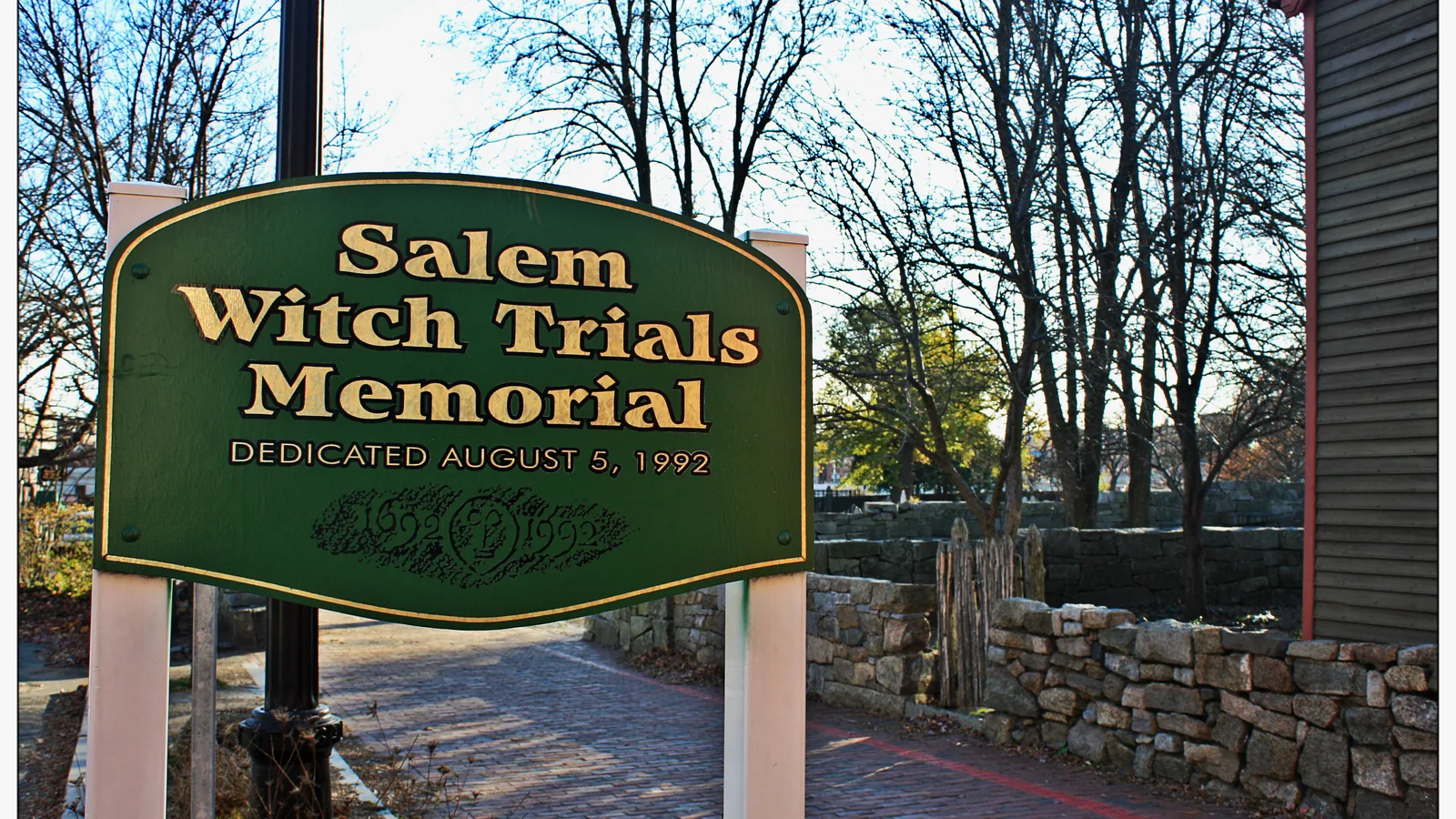
,_Essex_Street_and_North_Street,_Salem,_MA.jpg)
TL;DR — A 1692 warrant accused Sarah Good of witchcraft; twenty died that year; a 1711 act cleared 22 names but missed six executed people, and Massachusetts finished the list in 2022.
“Whereas Mrs Joseph Hutcheson Thomas putnam Edward putnam and Thomas preston Yeomen of Salem Village in the County of Essex personally appeared before us, and made Complaint on Behalfe of theire Majests against Sarah Good the wife of William Good of Salem Village aboves’d for suspition of Witchcraft,” reads the complaint dated “Salem feb’y the 29th 1691/2,” preserved by the Salem Witch Trials Documentary Archive at the University of Virginia. Massachusetts lawmakers exonerated Elizabeth Johnson Jr., convicted in 1693, on May 26, 2022, the last of the Salem convictions to be cleared.
Quick facts
- When
- February 29, 1691/2 (Sarah Good complaint) through May 26, 2022 (Elizabeth Johnson Jr. exoneration)
- Where
- Salem Village and Salem, Essex County, Massachusetts Bay; Boston (colonial legislature); Massachusetts State House (1957, 2001, 2022)
- Who
- Sarah Good; Governor William Phips; William Stoughton; Samuel Sewall; Ann Pudeator; Elizabeth Johnson Jr.; State Senator Diana DiZoglio
- Outcome
- Twenty people died in 1692; a 1711 act reversed 22 convictions but omitted six of the executed; Massachusetts added one name in 1957, five more in 2001, and Elizabeth Johnson Jr. in 2022
Sarah Good's examination, March 1692
The complaint named four accusers, Joseph Hutchinson, Thomas Putnam, Edward Putnam and Thomas Preston, and four people said to be harmed: Elizabeth Parris, Abigail Williams, Ann Putnam and Elizabeth Hubbard. At her examination that March, the archive’s transcript records: “Sarah Good upon Examination denyed the matter of fact (viz) that she ever used any witchcraft; or hurt the abovesaid Children or any of them, The above named Children being all present positively accused her of hurting of them.” The case against her moved to a special court that spring.
The Court of Oyer and Terminer opens, June 2, 1692
A mittimus in the archive, issued in the name of William Stoughton, ordered Sarah Good, Rebecca Nurse, John Willard, John and Elizabeth Proctor, Susannah Martin, Bridget Bishop, Alice Parker and Tituba brought “before our Justices of our Court of Oyer & Terminer to be held at salem on thursday the second day of June next.” On June 2, 1692, Thomas Newton, appointed to act as attorney general, and Stephen Sewall, appointed clerk, took their oaths “in open Court before me Wm. Stoughton,” the archive’s record of that day states. The court held sessions through September. Bridget Bishop was executed June 10; Sarah Good, Rebecca Nurse, Susannah Martin, Elizabeth How and Sarah Wilds on July 19; George Burroughs, Martha Carrier, George Jacobs Sr., John Proctor and John Willard on August 19; Giles Corey, pressed to death, on September 16; and Martha Corey, Mary Esty, Alice Parker, Mary Parker, Ann Pudeator, Wilmott Reed, Margaret Scott and Samuel Wardwell on September 22. The Associated Press, in a report distributed by NPR, counts “twenty people from Salem and neighboring towns” killed: nineteen hanged and one man pressed to death.
Phips writes to London, October 12, 1692
Governor William Phips, in a letter the archive preserves, told the Privy Council that “the loud cries and clamours of the friends of the afflicted people” had led him to grant a commission of oyer and terminer, and that the court “convicted more than twenty persons of being guilty of witchcraft.” He wrote that on his return to Boston he “found many persons in a strange ferment of dissatisfaction,” and continued: “I have now forbidden the committing of any more that shall be accused without unavoidable necessity . . . I did before any application was made unto me about it put a stop to the proceedings of the Court and they are now stopt till their Majesties pleasure be known.” In a second letter, dated February 21, 1693, to the Earl of Nottingham, Phips wrote that “there ware at least fifty persons in prison” when he acted, and that he then permitted “a spetiall Superior Court to be held at Salem in the County of Essex on the third day of January,” with the lieutenant governor presiding. Of the fifty-two people tried there, he wrote, “all . . . were cleared saving three,” and he sent “a reprieve whereby the execucion was stopped” for those three and five others already condemned. In December 1692 the legislature passed, and Phips signed, “A Bill against Conjuration, Witchcraft and dealing with Evil and Wicked Spirits,” replacing the earlier witchcraft statute.
The 1711 act names twenty-two
“An Act to Reverse the Attainders of George Burroughs and Others For WitchCraft,” dated October 17, 1711, and preserved in the same archive, recited that George Burroughs, John Proctor, George Jacobs, John Willard, Giles Corey and his wife, Rebecca Nurse, Sarah Good and fourteen others “were severally Indicted convicted and attainted of Witchcraft, and some of them put to death, others lying still under the like Sentence.” The act declared “the several convictions Judgements and Attainders” against those twenty-two people “reversed made and declared to be null and void to all Intents.” That list did not include six people the archive’s own case files record as executed: Bridget Bishop, Susannah Martin, Alice Parker, Ann Pudeator, Wilmott Reed and Margaret Scott. On December 17, 1711, the colony ordered payments to survivors and heirs, itemized by name, totaling “Five hundred seventy eight poundes and Twelve Shillings,” to be distributed through Stephen Sewall and a legislative committee.

Samuel Sewall's diary and apology
Samuel Sewall served as a judge in the 1692 trials. The Massachusetts Historical Society’s guide to his diaries records that in 1697 he “asked pardon for his role in witchcraft trials.” The same guide quotes his diary entry of April 11, 1692, describing his examination of the accused with the marginal note “Vae, vae, vae, witchcraft,” and entries for August and September recording executions as “Doleful! Witchcraft.”
Three more acts: 1957, 2001 and 2022
In 1957 the Massachusetts legislature approved a resolve, published by the National Historical Society’s Fourscore archive from a State Library of Massachusetts document, stating that “One Ann Pudeator and certain other persons were indicted, tried, found guilty, sentenced to death and executed in the year sixteen hundred and ninety-two for ‘Witchcraft,’” and that despite “a public repentance by Judge Sewall” and a “public Fast Day proclaimed and observed,” “no other action” had been taken. The resolve declared the proceedings “shocking, and the result of a wave of popular hysterical fear,” and was “Approved August 28, 1957.” It named only Pudeator among the six omitted from 1711; the other five remained “certain other persons.” In 2001 the legislature amended that language. Chapter 122 of the Acts of 2001, preserved in a Wayback Machine capture of malegislature.gov, struck the phrase “Pudeator and certain other persons” and inserted “Ann Pudeator, Bridget Bishop, Susannah Martin, Alice Parker, Margaret Scott and Wilmot Redd.” One name was still missing. The Associated Press reported on Thursday, May 26, 2022: “Massachusetts lawmakers on Thursday formally exonerated Elizabeth Johnson Jr., clearing her name 329 years after she was convicted of witchcraft in 1693 and sentenced to death at the height of the Salem Witch Trials.” Johnson, the report noted, “never had children and thus had no descendants to act on her behalf.”
Key facts
- Sarah Good’s complaint, dated February 29, 1691/2, named four accusers and four people said to be harmed (University of Virginia archive).
- The Court of Oyer and Terminer’s officers took their oaths at Salem on June 2, 1692, before William Stoughton (University of Virginia archive).
- Twenty people died in 1692: nineteen hanged between June 10 and September 22, and Giles Corey pressed to death on September 16 (University of Virginia archive; AP/NPR).
- Phips’s letter of October 12, 1692, states he had already stopped the court’s proceedings before writing, without giving that date (University of Virginia archive).
- Phips’s letter of February 21, 1693, records that a new Superior Court cleared 49 of 52 people tried, and that he reprieved the remaining eight condemned (University of Virginia archive).
- The Massachusetts legislature’s 1711 act reversed the convictions of twenty-two people but omitted six people executed in 1692 (University of Virginia archive).
- The 1711 restitution order totaled 578 pounds, 12 shillings, distributed to survivors and heirs (University of Virginia archive).
- Massachusetts named the six omitted people across 1957 (Ann Pudeator) and 2001 (the other five), and exonerated Elizabeth Johnson Jr. on May 26, 2022 (Fourscore; Wayback capture of malegislature.gov; AP/NPR).
FAQ
Who was accused first in the Salem witch trials of 1692?
Sarah Good was named in a complaint dated February 29, 1691/2, brought by Joseph Hutchinson, Thomas Putnam, Edward Putnam and Thomas Preston, on behalf of Elizabeth Parris, Abigail Williams, Ann Putnam and Elizabeth Hubbard, according to the University of Virginia's documentary archive.
Why did the 1711 act not clear everyone executed in 1692?
The archive's copy of the act names twenty-two people, and the reason six executed people were left out is not stated in the surviving documents; Massachusetts named them separately in 1957 and 2001.
When was the last Salem witch trial conviction exonerated?
The Massachusetts legislature exonerated Elizabeth Johnson Jr. on May 26, 2022, according to the Associated Press, after an eighth-grade civics class at North Andover Middle School took up her case.
Sources
- University of Virginia, Electronic Text Center / Scholars Lab / Institute for Advanced Technology in the Humanities, "Introduction," Salem Witch Trials Documentary Archive and Transcription Project (supervised by Benjamin C. Ray, with National Endowment for the Humanities support)
- University of Virginia archive, "SWP No. 063: Sarah Good"
- University of Virginia archive, "SWP No. 164: Preparation for the Court of Oyer and Terminer (May - August 1692)" and "SWP No. 163: Two Letters of Gov. William Phips (1692-1693)"
- University of Virginia archive, "SWP No. 168: A Bill Against Conjurations, Witchcraft, and Dealing with Evil and Wicked Spirits (December 1692)"
- University of Virginia archive, "SWP No. 173: Reversal of Attainder and Restitution (1710 - 1750)"
- Massachusetts Historical Society, "Samuel Sewall Diaries, 1672-1729," Guide to the Collection
- National Historical Society, Fourscore, "Resolve Relative to the Indictment, Trial, Conviction, and Execution of Ann Pudeator and Certain Other Persons For 'Witchcraft' in the Year Sixteen Hundred and Ninety-Two" (source: Secretary of the Commonwealth, State Library of Massachusetts)
- Massachusetts General Court, "Session Law, Acts of 2001, Chapter 122," via Wayback Machine capture of malegislature.gov
- Associated Press, distributed by NPR, "After 329 years, a woman accused of being a witch in Salem has been exonerated" (May 26, 2022)
Cite this article
- APA
- Our Earth's History. (2026, September 26). Cleared in 2022: Salem's last conviction, and the court of 1692. Our Earth's History. https://ourearthshistory.com/americas/early-modern/salem-witch-trials-1692-phips-letters-1711-reversal-exonerated-2022/
- Chicago
- Our Earth's History. “Cleared in 2022: Salem's last conviction, and the court of 1692.” Our Earth's History, September 26, 2026. https://ourearthshistory.com/americas/early-modern/salem-witch-trials-1692-phips-letters-1711-reversal-exonerated-2022/.
- MLA
- “Cleared in 2022: Salem's last conviction, and the court of 1692.” Our Earth's History, 26 Sep. 2026, https://ourearthshistory.com/americas/early-modern/salem-witch-trials-1692-phips-letters-1711-reversal-exonerated-2022/.
Text licensed CC BY-NC-ND 4.0. Found an error? Tell us.