Cortés's Second Letter, 1520: four causeways and a market of 60,000

TL;DR — Cortés’s Second Letter of October 30, 1520, gave Tenochtitlan four causeways and a market of 60,000 a day; modern studies put the city near 200,000 people.
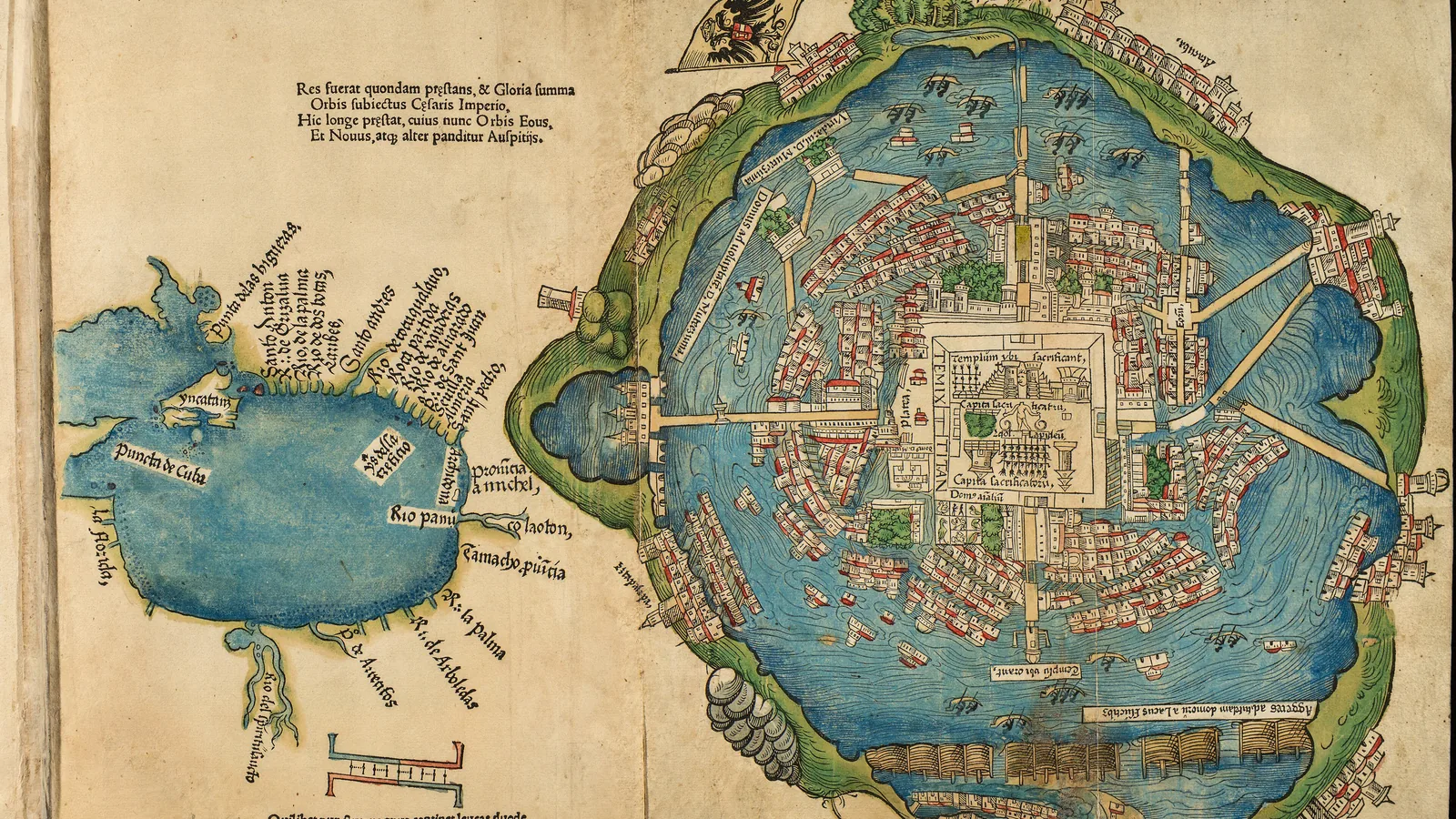
“This great city of Temixtitan is built on the salt lake,” Hernán Cortés wrote to the emperor Charles V in a letter dated at Segura de la Frontera on October 30, 1520. The Second Letter was printed in Seville by Juan Cronberger on November 8, 1522, and its 1908 translator, Francis Augustus MacNutt, called it “the first account ever written of the wonders of Mexico.” Cortés counted four artificial causeways, bridges wide enough for ten riders abreast, and one square where more than 60,000 people traded every day. He gave no figure for the people who lived there. Later chroniclers settled on 60,000 households, and MacNutt on at least 300,000 inhabitants; a 2014 study in PLOS ONE puts Tenochtitlan-Tlatelolco at about 200,000. Since 1978 Mexico’s National Institute of Anthropology and History (INAH) has been excavating the city’s sacred center.
Quick facts
- When
- November 8, 1519 (meeting of Cortés and Moctezuma, by the date on the Hospital de Jesús plaque) · October 30, 1520 (Second Letter dated at Segura de la Frontera) · November 8, 1522 (first printing, Seville) · 1978 (Templo Mayor Project begins) · October 12, 1987 (site museum opens)
- Where
- Tenochtitlan, the Mexica capital on the salt lake, now the historic center of Mexico City; the southern causeway from Iztapalapa; Segura de la Frontera
- Who
- Hernán Cortés; Moctezuma II (Motecuhzoma Xocoyotzin); the emperor Charles V; Francisco de Aguilar; Diego Durán; the translator Francis Augustus MacNutt; the archaeologists Eduardo Matos Moctezuma and Leonardo López Luján
- Outcome
- Cortés described a lake city of four causeways and a daily market of more than 60,000 people but gave no population figure; later chroniclers counted 60,000 households, and archaeological estimates put Tenochtitlan-Tlatelolco at about 200,000 people
November 8, 1519, on the southern causeway
Cortés and his men entered the island city from the south, along the causeway from Iztapalapa. Elena Mazzetto of the National Autonomous University of Mexico (UNAM) writes that a plaque on the outer wall of the Hospital de Jesús marks the spot where the first meeting of Moctezuma II and Cortés is presumed to have taken place on November 8, 1519.
In the Second Letter the meeting came just after the Spaniards crossed a bridge of long wooden beams that could be lifted out. “Having passed this bridge, we were received by that lord, Montezuma, with about two hundred chiefs, all barefooted,” Cortés wrote. When Cortés dismounted to embrace the ruler, two attending lords stopped him. He then put “a collar of pearls and glass diamonds” around Moctezuma’s neck. Later a servant brought two collars of colored shells, each hung with eight golden shrimps, and Moctezuma put them on Cortés.
Mazzetto identifies that bridge as the Xoloco bridge, near the present crossing of Calzada Chimalpopoca and San Antonio Abad. The Dominican friar Diego Durán placed the meeting elsewhere, at Tocititlan, a shrine of the earth goddess Toci near the first cross on the causeway out of the city. Mazzetto sets his account against those of the first expedition members, Cortés and the conqueror Francisco de Aguilar, finds the versions hard to reconcile, and adds that Sahagún’s Historia general places the meeting where the Hospital de Jesús was later built.
Causeways, bridges and two masonry conduits
Cortés put the city two leagues from the mainland on every side, reached by “four approaches by means of artificial causeways, two cavalry lances in width.” Tenochtitlan was, he wrote, “as large as Seville or Cordoba.” The principal streets were broad and straight. Others were half land and half water, traveled by canoe, with openings at intervals to let the water through and bridges over the openings, some so wide that “ten horsemen can ride abreast.”
He saw the risk in that design. If the inhabitants raised the bridges at the exits, he wrote, they could starve the Spaniards, so as soon as he entered the city he had four brigantines built that could carry 300 men and the horses to land.
Fresh water came in along one causeway through “two conduits of masonry each two paces broad, and five feet deep.” One carried water into the heart of the city while the other stood empty, so that either could be cleaned without cutting the supply.
"Twice as large as that of Salamanca"
The city had many market squares, Cortés wrote, and one was “twice as large as that of Salamanca, all surrounded by arcades, where there are daily more than sixty thousand souls, buying and selling.” He did not name the square. His inventory runs for pages: jewels of gold and silver, copper and zinc; adobe bricks; a street for game birds from quail to falcons; small dogs raised for eating; a street of medicinal herbs; places like barbers’ shops where heads were washed and shaved.
He also recorded how the trade was run. Each kind of goods had its own street, and “Everything is sold by a kind of measure”; the Spaniards had seen nothing sold by weight. A very large building, like a court of justice, held “ten or twelve persons, sitting as judges,” who settled market disputes, while officers walked through the crowd checking the measures, “and they have been seen to break some which were false.”
Sixty thousand households, or 200,000 people
MacNutt’s appendix of 1908 points out that Cortés “says nothing, however, about the number of inhabitants.” The earlier authorities, MacNutt wrote, “practically agree in numbering at 60,000 households”; he names Zuazo, Gómara, Motolinía, Peter Martyr and Clavigero, and reads the Anonymous Conqueror’s 60,000 people as a slip for families. From that he concluded that the population “was not less than 300,000 souls.” He added one caveat from the historian Orozco y Berra, who accepted the figures but observed that palaces and public buildings took up so much space that the people “must have been a good deal crowded.”
Modern estimates start from the ground. Between 1960 and 1975 teams from the University of Michigan and Pennsylvania State University surveyed more than 1,500 settlements across the Basin of Mexico. In 2014 Scott G. Ortman and three colleagues used them to study how settlement area scaled with population, adding the capital, which lay outside the surveyed ground, from the literature. Their paper gives Tenochtitlán-Tlatelolco “ca. 200,000 people,” against about 100,000 for Teotihuacan. Michael E. Smith, writing in the Revista Española de Antropología Americana in 2017, gives the imperial capital “more than 200,000 inhabitants” and dates the first regional demographic data for central Mexico to Sanders and colleagues in 1979.
Under the Templo Mayor since 1978
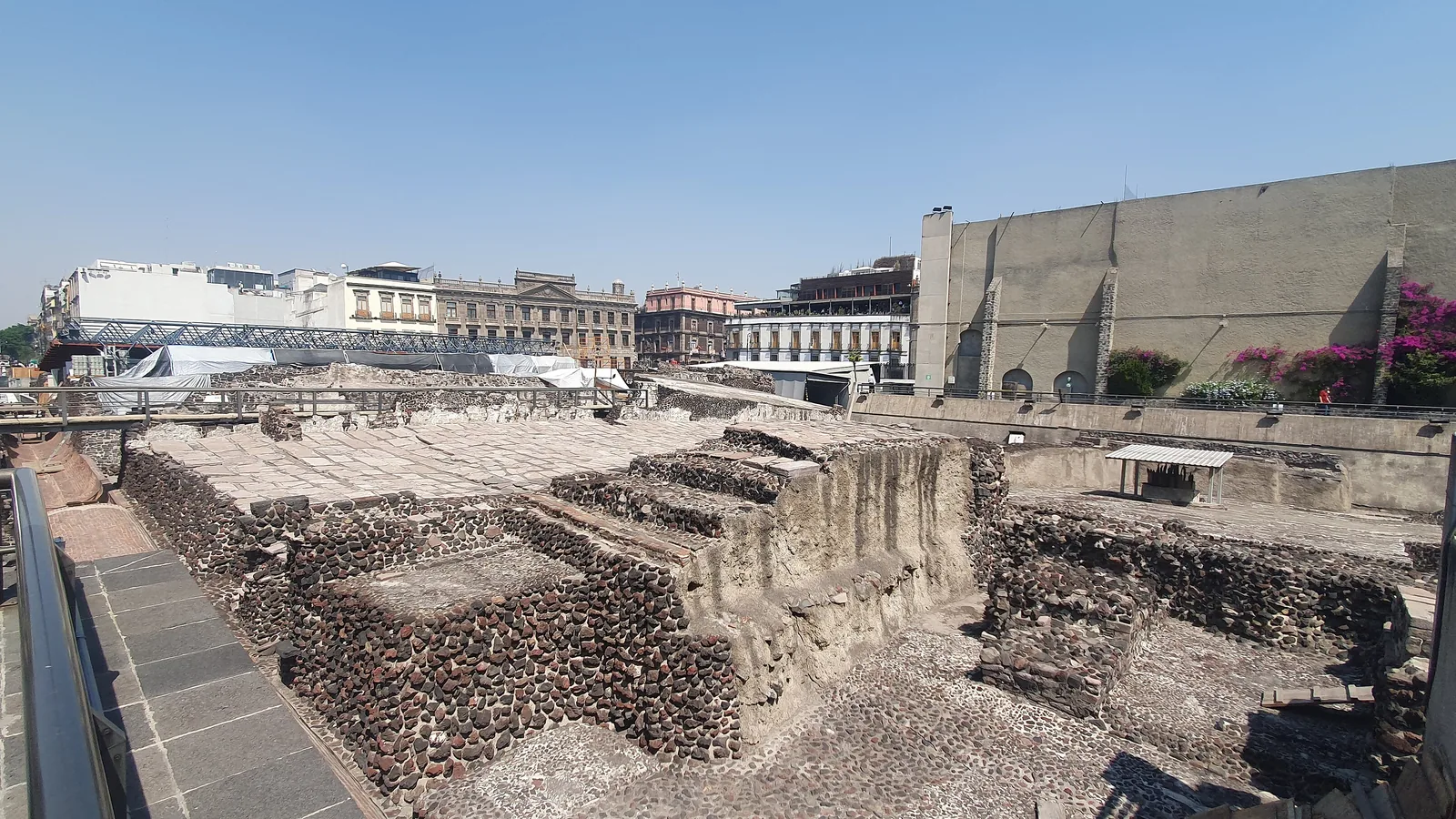
The Templo Mayor Archaeological Project began in 1978. It grew out of the find, that year, of the Coyolxauhqui monolith in the historic center, and was founded by the archaeologist Eduardo Matos Moctezuma. Leonardo López Luján, its director, led the fourth season from 1991, and by October 2024 INAH counted nine seasons.
The project began as a salvage dig because the Metropolitan Cathedral, built over pre-Hispanic ruins, was sinking, the archaeologist Adrián Velázquez Castro said at the Zócalo book fair on October 11, 2024. The dig covered seven city blocks, the area thought to have held the sacred precinct, and uncovered the Calmécac, the ball court, the Temple of Ehécatl and the Palace of Axayácatl. The Templo Mayor’s conservators, he said, look after 13,580 square meters of remains and 50,000 objects. The site museum, planned by the architect Pedro Ramírez Vázquez with museography by Miguel Ángel Fernández, opened on October 12, 1987.

Key facts
- Cortés dated the Second Letter at Segura de la Frontera on October 30, 1520; Juan Cronberger printed it in Seville on November 8, 1522 (MacNutt, 1908).
- A plaque at the Hospital de Jesús in Mexico City marks the presumed site of the first meeting of Moctezuma II and Cortés on November 8, 1519 (Mazzetto, UNAM).
- Cortés placed the meeting just past a bridge on the Iztapalapa causeway, which Mazzetto identifies as Xoloco; Diego Durán placed it at the shrine of Tocititlan.
- Cortés described four causeways “two cavalry lances in width” and a city “as large as Seville or Cordoba.”
- He described a square “twice as large as that of Salamanca” with more than 60,000 people a day, 10 or 12 market judges, and officers who broke false measures.
- Cortés gave no population figure; earlier authorities counted 60,000 households, from which MacNutt concluded at least 300,000 people.
- Ortman and colleagues (2014) give Tenochtitlán-Tlatelolco about 200,000 people; Smith (2017) gives the capital more than 200,000.
- INAH’s Templo Mayor Project began in 1978 after the Coyolxauhqui find; its site museum opened on October 12, 1987.
FAQ
How many people lived in Tenochtitlan in 1519?
Cortés gave no figure in the Second Letter. Earlier chroniclers counted 60,000 households, which MacNutt in 1908 took to mean at least 300,000 people. The PLOS ONE study of 2014 gives Tenochtitlan-Tlatelolco about 200,000, and Michael E. Smith in 2017 gives more than 200,000.
Where did Cortés and Moctezuma first meet?
On the southern causeway into Tenochtitlan. Cortés placed the meeting just after a bridge that Elena Mazzetto of UNAM identifies as Xoloco. A plaque on the Hospital de Jesús in Mexico City, a site Sahagún's history supports, gives the date November 8, 1519. Diego Durán placed the meeting at the shrine of Tocititlan, on the city's southern edge.
How big was the great market Cortés described?
Cortés wrote that the square was twice as large as the one in Salamanca, surrounded by arcades, with more than 60,000 people buying and selling there every day. Those numbers are his own; he did not name the square.
Sources
- Hernán Cortés, Letters of Cortés: The Five Letters of Relation to the Emperor Charles V, translated and edited by Francis Augustus MacNutt (New York and London: G. P. Putnam's Sons, 1908), vol. 1, full text on the Internet Archive. Editor's introduction, the Second Letter and Appendix II.
- Elena Mazzetto, "El lugar del encuentro entre Cortés y Moctezuma," Noticonquista, Instituto de Investigaciones Históricas, Universidad Nacional Autónoma de México.
- Scott G. Ortman, Andrew H. F. Cabaniss, Jennie O. Sturm and Luís M. A. Bettencourt, "The Pre-History of Urban Scaling," PLOS ONE 9(2): e87902 (2014).
- Michael E. Smith, "From Teotihuacan to Tenochtitlan. Two Trajectories of Social Change," Revista Española de Antropología Americana 47 (2017), Universidad Complutense de Madrid.
- Instituto Nacional de Antropología e Historia, "La historia y actualidad del Proyecto Templo Mayor, en libro disponible en la FIL Zócalo," bulletin 640 (October 2024).
Cite this article
- APA
- Song Letter. (2026, September 29). Cortés's Second Letter, 1520: four causeways and a market of 60,000. Our Earth's History. https://ourearthshistory.com/americas/early-modern/tenochtitlan-1519-cortes-second-letter-causeways-market/
- Chicago
- Song Letter. “Cortés's Second Letter, 1520: four causeways and a market of 60,000.” Our Earth's History, September 29, 2026. https://ourearthshistory.com/americas/early-modern/tenochtitlan-1519-cortes-second-letter-causeways-market/.
- MLA
- Song Letter. “Cortés's Second Letter, 1520: four causeways and a market of 60,000.” Our Earth's History, 29 Sep. 2026, https://ourearthshistory.com/americas/early-modern/tenochtitlan-1519-cortes-second-letter-causeways-market/.
Get the week in history
One email a week: the new articles, and what was happening elsewhere at the same moment. Free, no ads, unsubscribe any time. How we handle your email.
Text licensed CC BY-NC-ND 4.0. Found an error? Tell us.