Kongo's king writes to Lisbon, 1526: no slave trade in these kingdoms

TL;DR — In three letters of 1526, Afonso, king of Kongo, told João III that merchants took his people every day and asked that no slave trade exist in his kingdoms.
On July 6, 1526, Afonso I, king of Kongo, wrote to João III of Portugal that merchants were carrying his people out of the country every day. In the letter’s words, translated literally from the Portuguese: “the said merchants take away each day our natives, sons of the land and sons of our nobles and vassals and our relatives, because the thieves and men of bad conscience steal them.” Two more letters, of March 18 and October 18, lie with it in the Corpo Cronológico in Lisbon. Afonso asked for priests, teachers and physicians, and for no more merchants, because, as he put it, “our will is that in these kingdoms there be no trade in slaves nor any outlet for them.” No reply survives in the collection that printed the letters in 1877.
Quick facts
- When
- 1482 or 1484 (Diogo Cão at the Congo river mouth) · 1491 (royal baptisms) · 1509 (Afonso takes the throne) · March 18, July 6 and October 18, 1526 (the three letters) · January 28, 1530 (Afonso sends notes on Portuguese conduct)
- Where
- The royal city of the Kingdom of Kongo, called Banza and later San Salvador, 150 miles from the sea; the port of Sonho at the mouth of the Congo river; Lisbon
- Who
- Afonso I (Mbemba a Nzinga), king of Kongo from 1509; his father Nzinga a Nkuwu, baptized as Dom João; his son Dom Henrique, bishop of Utica; João III of Portugal; the secretary Dom João Teixeira
- Outcome
- Afonso asked for 50 priests, teachers, physicians, apothecaries, wine and flour for the mass, and that no slave trade exist in his kingdoms; he set three officers to inspect every captive before embarkation; the printed collection holds no reply from João III
A kingdom of six provinces before the ships came
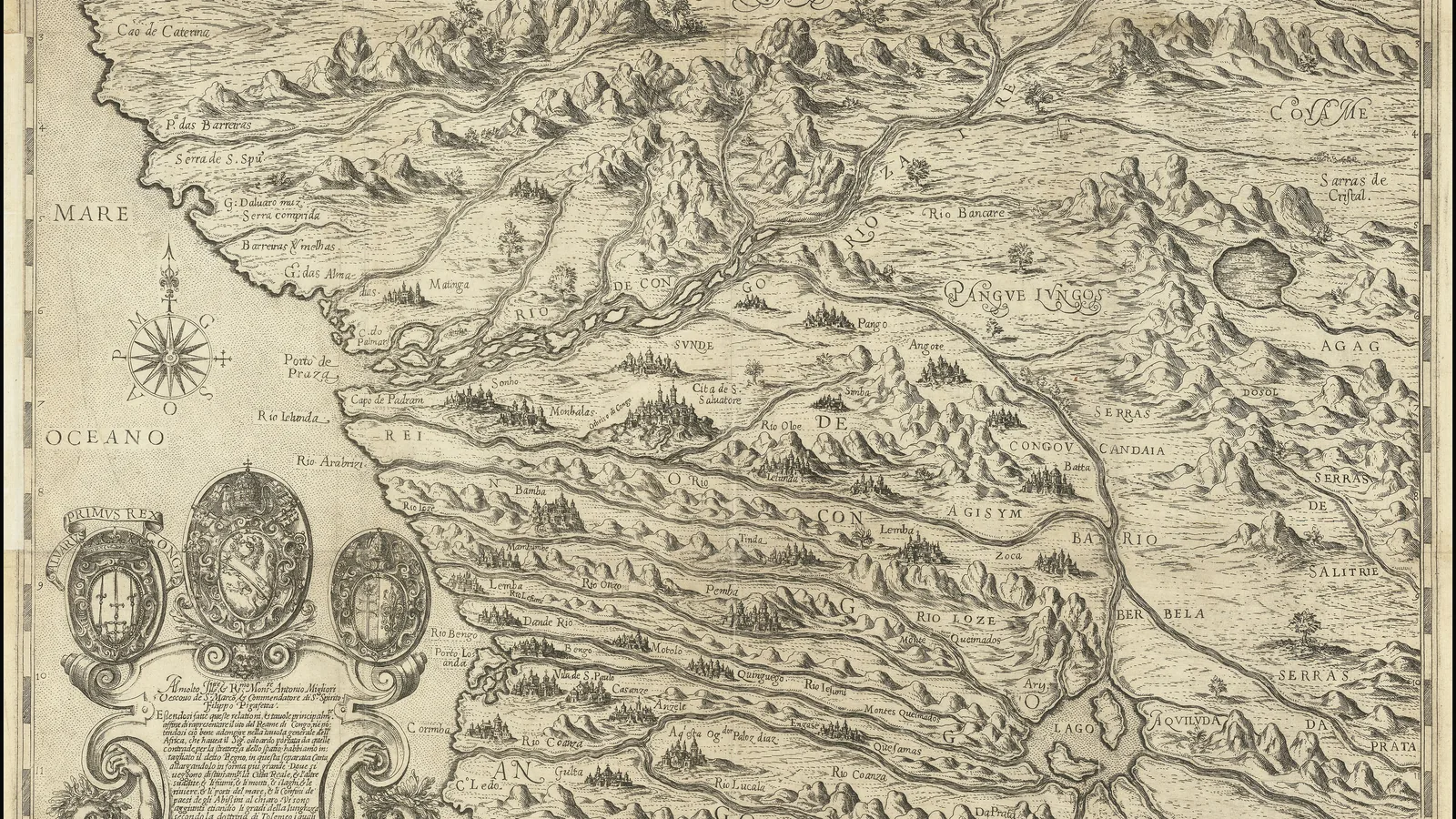
The Kingdom of Kongo, as the Portuguese traveler Duarte Lopes described it to Filippo Pigafetta in Rome in 1591, had six provinces: Bamba, Sogno, Sundi, Pango, Batta and Pemba. Its royal city stood 150 miles from the sea on a mountain of rock and was called Banza, a word Lopes glossed as “Court” and the London compiler John Ogilby, in 1670, as “Head”; under the Portuguese it became San Salvador.
Diogo Cão’s ships reached the mouth of the Congo river in 1482, by the editor E. G. Ravenstein’s reckoning in 1901, or “probably in 1484” by the 1881 editor of Pigafetta; Cavazzi wrote in 1687 “about the year 1481, or 85 as others would have it.” Cão set up a stone pillar there and carried four Kongo men to Lisbon as hostages. The king, Nzinga a Nkuwu, answered with an envoy of his own, who reached Portugal in December 1488 asking for priests and for masons and carpenters.
Baptism in 1491 and a war for the throne
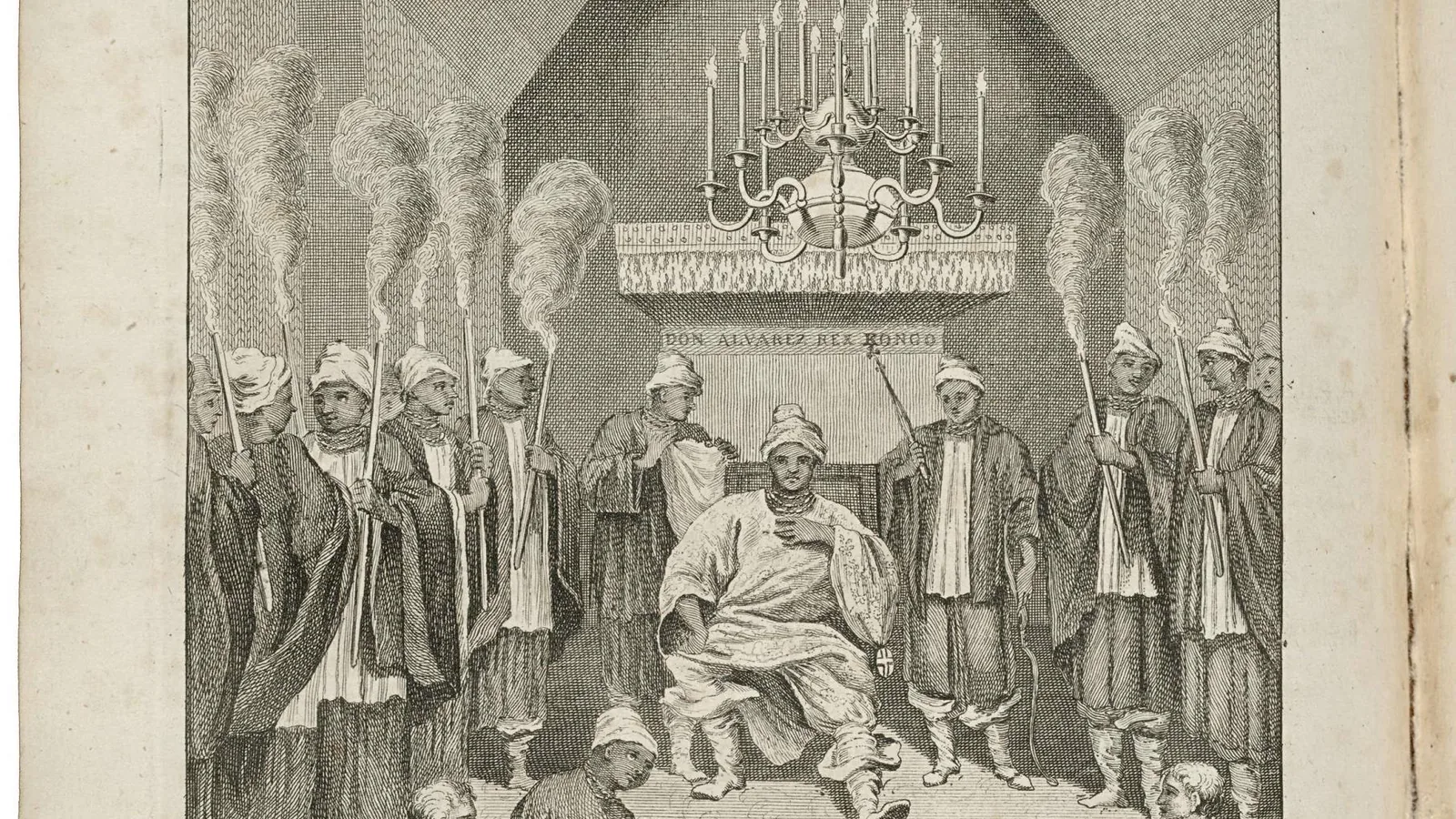
The ships with what Lopes called the provisions for baptism anchored in the Zaire in 1491. The lord of Sogno was baptized first, as Emmanuel; the king followed on May 3, by Ravenstein’s dating, and was named Dom João, his queen Leonora, after the king and queen of Portugal. The eldest son, Mbemba a Nzinga, took the name Afonso after the prince of Portugal.
When Dom João died, in 1509 by Ravenstein’s chronology, his second son Pango gathered nearly 200,000 men by Lopes’s count and marched on the royal city. Afonso held it with fewer than 10,000, about 100 of them Christians of the country, and won; Lopes credited the Virgin Mary and St. James, while Ravenstein wrote that Afonso’s own account mentions no such sign. Afonso then sent an embassy to Rome and Lisbon that included his son Henrique, who was ordained in Rome and made bishop of Utica in 1518. King Manuel sent back a mission under Simão da Silva with priests, masons, carpenters and a lawyer to explain the law books among the gifts.
Three letters in one year
The first letter, dated March 18, 1526, at “this our city of Congo,” asked for 50 priests, the first favor, Afonso wrote, that he had asked since João became king. The bishop, his beloved and esteemed son, had four priests with him, not enough to officiate one mass, and the king would not let him tour the kingdom for fear of poison. Dom João Teixeira, the secretary, wrote it out (Corpo Cronológico, part 1, bundle 33, document 121).
The letter of July 6 opened with news that a ship of the king of Portugal’s trade had reached the port of Sonho on June 26, and that the court lacked wine and flour for the mass. Then Afonso turned to the merchants whom the Portuguese factors let settle in his kingdom with shops and goods. The thieves, he wrote, stole people out of desire for that merchandise, and his land was being wholly depopulated. The letter is kept as part 1, bundle 34, document 94.
The third letter, October 18, asked for two physicians, two apothecaries and a surgeon, because the king was old and often ill. Free men and relatives of his were stolen, sold to the white men in his kingdom, brought hidden or by night, and branded with fire; when his guards found them at embarkation, the buyers said only that they had bought them and could not say from whom. Afonso therefore made a law: every white man who bought captives must show them to three officers of his court, Dom Pedro Manipanza, Dom Manuel Manissaba, his chief bailiff, and Gonçalo Pires, his chief armorer, who would judge whether each was captive or free; anyone who did otherwise forfeited them (part 1, bundle 35, document 21).
What the king asked for, and what came back
The three letters ask for the same things. In July Afonso put the need in one sentence, literally: nothing from Portugal “more than priests and a few people to teach in the schools, nor any merchandise, only wine and flour for the holy sacrament”; in October, physicians. In July he also named the limit outright: no merchants, no merchandise, no trade in slaves. In October he policed the trade with his own officers instead, writing that he allowed it for the share that fell to the king of Portugal and would otherwise not consent to it.
The 1877 collection prints no answer from João III. Afonso’s next surviving letter, dated January 28, 1530, sent a nephew to Lisbon with written notes on everything the Portuguese had done to him in his kingdom, and asked for a reply by the same bearer. Ravenstein wrote in 1901 that in 1526 the king “remonstrated against the conduct of the Portuguese slave-merchants,” and that by an inquiry of 1548 the trade had shifted south to Luanda. John Thornton and Linda Heywood of Boston University have since written on Kongo and on Central Africans in the Atlantic world. The letters of 1526 remain what a king wrote, in his secretary’s hand, about what the trade did to his kingdom.

Key facts
- Diogo Cão reached the mouth of the Congo river toward the end of 1482 (Ravenstein, 1901) or “probably in 1484” (Hutchinson’s edition of Pigafetta, 1881); Cavazzi in 1687 gave “about 1481, or 85.”
- The king Nzinga a Nkuwu was baptized as Dom João on May 3, 1491; his eldest son Mbemba a Nzinga took the name Afonso.
- Afonso took the throne in 1509 after defeating his brother Pango, who by Lopes’s count brought nearly 200,000 men against fewer than 10,000.
- Afonso’s son Henrique was ordained in Rome and made bishop of Utica in 1518 (Ravenstein).
- Letter of March 18, 1526: 50 priests requested; the bishop had four (Corpo Cronológico I-33-121).
- Letter of July 6, 1526: “our will is that in these kingdoms there be no trade in slaves nor any outlet for them” (I-34-94).
- Letter of October 18, 1526: physicians, apothecaries and a surgeon requested; three named court officers to inspect every captive before embarkation (I-35-21).
FAQ
What did Afonso I of Kongo write about the slave trade in 1526?
In his letter of July 6, 1526, he wrote that merchants took away his people every day because thieves stole them to sell, that his land was being depopulated, and that his will was that no trade in slaves exist in his kingdoms. On October 18 he wrote that he had ordered three court officers to examine every captive before embarkation.
Where are Afonso's letters kept?
The originals are in the Corpo Cronológico of Portugal's national archive in Lisbon. The Visconde de Paiva Manso printed them in full, with their shelf marks, in Historia do Congo (Documentos) in 1877.
Did the king of Portugal answer?
The 1877 collection holds no reply from João III to the three letters. Afonso wrote again on January 28, 1530, sending notes on Portuguese conduct in his kingdom and asking for an answer by the same bearer.
Sources
- Visconde de Paiva Manso (ed.), Historia do Congo (Documentos), Lisbon, Academia Real das Sciencias, 1877 — the letters of March 18, July 6 and October 18, 1526, and January 28, 1530, transcribed from the Corpo Cronológico, Arquivo Nacional (Internet Archive full text).
- Filippo Pigafetta and Duarte Lopes, A Report of the Kingdom of Congo and of the Surrounding Countries (Rome, 1591), translated by Margarite Hutchinson, London, 1881 — the six provinces, the royal city, the baptisms of 1491, the war with Pango (Internet Archive full text).
- E. G. Ravenstein (ed.), The Strange Adventures of Andrew Battell of Leigh, in Angola and the Adjoining Regions, Hakluyt Society, 1901 — Appendix II on the discovery of the Kongo, the embassy of 1490–91 and the reign of Afonso I (Internet Archive full text).
- John Ogilby, Africa, being an accurate description of the regions of Aegypt, Barbary, Lybia, and Billedulgerid, the land of Negroes, Guinee, Aethiopia, and the Abyssines, London, 1670 — the Kingdom of Congo and its head city (Internet Archive full text).
- Giovanni Antonio Cavazzi da Montecuccolo, Istorica descrizione de' tre' regni Congo, Matamba et Angola, Bologna, 1687 — Book II on Diogo Cão and on Afonso's war with his brother (Internet Archive full text).
- Boston University, African American & Black Diaspora Studies — faculty page of John Thornton (The Kingdom of Kongo, 1983; Africa and Africans in the Formation of the Atlantic World, 1992).
- Boston University, African American & Black Diaspora Studies — faculty page of Linda Heywood (Central Africans, Atlantic Creoles, and the Foundation of the Americas, with John Thornton, 2007).
Cite this article
- APA
- Our Earth's History. (2026, September 21). Kongo's king writes to Lisbon, 1526: no slave trade in these kingdoms. Our Earth's History. https://ourearthshistory.com/africa/early-modern/kongo-afonso-letters-1526-slave-trade/
- Chicago
- Our Earth's History. “Kongo's king writes to Lisbon, 1526: no slave trade in these kingdoms.” Our Earth's History, September 21, 2026. https://ourearthshistory.com/africa/early-modern/kongo-afonso-letters-1526-slave-trade/.
- MLA
- “Kongo's king writes to Lisbon, 1526: no slave trade in these kingdoms.” Our Earth's History, 21 Sep. 2026, https://ourearthshistory.com/africa/early-modern/kongo-afonso-letters-1526-slave-trade/.
Text licensed CC BY-NC-ND 4.0. Found an error? Tell us.