Kulwa in the Travels: Kilwa in 1331 and five coins in Australia
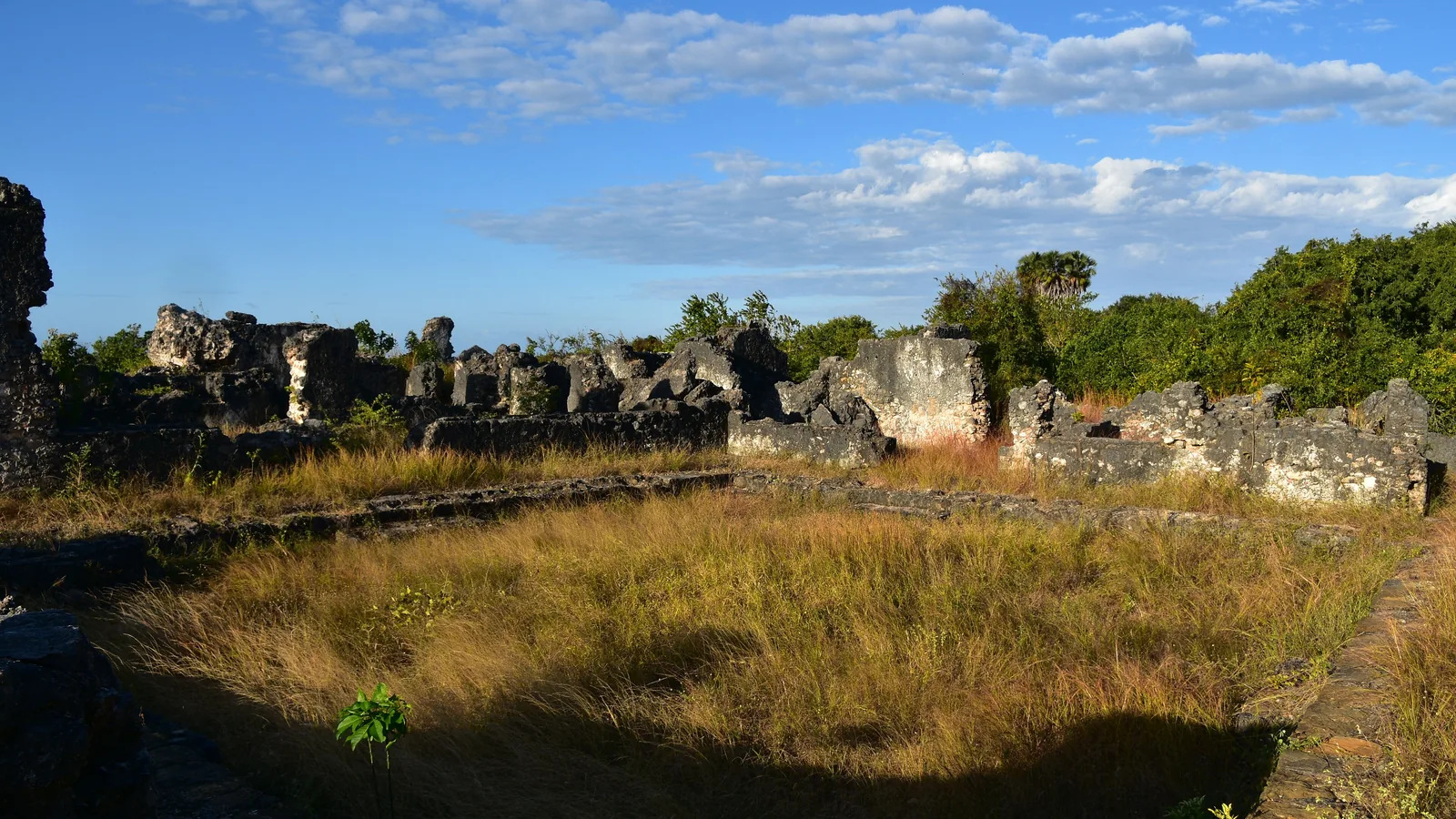
_(28453141643).jpg)
TL;DR — Ibn Battuta visited Kilwa in 1331. Excavations in the 1960s and 2016 and a 2023 DNA study date its beginnings differently, and five Kilwa coins surfaced in northern Australia.
“Kulwa is a very fine and substantially built town, and all its buildings are of wood.” So reads Ibn Battuta’s description of Kilwa Kisiwani, an island town on the southern coast of what is now Tanzania, in H. A. R. Gibb’s 1929 translation. The traveler from Tangier arrived in 1331, the year given by the archaeologists Stephanie Wynne-Jones, Mark Horton, Jeffrey Fleisher and Jesper Olsen. A trench dug in 2016 beside one of Neville Chittick’s from the 1960s produced radiocarbon dates that put the first coral buildings and coins at the end of the tenth century. Five copper coins of Kilwa’s sultans were picked up on an island beach off northern Australia during the Second World War.
Quick facts
- When
- 1331 (Ibn Battuta's visit, in the dating of Wynne-Jones, Horton, Fleisher and Olsen) · the 1960s (Neville Chittick's excavations) · 2016 (trench KK001) · March 29, 2022 (radiocarbon chronology published) · March 29, 2023 (ancient-DNA study published in Nature) · the Second World War (coins found on Marchinbar Island)
- Where
- Kilwa Kisiwani, an island town on the southern coast of what is now Tanzania; Marchinbar Island in the Wessel Islands, off Arnhem Land in northern Australia
- Who
- Ibn Battuta of Tangier; the sultan Abu'l-Muzaffar Hasan, named al-Hasan bin Sulaiman by Wynne-Jones and her co-authors, and his brother Dawud; the translator H. A. R. Gibb; the archaeologist Neville Chittick; Stephanie Wynne-Jones, Mark Horton, Jeffrey Fleisher and Jesper Olsen; the geneticist Esther S. Brielle; M. Isenberg, who found the coins
- Outcome
- Ibn Battuta's account of a generous sultan and a large town survives in Gibb's translation. A 2016 trench beside Chittick's Trench ZLL gave 21 calibrated radiocarbon dates placing the first coral buildings and coins at the end of the tenth century, while other studies give the ninth century, the 1060s and the mid-eleventh century for the town's early history. Five Kilwa copper coins found on Marchinbar Island entered the Powerhouse collection in 1985
Abu'l-Muzaffar Hasan and his brother Dawud
Ibn Battuta sailed south from Mogadishu “for the Sawahil [Swahili] country, with the object of visiting the town of Kulwa [Kilwa, Quiloa] in the land of the Zanj,” in Gibb’s text. He stopped one night at Mombasa and went on to Kulwa, “a large town on the coast.” A merchant there told him that the town of Sufala lay a fortnight’s journey away and that gold dust reached Sufala from Yufi, a month’s journey beyond it.
Gibb’s text names the ruler: “The sultan at the time of my visit was Abu’l-Muzaffar Hasan, who was noted for his gifts and generosity.” He set aside a fifth of the booty from his expeditions for pious and charitable purposes, as the Koran prescribes, and Ibn Battuta wrote that he had seen him hand the clothes off his back to a mendicant who asked for them. His brother Dawud, who succeeded him, was the opposite. To petitioners he said, “He who gave is dead, and left nothing behind him to be given,” and visitors waited months for a small gift until they stopped coming to his gate.
Wynne-Jones and her co-authors, citing G. S. P. Freeman-Grenville’s 1962 collection of documents, name him al-Hasan bin Sulaiman and write that Ibn Battuta admired the town’s architecture, wealth and Islamic piety.
Excavations of the 1960s and Trench ZLL
Chittick, the first director of the British Institute in Eastern Africa, led the digging. The institute’s digital archive at the Archaeology Data Service dates his excavations to “the 1960s and early 1970s,” and its metadata gives intervention dates of 1960 to 1979. Wynne-Jones and her co-authors write that the town was extensively excavated in the 1960s, with British Academy support.
The work concentrated on the largest stone monuments: the Great Mosque, the palace of Husuni Kubwa, dated in the same paper to the 14th century, and some of the larger houses. Chittick divided the site into seven phases by matching imported pottery, named coins and building styles against the written histories. He placed the first occupation in the ninth century without direct dating evidence. Of three charcoal samples he sent for radiocarbon dating, two were dismissed as stratigraphically impossible.
2016: a trench beside the slumped hole
In 2016 the Songo Mnara Urban Landscape Project opened a trench, KK001, four meters by four meters, immediately south of the Great Mosque. It lay against Chittick’s Trench ZLL, which had never been backfilled and had become, in the team’s words, “a massive slumped hole.”
The upper layers held coral-built structures of the 14th and 15th centuries, set over the foundations of a circular structure of porites coral blocks. As a preliminary reading, the excavators suggested it was an earlier minaret destroyed during a change of sectarian allegiance, and they noted that “the 14th-century mosques of Kilwa do not possess minarets.”
The radiocarbon results appeared in the African Archaeological Review on March 29, 2022: Horton, Olsen, Fleisher and Wynne-Jones modeled 21 calibrated dates and placed “the first coral buildings and coins at the end of the tenth century.”
"Consistent with the narrative of the Kilwa Chronicle"
Portuguese travelers first wrote down the Kilwa Chronicle, the coast’s earliest written local history. It tells of settlers from Shiraz founding seven towns, and of an Ali who bought Kilwa’s island from a local chief with cloth and converted its people to Islam. Wynne-Jones and her co-authors, following R. Pouwels’s 1984 article on the Shirazi traditions, treat these “Shirazi myths” as figurative, not as evidence of Persian settlement.
A study led by Esther S. Brielle of Harvard University, published in Nature on March 29, 2023, reported ancient DNA from 80 individuals, including two from Kilwa who lived between AD 1300 and 1600. African ancestry averaged about 74% at Kilwa. The one Kilwa man whose Y chromosome was read carried haplogroup J2, a lineage the authors call characteristic of Southwest Asia and largely absent in sub-Saharan Africans. Before about AD 1500 the Southwest Asian ancestry was mainly Persian-related, “consistent with the narrative of the Kilwa Chronicle.”
Brielle’s team also writes that coin evidence dates Ali bin al-Hasan, a ruler of the Shirazi line, to the mid-11th century, and gives AD 708 to 1219 as the 95% interval for the mixing of ancestries at Kilwa and nearby Songo Mnara. Wynne-Jones and her co-authors date the first mention of Kilwa, on a Fatimid-period map, probably to the 1060s.
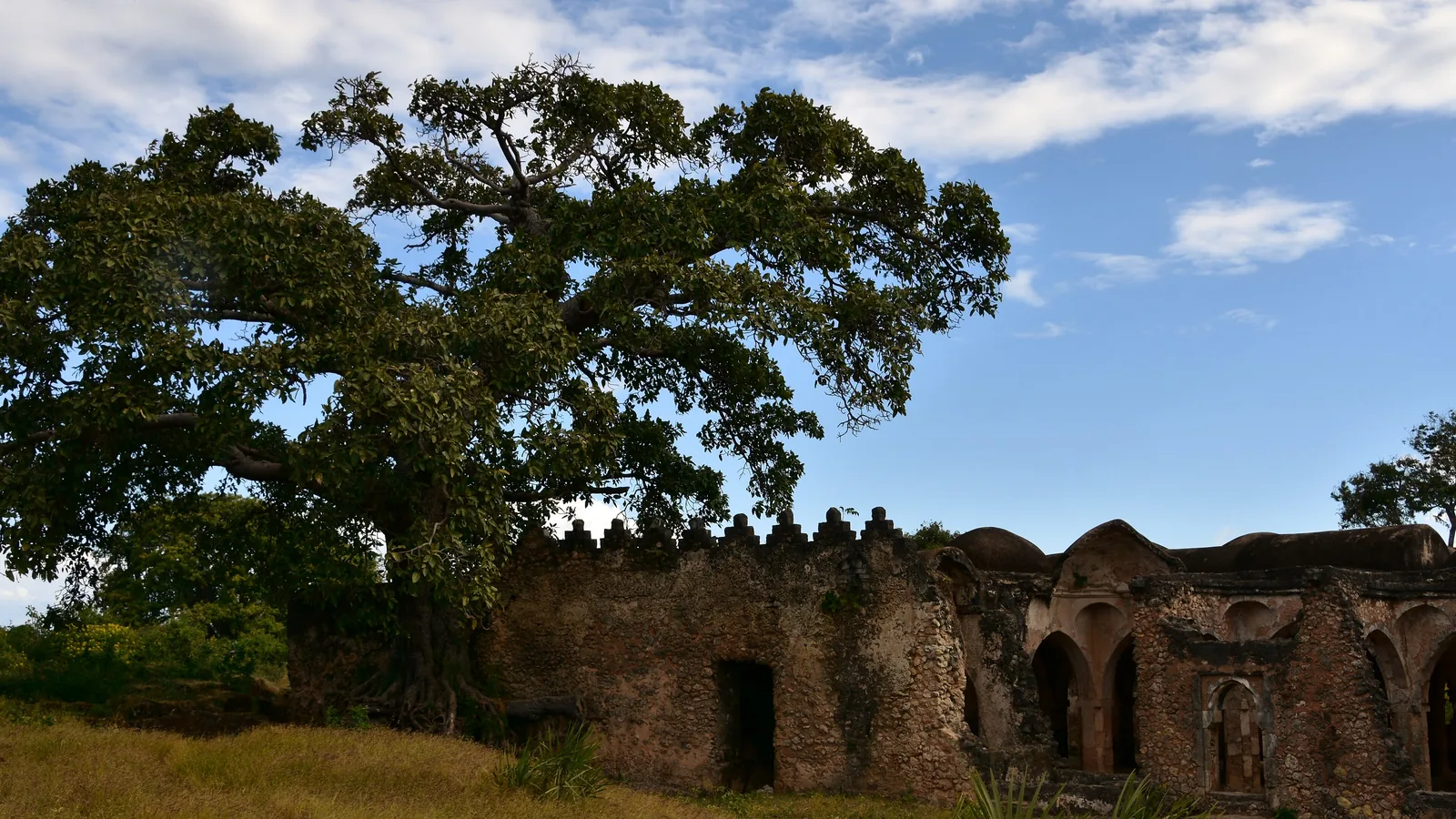
_(28963308352).jpg)
Five copper coins on Marchinbar Island
During the Second World War M. Isenberg collected nine copper coins on one stretch of beach on Marchinbar Island, in the Wessel Islands about 75 miles north of Arnhem Land. Five came from the Kilwa Sultanate: two of Sulaiman ibn al-Hasan, two of Ali ibn al-Hasan and one of al-Hasan ibn Sulaiman. The other four were Dutch doits of 1690 to 1784. The Powerhouse record suggests about AD 1294 to about 1308 for the Kilwa coins and calls its Kilwa dates “at best tentative.”
The record gives two explanations. G. S. P. Freeman-Grenville of the University of York, in a paper presented in Perth in December 1984, discussed W. J. Mira’s earlier conjecture that Malays traveling from Macassar carried the coins. A label written around 1982 by Major H. P. Boland, curator of the Sydney Mint Museum, judged it more likely that they came with Portuguese voyages of the 16th century. The label states that the Portuguese sacked Kilwa in AD 1505 and probably conscripted its sailors, and it quotes Hans Mayr, a German witness that year: “Kilwas had copper coins like our ceptis, four being equally to one real.” The coins entered the Powerhouse collection as a gift of M. Isenberg, with an acquisition date of June 18, 1985.
Key facts
- Ibn Battuta visited Kilwa in 1331, by the dating of Wynne-Jones, Horton, Fleisher and Olsen (2018); Gibb’s 1929 translation has him call it “a large town on the coast” whose buildings were “of wood.”
- He named the sultan Abu’l-Muzaffar Hasan, “noted for his gifts and generosity”; Wynne-Jones and her co-authors identify him as al-Hasan bin Sulaiman. His brother Dawud succeeded him (Gibb, via Fordham).
- Neville Chittick’s excavations are dated to “the 1960s and early 1970s” by the Archaeology Data Service archive, whose metadata gives intervention dates of 1960 to 1979.
- Chittick divided the site into seven phases and placed first occupation in the ninth century; two of his three radiocarbon samples were dismissed as stratigraphically impossible (Wynne-Jones et al., 2018).
- Trench KK001, dug in 2016 beside Chittick’s Trench ZLL, yielded 21 calibrated radiocarbon dates that place the first coral buildings and coins at the end of the tenth century (Horton et al., 2022).
- A Fatimid-period map probably of the 1060s is the first mention of Kilwa (Wynne-Jones et al., 2018).
- Brielle and her co-authors (Nature, 2023) found African ancestry averaging about 74% at Kilwa and dated the Shirazi-line ruler Ali bin al-Hasan to the mid-11th century from coin evidence.
- Five Kilwa copper coins and four Dutch doits from Marchinbar Island entered the Powerhouse collection on June 18, 1985 (Object No. N21359).
FAQ
When did Ibn Battuta visit Kilwa?
Wynne-Jones, Horton, Fleisher and Olsen give 1331. He sailed there from Mogadishu by way of Mombasa, and the sultan at the time was Abu'l-Muzaffar Hasan, whom the same authors call al-Hasan bin Sulaiman.
When was Kilwa Kisiwani founded?
No single date is agreed. Neville Chittick placed first occupation in the ninth century; a Fatimid-period map probably of the 1060s is the first written mention; Horton and his co-authors date the first coral buildings and coins to the end of the tenth century; and a 2023 Nature study dates the ruler Ali bin al-Hasan to the mid-11th century.
How did Kilwa coins reach Australia?
The Powerhouse record on the Marchinbar Island coins gives two explanations: W. J. Mira's conjecture, discussed by G. S. P. Freeman-Grenville in 1984, that Malays from Macassar carried them, and a Sydney Mint Museum label of about 1982 that judged Portuguese voyages of the 16th century more likely.
Sources
- Fordham University, Internet History Sourcebooks Project: Ibn Battuta, Travels in Asia and Africa 1325–1354, translated and edited by H. A. R. Gibb (London: Broadway House, 1929), selections.
- Stephanie Wynne-Jones, Mark Horton, Jeffrey Fleisher and Jesper Olsen, "Dating Kilwa Kisiwani: A thousand years of East African history in an urban stratigraphy," in Rubina Raja and Søren M. Sindbæk (eds.), Urban Network Evolutions: Towards a High-Definition Archaeology (Aarhus University Press, 2018), pp. 277–286. White Rose Research Online, University of York.
- Mark Horton, Jesper Olsen, Jeffrey Fleisher and Stephanie Wynne-Jones, "The Chronology of Kilwa Kisiwani, AD 800–1500," African Archaeological Review 39 (2022), pp. 143–166 (abstract).
- Esther S. Brielle, Jeffrey Fleisher, Stephanie Wynne-Jones et al., "Entwined African and Asian genetic roots of medieval peoples of the Swahili coast," Nature 615 (2023), pp. 866–873. PubMed Central.
- Powerhouse Collection, Sydney, Object No. N21359, "Collection of coins, photograph and documentation."
- Archaeology Data Service, University of York: British Institute in Eastern Africa Digital Archives, "Kilwa Kisiwani: Introduction" (doi:10.5284/1090373).
- Archaeology Data Service, University of York: British Institute in Eastern Africa Digital Archives, "Kilwa Kisiwani: Collection Metadata."
Cite this article
- APA
- Song Letter. (2026, September 29). Kulwa in the Travels: Kilwa in 1331 and five coins in Australia. Our Earth's History. https://ourearthshistory.com/africa/medieval/kilwa-kisiwani-1331-ibn-battuta-husuni-kubwa/
- Chicago
- Song Letter. “Kulwa in the Travels: Kilwa in 1331 and five coins in Australia.” Our Earth's History, September 29, 2026. https://ourearthshistory.com/africa/medieval/kilwa-kisiwani-1331-ibn-battuta-husuni-kubwa/.
- MLA
- Song Letter. “Kulwa in the Travels: Kilwa in 1331 and five coins in Australia.” Our Earth's History, 29 Sep. 2026, https://ourearthshistory.com/africa/medieval/kilwa-kisiwani-1331-ibn-battuta-husuni-kubwa/.
Get the week in history
One email a week: the new articles, and what was happening elsewhere at the same moment. Free, no ads, unsubscribe any time. How we handle your email.
Text licensed CC BY-NC-ND 4.0. Found an error? Tell us.