How much gold did Mansa Musa bring to Cairo in 1324?

TL;DR — About a ton, by one museum estimate; the 100 camels and 500 gold staffs are report, not record. Al-Umari, in Cairo 12 years after, wrote that the gold dinar lost value.
Mansa Musa of Mali reached Cairo in July 1324 with roughly a ton of gold, by the Metropolitan Museum of Art’s estimate, and his spending lowered the gold dinar’s value. He was on his way to Mecca and stayed about three months. The larger figures that travel with the story, 100 camels with 300 pounds of gold apiece and 500 slaves with gold staffs, appear in the surveys only as report, with no named chronicle behind them. The price effect rests on the chronicler Shihab al-Umari, who came to Cairo 12 years after the visit and wrote down what the city still said about it.
Quick facts
- When
- Reign about 1312–1337 · pilgrimage 1324–25 · Cairo stay from July 1324 · mosque at Timbuktu completed by 1330 · Catalan Atlas 1375
- Where
- Mali Empire (Niani, Timbuktu, the Bambuk and Bure goldfields), Cairo in Egypt, Mecca
- Who
- Mansa Musa I of Mali; the sultan of Egypt; the chronicler Shihab al-Umari; an architect-poet from al-Andalus; the mapmaker Abraham Cresques of Mallorca
- Outcome
- Gold spent in Cairo lowered the gold dinar against silver; Europe learned Mali's name through the 1375 atlas; the "richest man ever" figure has no scholarly number behind it
Where Mali's gold came from
Mali, whose capital was Niani, drew its gold from alluvial fields far to the south of the Sahara. The oldest were Bambuk, where the Falémé meets the Senegal River, and Bure on the upper Niger in what is now Guinea. Under the Mali kings the supply widened to the Black Volta and the Akan forest, in what is now Burkina Faso and Ghana. Mark Cartwright’s 2019 survey for World History Encyclopedia described the mining: shafts only a few meters deep, each yielding 2.5 to 5 grams, dug by the thousand in a single field.
The gold moved north against salt. Camel caravans carried slabs of rock salt from Idjil, Awlil and Taghaza down to the Niger, where salt was scarce, and carried gold back up. Cartwright cited an 11th-century case in which a 90-kilogram block of salt shipped by river from Timbuktu to Djenné doubled in value, to about 450 grams of gold. At the peak of the trade, by the same survey, two-thirds of the gold moving around the medieval Mediterranean came from West Africa.
The road to Cairo in 1324
Musa took the throne about 1312. Like earlier Mali rulers he was a Muslim, and in 1324 he set out for Mecca across the Sahara, arriving in Cairo in July of that year. The sultan of Egypt received him, and Cartwright recorded a first-meeting gift of 50,000 gold dinars from the visitor, who was then lodged in a palace for about three months.
The size of the caravan is where report and record part ways. Cartwright’s survey gives the figures “in some accounts”: 100 camels, each with 135 kilograms (300 pounds) of gold dust, and 500 slaves, each carrying a 2.7-kilogram (six-pound) gold staff. The BBC’s 2019 report gives a party of 60,000 men and 12,000 slaves, with the word “reportedly.” None of the surveys read for this article names the chronicle behind each number. The Met’s essay set the total lower and plainer: about a ton of gold, enough to move a market.
What al-Umari wrote about the gold and the dinar
The claim that Musa crashed Cairo’s gold price traces to Shihab al-Umari, a chronicler of the 14th century who, according to the BBC, visited Cairo 12 years after the king and recorded how the people of the city still spoke of him. Cartwright summarized the effect as a 20 percent fall in the gold dinar against the silver dirham, caused by gifts and by an entourage that shopped hard while Egyptian merchants raised their prices. Musa’s party left the city in debt, and the BBC reported a further story, attributed only to “some,” that on the way home he borrowed gold back from Cairo lenders at high interest.
How long the market stayed down is less settled. Cartwright and National Geographic both give 12 years for gold to recover its value in Egypt; the BBC gives 10. None of them attributes the span to a named source, so the recovery time is a repeated figure, not one al-Umari is known to have measured. The Met’s essay drew a different lesson: that a single ton could depress the price at all suggests the ordinary flow of West African gold to Egypt was a steady but small stream.
The return: Timbuktu and the great mosque
Musa came home about 1325 with books, scholars and at least one builder. The BBC and Cartwright both describe him as a poet and architect from al-Andalus, met in Cairo; the BBC spells his name Abu Es Haq es Saheli, Cartwright gives Ishak al-Tuedjin of Granada, and the two spellings appear to describe the same man. Both accounts report a fee of 200 kilograms (440 pounds) of gold. He designed the great mosque of Timbuktu, the Djinguereber, which Cartwright dates as complete by 1330.
UNESCO’s World Heritage record for Timbuktu confirms that the first construction of the Djingareyber, as it spells the name, dates to “Sultan Kankan Moussa, returning from a pilgrimage to Mecca,” and that the imam al-Aqib rebuilt and enlarged it between 1570 and 1583. The building is beaten earth reinforced with wood, because the region has no stone, and its central minaret, in UNESCO’s words, dominates the city.
The 1375 map and how Europe learned his name
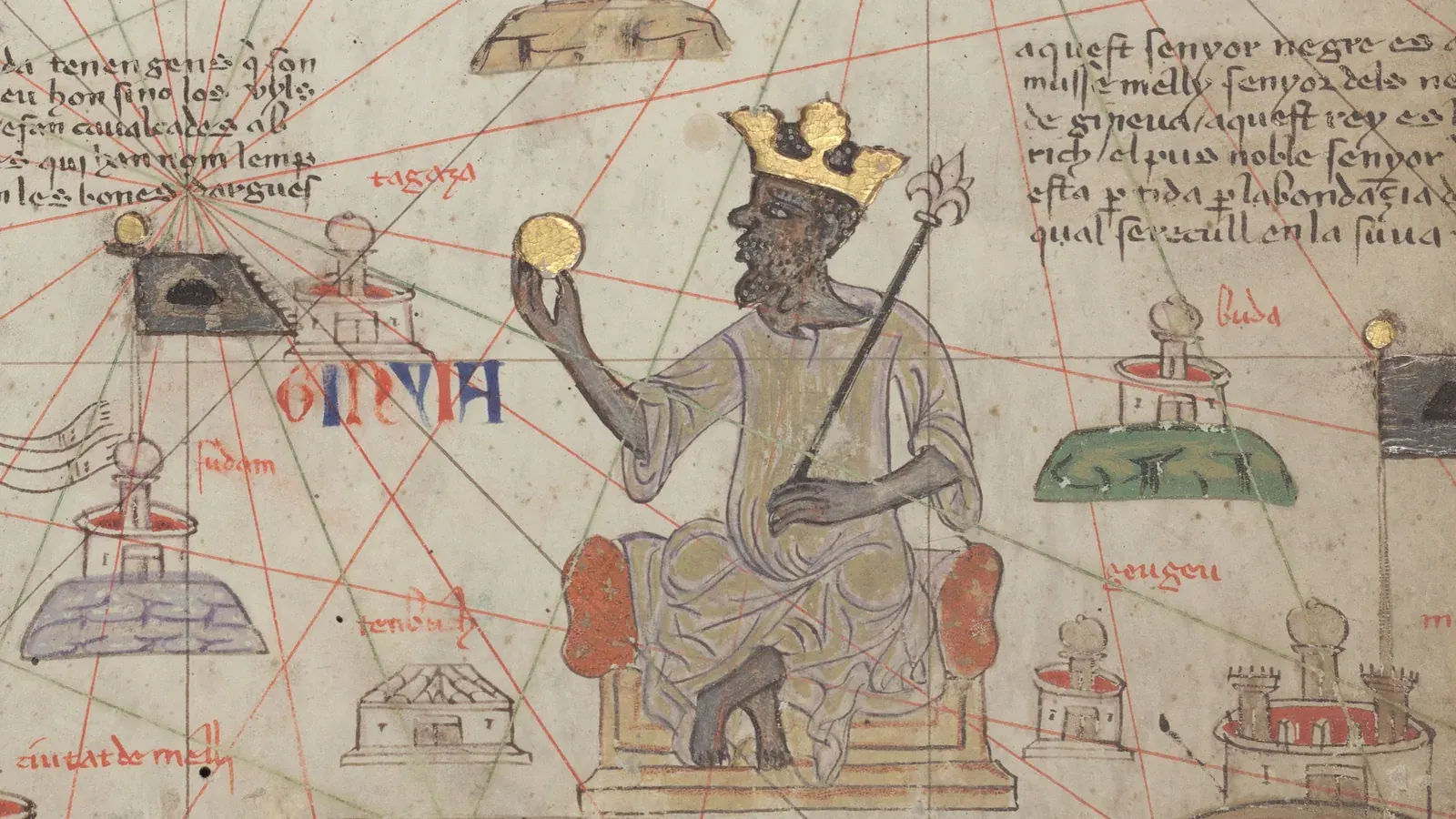
Half a century after the pilgrimage, a mapmaker in Mallorca put the king of Mali on parchment. The Block Museum at Northwestern University, which showed the sheet in reproduction in 2019, catalogs it as the Catalan Atlas of 1375 by Abraham Cresques, parchment on six wood panels, held by the Bibliothèque nationale de France; the library’s own record attributes it to Cresques with a question mark. The figure sits on a throne in West Africa, crowned, with a staff in one hand and a gold nugget in the other. The Met’s essay describes the same image as proof of how far the fame of African gold had traveled.
The richest man ever: what can and cannot be known
The BBC’s 2019 report traced the popular dollar figure for Musa’s fortune to a celebrity-finance website’s 2012 estimate and reported that economic historians consider his wealth impossible to pin down to a number. Rudolph Ware, a historian at the University of California, told the BBC: “Contemporary accounts of Musa’s wealth are so breathless that it’s almost impossible to get a sense of just how wealthy and powerful he truly was.”
What the sources do support is narrower and firmer. Mali taxed the passage of the gold that fed the medieval Mediterranean. A king from that country arrived in Cairo in July 1324 with enough gold to lower the dinar against silver, a fact written down 12 years later. The camels and the gold staffs belong to report, and the fortune belongs to no ledger at all.
Key facts
- Mansa Musa ruled the Mali Empire from about 1312 to 1337 and left for Mecca in 1324, reaching Cairo in July of that year (World History Encyclopedia).
- Mali’s gold came from the Bambuk and Bure fields and, later, the Black Volta and Akan forest; shafts a few meters deep yielded 2.5 to 5 grams each (Cartwright, 2019).
- The Metropolitan Museum of Art puts the gold he carried at about a ton; the 100-camel and 500-staff figures appear only “in some accounts.”
- Cartwright records a 20 percent fall in the gold dinar against the silver dirham in Cairo; the BBC traces the story to al-Umari, who visited 12 years later.
- Recovery time is given as 12 years by two surveys and 10 by the BBC, with no named source.
- The Djinguereber mosque at Timbuktu was built by an architect-poet from al-Andalus and finished by 1330; the imam al-Aqib rebuilt it in 1570–1583 (UNESCO).
- The Catalan Atlas of 1375, by Abraham Cresques of Mallorca, shows the king of Mali holding a gold nugget (Block Museum; Bibliothèque nationale de France).
FAQ
Did Mansa Musa really crash the price of gold in Cairo?
The chronicler al-Umari, who came to Cairo 12 years after the 1324 visit, recorded that Musa's gifts and spending lowered the value of the gold dinar. World History Encyclopedia puts the fall at 20 percent against the silver dirham. The length of the slump, 10 or 12 years depending on the source, is not attributed to any chronicle in the surveys read here.
How much gold did the caravan carry?
The Metropolitan Museum of Art estimates about a ton. The figures of 100 camels with 300 pounds each and 500 slaves with six-pound gold staffs come from later accounts and are given as report, not record, by the surveys that repeat them.
Was Mansa Musa the richest person in history?
No source from his time gives a number, and the BBC reported in 2019 that economic historians consider his wealth impossible to quantify. The dollar figures in circulation come from a 2012 website estimate, not from historians.
Sources
- World History Encyclopedia — Mark Cartwright, "Mansa Musa I" (February 26, 2019).
- World History Encyclopedia — Mark Cartwright, "The Gold Trade of Ancient & Medieval West Africa" (May 13, 2019).
- The Metropolitan Museum of Art, Heilbrunn Timeline of Art History — "The Trans-Saharan Gold Trade (7th–14th Century)" (October 2000).
- BBC News — Naima Mohamud, "Is Mansa Musa the richest man who ever lived?" (March 10, 2019).
- UNESCO World Heritage Centre — "Timbuktu," World Heritage List entry with Statement of Outstanding Universal Value.
- National Geographic Society, Education — "Mansa Musa (Musa I of Mali)," encyclopedic entry (updated October 19, 2023).
- Block Museum of Art, Northwestern University — "Caravans of Gold, Fragments in Time: Art, Culture, and Exchange across Medieval Saharan Africa," exhibition page (2019).
- Bibliothèque nationale de France, Gallica — "Abraham Cresques ? Atlas de cartes marines, dit Atlas catalan," catalog record.
Cite this article
- APA
- Our Earth's History. (2026, September 19). How much gold did Mansa Musa bring to Cairo in 1324? Our Earth's History. https://ourearthshistory.com/africa/medieval/mansa-musa-gold-cairo-1324/
- Chicago
- Our Earth's History. “How much gold did Mansa Musa bring to Cairo in 1324?” Our Earth's History, September 19, 2026. https://ourearthshistory.com/africa/medieval/mansa-musa-gold-cairo-1324/.
- MLA
- “How much gold did Mansa Musa bring to Cairo in 1324?” Our Earth's History, 19 Sep. 2026, https://ourearthshistory.com/africa/medieval/mansa-musa-gold-cairo-1324/.
Text licensed CC BY-NC-ND 4.0. Found an error? Tell us.