Four hundred men and one witness: Castanhoso in Ethiopia, 1541–1543
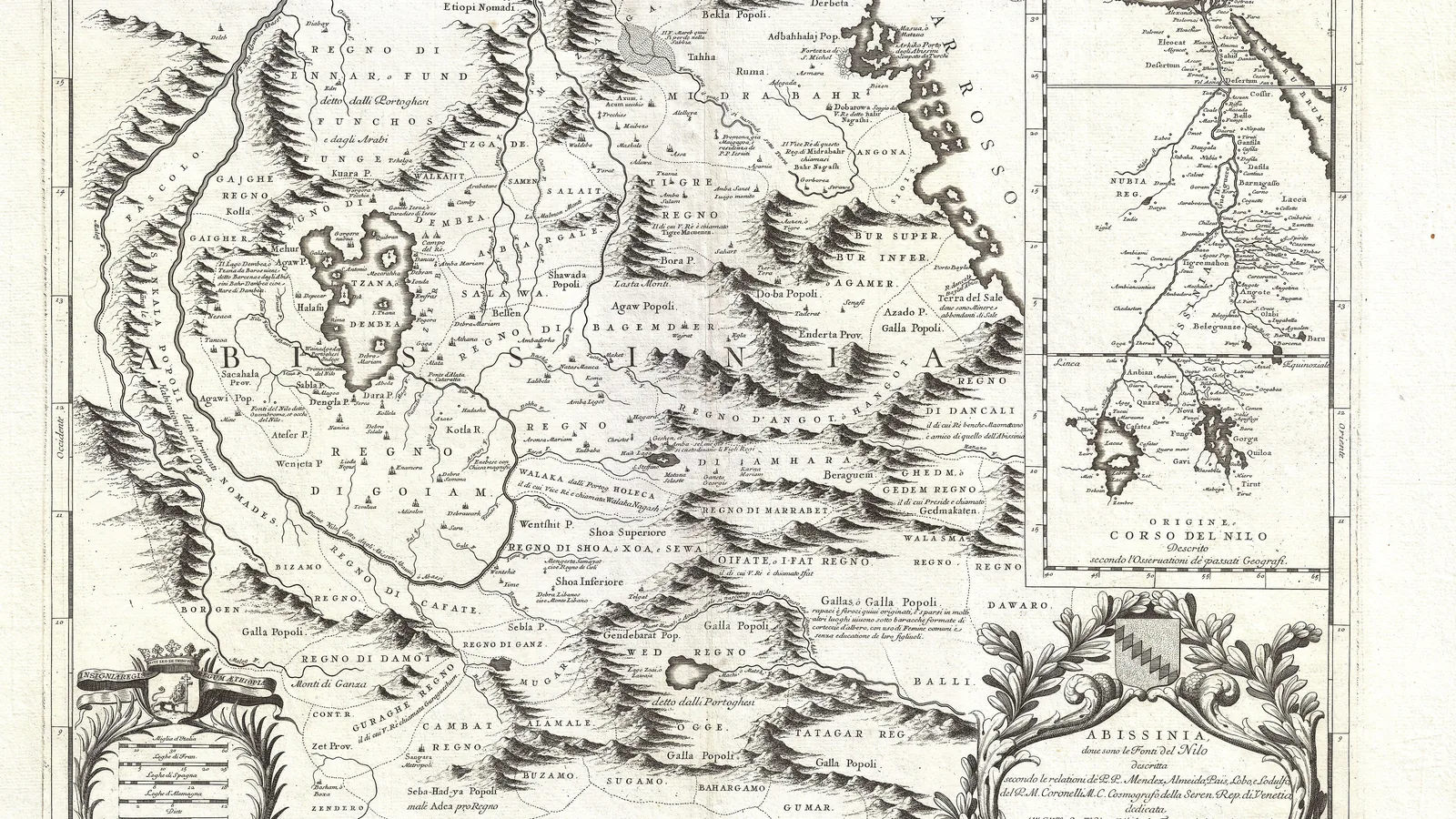

TL;DR — One eyewitness, Castanhoso, recorded the 400 Portuguese who marched into Ethiopia in July 1541, lost their captain at Wofla in 1542 and saw Imam Ahmad shot in 1543.
When Cristóvão da Gama mustered his men in Ethiopia in 1541, “it was not found that there were more than four hundred men, very well armed, and among them over six hundred matchlocks.” The count is Miguel de Castanhoso’s, who marched with them. “On Saturday, on the 9th day of July, 1541, late in the day, taking leave of the Governor and all his people, he marched with his camp, conveying artillery and munitions for the war.” The English text is R. S. Whiteway’s Hakluyt Society volume of 1902, The Portuguese Expedition to Abyssinia in 1541–1543. The battle narrative rests on that one book, which also prints the rival memoir of João Bermudez, a letter of the Ethiopian king Galawdewos and extracts from Gaspar Correa’s Lendas da Índia.
Quick facts
- When
- February 10, 1541 (Estevão da Gama's fleet at Massawa) · July 9, 1541 (Cristóvão marches inland) · April 4, 1542 (first battle) · the Sunday after Easter 1542 (second battle) · August 28, 1542 by Castanhoso, August 29 by Whiteway (Wofla; Cristóvão captured and beheaded) · February 6, 1543 (march begins) · February 21, 1543 by Whiteway's computation (Wayna Daga; Imam Ahmad shot)
- Where
- Massawa on the Red Sea; the highlands of Tigray; the plains near Antalo; Wofla, south of Lake Ashangi; Wayna Daga in Dembya, near Lake Tana
- Who
- Cristóvão da Gama, 25, son of Vasco da Gama; his brother Estevão da Gama, governor of India; the eyewitness Miguel de Castanhoso; Queen Sabla Wangel and her son Galawdewos (Asnaf Sagad); Imam Ahmad ibn Ibrahim, called Gran; João Bermudez; the editor R. S. Whiteway
- Outcome
- Two Portuguese victories in April 1542, a defeat at Wofla in August 1542 in which Cristóvão was captured and beheaded, and the death of Imam Ahmad from a matchlock ball at Wayna Daga in February 1543. Whiteway reckons about 200 Portuguese killed, 50 with Manuel da Cunha and 110 to 120 with the queen
Massawa, February to July 1541
Estevão da Gama, governor of India, brought his fleet to Massawa on the Red Sea on February 10, 1541, and there, Whiteway’s introduction records, first heard that the Ethiopian king Lebna Dengel had died, at Debra Damo on September 2, 1540. The widow, Sabla Wangel, and her son Galawdewos were still fighting Imam Ahmad ibn Ibrahim, called Gran in the Ethiopian chronicles. The plea came from the Barnaguais, the king’s governor on the coast, whose letters said his king’s lands “had been for fourteen years occupied by the Moors, and that the main of his people were in captivity.” Estevão returned from Suez on May 22 and only then gave the command to his younger brother, “moved by his great importunity,” as Castanhoso wrote. Cristóvão was 25, a son of Vasco da Gama. Correa’s count, quoted by Whiteway, was “400, less 3 men; there were 130 slaves, good men to help their masters.” Castanhoso named five captains with 50 men each, Manuel da Cunha, João da Fonseca, Inofre de Abreu, Francisco de Abreu and Francisco Velho, and Cunha and Velho went to fetch the queen.
.jpg)
Two battles near Antalo, April 1542
Cut off from supplies, Whiteway writes, the Portuguese had to fight in the open or starve. “At break of day, on Tuesday, April 4, 1542, we began to march towards the enemy.” Cristóvão was hit in the leg, and about midday Ahmad “was wounded in the thigh by a matchlock bullet, that pierced his horse, which fell dead under him.” The Ethiopian royal chronicle, as Whiteway quotes it, dates the fight to March 25, 1542.
The second battle came “when the Sunday after Easter came”; Whiteway’s table puts Easter 1542 on April 9, so the Sunday after it was April 16, a date the text never states. Ahmad “lay on a bed carried on men’s shoulders,” and his army fled. The chronicle says Gran “passed the winter at Zabl,” and David Vô Vân, in Annales d’Éthiopie in 2002, writes in a footnote: “Où Gran trouva refuge en 1542, après ses deux défaites face aux Portugais de Cristovão da Gama, en attendant les renforts turcs,” where Gran took refuge in 1542, after his two defeats by the Portuguese of Cristóvão da Gama, while waiting for Turkish reinforcements.
"One thousand Turks in advance": Wofla, August 1542
Castanhoso dates the defeat: “Wednesday, August 28th, 1542, the day of the beheadal of St. John the Baptist,” when Ahmad came out “with one thousand Turks in advance, to give us battle.” Whiteway’s footnote objects that August 28, 1542 fell on a Monday and, since a saint’s day is easier to remember than a date, decides that “the probable date of the battle is Tuesday, August 29th, 1542.”
Cristóvão, already lame, was hit by “another bullet that broke his right arm.” When the Turks entered the queen’s houses, where more than 40 wounded lay, one of them fired the powder store: “The house blew up, none escaping.” Cristóvão fled in the dark with fourteen Portuguese and was brought to Ahmad, “who with his own hand cut off his head.” Bermudez tells it differently: in his account Ahmad sent the head “as a present to the Governor of Cairo.” Whiteway printed Bermudez anyway: “if Bermudez’ narrative is so untrustworthy it need not have been translated here,” he wrote, but it had a notoriety “to which Castanhoso’s far superior work can lay no claim.”
Shrove Tuesday, February 6, 1543
Whiteway’s arithmetic: the other sources put the Portuguese loss at Wofla “at about two hundred killed,” 50 under Manuel da Cunha had gone off to Debarwa, and with 30 killed near Antalo and “some eight at Baganete” that left “about one hundred and ten or one hundred and twenty fugitives with the Queen.”
The march to avenge him began, Castanhoso wrote, “on Shrove Tuesday, February 6th, 1543,” with 8,000 foot, 500 horse “and one hundred and twenty Portuguese, some maimed, with wounds still open, who refused to stay behind.” Whiteway places the battle at Wainadega, near Lake Tana, and computes February 21, 1543 from the Ethiopian chronicle; Castanhoso gives no date. The Portuguese fired at Ahmad when he rode close: “one ball should strike him in the breast, and he fell over his saddlebow and left the press; when his followers knew that he was wounded to the death, they lost heart and took to flight.” Four Portuguese died, João Correa, Francisco Vieyra, Francisco Fialho and a Galician, whom Correa credits with the shot. The head went round on a spear. “It was first taken to the Queen, to be sent thence to the other places; and thus she was avenged by her pleasure for the sadness past.”
Galawdewos writes to Lisbon, 1550
The Muslim chronicle, the Futuh al-Habasha, offers, in René Basset’s judgment as Vô Vân quotes it in a 2001 article, “des détails précis et minutieux qu’on chercherait en vain chez les écrivains chrétiens,” precise details sought in vain among the Christian writers. In a letter of 1550 to the king of Portugal, which Whiteway printed with the warning that it “requires careful collation with the original,” Galawdewos wrote that “D. Christovao landed from the sea, and entered my country with four hundred Franks,” and of the captain: “May God pardon his soul, and place him among the martyrs. Amen.” The royal chronicle, as Whiteway translated it, says that Ahmad “fell at the third hour on a Wednesday, his forces scattered like smoke and as the ashes of a furnace,” and closes the war with a reign count under Galawdewos’s throne name: “When Gran died, Asnaf Sagad had reigned two years, five months, and twenty-two days.”
Key facts
- Estevão da Gama’s fleet reached Massawa on February 10, 1541; he sailed for Suez on February 18 and returned on May 22, and only then gave the expedition to his brother Cristóvão, aged 25 (Whiteway, introduction).
- Lebna Dengel died at Debra Damo on September 2, 1540; his widow Sabla Wangel and son Galawdewos carried on the war (Whiteway, introduction).
- Castanhoso: “it was not found that there were more than four hundred men,” with “over six hundred matchlocks”; Correa counted “400, less 3 men; there were 130 slaves” (Castanhoso chapter III; Correa, Lendas, vol. iv).
- The march inland began “on Saturday, on the 9th day of July, 1541, late in the day” (Castanhoso chapter I).
- On Tuesday, April 4, 1542, Ahmad “was wounded in the thigh by a matchlock bullet”; the second battle came on the Sunday after Easter, which fell on April 9 that year (Castanhoso chapters XIV–XV; Whiteway’s Easter table).
- Castanhoso dates Wofla “Wednesday, August 28th, 1542”; Whiteway’s footnote finds that date a Monday and gives “the probable date of the battle” as Tuesday, August 29 (chapter XVIII).
- At Wofla “one thousand Turks” led the attack, Cristóvão’s right arm was broken by a bullet, the powder store in the queen’s houses was blown up, and Ahmad “with his own hand cut off his head” (chapters XVIII–XIX).
- On February 6, 1543, 120 Portuguese marched with Galawdewos; at Wayna Daga a ball struck Ahmad “in the breast” and four Portuguese died; Whiteway computes the date as February 21 (chapters XXII–XXIII; introduction).
FAQ
How many Portuguese went to Ethiopia with Cristóvão da Gama in 1541?
Castanhoso wrote that "it was not found that there were more than four hundred men," with over 600 matchlocks among them. Correa's count, quoted by Whiteway, was 397, of whom 130 were slaves armed to help their masters.
When and where was Cristóvão da Gama killed?
At Wofla, south of Lake Ashangi, after the defeat that Castanhoso dates to Wednesday, August 28, 1542 and Whiteway to Tuesday, August 29. He was captured with a broken arm and, according to Castanhoso, beheaded by Ahmad himself.
Who killed Imam Ahmad, and when?
A matchlock ball fired by the Portuguese struck him in the breast at Wayna Daga, near Lake Tana; Correa names the marksman as João the Galician. Castanhoso gives no date; Whiteway computes February 21, 1543 from the Ethiopian chronicle, which says only that Ahmad "fell at the third hour on a Wednesday."
Sources
- R. S. Whiteway (ed. and trans.), The Portuguese Expedition to Abyssinia in 1541–1543, as Narrated by Castanhoso, Hakluyt Society, 2nd series, no. 10 (London, 1902): editor's introduction, with the chronology of 1541, the death of Lebna Dengel, the casualty arithmetic and the verdict on Bermudez (Internet Archive full text, the only online copy of the volume).
- Whiteway 1902: Castanhoso's narrative, chapters I–XV, on the march of July 9, 1541, the muster of 400 men, the fetching of the queen and the two battles of April 1542, with the editor's notes from the Ethiopian royal chronicle.
- Whiteway 1902: Castanhoso's narrative, chapters XVIII–XXIII, on the defeat at Wofla, the capture and death of Cristóvão da Gama, the march of February 6, 1543 and the death of Imam Ahmad, with the editor's notes on the date of Wofla and the chronicle's account of Wayna Daga.
- Whiteway 1902: Letters of and to the King of Abyssinia, Letter IV, the letter of 1550 from Galawdewos (Asnaf Sagad) to João III of Portugal, with the editor's note on its reliability.
- Whiteway 1902: the Short Account of João Bermudez, chapter XXIII, on the death of Cristóvão da Gama, and the editor's extracts from Gaspar Correa, Lendas da Índia, vol. iv, on the count of 397 men and the shot at Wayna Daga.
- David Vô Vân, "Grañ à Hayq : un épisode de la conquête de l'Amhara dans la mémoire du Wällo," Annales d'Éthiopie, vol. XVIII (2002), pp. 245–251, on Persée; footnote 3 on Zobel, where Gran waited for Turkish reinforcements after his two defeats of 1542.
- David Vô Vân, "À propos du ǧihâd dans le Futuh al-Habasha. De la lecture d'Alfred Morabia à la relecture d'Arab-Faqih," Annales d'Éthiopie, vol. XVII (2001), on Persée; René Basset's estimate of the Futuh al-Habasha as a source for the war.
Cite this article
- APA
- Our Earth's History. (2026, September 22). Four hundred men and one witness: Castanhoso in Ethiopia, 1541–1543. Our Earth's History. https://ourearthshistory.com/africa/early-modern/cristovao-da-gama-ethiopia-1541-1543-castanhoso-wofla-wayna-daga/
- Chicago
- Our Earth's History. “Four hundred men and one witness: Castanhoso in Ethiopia, 1541–1543.” Our Earth's History, September 22, 2026. https://ourearthshistory.com/africa/early-modern/cristovao-da-gama-ethiopia-1541-1543-castanhoso-wofla-wayna-daga/.
- MLA
- “Four hundred men and one witness: Castanhoso in Ethiopia, 1541–1543.” Our Earth's History, 22 Sep. 2026, https://ourearthshistory.com/africa/early-modern/cristovao-da-gama-ethiopia-1541-1543-castanhoso-wofla-wayna-daga/.
Text licensed CC BY-NC-ND 4.0. Found an error? Tell us.