Why did the League of Nations fail Ethiopia in 1935–36?

TL;DR — Article 16 required members to cut all trade with an aggressor. Against Italy they applied it in part, left oil and Suez open, and offered Rome part of Ethiopia.
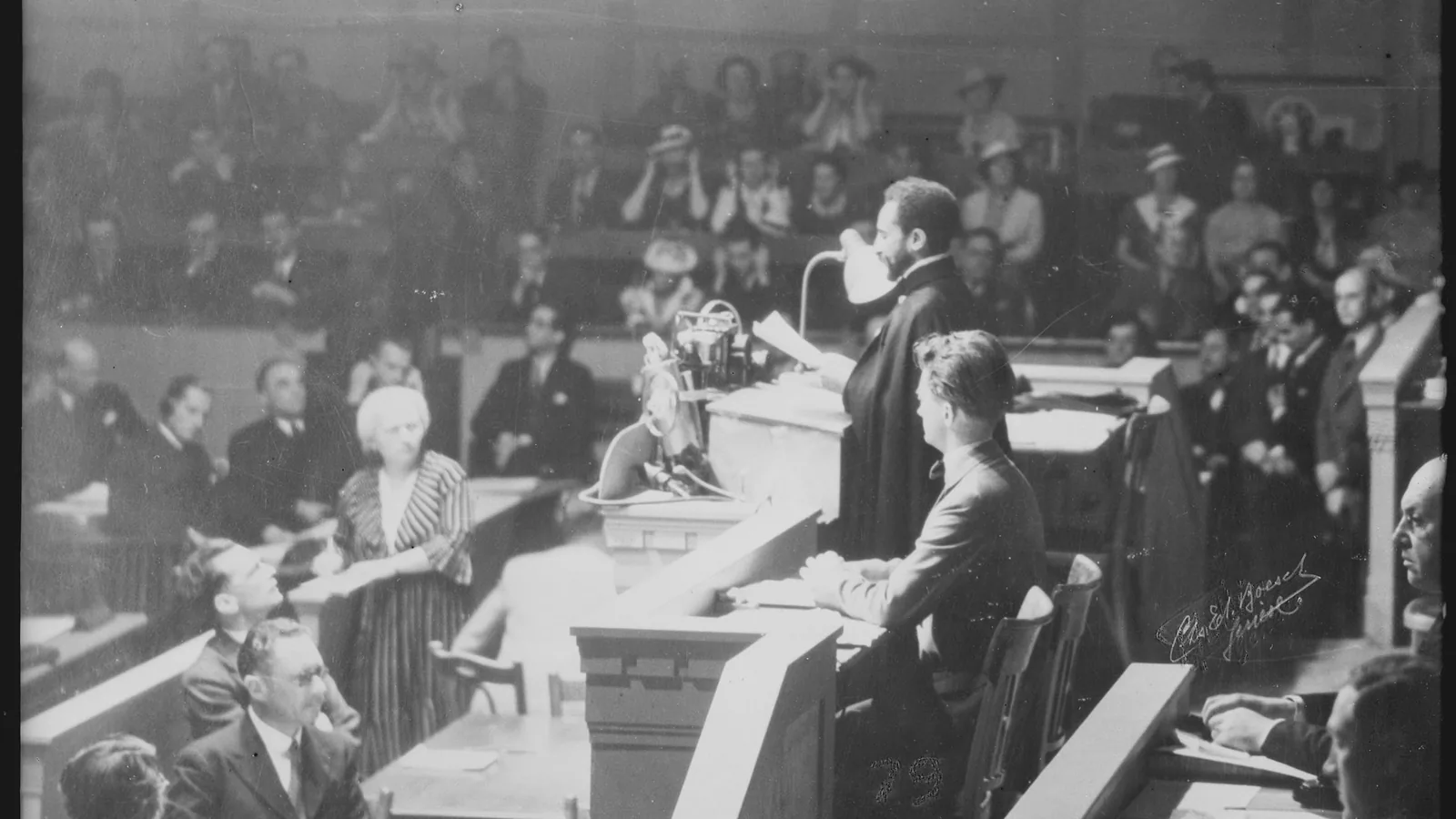
The League of Nations failed Ethiopia because its 50 sanctioning members applied Article 16 of the Covenant only in part, leaving oil and the Suez Canal open to Italy. After Italy invaded on October 3, 1935, the League named Italy the aggressor and voted sanctions, but an oil embargo was debated for months and never imposed, and the canal stayed open. In December 1935 Samuel Hoare, the British foreign secretary, and Pierre Laval of France drew up terms that would have handed Italy part of the northern province of Tigre and a zone of the south; Hoare resigned when the plan leaked. Addis Ababa fell in the first week of May 1936, and on June 30 the emperor Haile Selassie I told the Assembly in Geneva that the sanctions had been “intentionally inadequate.”
Quick facts
- When
- December 1934 (Wal Wal) · December 14, 1934 (Ethiopia's first appeal to the Council) · October 3, 1935 (Italian invasion) · December 1935 (Hoare–Laval proposals, Hoare resigned December 19) · late January 1936 (mustard gas sprayed from aircraft, by the emperor's account) · first week of May 1936 (Addis Ababa occupied) · June 30, 1936 (the emperor's speech to the Assembly) · July 1936 (sanctions lifted)
- Where
- Wal Wal in the Ogaden; Makalle in Tigre; Addis Ababa; the Suez Canal; Paris, where Hoare and Laval met; Geneva, seat of the League; the House of Commons in London
- Who
- Haile Selassie I, emperor of Ethiopia; Benito Mussolini; Samuel Hoare and Pierre Laval; Stanley Baldwin and Anthony Eden; Clement Attlee and David Lloyd George, who attacked the government in the Commons; the 50 League members that voted sanctions
- Outcome
- The League declared Italy an aggressor in October 1935 and voted partial sanctions; oil was never embargoed and the Suez Canal stayed open; Britain and France proposed ceding territory to Italy in December 1935; Italy occupied Addis Ababa in May 1936; the emperor appealed to the Assembly on June 30, 1936; sanctions ended in July 1936
The wells of Wal Wal, December 1934
The dispute began at Wal Wal, a watering place in the Ogaden, the desert of southeastern Ethiopia on the border of Italian Somaliland. An armed clash there in December 1934, the emperor told the Assembly, “came as a thunderbolt to me.” He appealed to Geneva at once, invoking a 1928 Treaty of Friendship with Italy that barred force of arms. The League’s Committee of Thirteen, which he quoted, dated Ethiopia’s first appeal to the Council to December 14, 1934, and Italy’s memorandum of complaint to September 4, 1935; in the months between, the report said, “the despatch of Italian troops to East Africa was proceeding.” The troops kept coming.
October 3, 1935, and Article 16
Italian troops crossed the frontier on October 3, 1935; the emperor decreed general mobilization “a few hours later.” Article 16 then applied. It deemed the covenant-breaking state to have “committed an act of war against all other Members,” who undertook “immediately” to cut all trade and financial relations with it, and it made the Council responsible for recommending what armed force each member should contribute. The Council and Assembly found unanimously, the emperor recalled, that Italy “had violated the Covenant and was in a state of aggression.” What the 50 members adopted in October 1935 were economic and financial measures. The clause on armed force was never used; no government was prepared to fight, Anthony Eden, the British foreign secretary, told the Commons on June 18, 1936.
What the sanctions left out: oil and Suez
The first gap was oil. Hoare, explaining his resignation to the Commons on December 19, 1935, said an oil embargo joined by non-member states “might have such an effect upon the hostilities as to force their termination,” but that Italy would treat it “as a military sanction or an act involving war against her.” That afternoon Hugh Dalton read the House a telegram from Geneva: the League’s Committee of Eighteen had “finished its meeting in 10 minutes this afternoon without mentioning an embargo on oil.” The embargo never came. David Lloyd George summed up on June 18, 1936: “We led, too, in proposing . . . oil sanctions in principle; and we also led in selling oil in practice.” Britain had led in both directions.
The second gap was the canal. The emperor’s account was that “many Governments proclaimed an embargo” on arms to Ethiopia in 1935, “whereas the Italian Government through the Suez Canal, was given all facilities for transporting . . . troops, arms, and munitions.” On May 6, 1936, the member Vyvyan Adams asked Eden whether he would seek League authority “to deny to Italian shipping access to the Suez Canal”; Eden deferred, and William Brass interjected that closing the canal “would lead to European war.” It stayed open.
Hoare and Laval's map, December 1935
Hoare went to Paris in early December 1935 and spent two days with Laval. Under the proposals he described to the Commons, Italy would keep a part of Tigre it already held, receive “a strip of Danakil and Ogaden territory,” and gain a large southern area where Italian officials “would take a predominant part in the local control”; Ethiopia would get a corridor to the sea at Assab. Clement Attlee moved that the terms “reward the declared aggressor at the expense of the victim” and called them “the surrender to an aggressor of half an Empire in exchange for a corridor for camels.” The plan leaked, and Hoare resigned on December 19. Ethiopia was one of two African states still independent after the partition whose rules the Berlin conference of 1884 to 1885 had set; the Paris terms proposed to divide it.
Gas from the air and the fall of Addis Ababa
The emperor’s testimony on gas is the center of his Geneva speech. Toward the end of 1935, he said, Italian aircraft dropped tear-gas bombs, then barrels of mustard gas. During the encirclement of Makalle the method changed: “Special sprayers were installed on board aircraft so that they could vaporize, over vast areas of territory, a fine, death-dealing rain.” From the end of January 1936, “soldiers, women, children, cattle, rivers, lakes and pastures were drenched continually with this deadly rain.” He called this a breach of the nations’ “most solemn promises” against gas, meaning the Geneva Protocol of June 17, 1925, signed by 26 states according to the International Committee of the Red Cross, whose journal later carried Rainer Baudendistel’s study of chemical warfare in this war.
By May 6, 1936, when Adams put it to Eden that Italy had broken “the Pact of Paris, the Covenant of the League and the Gas Protocol,” the capital was falling: Adams reported that Marshal Badoglio had threatened Addis Ababa “with annihilation if the advance of the Italian force is resisted.” Ethiopian authority did not vanish everywhere; on July 1 the Foreign Office told the Commons that the local authorities at Gore were still Abyssinian. Eden’s summary on June 18 was that “the Italian military campaign succeeded,” and it drew its conclusion from that.
Geneva, June 30, 1936
On June 30, 1936, the emperor told the Assembly in Geneva that he had come “to claim that justice which is due to my people, and the assistance promised to it eight months ago, when fifty nations asserted that aggression had been committed.” Of the sanctions: “At no time, and under no circumstances could sanctions that were intentionally inadequate, intentionally badly applied, stop an aggressor.” He closed with a question: “What reply shall I have to take back to my people?” The transcription used here does not contain the warning about “today” and “tomorrow” often attributed to the speech.
The reply had been given 12 days earlier. Eden had told the Commons on June 18 that the government saw “no longer any utility in continuing these measures,” since the only purpose they could serve, restoring Ethiopia, needed military action no government would take. Sanctions ended in July 1936.
What the record leaves open is whether an oil embargo or a closed canal would have worked; neither was tried. What it settles is the sequence: a Covenant that promised total economic severance, members that chose partial measures, a ministerial plan to reward the invader, and an emperor left asking Geneva for a reply.
Key facts
- Ethiopia first appealed to the League Council on December 14, 1934; Italy’s memorandum reached the Council on September 4, 1935 (Committee of Thirteen report, quoted by the emperor).
- Italy invaded on October 3, 1935; 50 League members voted economic and financial sanctions.
- Article 16 required “the severance of all trade or financial relations” with a covenant-breaking state and a Council recommendation on armed force.
- No oil embargo was imposed; the Committee of Eighteen adjourned on December 19, 1935, without discussing one (telegram read by Dalton).
- The Suez Canal stayed open to Italian shipping (the emperor’s testimony; Adams’s question of May 6, 1936).
- The Hoare–Laval terms offered Italy part of Tigre, a Danakil-Ogaden strip and a southern zone; Hoare resigned on December 19, 1935.
- The emperor testified that mustard gas was sprayed from aircraft from the end of January 1936; the Geneva Protocol had been signed by 26 states on June 17, 1925.
- Addis Ababa was in Italian occupation by early May 1936; the emperor spoke at Geneva on June 30, 1936; sanctions ended in July 1936.
FAQ
Did the League of Nations impose sanctions on Italy in 1935?
Yes. In October 1935, 50 member states voted economic and financial measures against Italy. They did not embargo oil, close the Suez Canal or recommend any use of force, and Article 16 provided for all three.
What was the Hoare–Laval plan?
Terms drawn up in Paris in December 1935 by Samuel Hoare and Pierre Laval: Italy would gain part of Tigre, a strip of Danakil and Ogaden and a southern zone of economic control; Ethiopia would get a corridor to the sea at Assab. The plan leaked and Hoare resigned on December 19, 1935.
What did Haile Selassie say at Geneva in 1936?
That the sanctions had been "intentionally inadequate, intentionally badly applied," that Italy had sprayed mustard gas from aircraft over soldiers, civilians and pastures, and that a League that refused to stop an aggressor put every small state at risk. He ended by asking what reply he should take back to his people.
Sources
- Haile Selassie I, Appeal to the League of Nations, Geneva, June 30, 1936 (Mount Holyoke College transcription, archived).
- Yale Law School, Avalon Project — The Covenant of the League of Nations, Article 16.
- UK Parliament, Historic Hansard — Sir Samuel Hoare, "Personal Explanation," HC Deb December 19, 1935, vol 307 cc2007-17.
- UK Parliament, Historic Hansard — "League of Nations and Abyssinia," HC Deb December 19, 1935, vol 307 cc2017-127 (Attlee, Baldwin, Austen Chamberlain, Dalton).
- UK Parliament, Historic Hansard — "Italy and Abyssinia," oral answers, HC Deb May 5, 1936, vol 311 c1522.
- UK Parliament, Historic Hansard — "Italy and Abyssinia," oral answers, HC Deb May 6, 1936, vol 311 cc1676-9.
- UK Parliament, Historic Hansard — "Italy and Abyssinia," oral answers, HC Deb May 7, 1936, vol 311 cc1876-7.
- UK Parliament, Historic Hansard — "Italy and Abyssinia," oral answers, HC Deb June 18, 1936, vol 313 cc1165-6.
- UK Parliament, Historic Hansard — "Class II. Foreign Office," supply debate, HC Deb June 18, 1936, vol 313 cc1197-247 (Eden, Greenwood, Lloyd George).
- UK Parliament, Historic Hansard — "League of Nations. Emperor of Abyssinia," HC Deb June 29, 1936, vol 314 c11.
- UK Parliament, Historic Hansard — "Italy and Abyssinia," oral answers, HC Deb July 1, 1936, vol 314 cc375-7.
- International Review of the Red Cross, No. 322 (March 1998) — Rainer Baudendistel, "Force versus law: The International Committee of the Red Cross and chemical warfare in the Italo-Ethiopian war 1935–1936," introduction (archived).
Cite this article
- APA
- Our Earth's History. (2026, September 20). Why did the League of Nations fail Ethiopia in 1935–36? Our Earth's History. https://ourearthshistory.com/africa/contemporary/ethiopia-1935-league-of-nations-failed/
- Chicago
- Our Earth's History. “Why did the League of Nations fail Ethiopia in 1935–36?” Our Earth's History, September 20, 2026. https://ourearthshistory.com/africa/contemporary/ethiopia-1935-league-of-nations-failed/.
- MLA
- “Why did the League of Nations fail Ethiopia in 1935–36?” Our Earth's History, 20 Sep. 2026, https://ourearthshistory.com/africa/contemporary/ethiopia-1935-league-of-nations-failed/.
Text licensed CC BY-NC-ND 4.0. Found an error? Tell us.