The water-cart communiqué: Hola Camp, March 3, 1959, and the Commons
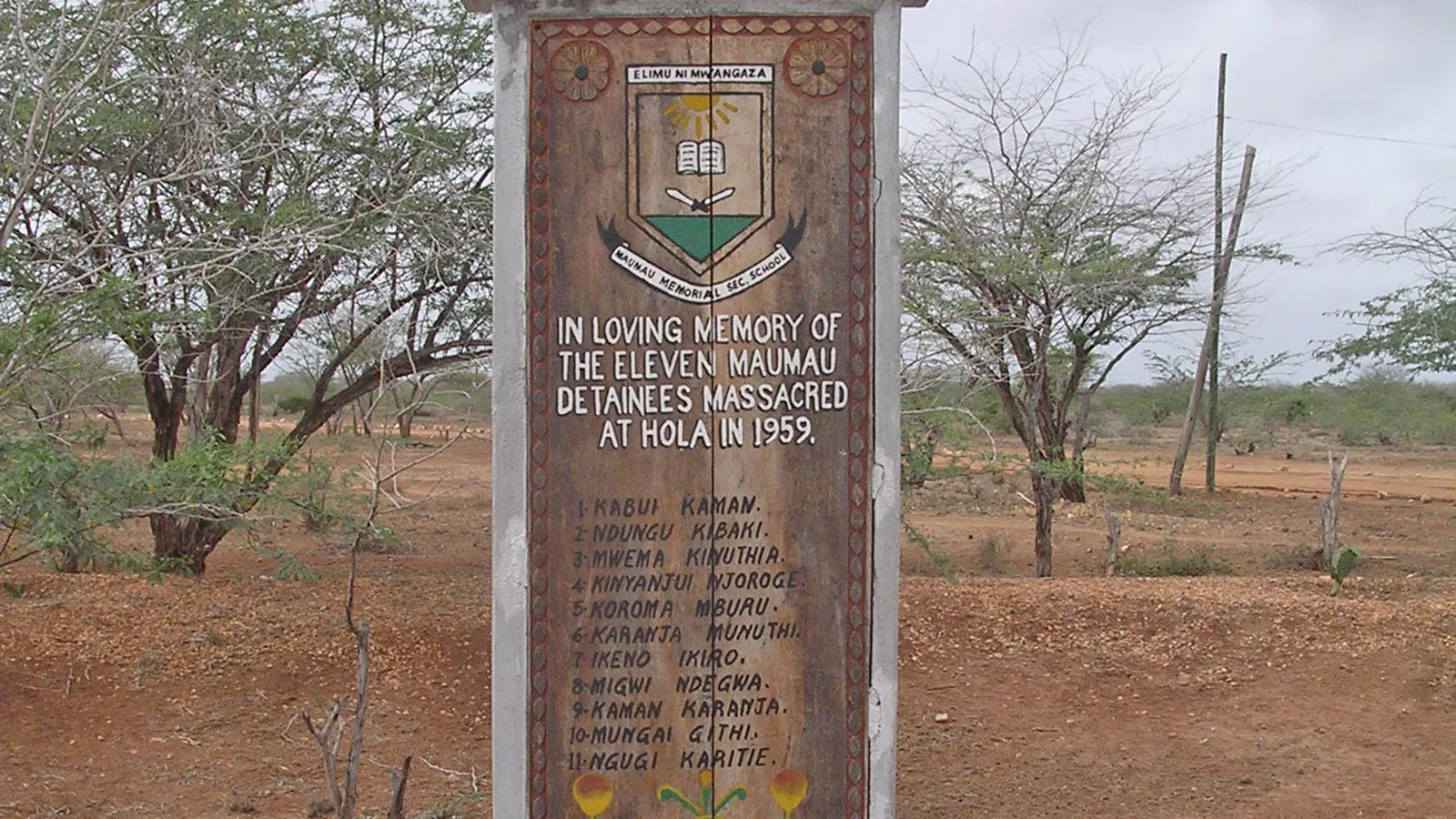

TL;DR — Eleven Mau Mau detainees died at Hola Camp, Kenya, on March 3, 1959; Nairobi blamed a water cart, the inquest found violence, and the Commons debated it twice.
“The deaths occurred after they had drunk water from a water cart which was used by all members of the working party and by their guards.” That sentence, issued in Nairobi on March 4, 1959, was read into Hansard on June 16 by Sir Frank Soskice, who moved the opposition motion on Hola Detention Camp in Kenya. He gave the count: “Ten detainees were clubbed to death and an eleventh died later from his injuries. Twenty-two others were admitted to the camp hospital suffering from more or less severe injuries.” The medical evidence, he said, put beyond doubt that the deaths “were all caused by violence.” The eleven were Mau Mau detainees at Hola, in Kenya’s Northern Coast Province, who had refused to dig an irrigation trench by the Tana River. Two Commons debates, on June 16 and July 27, and no prosecution followed; the Kenya government’s files on the case were opened at The National Archives in 2012 and 2014.
Quick facts
- When
- March 3, 1959 (deaths at Hola) · March 4 (press statement in Nairobi) · March 18 (inquest opens at Mombasa) · March 26 (first Commons answer) · June 16 (Commons debate, vol. 607) · July 27 (adjournment debate, vol. 610; Powell speaks at 1.15 a.m.) · June 6, 2013 (Hague statement) · January 22, 2014 (file FCO 141/6453 opened)
- Where
- Hola detention camp on the Tana River, Northern Coast Province, Kenya; the inquest at Mombasa; the House of Commons, London; The National Archives, Kew
- Who
- Sir Frank Soskice; Alan Lennox-Boyd, Secretary of State for the Colonies; Barbara Castle; Sir Reginald Manningham-Buller, Attorney-General; J. Enoch Powell; Mr. Goudie, the Resident Magistrate; Sullivan, camp commandant; Lewis, Commissioner of Prisons; Cowan, Senior Superintendent of Prisons; William Hague
- Outcome
- The magistrate found that all eleven deaths were caused by violence and that beating to compel work was "entirely unjustified and illegal." No prosecution followed. The Commons rejected an opposition motion by 255 votes to 314 on June 16, 1959. In 2013 the British government paid £19.9 million to 5,228 claimants for the 1952–63 Emergency while denying liability; the Kenya files on Hola were opened at The National Archives in 2012 and 2014
Two camps on the Tana, and the Cowan plan
Soskice described an open camp for detainees who cooperated and a closed camp for the men the administration called hard core, about one mile from the trench. Alan Lennox-Boyd, the Secretary of State for the Colonies, gave the figures for February 1959: 208 detainees in the closed camp; 98 in a second compound, of whom 32 were certified unfit to work and 66 had refused to work.
Sullivan, the camp commandant, took up his post on January 20, 1959. On February 7 Cowan, Senior Superintendent of Prisons in Nairobi, came to Hola to draw up a plan with him, and on February 11 he sent a written report to Lewis, the Commissioner of Prisons. It contained the sentence “should they refuse they would be manhandled to the site of work and forced to carry out the task.” Mr. Goudie, the Resident Magistrate, wrote at the inquest that any reasonable person would read those words “as a carte blanche to use whatever force might prove necessary to ensure the performance of the task.” Beating to put down violence he found justified; of beating to make men work he wrote, “The latter was entirely unjustified and illegal.”

"After they had drunk water": the communiqué and the magistrate
On March 26, 1959, Barbara Castle asked in the Commons for a statement. Lennox-Boyd said an inquest had opened at Mombasa on March 18, and to Castle’s charge that local officials had tried to cover the deaths up he answered: “Any suggestion that they tried to cover it up is very untrue.”
The Crown had argued that the press statement said “after” and not “because.” The magistrate dismissed that as “merely playing with words,” while declining to find whether the statement had been deliberately misleading. Lennox-Boyd conceded: “It was certainly a very unfortunate one, and it should not have been issued in that form.”
June 16, 1959: a motion, an amendment and no prosecution
The opposition motion asked the House to deplore deaths caused by “the use of unlawful violence” and to regret the refusal of a public inquiry. The government amendment “deeply regrets the recent death of eleven men in Hola Detention Camp and fully supports Her Majesty’s Government and the Government of Kenya in the steps both remedial and disciplinary” being taken. Lennox-Boyd was “completely satisfied that by the use of this phrase Mr. Cowan did not seek the approval of his superiors to beating the detainees to make them work.” He accepted the magistrate’s finding of scurvy and said the Fairn Inquiry would advise on rehabilitation for “the last few hundred detainees and Mau Mau convicts.”
Sir Reginald Manningham-Buller, the Attorney-General, read the decision of the Attorney-General of Kenya: “the available evidence was insufficient . . . no prosecution should be instituted.” The detainees had refused to identify warders, or even the bodies, “which had, therefore, to be identified by fingerprints.” Of the disciplinary proceedings against Sullivan and Coutts, Soskice said: “Two scapegoats are to be offered up as a sacrifice.” The House divided 255 to 314 against the motion and 314 to 255 for the amendment.
Enoch Powell at 1.15 a.m., July 27
An adjournment debate on a further white paper opened at 10.22 p.m. on July 27. J. Enoch Powell rose at 1.15 a.m. “The affair of Hola Camp was a great administrative disaster,” he said, and one of its three aspects was “the incident, which it is difficult to find a word to describe, of the water cart communiqué.” Responsibility, he said, “goes higher” than the retirement of the camp’s officer in charge or of the Commissioner of Prisons.
His central document was a minute of February 17 from the Commissioner of Prisons to the Minister of Defence: the plan “would mean the use of a certain degree of force, in which operation someone might get hurt or even killed.” Powell held Lennox-Boyd “without any jot or tittle of blame” and put the responsibility on the two Kenya ministers who had read that minute. He closed: “We cannot say, ‘We will have African standards in Africa, Asian standards in Asia and perhaps British standards here at home.’ We have not that choice to make. . . . We cannot, we dare not, in Africa of all places, fall below our own highest standards in the acceptance of responsibility.”
Migrated archives and £19.9 million, 2011 to 2014
On June 6, 2013, William Hague, the Foreign Secretary, told the Commons that claims by Kenyans detained during the Emergency of 1952 to 1963 had been settled: “payment of a settlement sum in respect of 5,228 claimants, as well as a gross costs sum, to the total value of £19.9 million.” The claims had begun in the High Court in October 2009; rulings in 2011 and 2012 let three of five cases go on. The government “sincerely regrets” the abuses, Hague said, and would “continue to deny liability.” The settlement covered the Emergency as a whole, not Hola alone, though the statement named “an important debate in this House on the infamous events at Hola Camp in 1959.”
The Kenya papers belong to series FCO 141 at The National Archives, the “migrated archives.” The series description records a Colonial Office telegram of May 3, 1961: successor governments were not to be given papers which “might embarrass Her Majesty’s Government or other governments” or “might compromise sources of intelligence information.” A review by Anthony Cary was laid before Parliament in February 2011, and the files reached the archives in 2012 and 2013. FCO 141/5651 and FCO 141/6454 were opened on November 30, 2012. FCO 141/6453, “Kenya: death of eleven detainees at Hola Camp, 3 March 1959,” was opened to readers on January 22, 2014.
Key facts
- Eleven detainees from the closed camp at Hola, Kenya, died on March 3, 1959; Soskice told the Commons that ten were clubbed to death, an eleventh died later and 22 were admitted to the camp hospital (Hansard, June 16, 1959).
- In February 1959 the closed camp held 208 detainees; 66 in the second compound had refused to work (Lennox-Boyd, June 16, 1959).
- Cowan’s report of February 11, 1959, said refusing detainees “would be manhandled to the site of work”; the magistrate called this “a carte blanche” and found beating to compel work “entirely unjustified and illegal.”
- The Nairobi press statement of March 4, 1959, said the deaths “occurred after they had drunk water from a water cart”; Lennox-Boyd called it “a very unfortunate one.”
- The inquest opened at Mombasa on March 18, 1959; the first Commons answer came on March 26 (vol. 602, cc1502–3).
- On June 16, 1959, the motion failed 255 to 314 and the amendment passed 314 to 255; the Attorney-General of Kenya had decided “no prosecution should be instituted.”
- Powell spoke at 1.15 a.m. on July 27, 1959, calling Hola “a great administrative disaster” and quoting the February 17 minute, “someone might get hurt or even killed.”
- On June 6, 2013, Hague announced £19.9 million for 5,228 claimants; FCO 141/6453 on the Hola deaths was opened on January 22, 2014.
FAQ
What did the Kenya government say caused the Hola deaths in 1959?
A press statement issued in Nairobi on March 4, 1959, said the deaths "occurred after they had drunk water from a water cart." The inquest found that all eleven deaths were caused by violence, and Lennox-Boyd told the Commons the statement "should not have been issued in that form."
Was anyone prosecuted for the Hola Camp deaths?
No. The Attorney-General of Kenya decided that "the available evidence was insufficient" and that "no prosecution should be instituted," because the surviving detainees would not identify warders or the bodies, which were identified by fingerprints. Disciplinary proceedings were to be brought against Sullivan and Coutts.
Did the 2013 Mau Mau settlement cover Hola?
The June 6, 2013 statement settled claims by 5,228 Kenyans about detention during the Emergency of 1952 to 1963 for £19.9 million, while denying liability. It referred to the Hola debate of 1959 but did not name Hola as a separate head of claim.
Sources
- UK Parliament, Historic Hansard, "Hola Irrigation Scheme Camp, Kenya," House of Commons, oral answers, March 26, 1959, vol. 602, cc1502–3 (Barbara Castle's question and Alan Lennox-Boyd's first answer on the deaths).
- UK Parliament, Historic Hansard, "Hola Detention Camp," House of Commons debate, June 16, 1959, vol. 607, cc248–384 (Sir Frank Soskice's motion and his reading of the inquest findings; Lennox-Boyd's reply; the Attorney-General on the decision not to prosecute; divisions 137 and 138).
- UK Parliament, Historic Hansard, "Hola Camp, Kenya (Report)," House of Commons adjournment debate, July 27, 1959, vol. 610, cc181–262 (J. Enoch Powell's speech at 1.15 a.m.; the minute of February 17, 1959).
- UK Government (gov.uk), Foreign & Commonwealth Office and William Hague, "Statement to Parliament on settlement of Mau Mau claims," published June 6, 2013.
- The National Archives, Discovery catalog (API), series FCO 141, "Foreign and Commonwealth Office and predecessors: Records of Former Colonial Administrations: Migrated Archives," administrative background and accruals note.
- The National Archives, Discovery catalog (API), FCO 141/6453 and FCO 141/6454, "Kenya: death of eleven detainees at Hola Camp, 3 March 1959," and FCO 141/5651, "Kenya: Mau Mau unrest; inquest on death of eleven detainees at Hola Detention Camp, 3 March 1959" (record opening dates).
- UK Government (gov.uk), Foreign & Commonwealth Office, "Cary report on release of the colonial administration files," published February 24, 2011 (publication page).
Cite this article
- APA
- Our Earth's History. (2026, September 22). The water-cart communiqué: Hola Camp, March 3, 1959, and the Commons. Our Earth's History. https://ourearthshistory.com/africa/contemporary/hola-camp-march-3-1959-water-cart-communique-powell-hansard/
- Chicago
- Our Earth's History. “The water-cart communiqué: Hola Camp, March 3, 1959, and the Commons.” Our Earth's History, September 22, 2026. https://ourearthshistory.com/africa/contemporary/hola-camp-march-3-1959-water-cart-communique-powell-hansard/.
- MLA
- “The water-cart communiqué: Hola Camp, March 3, 1959, and the Commons.” Our Earth's History, 22 Sep. 2026, https://ourearthshistory.com/africa/contemporary/hola-camp-march-3-1959-water-cart-communique-powell-hansard/.
Text licensed CC BY-NC-ND 4.0. Found an error? Tell us.