Lake Nyos, August 21, 1986: the carbon dioxide cloud and its pipes
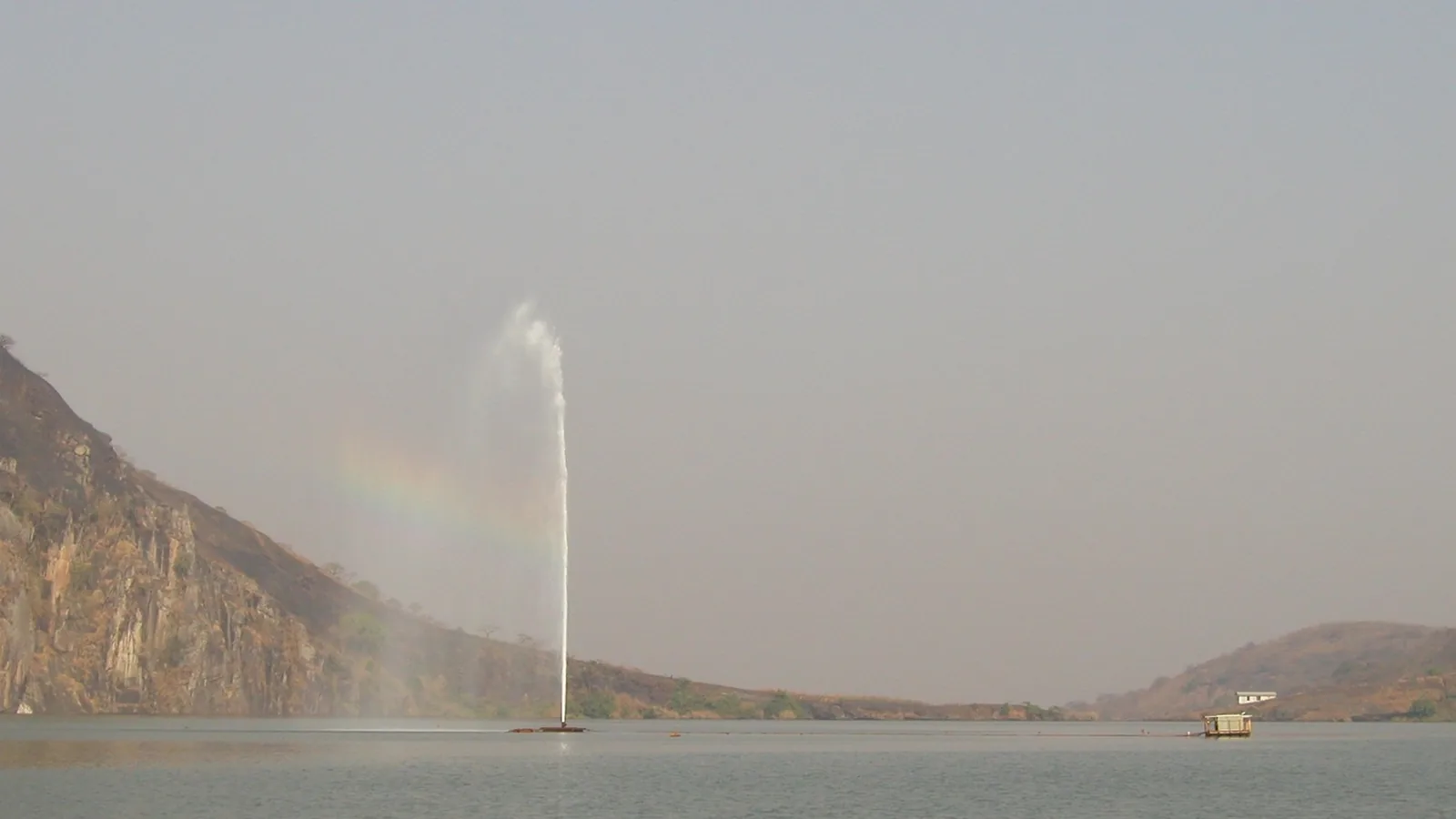

TL;DR — Lake Nyos released stored carbon dioxide on August 21, 1986, killing at least 1,700 people in Cameroon; a degassing pipe began pumping the lake in 2001.
“The sudden, catastrophic release of gas from Lake Nyos on 21 August 1986 caused the deaths of at least 1700 people in the northwest area of Cameroon, West Africa,” George W. Kling and eight co-authors wrote in Science in 1987. Chemical, isotopic, geologic, and medical evidence, they found, pointed to a lake and not to a volcano: stored carbon dioxide, not an eruption, had killed the victims. A similar gas release at nearby Lake Monoun had already killed 37 people two years earlier. Pumping to remove the gas began at Lake Nyos in 2001, and a paper published in 2021 found the lake still refilling with carbon dioxide.
Quick facts
- When
- August 21, 1986 (Lake Nyos gas release) · 1984 (Lake Monoun gas release, two years earlier) · 2001 (degassing pumping begins at Lake Nyos) · 2003 (pumping begins at Lake Monoun) · March 2016 (30th-anniversary conference in Yaounde) · July 28, 2021 (Frontiers in Earth Science paper published)
- Where
- Lake Nyos, a volcanic crater lake in northwest Cameroon; Lake Monoun, nearby in the same region
- Who
- George W. Kling and co-authors; P. J. Baxter, M. Kapila, and D. Mfonfu, University of Cambridge Clinical School; Michel Halbwachs and co-authors
- Outcome
- Kling (1987) and Baxter, Kapila, and Mfonfu (1989) counted at least 1,700 dead at Nyos; Halbwachs et al. (2004) counted 1,800 at Nyos plus 37 at Monoun; Kling et al. (2005) gave about 1,800 combining both lakes. Degassing pipes began operating at Nyos in 2001 and Monoun in 2003; a 2021 study found the lake still being resupplied with carbon dioxide
August 21, 1986: a lake, not a volcano
Kling and his co-authors set out their conclusions in the same Science paper. “Chemical, isotopic, geologic, and medical evidence support the hypotheses that (i) the bulk of gas released was carbon dioxide that had been stored in the lake’s hypolimnion, (ii) the victims exposed to the gas cloud died of carbon dioxide asphyxiation, (iii) the carbon dioxide was derived from magmatic sources, and (iv) there was no significant, direct volcanic activity involved,” they wrote. Lake Nyos sits in a volcanic crater, but the disaster came from the water column, not from a vent. “The limnological nature of the gas release suggests that hazardous lakes may be identified and monitored and that the danger of future incidents can be reduced,” the same abstract concluded.
Kling returned to the question of timing later that year in a second Science paper, “Seasonal Mixing and Catastrophic Degassing in Tropical Lakes, Cameroon, West Africa.” He wrote that the Nyos and Monoun releases were “more lacustrine than volcanic in origin” and that both happened in August, two years apart, a pattern he tied to the season when lakes in tropical Africa mix and turn over most deeply. Kling added that a longer decline in air temperature and sunlight, weakening the water layers that normally trap deep gas, “may be responsible for the timing of these events.”
Baxter, Kapila, and Mfonfu counted the survivors
P. J. Baxter, M. Kapila, and D. Mfonfu, of the Department of Community Medicine at the University of Cambridge Clinical School, Addenbrooke’s Hospital, published a medical study of the disaster in the British Medical Journal in May 1989. “Carbon dioxide was blamed for the deaths of around 1700 people in Cameroon, west Africa, in 1986 when a massive release of gas occurred from Lake Nyos, a volcanic crater lake,” they wrote. “The clinical findings in 845 survivors seen at or admitted to hospital were compatible with exposure to an asphyxiant gas.” Physicians who first examined survivors took skin lesions on 161 of them, or 19 percent, for burns caused by an acidic gas; the Cambridge team’s later review linked the lesions instead to the coma that carbon dioxide exposure produced. Baxter, Kapila, and Mfonfu also compared Nyos to the 1984 release at nearby Lake Monoun, though they wrote that the presence of other toxic factors in the two events “cannot be excluded.”
Death tolls that do not agree
Death tolls for the disaster differ by institution and by which lake is counted. Kling’s 1987 Science paper gave “at least 1700 people” for Nyos alone. Baxter, Kapila, and Mfonfu’s 1989 BMJ paper gave “around 1700 people,” also for Nyos alone. Michel Halbwachs and ten co-authors, writing in Eos, Transactions American Geophysical Union in July 2004, described “the Lake Nyos catastrophe, which claimed 1800 victims in August 1986,” and noted that two years earlier “a lethal gas burst, originating from nearby Lake Monoun in the same remote area of Cameroon, killed 37 people.” Kling returned to the count himself in a 2005 paper in the Proceedings of the National Academy of Sciences, this time combining both lakes: the 1986 and 1984 releases together, he and six co-authors wrote, “claimed the lives of ≈1,800 people by asphyxiation.” A 2021 paper in Frontiers in Earth Science, by Boehrer and co-authors, also combined the two disasters: “More than 1700 humans perished in these natural disasters.”
"The solution is to degas the lakes"
“The solution is to degas the lakes through controlled piping of gas-rich bottom water to the lake surface where the gas is released harmlessly to the atmosphere in low concentrations,” Kling and his co-authors wrote in the 2005 PNAS paper. “Once flow in a pipe is mechanically initiated, lift is provided by the buoyant rise of bubbly water and the process becomes spontaneous and self-sustaining.” Pumping began at Lake Nyos in 2001 and at Lake Monoun in 2003. Before pumping started, total gas pressure had reached 15.6 bar at Nyos in 2001 and 8.3 bar at Monoun in 2003, with gas saturation as high as 97 percent. Lake Nyos covers a maximum area of 1.58 million square meters and holds a maximum volume of 179.4 million cubic meters, the same paper stated. A model built on 12 years of measurements found that “in Nyos the single pipe will remove ≈25% of the gas remaining by 2015; this slow removal extends the present risk to local populations,” and the authors concluded that “more pipes and continued vigilance are required to reduce the risk of repeat disasters.” The paper also noted that survivors who had lived near Nyos were evacuated after the disaster and, by 2005, “already have been refugees for a generation.”
Thirty years on, a 2021 measurement
Researchers gathered in Yaounde, Cameroon, in March 2016 for a conference that a 2021 paper in Frontiers in Earth Science described as a chance “to reflect upon the work so far that dealt with managing the danger of limnic eruptions at Lake Nyos and Lake Monoun.” The same paper, by Boehrer and co-authors, measured the gas dissolved in Lake Nyos by sound speed and reported that “since 2001, the gas risk at Lake Nyos has been mitigated by induced degassing, but the lake continues to be supplied by CO2, and a regular survey needs to be implemented to guarantee safe conditions.” The paper was published on July 28, 2021.
Key facts
- Kling and eight co-authors wrote in Science in 1987 that the gas release “caused the deaths of at least 1700 people” in northwest Cameroon on August 21, 1986.
- The same paper found no significant, direct volcanic activity; the gas was carbon dioxide stored in the lake’s hypolimnion and derived from magmatic sources.
- Baxter, Kapila, and Mfonfu (BMJ, 1989) recorded 845 survivors seen at or admitted to hospital, with clinical findings compatible with an asphyxiant gas.
- Skin lesions on 161 survivors (19 percent), first taken for acid-gas burns, were later linked by the Cambridge team to comas caused by carbon dioxide.
- Halbwachs et al. (Eos, 2004) counted 1,800 victims at Nyos and 37 dead in the 1984 Lake Monoun release; Kling et al. (PNAS, 2005) gave about 1,800 combining both lakes.
- Degassing pumping began at Lake Nyos in 2001 and at Lake Monoun in 2003, using pipes that Kling et al. (2005) described as self-sustaining once started.
- Before pumping, gas pressure reached 15.6 bar at Nyos (2001) and 8.3 bar at Monoun (2003), with saturation up to 97 percent (Kling et al., 2005).
- Boehrer et al. (Frontiers in Earth Science, 2021) reported that Lake Nyos “continues to be supplied by CO2” and recommended regular surveys.
FAQ
What caused the Lake Nyos disaster of August 21, 1986?
Carbon dioxide that had built up in the lake's hypolimnion was released suddenly. Kling et al. (Science, 1987) found no significant, direct volcanic activity; the victims died of carbon dioxide asphyxiation.
How many people died at Lake Nyos?
Sources differ. Kling (1987) and Baxter, Kapila, and Mfonfu (1989) gave at least 1,700 for Nyos alone. Halbwachs et al. (2004) gave 1,800 for Nyos and 37 for Monoun. Kling et al. (2005) gave about 1,800 combining both lakes.
When did degassing of Lake Nyos begin?
Pumping to remove carbon dioxide from the lake's depths began in 2001, according to Kling et al. (PNAS, 2005). A parallel pipe at Lake Monoun began operating in 2003.
Sources
- George W. Kling et al., "The 1986 Lake Nyos Gas Disaster in Cameroon, West Africa," Science 236(4798), 1987, pp. 169-175 (abstract, via Crossref).
- George W. Kling, "Seasonal Mixing and Catastrophic Degassing in Tropical Lakes, Cameroon, West Africa," Science 237(4818), 1987, pp. 1022-1024 (abstract, via Crossref).
- P. J. Baxter, M. Kapila, and D. Mfonfu, "Lake Nyos disaster, Cameroon, 1986: the medical effects of large scale emission of carbon dioxide?", BMJ 298(6685), May 27, 1989, pp. 1437-1441.
- Michel Halbwachs et al., "Degassing the 'Killer Lakes' Nyos and Monoun, Cameroon," Eos, Transactions American Geophysical Union 85(30), July 27, 2004 (abstract, via Crossref).
- George W. Kling et al., "Degassing Lakes Nyos and Monoun: Defusing certain disaster," Proceedings of the National Academy of Sciences 102(40), 2005, pp. 14185-14190.
- B. Boehrer et al., "Carbon Dioxide in Lake Nyos, Cameroon, Estimated Quantitatively From Sound Speed Measurements," Frontiers in Earth Science 9, article 645011, July 28, 2021.
Cite this article
- APA
- LETTER. (2026, September 28). Lake Nyos, August 21, 1986: the carbon dioxide cloud and its pipes. Our Earth's History. https://ourearthshistory.com/africa/contemporary/lake-nyos-august-21-1986-cameroon-co2-limnic-eruption-degassing/
- Chicago
- LETTER. “Lake Nyos, August 21, 1986: the carbon dioxide cloud and its pipes.” Our Earth's History, September 28, 2026. https://ourearthshistory.com/africa/contemporary/lake-nyos-august-21-1986-cameroon-co2-limnic-eruption-degassing/.
- MLA
- LETTER. “Lake Nyos, August 21, 1986: the carbon dioxide cloud and its pipes.” Our Earth's History, 28 Sep. 2026, https://ourearthshistory.com/africa/contemporary/lake-nyos-august-21-1986-cameroon-co2-limnic-eruption-degassing/.
Text licensed CC BY-NC-ND 4.0. Found an error? Tell us.