Chernobyl at 01:23:40, April 26, 1986: the Unit 4 test in INSAG-7

TL;DR — The scram button at Chernobyl Unit 4 was pressed at 01:23:40 on April 26, 1986; INSAG-7 in 1992 named faulty rod design beside the operators’ errors.
At 01:23:04 on April 26, 1986, the emergency stop valves of turbogenerator No. 8 at Chernobyl Unit 4 closed and a rundown test began. The timeline printed in 1992 by the International Atomic Energy Agency’s advisory group, in a report known as INSAG-7, then runs in seconds: at 01:23:40 the emergency protection button, EPS-5, was pressed and the control rods started down into the core; at 01:23:43 “power exceeded 530 MW(th)”; at 01:23:49 the plant computer logged “Pressure increase in reactor space (rupture of a fuel channel).” The plant’s operator, Chornobyl NPP, states the test’s purpose: the safety system “stipulated the use of residual rotation energy from turbine generators being shut down to generate electric power” for the emergency cooling pumps during a total loss of power. The reactor was destroyed, two workers died that morning, and the Soviet government said nothing in public until April 28.
Quick facts
- When
- April 25–26, 1986 (test scheduled for the afternoon of April 25, run after midnight) · 01:23:04 (rundown begins) · 01:23:40 (scram button pressed) · 01:23:49 (fuel-channel rupture signal) · April 27 (Pripyat evacuated from 14:00) · April 28 (Soviet announcement) · November 30, 1986 (sarcophagus accepted) · November 29, 2016 (New Safe Confinement slid into place) · February 14, 2025 (drone strike on the confinement)
- Where
- Chernobyl nuclear power plant, Unit 4, about 3 km from the town of Pripyat, in what was then the Ukrainian SSR of the Soviet Union and is now Ukraine; Vienna (IAEA review meetings of 1986 and 1992)
- Who
- The Unit 4 operating shift; the International Nuclear Safety Advisory Group (INSAG) of the IAEA; the State Specialized Enterprise Chornobyl NPP; UNSCEAR; the World Health Organization; the European Bank for Reconstruction and Development; Kenneth Baker, British environment secretary
- Outcome
- The reactor was destroyed. Two workers died at once and 28 of 134 people with acute radiation syndrome died within months (UNSCEAR). About 116,000 people were evacuated in 1986 and 220,000 relocated later. A sarcophagus built in 206 days was covered in 2016 by a 257-meter steel arch, which a drone breached on February 14, 2025
Unit 4, turbogenerator No. 8 and a test moved past midnight
INSAG-7’s Annex I opens its account of the cause plainly: “The accident at Chernobyl Unit 4 occurred during testing of the capacity of turbogenerator No. 8 to supply power during its rundown for the unit’s internal requirements.” Chornobyl NPP records that the test was scheduled for the afternoon of April 25, 1986, at 700 MW of thermal power. It was run instead after midnight, at far lower power.
In an RBMK reactor the water in the fuel channels boiled into steam as power rose, and steam absorbed fewer neutrons than water, so more fission followed. INSAG-7 states that this void coefficient “is the dominant component of the power coefficient of reactivity of RBMK type reactors” and that “at the time of the accident, the void and power coefficients of reactivity were both positive.” The rods were the second problem. Each carried a graphite displacer below the absorber, and when a fully withdrawn rod fell on a scram signal the displacer pushed water out of the lower core and “caused a local insertion of positive reactivity in the lower part of the core.” INSAG-7 calls this the ‘positive scram’ effect.
"Most ill judged": INSAG-1 in 1986 and INSAG-7 in 1992
The IAEA’s first verdict, INSAG-1 of September 1986, followed a review meeting in Vienna on August 25–29, 1986, at which Soviet scientists presented the sequence of events with “statements of violations by operators of procedures and rules.”
Six years later the same group rewrote its conclusions. “It is not known for certain what started the power excursion that destroyed the Chernobyl reactor,” INSAG-7 states. The reactivity added by the falling rods “was probably a decisive contributory factor,” a result of “faulty design of the rods, the nature of which had been discovered at the Ignalina nuclear power plant in 1983.” On the operators the report shifts and holds at once: “Certain actions by operators that were identified in INSAG-1 as violations of rules were in fact not violations. Yet INSAG remains of the opinion that critical actions of the operators were most ill judged.” INSAG-7 “does not retract INSAG-1”; the balance of its judgment, it says, “has shifted.”
April 27 and 28, 1986: buses at 14:00 and an announcement the next day
Pripyat, a town of 49,000 people about 3 km from the reactor according to the OECD Nuclear Energy Agency, was told at 11:00 on April 27 that it would be evacuated; buses started at 14:00, and the NEA gives about two and a half hours for the town to empty. The IAEA’s Chernobyl Forum digest says its residents left “within 40 hours after the accident.” Chornobyl NPP counts about 116,000 people evacuated from 188 settlements by the end of 1986; UNSCEAR gives 115,000, and 220,000 more were resettled in later years.
Outside the Soviet Union, the NEA records, the first sign was contamination on monitored workers at a nuclear power station in Sweden. The British government’s statement to the House of Lords on April 30 gives the order of events: “the Soviet authorities announced on 28th April that there had been an accident at the nuclear reactor in Chernobyl. This was a day after radioactivity had first been monitored in Scandinavia.” The day before, Kenneth Baker, the environment secretary, had told the Commons: “A disturbing feature of this incident is the way in which knowledge of it has come not from the Soviet Government, but from monitoring in other countries.”
Twenty-eight deaths, 6,000 thyroid cancers and "up to 4000"
UNSCEAR’s 2008 report counts the early deaths in one sentence: “Two workers died in the immediate aftermath,” and high doses to 134 plant staff and emergency personnel caused acute radiation syndrome, “which proved fatal for 28 of them.” The larger number is thyroid cancer: 6,848 cases between 1991 and 2005 among people under 18 in 1986 in Belarus, Ukraine and the four most affected Russian regions, of which “by 2005, 15 cases had proved fatal.” UNSCEAR’s 2018 white paper carries the registers to 2015, with 19,233 cases, and judges the fraction attributable to radiation to be “of the order of 0.25.”
On total deaths the institutions differ in tone. The World Health Organization’s release of September 5, 2005, on the Chernobyl Forum report opened with the estimate that “up to 4000 people could eventually die of radiation exposure.” The IAEA’s digest of the same Forum states that “it is impossible to assess reliably, with any precision, numbers of fatal cancers caused by radiation exposure due to the Chernobyl accident.” The IAEA and NEA event scale rates the accident at Level 7, its top level.
Sarcophagus in 206 days, an arch in 2016, a breach in 2025
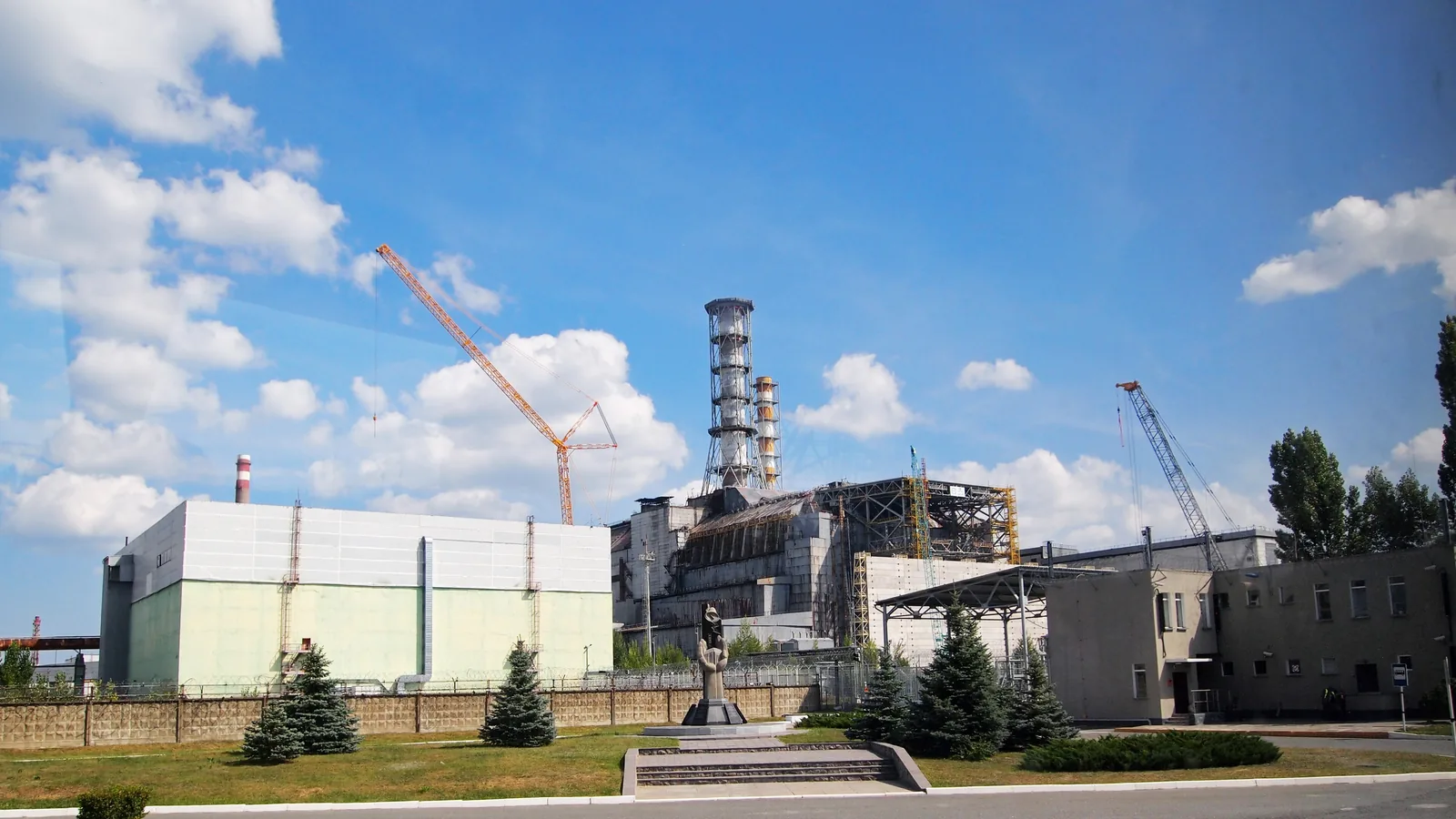
On May 29, 1986, the decision was taken to bury Unit 4 in a structure called the Shelter; Chornobyl NPP gives 206 days for the work and an acceptance act signed on November 30, 1986. Unit 3, the last reactor still running, was shut down at 13:17 on December 15, 2000, on the order of President Leonid Kuchma “with a turn of the key.”
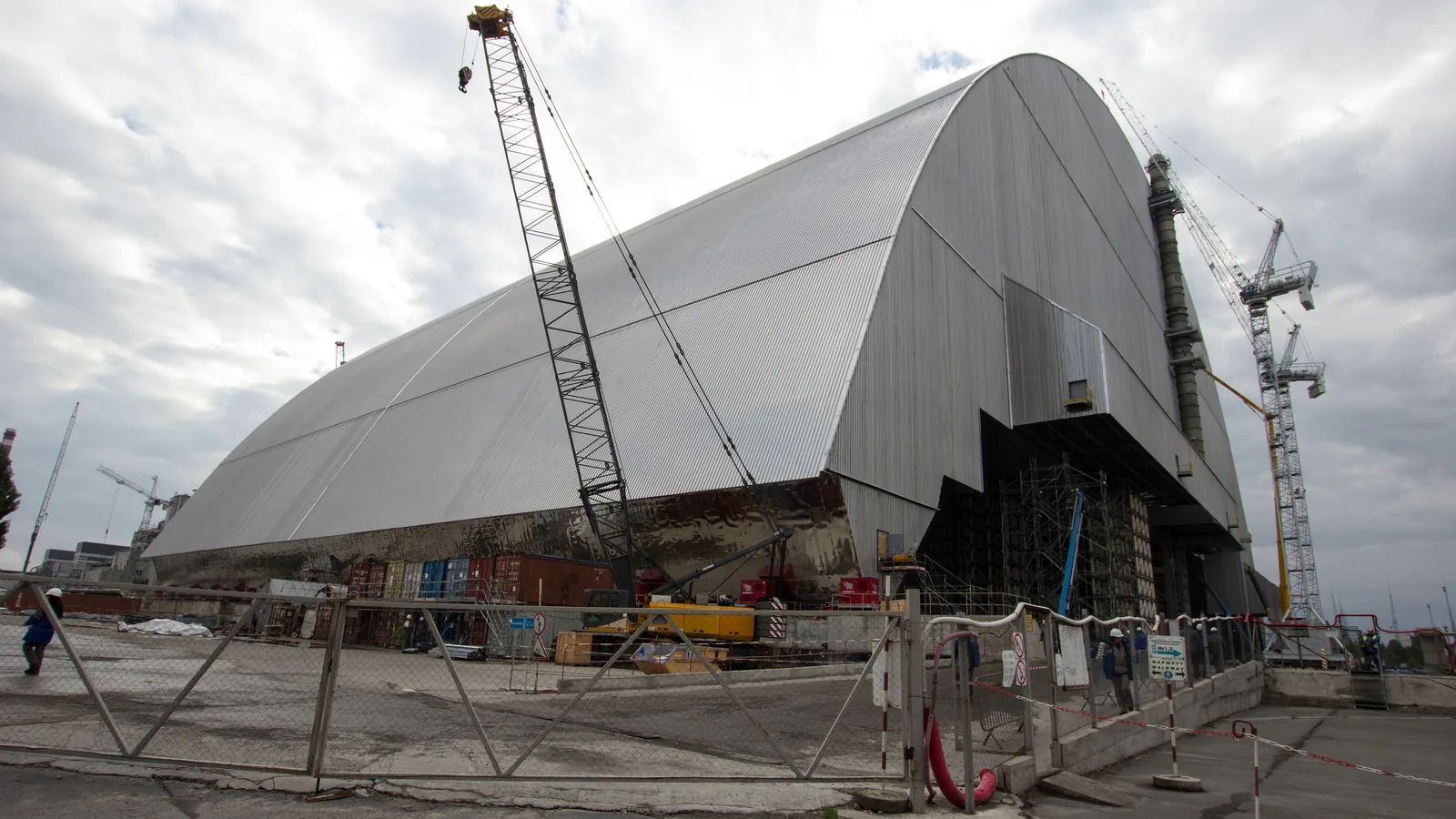
The Shelter’s replacement was the New Safe Confinement, an arch 257 m across and 162 m long; the EBRD gives its height as 110 m. It was slid into position on November 29, 2016; the handover to Ukraine came in 2019. The EBRD puts the Shelter Implementation Plan at 2.1 billion euros and the arch’s design life at 100 years.
Russian troops seized the plant site on February 24, 2022, and withdrew on March 31 of that year. On February 14, 2025, in the EBRD’s words, “a high-explosive Russian drone struck the NSC at Chornobyl. The attack caused a 15 m² breach in the inner and outer cladding and damaged around 200 m² of panels.” The bank estimates repairs at a minimum of 500 million euros. On April 1, 2026, the EBRD announced that donors to its International Chornobyl Cooperation Account had approved 30 million euros for early engineering and procurement work.

Key facts
- At 01:23:04 on April 26, 1986, the stop valves of turbogenerator No. 8 closed and the rundown test began; the EPS-5 scram button was pressed at 01:23:40 and the fuel-channel rupture signal came at 01:23:49 (INSAG-7, Annex I, Table I-I).
- Chornobyl NPP states the test’s purpose: using the “residual rotation energy” of a stopping turbine generator to power emergency core cooling pumps during a total loss of power.
- INSAG-7 (1992) states that some operator actions called violations in INSAG-1 (1986) “were in fact not violations,” while the operators’ critical actions “were most ill judged”; the rod design fault had been found at Ignalina in 1983.
- Pripyat, 49,000 people about 3 km away (NEA), was notified at 11:00 on April 27 and emptied from 14:00; the IAEA digest gives “within 40 hours.”
- About 116,000 people were evacuated in 1986 (Chornobyl NPP, WHO, IAEA; UNSCEAR gives 115,000) and 220,000 were relocated later.
- The Soviet authorities announced the accident on April 28, 1986, a day after radioactivity was first monitored in Scandinavia (UK government statement, House of Lords, April 30, 1986).
- UNSCEAR counts two workers dead at once, 134 cases of acute radiation syndrome with 28 deaths, more than 6,000 thyroid cancers by 2005 with 15 deaths, and 19,233 thyroid cancers registered 1991–2015; WHO’s 2005 release gives “up to 4000” eventual deaths.
- The Shelter was accepted on November 30, 1986, after 206 days; the New Safe Confinement was slid into place on November 29, 2016, and a drone breached it on February 14, 2025 (EBRD: repairs at least 500 million euros).
FAQ
What was being tested at Chernobyl Unit 4 on April 26, 1986?
Whether turbogenerator No. 8, as it spun down after its steam supply was cut, could generate enough electricity to keep the main circulating pumps and emergency core cooling pumps running during a total loss of power. INSAG-7 records that Unit 4 had been commissioned in December 1983 without this test.
Did INSAG-7 blame the operators or the reactor design?
Both, in different measure from INSAG-1. INSAG-7 identifies faulty control-rod design and the positive void coefficient as design defects and states that some actions listed as violations in 1986 "were in fact not violations," while holding that the operators' critical actions "were most ill judged." It says the balance of its judgment "has shifted" without retracting INSAG-1.
How many people died because of Chernobyl?
UNSCEAR counts two workers killed at once and 28 deaths among 134 people with acute radiation syndrome, plus 15 thyroid cancer deaths by 2005. The WHO's 2005 Chernobyl Forum release estimated "up to 4000" eventual deaths from radiation, while the IAEA's digest of the same Forum states that fatal cancers cannot be assessed "with any precision."
Sources
- International Atomic Energy Agency, International Nuclear Safety Advisory Group, The Chernobyl Accident: Updating of INSAG-1 (Safety Series No. 75-INSAG-7, Vienna, 1992): preface, sections 2.1–2.3 and 5, conclusions (4)–(7), and Annex I, Table I-I (DREG timeline).
- State Specialized Enterprise Chornobyl NPP, "Accident of 1986" (purpose of the test, 01:23:04 and 01:23:43, evacuation figures, Shelter construction and acceptance act of November 30, 1986).
- State Specialized Enterprise Chornobyl NPP, "Post-accident operation and shutdown" (Unit 3 shut down December 15, 2000), "Project: NSC construction" (arch dimensions, November 29, 2016, July 10, 2019) and "The full-scale war of russia against Ukraine" (February 24–March 31, 2022).
- UNSCEAR, Sources and Effects of Ionizing Radiation, UNSCEAR 2008 Report, Vol. II, Annex D, "Health effects due to radiation from the Chernobyl accident" (paragraphs 2, 21, 66 and 99).
- UNSCEAR, Evaluation of Data on Thyroid Cancer in Regions Affected by the Chernobyl Accident (white paper, 2018): summary and Table 2; and the UNSCEAR web page "Assessments of the radiation effects from the Chernobyl nuclear reactor accident."
- World Health Organization, news release "Chernobyl: the true scale of the accident," September 5, 2005.
- IAEA, Chernobyl's Legacy: Health, Environmental and Socio-Economic Impacts (Chernobyl Forum digest, second revised version, April 2006): summary, health section and Pripyat evacuation.
- OECD Nuclear Energy Agency, Chernobyl: Assessment of Radiological and Health Impacts, 2002 Update of Chernobyl: Ten Years On, chapters I and II (Pripyat population, detection in Sweden, evacuation timing).
- UK Parliament, Historic Hansard, House of Commons, "Soviet Nuclear Accident," April 29, 1986, vol. 96 cc783–7 (statement by Kenneth Baker); House of Lords, "Soviet Nuclear Accident: UK Citizens," April 30, 1986 (government statement repeated by Baroness Young).
- European Bank for Reconstruction and Development, "Making Chornobyl safe" (arch dimensions, 2016 and 2019, Shelter Implementation Plan cost, February 14, 2025 strike) and news release "EBRD donors back plan to repair Chornobyl's protective shield," April 1, 2026.
- IAEA and OECD/NEA, INES: The International Nuclear and Radiological Event Scale User's Manual, 2008 Edition (section 1.2 and Table 12).
Cite this article
- APA
- Our Earth's History. (2026, September 22). Chernobyl at 01:23:40, April 26, 1986: the Unit 4 test in INSAG-7. Our Earth's History. https://ourearthshistory.com/europe/contemporary/chernobyl-april-26-1986-unit-4-test-insag-7/
- Chicago
- Our Earth's History. “Chernobyl at 01:23:40, April 26, 1986: the Unit 4 test in INSAG-7.” Our Earth's History, September 22, 2026. https://ourearthshistory.com/europe/contemporary/chernobyl-april-26-1986-unit-4-test-insag-7/.
- MLA
- “Chernobyl at 01:23:40, April 26, 1986: the Unit 4 test in INSAG-7.” Our Earth's History, 22 Sep. 2026, https://ourearthshistory.com/europe/contemporary/chernobyl-april-26-1986-unit-4-test-insag-7/.
Text licensed CC BY-NC-ND 4.0. Found an error? Tell us.