Crystal Palace, 1,851 feet: the Great Exhibition opens, May 1, 1851

TL;DR — On May 1, 1851 the Royal Commission told Queen Victoria its glass hall was 1,851 feet long and seven months old; its own catalogue printed 1,848 feet.
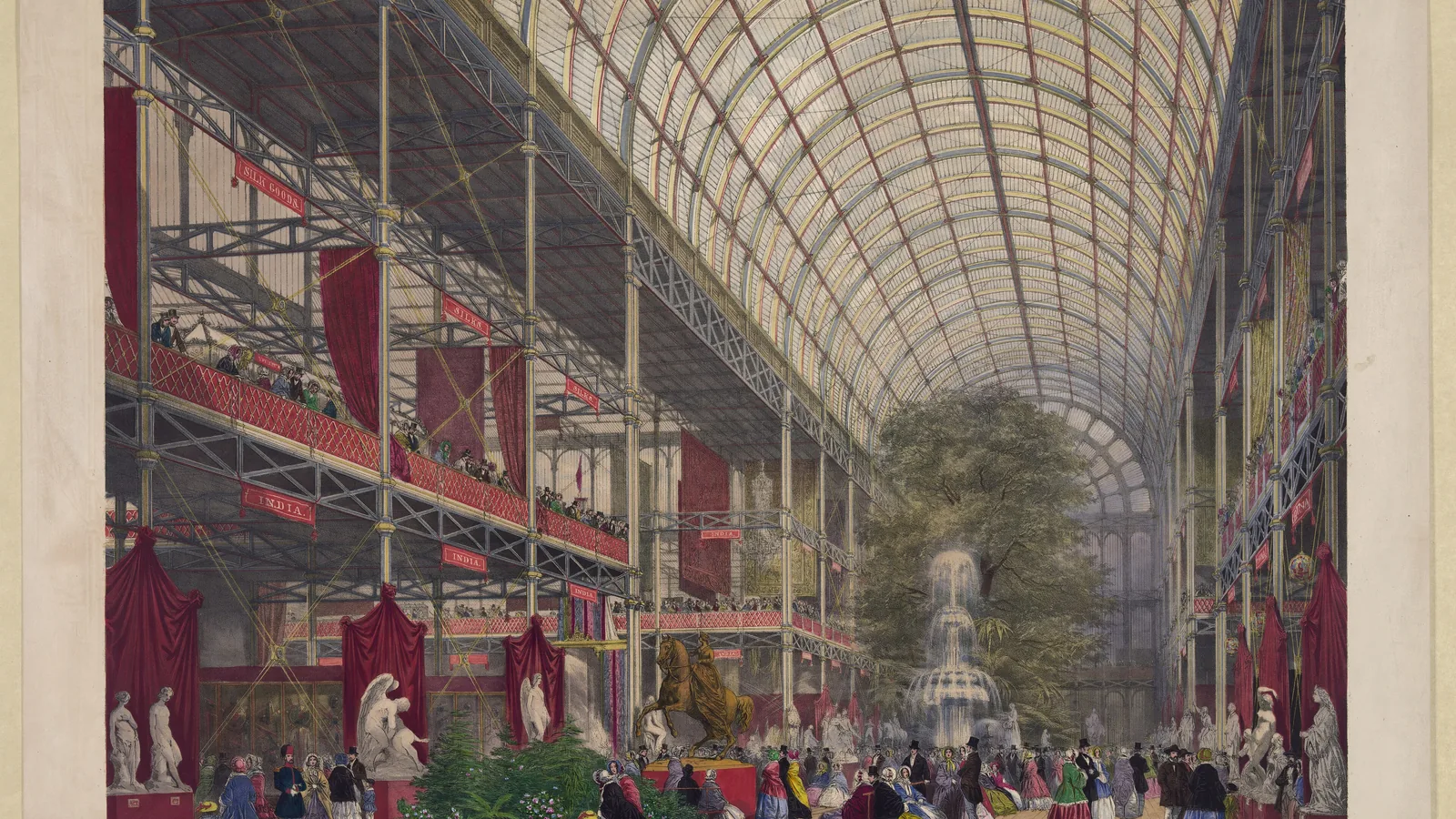
The building that Queen Victoria opened in Hyde Park on May 1, 1851 was, in the address the Royal Commission read to her that day, 1,851 feet long, 456 feet at its widest, and complete seven months after its first column went up on September 26, 1850. The Commission’s Official Descriptive and Illustrated Catalogue, on sale for the same opening, gave the length as “not less than 1848 feet” and the glass as 896,000 square feet on one page and 900,000 on another. The exhibition ran until October 11, 1851, and the Victoria and Albert Museum (V&A) counts more than six million visitors.
Quick facts
- When
- June 30, 1849 (Hyde Park proposed) · July 4, 1850 (Commons votes on the site) · July 15, 1850 (Paxton's design accepted) · September 26, 1850 (first column) · May 1, 1851 (opening) · October 11, 1851 (closed to the public) · October 15, 1851 (juries' reports received) · August 5, 1852 (first column at Sydenham) · June 10, 1854 (Sydenham opening)
- Where
- A strip of Hyde Park in London between the Queen's Drive and Rotten Row, about 26 acres; then Penge Park at Sydenham, south of London, in what was then Kent
- Who
- Prince Albert as President of the Royal Commission; Henry Cole of its executive committee; Joseph Paxton, who drew the glass design; the contractors Fox, Henderson and Co.; Chance Brothers of Birmingham, who made the glass; Queen Victoria, who opened it; Antonio Panizzi, who reported for the juries
- Outcome
- A glass and iron hall of 1,851 feet (or 1,848, depending on which Royal Commission document is read) rose in seven months, held about 15,000 exhibitors by the Commission's count and over six million visitors by the V&A's, closed on October 11, 1851 and was re-erected at Sydenham in a larger form
Noon on May 1, 1851
The doors opened at 9 am to 25,000 season-ticket holders, according to the V&A, and the ceremony waited until noon. The Commissioners’ address then told the Queen that the first column had been fixed on September 26, that the building had gone up within seven months, and that the principle of the structure was Joseph Paxton’s suggestion.
Henry Cole, a member of the Commission’s executive committee, dated his preface to the catalogue April 30, 1851 and ended it: “The work is done, and the collection made of the productions of 15,000 exhibitors, working with the ability God hath given them.” The address used the same round figure, about 15,000, nearly half of them British and the rest from more than forty foreign countries. The V&A article of 2026 counts 13,937 exhibitors from 34 nations and over 30 British territories, and adds that the final tally was never known because displays kept growing after the opening.
Bricks lost, glass won: the site fight of 1850
Prince Albert first proposed the Hyde Park ground, about 26 acres, on June 30, 1849, the catalogue records. The Building Committee received 245 designs, set them aside and published its own plan, a brick hall with a dome 200 feet across, in the Illustrated London News on June 22, 1850. Residents near the park objected, and on July 4, 1850 the House of Commons divided twice on whether the site should be used at all. The catalogue gives the votes as 166 to 47 and 166 to 46 in favor.
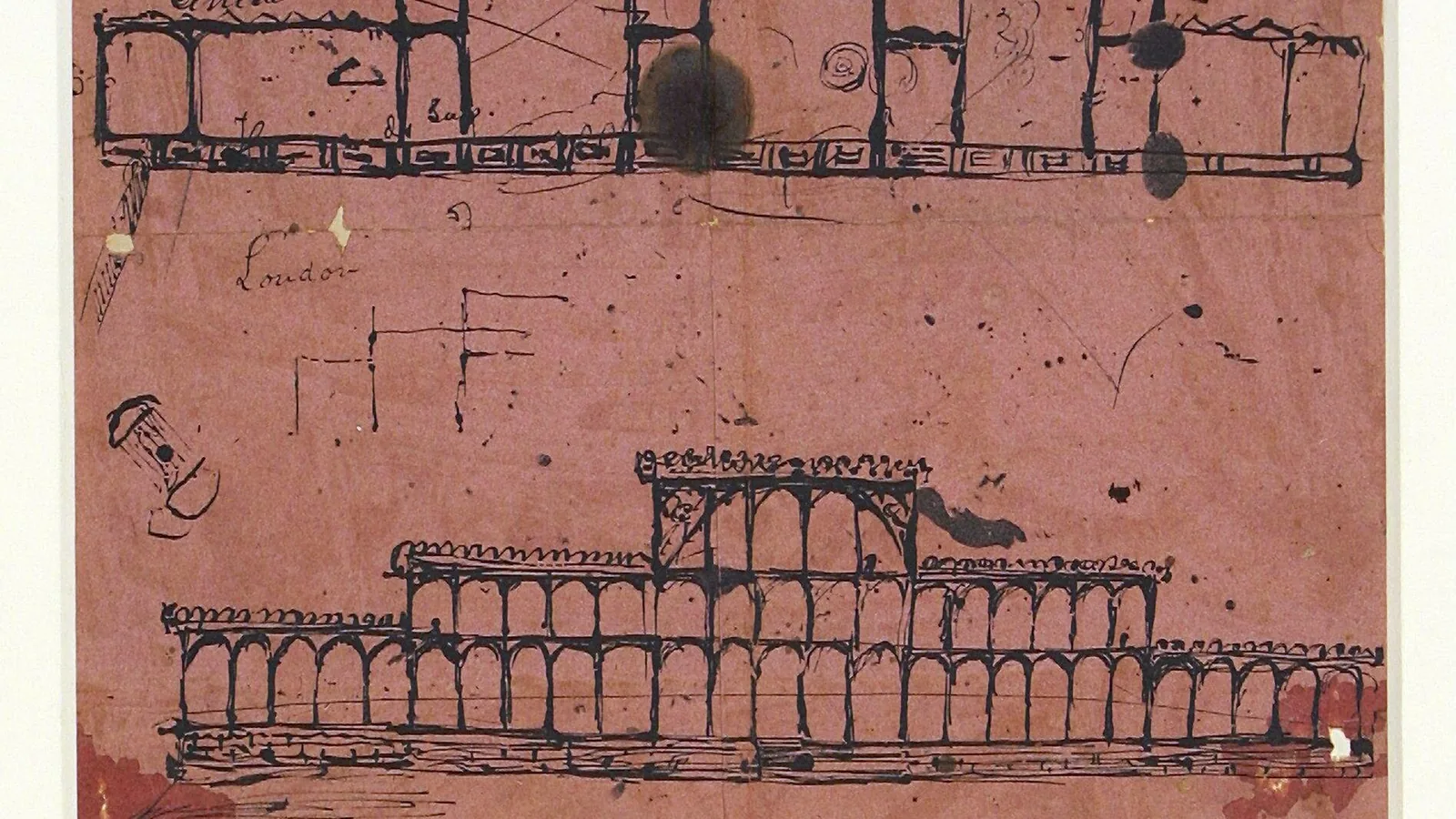
Paxton had sketched an alternative on June 11, 1850, modeled on his glass Lily House at Chatsworth, and put it to the Commission on June 29. The Commission accepted the scheme, with transepts added to spare ten elms, on July 15. On July 26 it adopted the tender of Fox, Henderson and Co. to build Paxton’s design for £79,800. A deed sealed on November 14, 1850 bound the Commissioners to remove the building before June 1, 1852.
Iron by the ton, glass by the square foot
The catalogue’s chapter on the construction, written by M. Digby Wyatt, put the ironwork at 3,500 tons of cast iron and 550 tons of wrought, with nearly 2,300 cast-iron girders, 358 wrought-iron trusses and 202 miles of sash bars. That chapter gives 900,000 superficial feet of glass; an earlier page of the same volume estimates 896,000 superficial feet, weighing 400 tons. A Routledge guide of 1851 also gave about 900,000 feet. Only the V&A counts panes: Chance Brothers of Birmingham supplied 293,655 panes, 18,392 of them mouth-blown for the roof.
The same catalogue chapter gives the total length as not less than 1,848 feet, three feet short of the address read to the Queen. The V&A puts an average of 2,000 workers and 200 horses on site each day and dates the certificate of completion to the end of January 1851.

Shilling days, silver by the ton
Tallis’s History and Description of the Crystal Palace (1852) set the five-shilling days against the one-shilling days, peach-colored visites against cotton prints. The Crystal Palace and its Contents, a weekly bound up in 1852, printed the cash returns: £275,000 taken at the doors in silver and £81,000 in gold. The silver weighed 35 tons; £90 of bad silver got through, one bad half-sovereign, and nearly all the false coin came in on the half-crown and five-shilling days.
The Koh-i-Noor diamond sat in the Indian section, and Tallis’s writer found the public unmoved by it: “The nose of the unhappy Koh-i-noor has been dreadfully put out of joint; but there are Hope diamonds and black diamonds, and marvellous emeralds and amethysts, which still reflect in their precious depths the translucent eyes which sparkle over them.”
October 11, the juries and the move to Sydenham
The Crystal Palace and its Contents dated the close to the public to October 11, 1851. On October 13 and 14 exhibitors and their friends came in on free tickets, and on October 15 Prince Albert received the reports of the juries on a dais in the transept. The Queen’s speech of August 8 proroguing Parliament had referred only to “an Occasion which has brought many Foreigners to this Country.”
The surplus was still unassigned when the doors closed. Antonio Panizzi, Keeper of Printed Books at the British Museum, reported for the juries that a permanent industrial museum was “the logical and practical consequence of this Exhibition,” and the V&A records that 244 objects were bought with a Treasury grant for the Government School of Design, part of the foundation collections of the museum that opened in South Kensington in 1857.
The building itself was sold. Tallis records that Francis Fuller offered £75,000 for the materials, that Fox and Henderson contracted for £120,000 to take it down and re-erect it at Sydenham, and that Mr. Schuster, owner of Penge Park, gave the ground. The first column of the new palace rose on August 5, 1852, and Tallis gives its length as 1,608 feet, a different building from the one in Hyde Park. Victoria and Albert opened it on June 10, 1854; it burned in 1936.
The Hyde Park hall stood for under two years and left no single agreed set of measurements: 1,851 or 1,848 feet, 896,000 or 900,000 square feet of glass, 15,000 or 13,937 exhibitors. The seven months from first column to opening day is the one figure every source shares.
Key facts
- The Royal Commission’s address of May 1, 1851 gave the building as 1,851 feet long and 456 feet wide, holding 40,000 visitors; its catalogue’s construction chapter gave “not less than 1848 feet.”
- The first column was fixed on September 26, 1850; the V&A dates the certificate of completion to the end of January 1851.
- The Commons voted 166 to 47 and 166 to 46 on July 4, 1850 to keep the Hyde Park site (Official Catalogue).
- Fox, Henderson and Co.’s tender of £79,800 was adopted on July 26, 1850; a deed of November 14, 1850 required removal before June 1, 1852.
- The catalogue counts 3,500 tons of cast iron, 550 tons of wrought iron, 202 miles of sash bars and 896,000 or 900,000 square feet of glass; the V&A counts 293,655 panes from Chance Brothers.
- Exhibitors: about 15,000 (Royal Commission, 1851) or 13,937 (V&A, 2026). Visitors: more than six million (V&A).
- Door money came to £275,000 in silver and £81,000 in gold; the silver weighed 35 tons (The Crystal Palace and its Contents).
- The public closed on October 11, 1851; the juries’ reports were received on October 15; the Sydenham palace opened on June 10, 1854.
FAQ
How long did it take to build the Crystal Palace?
Seven months by the Royal Commission's own reckoning: the first column was fixed on September 26, 1850, and the address read to the Queen on May 1, 1851 counted the building complete within seven months. The V&A dates the formal certificate of completion to the end of January 1851.
How many people visited the Great Exhibition of 1851?
The V&A gives more than six million visitors between May 1 and October 11, 1851. The cash returns printed in The Crystal Palace and its Contents put the door money at £275,000 in silver and £81,000 in gold, most of it taken on the shilling days.
What happened to the Crystal Palace after 1851?
Under the deed of November 14, 1850 the building had to leave Hyde Park by June 1, 1852. Francis Fuller bought the materials for £75,000, Fox and Henderson re-erected it at Sydenham for £120,000 in a longer form of 1,608 feet, and the new palace opened on June 10, 1854. It burned in 1936.
Sources
- Victoria and Albert Museum, "The foundation of the V&A's Collections: the Great Exhibition of 1851," edited extract from Julius Bryant, The Great Exhibition in Art (2025), published May 14, 2026.
- Royal Commission, Official Descriptive and Illustrated Catalogue of the Great Exhibition of the Works of Industry of All Nations, 1851: Introductory and Section I (London: Spicer Brothers, 1851), with Henry Cole's preface of April 30, 1851 and M. Digby Wyatt's chapter on the construction of the building (Internet Archive full text, V&A National Art Library copy).
- The Crystal Palace, and its Contents: being an Illustrated Cyclopaedia of the Great Exhibition of the Industry of All Nations, 1851 (London: W. M. Clark, 1852), including the Royal Commission's address to the Queen of May 1, 1851, the closing of October 11 to 15 and the cash returns (Internet Archive full text).
- The Great Exhibition: its Palace, and its Principal Contents; with Notices of the Public Buildings of the Metropolis (London: George Routledge and Co., 1851), section on the building's materials (Internet Archive full text).
- Tallis's History and Description of the Crystal Palace, and the Exhibition of the World's Industry in 1851, vol. III (London: John Tallis and Co., 1852), on the jewels, the sale of the building and the first column at Sydenham (Internet Archive full text).
- UK Parliament, Historic Hansard — House of Lords, "Prorogation of the Parliament," August 8, 1851, Series 3, vol. 118, cc. 1956–60 (the Queen's speech).
Cite this article
- APA
- Our Earth's History. (2026, September 22). Crystal Palace, 1,851 feet: the Great Exhibition opens, May 1, 1851. Our Earth's History. https://ourearthshistory.com/europe/modern/crystal-palace-great-exhibition-1851-hyde-park/
- Chicago
- Our Earth's History. “Crystal Palace, 1,851 feet: the Great Exhibition opens, May 1, 1851.” Our Earth's History, September 22, 2026. https://ourearthshistory.com/europe/modern/crystal-palace-great-exhibition-1851-hyde-park/.
- MLA
- “Crystal Palace, 1,851 feet: the Great Exhibition opens, May 1, 1851.” Our Earth's History, 22 Sep. 2026, https://ourearthshistory.com/europe/modern/crystal-palace-great-exhibition-1851-hyde-park/.
Text licensed CC BY-NC-ND 4.0. Found an error? Tell us.