How did a 21-year-old sultan take Constantinople in 1453?
.jpg)
TL;DR — Mehmed II battered the Theodosian walls with a giant bronze cannon, hauled his ships overland past the harbor chain, and wore down fewer than 5,000 defenders in 53 days.
Mehmed II took Constantinople on May 29, 1453, by pairing a cannon large enough to breach the Theodosian walls with a fleet dragged overland into the Golden Horn. The sultan was 21. The city he attacked held about 50,000 people inside walls built for a capital many times that size, and its defenders, by the count of the emperor’s secretary George Sphrantzes, numbered 4,773 Greeks and about 200 foreigners. The siege ran 53 days, from April 6 to May 29. On the last morning a wound to the Genoese commander Giovanni Giustiniani emptied the breach, and the emperor Constantine XI died in a way no witness recorded the same. Mehmed then cut the sack short, kept the buildings for himself, made the church of Hagia Sophia a mosque and set about refilling the city as his capital.
Quick facts
- When
- March 26, 1452 (Rumeli Hisarı begun) · April 6, 1453 (siege opened) · April 22 (ships hauled overland) · Tuesday, May 29, 1453 (city taken) · January 6, 1454 (Scholarios made patriarch)
- Where
- Constantinople, capital of the Byzantine Empire on the Bosporus, now Istanbul in Turkey; the Theodosian land walls and the Golden Horn harbor
- Who
- Sultan Mehmed II, aged 21; the emperor Constantine XI; the Genoese commander Giovanni Giustiniani; the engineer Urban; the witnesses Barbaro, Sphrantzes and Kritoboulos
- Outcome
- The city fell after 53 days; the last emperor died in a way no witness recorded the same; Mehmed stopped the sack early, made Hagia Sophia a mosque and refilled the city as his capital
What was left of Byzantium in 1453
By 1453 the Byzantine Empire was the city and little else. Halil İnalcık, a historian of the Ottoman Empire writing in Turkish, argued in a paper for a Dumbarton Oaks symposium in 1968 that Constantinople was “a half-ruined city whose population might at the most have numbered fifty thousand,” in effect “a collection of villages” since the Latin occupation of 1204. George Scholarios, who later became patriarch, called the capital before its fall “a city of ruins, poor, and largely uninhabited.”
Constantine XI had reigned since 1449. Beyond the walls, Byzantine rule survived in the Morea in southern Greece and at Trebizond on the Black Sea; the Ottomans took them in 1460 and 1461. Sphrantzes, a courtier who served several emperors as a diplomat, wrote that “no aid whatsoever was dispatched by other Christians.”
The sultan's preparations, 1451 to 1452
Mehmed had ruled briefly as a boy in 1444 to 1446 and took the throne again in 1451. On March 26, 1452, Sphrantzes recorded, “the sultan occupied the straits with the intention of constructing his castle.” The castle was Rumeli Hisarı, on the European shore of the Bosporus north of the city, facing the Ottoman fort at Anadolu on the Asian side.
The cannon came from a Hungarian engineer named Urban, who offered his skill first to Constantine, who could not pay him, and then to the sultan, who could; the Bryn Mawr review of Philippides and Hanak calls him “probably” Hungarian. Kritoboulos, a Greek who later wrote a history for Mehmed, described the casting in detail: 1,500 talents of bronze and tin poured into a clay mold, with bellows driving the furnaces “for three whole days and as many nights.”
The walls and the guns
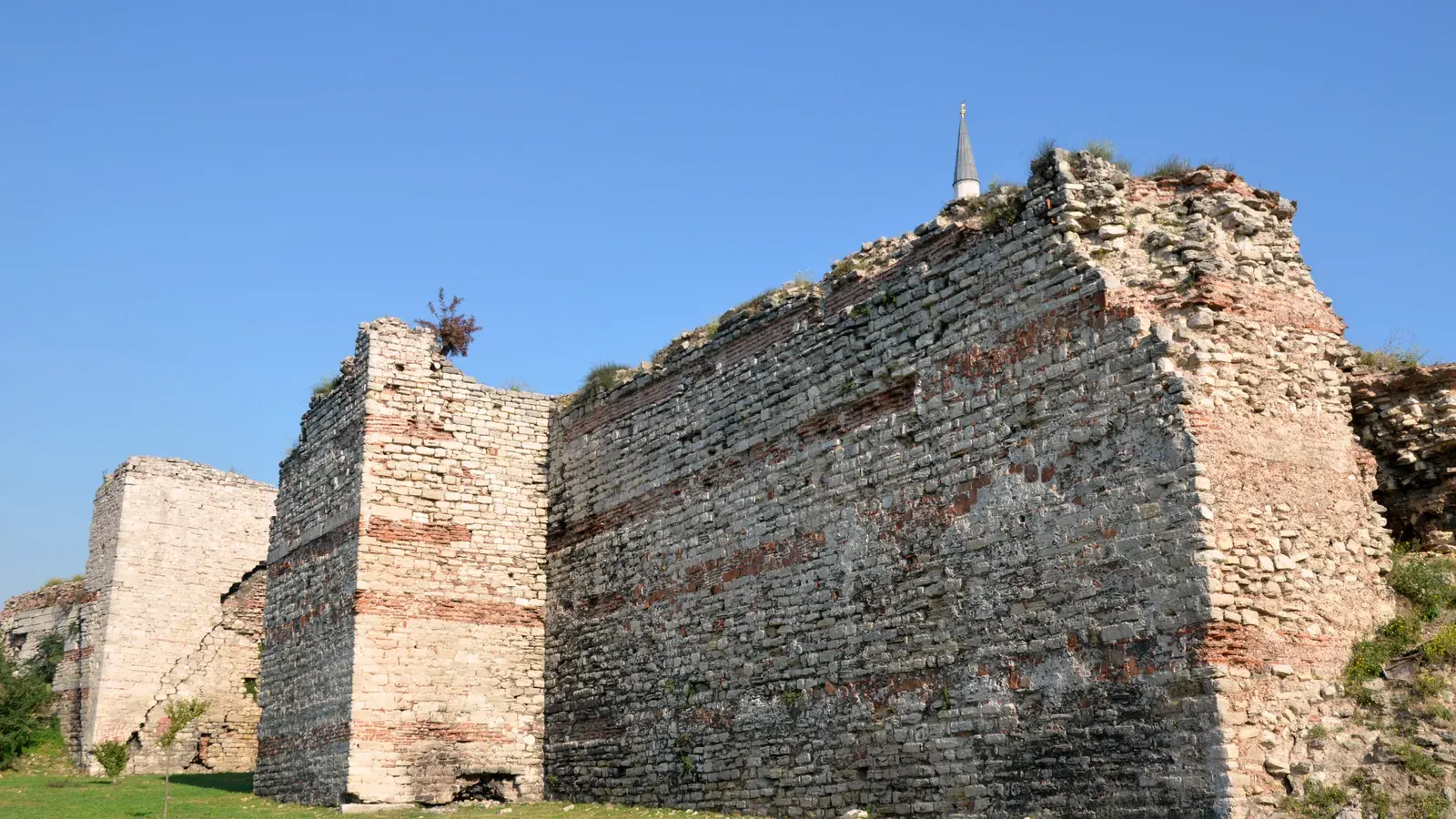
The land walls had stood since the reign of Theodosius II (408 to 450). World History Encyclopedia describes a moat 20 meters wide and seven deep, an outer wall, and an inner wall almost five meters thick and 12 meters high with 96 towers, over a line of about 6.5 kilometers. In 800 years the walls had been passed once, by the Fourth Crusade in 1204.
Nicolo Barbaro, a Venetian surgeon who kept a daily diary inside the city, wrote that the sultan arrived on April 5 with “about a hundred and sixty thousand men.” Sphrantzes wrote 200,000 men and 400 ships. Modern historians, according to World History Encyclopedia, prefer 60,000 to 80,000; Bartusis put the odds at something like ten to one. World History Encyclopedia gives the great gun nine meters of length, a 500-kilogram ball and seven shots a day. Kritoboulos wrote that no part of the wall was “thick enough to be able to withstand it.” Each night the defenders refilled the gaps with earth and timber, and Kritoboulos wrote that the balls sank into the soft fill instead of breaking it.
The chain and the ships over land
A chain, which Barbaro called the boom, ran across the mouth of the Golden Horn from the city to the Genoese colony of Pera, and on April 9 the defenders moored their biggest ships along it. The Ottoman fleet, 145 vessels by Barbaro’s count, arrived on April 12 and could not get past.
Two days later the sultan went around the chain. Barbaro recorded that on April 22 the Ottomans dragged their light galleys over the hill behind Pera and down into the harbor, “as many as seventy-two” by his count. Kritoboulos, describing the same operation, counted 67 vessels on timber ways about eight stadia long, with sails hoisted and oarsmen rowing the air as the hulls moved over land. World History Encyclopedia settles on about 70.
May 29: the last assault and the emperor's end
The assault opened before dawn on Tuesday, May 29, after the sultan’s offer of terms for tribute had been refused. Barbaro described waves of troops, the great gun knocking down the night’s repairs, and men coming through the smoke into the outer defenses near St. Romanos.
Then Giustiniani went down. Kritoboulos wrote that a crossbow bolt passed through his breastplate, that he was carried to his tent, and that his men left the palisade despite the emperor’s pleas. Barbaro, who disliked the Genoese, wrote instead that Giustiniani “decided to abandon his post” and ran through the city shouting that the Turks were in. Philippides and Hanak, in a 759-page study of the sources published in 2011, concluded that he was mortally wounded and that his absence, more than gunpowder, gave the sultan his opening.
The emperor’s end has three versions. Kritoboulos wrote that Constantine “fell in gallant combat” at a small gate he had opened in the great wall. Barbaro wrote that no one had news of him, that some said his body lay among the corpses, and that others said he had hanged himself. Sphrantzes wrote only that his master was killed and that he himself was elsewhere on the walls by the emperor’s order. No body was ever identified with certainty.
What Mehmed did with the city
Kritoboulos put the dead at “well-nigh four thousand” and the prisoners at “a little more than fifty thousand,” and described soldiers netting the crowd that had fled into Hagia Sophia. İnalcık’s reading of the Ottoman and Greek sources is that Mehmed had promised three days of plunder and stopped it on the evening of the first. Doukas, whom İnalcık calls well informed on Ottoman affairs, reported that the sultan kept the walls and buildings for himself and left movable goods to the troops. Hagia Sophia became a mosque, Ayasofya Camii, at once, according to Dumbarton Oaks.
Doukas wrote that Mehmed ordered 5,000 households moved into the city by September; On January 6, 1454, the sultan made Scholarios patriarch of the Orthodox church. By 1477, the Metropolitan Museum’s timeline records, three fifths of the population was Muslim and the harbor was again a center of trade.
How we know: five accounts that disagree
Philippides and Hanak counted 12 eyewitness accounts and 13 contemporary ones, and struck two from the list: the “Riccherio” account was a 16th-century French scholar’s work, and the long chronicle once credited to Sphrantzes was forged in the 16th century by a bishop, Makarios Melissourgos. What remains disagrees on nearly every number. On the answer they agree. The walls faced a gun they were never built for, the harbor held a fleet that had come by road, and the garrison was too small to lose a single commander.
Key facts
- Constantinople in 1453 held about 50,000 people, down from at least 250,000 in the fifth century (İnalcık; Metropolitan Museum).
- Sphrantzes counted 4,773 Greek defenders and about 200 foreigners; Barbaro wrote 160,000 attackers, Sphrantzes 200,000, and modern estimates run 60,000 to 80,000.
- Rumeli Hisarı was begun on March 26, 1452, and finished by August 31; the siege opened on April 6, 1453, and lasted 53 days.
- Barbaro measured the largest cannon’s ball at about 1,200 pounds; Kritoboulos recorded 1,500 talents of bronze in its casting.
- On April 22, 1453, the Ottomans hauled their galleys overland into the Golden Horn: 72 by Barbaro’s count, 67 by Kritoboulos’s.
- Constantine XI died on May 29, 1453; Kritoboulos wrote he fell fighting, Barbaro reported rumors of a hanging, and no body was identified.
- Mehmed made Scholarios patriarch on January 6, 1454, and ordered 5,000 households moved into the city (Doukas, via İnalcık).
FAQ
How old was Mehmed II when he took Constantinople?
He was 21. He had first held the throne as a boy in 1444 to 1446 and became sultan again in 1451.
How did the Ottomans get ships into the Golden Horn?
On April 22, 1453, they dragged light galleys over the hill behind Pera on timber ways and launched them inside the chain. Barbaro counted 72 ships and Kritoboulos 67.
How did Constantine XI die?
No witness agreed. Kritoboulos wrote that he fell fighting at a gate in the land walls; Barbaro heard that his body was seen among the dead, or that he hanged himself; Sphrantzes wrote only that he was killed. The body was never identified.
Sources
- De Re Militari — Nicolo Barbaro, Diary of the Siege of Constantinople 1453, translated by John Melville-Jones (New York, 1969), excerpt.
- De Re Militari — Kritovoulos, History of Mehmed the Conqueror, translated by Charles T. Riggs (Princeton University Press, 1954), Book 1, chapters 117–257.
- De Re Militari — George Sphrantzes, The Fall of the Byzantine Empire: A Chronicle, translated by Marios Philippides (University of Massachusetts Press, 1980), chapters 35–36.
- Internet Archive — Halil İnalcık, "The Policy of Mehmed II toward the Greek Population of Istanbul and the Byzantine Buildings of the City," Dumbarton Oaks Papers 23/24 (1969–1970), pp. 229–249, scanned text.
- Bryn Mawr Classical Review 2012.03.27 — Mark Bartusis, review of Marios Philippides and Walter K. Hanak, The Siege and the Fall of Constantinople in 1453: Historiography, Topography, and Military Studies (Ashgate, 2011).
- World History Encyclopedia — Mark Cartwright, "1453: The Fall of Constantinople" (January 23, 2018).
- The Metropolitan Museum of Art, Heilbrunn Timeline of Art History — Annie Labatt, "Constantinople after 1261" (October 2004).
- The Metropolitan Museum of Art, Heilbrunn Timeline of Art History — Suzan Yalman, "The Art of the Ottomans before 1600" (October 2002).
- Dumbarton Oaks — "Hagia Sophia Resources," Byzantine Studies research page.
- UNESCO World Heritage Centre — "Historic Areas of Istanbul," World Heritage List no. 356.
Cite this article
- APA
- Our Earth's History. (2026, September 20). How did a 21-year-old sultan take Constantinople in 1453? Our Earth's History. https://ourearthshistory.com/europe/medieval/fall-of-constantinople-1453/
- Chicago
- Our Earth's History. “How did a 21-year-old sultan take Constantinople in 1453?” Our Earth's History, September 20, 2026. https://ourearthshistory.com/europe/medieval/fall-of-constantinople-1453/.
- MLA
- “How did a 21-year-old sultan take Constantinople in 1453?” Our Earth's History, 20 Sep. 2026, https://ourearthshistory.com/europe/medieval/fall-of-constantinople-1453/.
Text licensed CC BY-NC-ND 4.0. Found an error? Tell us.