Twenty-eight letters, 1443: Sejong's alphabet in the Sillok

TL;DR — The Sejong Sillok records 28 new letters in 1443 and a finished Hunminjeongeum in 1446, both dated only “this month,” with Choe Malli’s 1444 protest between them.
“This month, the king personally made twenty-eight letters of the vernacular script,” reads the closing line of the Sejong Sillok’s entry for the twelfth month of Sejong 25, 1443. The Chinese original states “是月, 上親制諺文二十八字,” is-wol, “this month,” with no day given. Three years later, the entry for the ninth month of Sejong 28 ends the same way: “This month, the Hunminjeongeum was completed,” is-wol hunminjeongeum seong. Between the two entries, a Jiphyeonjeon official filed a memorial against the new script and was jailed for one night.
Quick facts
- When
- December 1443 (Sejong 25, a month-end entry with no exact day); February 20, 1444 (Sejong 26, Choe Malli's memorial); September 1446 (Sejong 28, the Haerye completion entry, also undated within the month)
- Where
- The Joseon court at Hanseong, recorded in the Sejong Sillok (Veritable Records of King Sejong)
- Who
- King Sejong; Choe Malli, deputy director of the Jiphyeonjeon (Hall of Worthies); Jeong Injip, minister of rites; Jeong Changson and six other Jiphyeonjeon officials who signed the 1444 memorial
- Outcome
- A 28-letter script the Sillok calls Hunminjeongeum was recorded as made in 1443 and its Haerye commentary as finished in 1446; the men who protested it in 1444 were jailed one day and released, and Jeong Changson alone was dismissed
1443: twenty-eight letters with no day
The Sillok’s account of the letters is short and administrative. It states that the king “personally made” the script, that the shapes were modeled on old seal characters, and that syllables were formed by combining an initial, a medial and a final sound. The record adds that the letters could write “all matters of writing and the vernacular speech of this country,” and that though the letters were “simple and few,” their combinations were without limit; the entry names the script Hunminjeongeum. This appears as the last item under the twelfth month of 1443. Jeong Injip’s later preface, entered in 1446, points to the same period from the other side, dating the creation to “the winter of the year gyehae,” the cyclical name for 1443.
Choe Malli's memorial, 1444
Choe Malli, deputy director of the Jiphyeonjeon, and six colleagues submitted a memorial dated the twentieth day of the second month of Sejong 26, which corresponds to 1444. It opens: “Your servants humbly observe that the making of the vernacular script is extremely ingenious, that it creates the myriad things and turns wisdom in a way unmatched in a thousand years, yet in our narrow view there remain matters of doubt.” The memorial argues that Joseon had “sincerely served the great country” and followed Chinese institutions, and that inventing a script “at the very time writing and rules are shared” would draw astonishment if it reached China. It sets the new script against the writing systems of the Mongols, the Western Xia, the Jurchens, Japan and Tibet, calling those “matters of barbarians, not worth mentioning,” and states that making a separate script meant abandoning China to make Joseon like the barbarians. On the argument that a vernacular script would let prisoners read their own depositions and avoid false confessions, the memorial answers that prisoners literate in idu, the older transcription system, already confessed falsely under duress, so illiteracy was not the cause of injustice. It also raises the crown prince’s education, saying he should be applying himself to the sages’ learning rather than to what the memorial calls one of the lesser arts.
"Twenty-seven letters," the memorial says
The memorial uses “twenty-seven letters of the vernacular script,” eoneum isipchiljja, throughout, where the king’s 1446 preface and Jeong Injip’s preface both say twenty-eight. The Sillok gives no note reconciling the two figures. Sejong answered the memorial in person, comparing the new script to Seol Chong’s idu system, which was also built on foreign readings of characters: “You say that using sounds and combining letters all goes against the old writings. Is Seol Chong’s idu not also a different sound? If you say Seol Chong was right and your sovereign’s work is wrong, what is the reason?” Choe Malli and his colleagues replied that idu, unlike the new script, kept its sounds tied to existing characters, while combining new letters together changed both the sound and the form. Sejong also cited an official, Kim Mun, who had earlier told him nothing was wrong with making the script and later reversed himself, and rebuked another signer, Jeong Changson, over a remark that virtuous conduct did not depend on translated moral texts. The king ordered Choe Malli, Sin Seokjo, Kim Mun, Jeong Changson, Ha Wiji, Song Cheogeom and Jo Geun sent to the Uigeumbu, the state tribunal, and released the next day; only Jeong Changson was dismissed from office, and Kim Mun was ordered questioned over his reversal.
The Haerye edition and a completed script
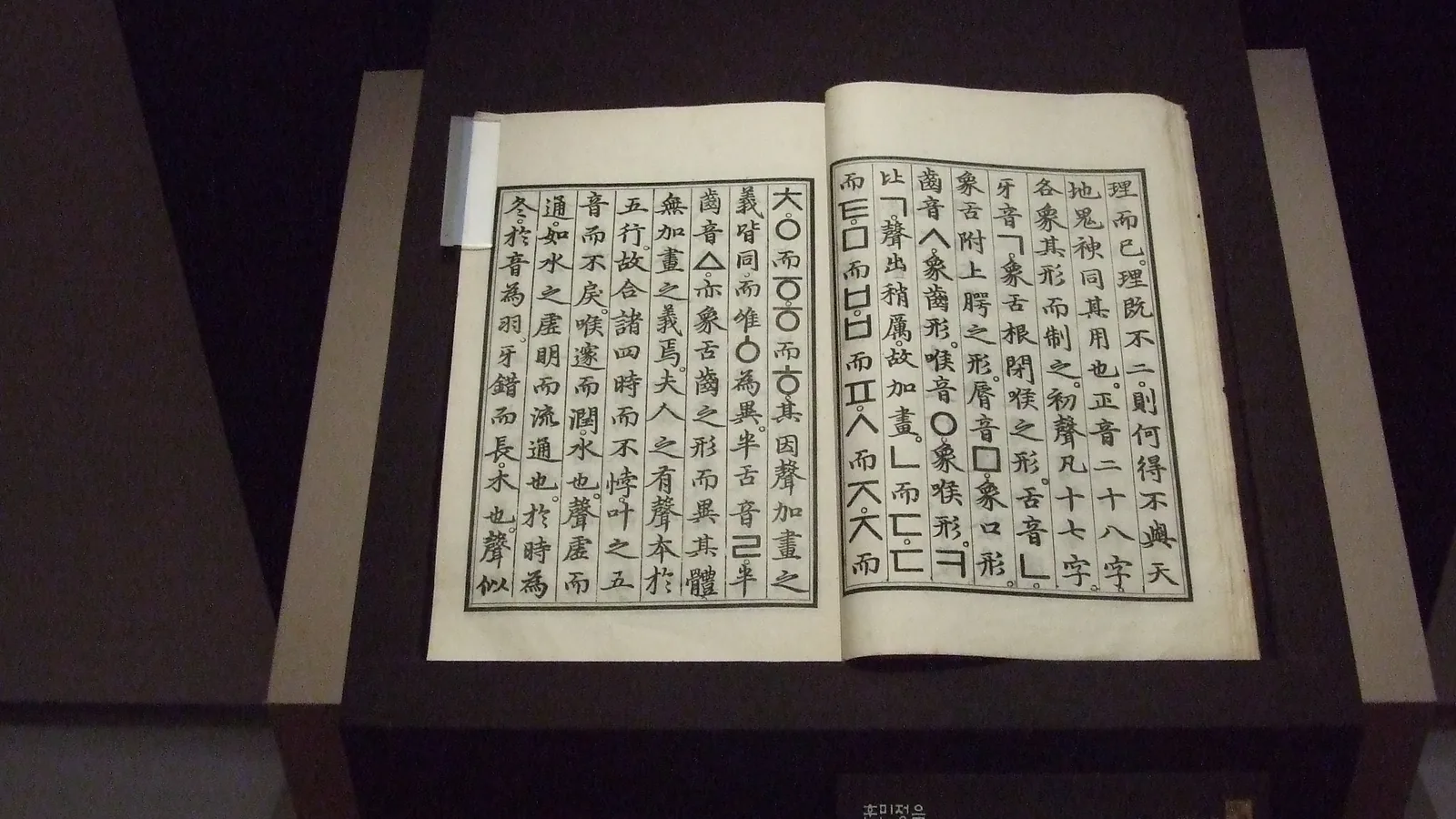
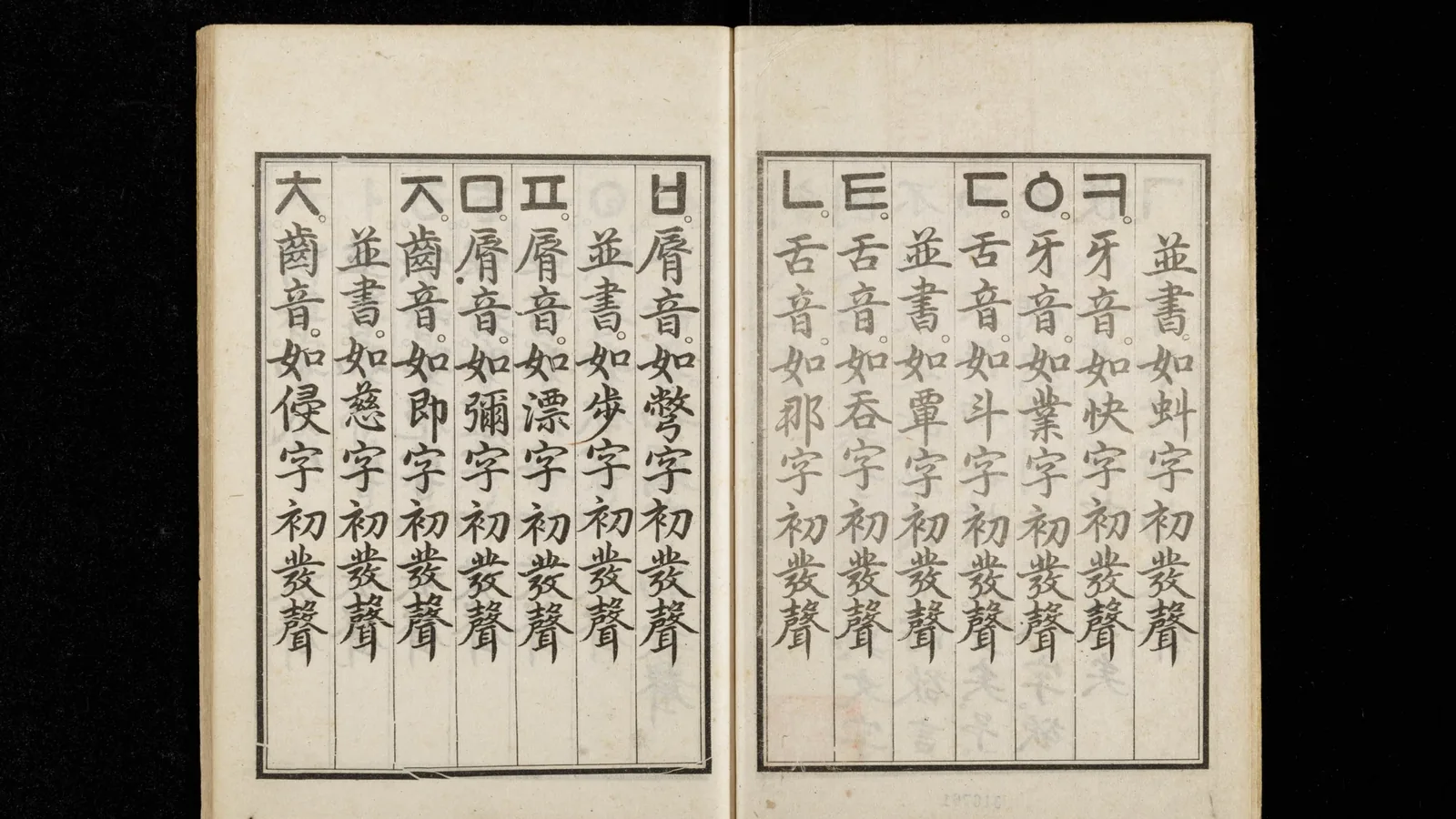
The entry for the ninth month of 1446 carries the king’s own preface in full: “The sounds of our country’s language differ from those of China and do not match with its writing, so among the ignorant people there have been many who, having something to put into words, have in the end been unable to express their feelings. I have been distressed because of this, and have newly made twenty-eight letters, wishing only that everyone might easily learn them and use them conveniently in their daily life.” Jeong Injip’s preface follows, stating that “in the winter of the year gyehae, our king first made the twenty-eight letters of the correct sounds, briefly setting out examples and their meaning, and called it Hunminjeongeum,” and that he had worked with seven other Jiphyeonjeon scholars, Choe Hang, Bak Paengnyeon, Sin Sukju, Seong Sammun, Gang Huian, Yi Gae and Yi Seollo, to compose the commentary. The Korea Heritage Service lists the resulting book, the Hunminjeongeum Haerye edition, as a registered heritage item dated Sejong 28 (1446), one volume of 33 leaves in woodblock print, held by the Kansong Art Museum in Seoul, with a registration date of December 20, 1962. The heritage service’s own page states that the commentary and Jeong Injip’s preface, as preserved in this book, first made known the scholars’ role and the alphabet’s design principles.

Hangul Day: October 29 to October 9
The National Institute of Korean Language sets out how the date now marked as Hangul Day was fixed. Because the Sillok recorded the 1446 completion only as “this month” with no day, scholars first assumed the last day of the ninth month and converted it to the solar calendar, arriving at October 29. In the 1940s, according to the institute, Bang Jonghyun argued that the 1446 entry described the completion of the Hunminjeongeum book, the Haerye edition, rather than the alphabet itself. The original Haerye volume was then found, and its copy of Jeong Injip’s preface carried a date the Sillok’s summary entry had not given: “the early ten-day period of the ninth month of Sejong 28.” That phrase moved the calculated date back about twenty days, from October 29 to October 9, which the institute states is how the current date was set. The same institute page states directly that the claim of a formal promulgation ceremony in September 1446 has no supporting record, adding that no document shows Sejong held any such event for the script.
Key facts
- The Sejong Sillok, vol. 102, 12th month of 1443, records: “This month, the king personally made twenty-eight letters of the vernacular script,” with no day given within the month.
- Jeong Injip’s 1446 preface dates the creation to “the winter of the year gyehae” (1443) and names Choe Hang, Bak Paengnyeon, Sin Sukju, Seong Sammun, Gang Huian, Yi Gae and Yi Seollo as his co-authors on the commentary.
- Choe Malli’s memorial, Sejong Sillok vol. 103, is dated the 20th day of the 2nd month of Sejong 26 (1444) and calls the new script “twenty-seven letters of the vernacular script.”
- Sejong’s own 1446 preface and Jeong Injip’s preface both state the script has twenty-eight letters, a figure that does not match the memorial’s count.
- Choe Malli, Sin Seokjo, Kim Mun, Jeong Changson, Ha Wiji, Song Cheogeom and Jo Geun were sent to the Uigeumbu and released the next day; only Jeong Changson was dismissed.
- The Sejong Sillok, vol. 113, 9th month of 1446, records: “This month, the Hunminjeongeum was completed,” again with no day given.
- The Korea Heritage Service registers the Hunminjeongeum Haerye edition, one volume of 33 woodblock-printed leaves, held by the Kansong Art Museum, with a registration date of December 20, 1962.
- The National Institute of Korean Language states that Hangul Day was first set at October 29 and later moved to October 9 after the discovery of Jeong Injip’s preface date, “the early ten-day period of the ninth month.”
FAQ
Did the Sejong Sillok give an exact date for the creation of Hunminjeongeum?
No. The 1443 entry appears at the end of the twelfth month with the phrase "this month" and no specific day, and the 1446 completion entry uses the same phrasing for the ninth month.
Why do Choe Malli's memorial and Sejong's preface disagree on the number of letters?
Sejong's 1446 preface and Jeong Injip's preface both state twenty-eight letters, while Choe Malli's 1444 memorial uses the phrase "twenty-seven letters of the vernacular script." The Sillok does not explain the difference, and both figures are quoted here as the text gives them.
Was there a public promulgation ceremony for Hunminjeongeum in 1446?
The National Institute of Korean Language states that no record shows such a ceremony took place, and that the 1446 Sillok entry describes the completion of a manuscript reported to the king, not a public event.
Sources
- National Institute of Korean History, Sejong Sillok, vol. 102, Sejong 25 (1443), 12th month, 30th day entry, "The king personally made twenty-eight letters of the vernacular script."
- National Institute of Korean History, Sejong Sillok, vol. 113, Sejong 28 (1446), 9th month, 29th day, 4th entry, with the king's preface and Jeong Injip's preface.
- National Institute of Korean History, Sejong Sillok, vol. 103, Sejong 26 (1444), 2nd month, 20th day entry, Choe Malli's memorial and the king's reply.
- Korea Heritage Service, National Heritage Portal, detail page for Hunminjeongeum (Haerye edition), Kansong Art Museum.
- National Institute of Korean Language, "Algo sipeun Hangeul" (Things worth knowing about Hangul), on the dating of Hangul Day.
Cite this article
- APA
- LETTER. (2026, September 28). Twenty-eight letters, 1443: Sejong's alphabet in the Sillok. Our Earth's History. https://ourearthshistory.com/east-asia/medieval/hunminjeongeum-1446-sejong-alphabet-choe-malli-1444-sillok/
- Chicago
- LETTER. “Twenty-eight letters, 1443: Sejong's alphabet in the Sillok.” Our Earth's History, September 28, 2026. https://ourearthshistory.com/east-asia/medieval/hunminjeongeum-1446-sejong-alphabet-choe-malli-1444-sillok/.
- MLA
- LETTER. “Twenty-eight letters, 1443: Sejong's alphabet in the Sillok.” Our Earth's History, 28 Sep. 2026, https://ourearthshistory.com/east-asia/medieval/hunminjeongeum-1446-sejong-alphabet-choe-malli-1444-sillok/.
Text licensed CC BY-NC-ND 4.0. Found an error? Tell us.