January 24, 1601: a clock and a world map arrive at the Ming court

TL;DR — The Ming History records Ricci reaching the capital in 1601 with pictures and relics, the court lodging and feeding him, and a grave granted outside the west wall in 1610.
A picture of the Lord of Heaven, a picture of the Lord of Heaven’s mother, and objects the Ministry of Rites called “bones of immortals”: those are the goods the Ming History, the dynasty’s official history compiled under the Qing, lists as presented to the Wanli emperor by the eunuch Ma Tang on behalf of Matteo Ricci in 1601. Ricci, a Jesuit from Macerata in the Papal States, entered Beijing on January 24, 1601, by the Catholic Encyclopedia’s date; Nicolas Trigault’s Latin account of 1615 adds a larger clock among the presents for the emperor. A six-panel world map followed in 1602, Euclid in Chinese in 1607, and in 1610 a grave outside the capital’s western wall.
Quick facts
- When
- January 24, 1601 (Ricci enters Beijing, by the Catholic Encyclopedia's date) · first autumn month of 1602 (the six-panel map printed, by the Kyoto copy's colophon) · 1607 (first six books of Euclid printed at the capital) · fourth month of Wanli 38, 1610 (Ricci dies at the capital; the Ming History records the grant of burial ground)
- Where
- Beijing, the Ming capital; Hangzhou, where the map was cut and printed; Rome, where Clavius's Latin Euclid was printed in 1574
- Who
- Matteo Ricci; the Wanli emperor; the eunuch Ma Tang; the Ministry of Rites; Li Zhizao and Feng Yingjing, who printed the map from their own blocks; Xu Guangqi, who wrote down the Euclid
- Outcome
- The Ministry of Rites twice asked that Ricci be sent home and got no reply; the emperor lodged and fed him; a world map on six panels and a Chinese Euclid in six books were printed; in 1610 the court granted ground for his grave outside the west wall
Two pictures, some bones, and two memorials that went unanswered
The Ming History’s chapter on Italy, in a literal rendering: “In the twenty-ninth year he entered the capital; the palace eunuch Ma Tang presented his local products, and he called himself a man of the Great Western Ocean.” The Ministry of Rites objected in a memorial: no “Great Western Ocean” stood in the Collected Statutes, and “the pictures of the Lord of Heaven and of the Mother of the Lord of Heaven that he offers as tribute are unorthodox, and among the things he carries there are also such objects as bones of immortals. Now if they are called immortals, they can fly up of themselves; how can there be bones?” It asked that Ricci be sent home. The history’s note on the memorial is two characters long: no reply. A second memorial in the eighth month got the same.
The emperor’s answer takes one sentence: “Then the emperor commended him for coming from afar, lent him lodging and provided him with food, and granted him generous gifts. From the dukes and ministers down, people esteemed the man, and all came to receive him.”
Six panels cut at Hangzhou in the autumn of 1602
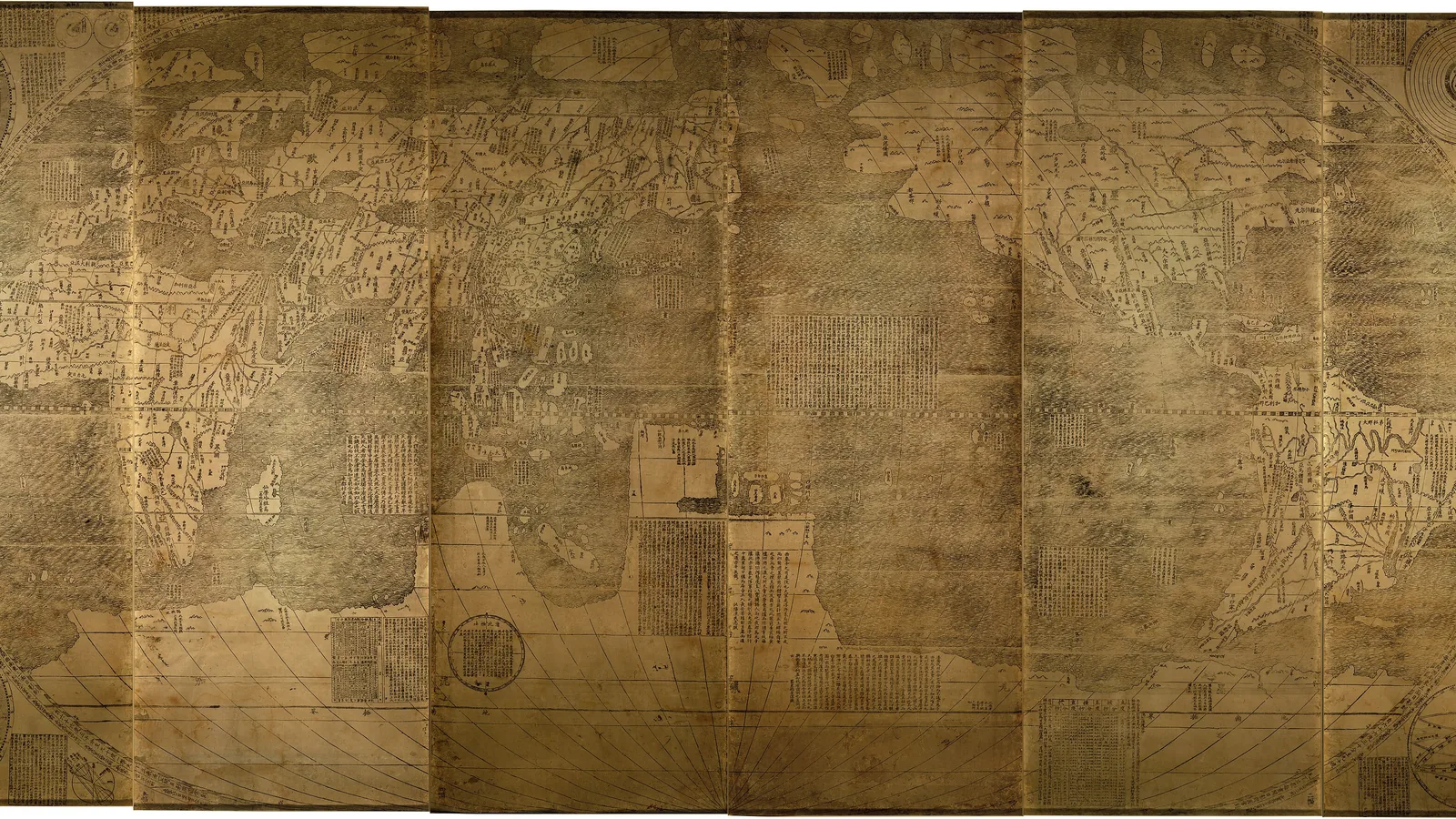
The map is the object the Ming History remembers first: Ricci “made the Complete Map of the Myriad Countries” and “said that under heaven there are five great continents.” The 1602 printing, Kunyu wanguo quantu, was the third edition of a map Ricci first drew at Zhaoqing in 1584, according to Cordell D. K. Yee in the History of Cartography (University of Chicago Press). The James Ford Bell Library at the University of Minnesota describes a woodblock print on six panels of bamboo paper, about 12 feet by 5.75 feet in all, engraved perhaps by Li Zhizao (1565–1630) and printed by Zhang Wentao of Hangzhou. Kyoto University’s copy carries on its sixth panel a printer’s note dated to the first autumn month of 1602. Feng Yingjing (1555–1606) wrote a preface for the 1603 edition, and he and Li each printed copies from their own blocks, Yee records.
China sits near the center of the sheet, and two explanations exist. Trigault’s Latin, in a literal rendering, says the Chinese, on first seeing European maps, “were annoyed that their kingdom was shown not in the middle but at the far east; for this reason, when Father Matteo Ricci had drawn the globe of the earth with Chinese names, he arranged it so that the kingdom of the Chinese would be seen in the middle.” Yee gives a second reason: on the Ortelius map Ricci copied, the 180-degree meridian ran through the Pacific, and Ricci put that meridian down the center of his sheet, so China landed near the middle. Yee quotes one Ming scholar, Wei Jun, by way of Kenneth Ch’en’s 1939 study: “China should be in the center of the world, which we can prove by the single fact that we can see the North Star resting at the zenith of the heaven at midnight. How can China be treated like a small unimportant country, and placed slightly to the north as in this map?”
Mr. Ding's Euclid, spoken in one language and written in another
The base text was a Latin Euclid printed at Rome in 1574 by Vincenzo Accolti, its dedication signed by Christopher Clavius of the Society of Jesus and dated February 1, 1574. Ricci had studied under Clavius at Rome, and in his introduction to the Chinese version called him “Mr. Ding” (ding, “nail,” as the St Andrews mathematics site explains).
Xu Guangqi (1562–1633), a Shanghai native who had passed the highest examination, did the writing. Ricci’s introduction, dated to the dingwei year of Wanli, 1607, describes the method: “He had me transmit by mouth and himself received it with the brush. . . . The draft was changed three times. . . . By the start of this spring, the most essential part, the first six books, was finished.”
Xu’s own notes on the book, printed with it, in a literal rendering: “This book has four things not needed: no need to doubt, no need to guess, no need to test, no need to alter. It has four things that cannot be had: to wish to leave any of it out cannot be had, to refute it cannot be had, to cut it cannot be had, to move its earlier and later parts around cannot be had.” When Xu came north again in 1610, his afterword says, “the gentleman had died.”
A grave outside the west wall, and six copies of the map
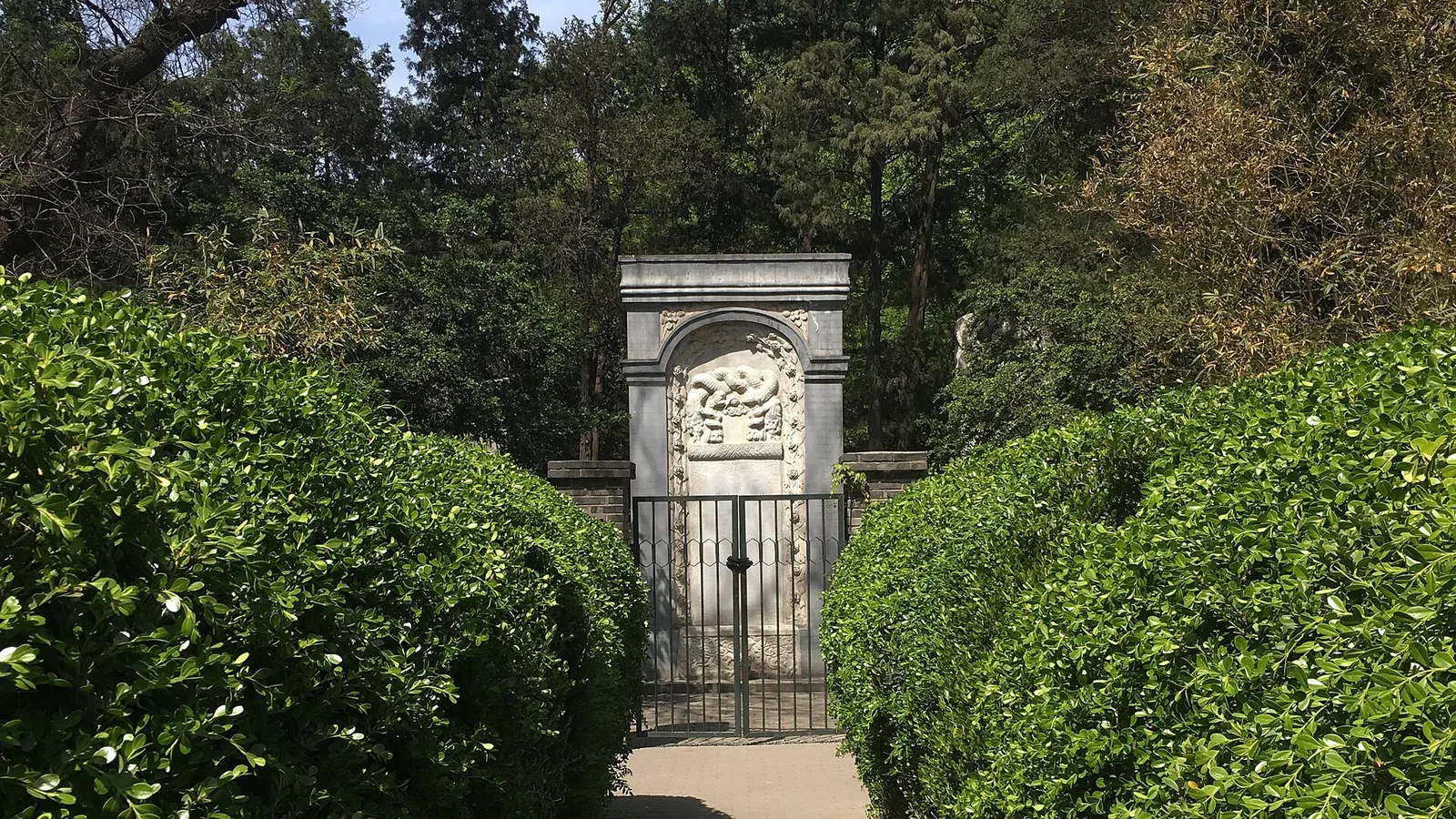
The Ming History closes Ricci’s part of the chapter in one line: “In the fourth month of the thirty-eighth year he died at the capital. He was granted burial outside the western wall.” The Catholic Encyclopedia gives the day as May 11, 1610. The same chapter names the men who took up the Jesuits’ books: “scholar-officials such as Xu Guangqi and Li Zhizao were the first to take to their teachings.”
Six complete copies of the 1602 printing survive, by the Bell Library’s 2013 list: the Vatican Apostolic Library; Kyoto University; the Miyagi Prefectural Library; the Library of the Japanese Cabinet; a private collection in Paris; and the James Ford Bell Trust’s copy, which the Trust later gave to the University of Minnesota. Kyoto’s six scrolls are online under record RB00013547; the sixth scroll shows the western half of Africa, the Iberian peninsula and the southern continent.

Key facts
- The Ming History records that in the twenty-ninth year of Wanli (1601) the eunuch Ma Tang presented Ricci’s gifts, which the Ministry of Rites listed as pictures of the Lord of Heaven and his mother and “bones of immortals”; the Catholic Encyclopedia dates Ricci’s entry into Beijing to January 24, 1601.
- The Ministry of Rites twice asked that Ricci be sent home; the history records “no reply” to both memorials, then the emperor’s grant of lodging and food and his gifts.
- The 1602 Kunyu wanguo quantu is a woodblock print on six panels, about 12 feet by 5.75 feet, with Li Zhizao as its likely engraver and Zhang Wentao of Hangzhou as printer (James Ford Bell Library); the Kyoto copy’s printer’s note is dated to the first autumn month of 1602.
- Trigault’s Latin of 1615 explains China’s central position as Ricci’s arrangement for Chinese readers; Yee traces it to Ricci’s choice of the 180-degree meridian as the center line of the Ortelius projection.
- Ricci and Xu Guangqi finished the first six books of Euclid, from Clavius’s 1574 Latin edition, by the spring of 1607; Ricci spoke and Xu wrote, through three drafts, by Ricci’s introduction.
- Ricci died at the capital in the fourth month of Wanli 38 (May 11, 1610, by the Catholic Encyclopedia) and, in the Ming History’s words, “was granted burial outside the western wall.”
FAQ
What did the Ming court object to in Ricci's gifts?
The Ministry of Rites wrote that the pictures of the Lord of Heaven and of his mother were "unorthodox," that the "bones of immortals" made no sense since immortals "can fly up of themselves," and that no "Great Western Ocean" appeared in the Collected Statutes. The Ming History records no reply from the emperor to either memorial, and then the emperor's grant of lodging, food and gifts.
Who made the 1602 world map?
Ricci drew it, on the model of an Ortelius map, as the third edition of a map he first made at Zhaoqing in 1584 (Yee). The Bell Library names Li Zhizao as the probable engraver and Zhang Wentao of Hangzhou as printer; the Kyoto copy's sixth panel carries a printer's note from Qiantang, the Hangzhou district, dated to the autumn of 1602.
How was Euclid translated into Chinese?
By voice and brush. Ricci's 1607 introduction says he spoke the Latin of Clavius's 1574 edition and Xu Guangqi wrote it down in Chinese, and that the two revised the text three times before printing the first six books. Xu's afterword adds that Ricci sent a corrected copy in 1608 and had died by the time Xu returned north in 1610.
Sources
- Mingshi (History of the Ming), juan 326, Liezhuan 214, Waiguo 7, section Yidaliya (Italy); the compilers' account of Li Madou (Matteo Ricci) at the capital, the Ministry of Rites memorials, his death and burial. Chinese text on Wikisource.
- Jihe yuanben (Euclid's Elements in Chinese), prefaces of 1607: Xu Guangqi's preface and Matteo Ricci's introduction, the latter dated to the dingwei year of Wanli. Chinese text on Wikisource.
- Jihe yuanben, Xu Guangqi's 'Miscellaneous remarks' (Zayi) on the book, with the four-not-needed and four-cannot-be-had passage. Chinese text on Wikisource.
- Jihe yuanben, Xu Guangqi's afterword (Yuanba): the 1607 printing, the corrected copy of 1608, Ricci's death. Chinese text on Wikisource.
- Nicolas Trigault, De Christiana expeditione apud Sinas suscepta ab Societate Iesu, ex P. Matthaei Ricij commentariis libri V (Augsburg: Christoph Mang, 1615); Getty Research Institute copy on the Internet Archive, Book I on the placement of China, Book V on the Euclid.
- Euclidis elementorum libri XV, accessit XVI de solidorum regularium comparatione (Rome: Vincenzo Accolti, 1574), two volumes, with Christopher Clavius's dedication to the Duke of Savoy dated February 1, 1574; Boston College copy on the Internet Archive.
- Kyoto University Rare Materials Digital Archive, Kon'yo bankoku zenzu (Kunyu wanguo quantu), record RB00013547: six hanging scrolls, 214 by 68 centimeters each, with the printer's note on the sixth panel dated to the renyin year of Wanli.
- University of Minnesota Libraries, James Ford Bell Library, '1602 World Map of Matteo Ricci': panels, paper, Li Zhizao, Zhang Wentao, the gift of the James Ford Bell Trust.
- University of Minnesota Libraries, James Ford Bell Library, 'Matteo Ricci, Li Zhizao, and Zhang Wentao: World Map of 1602,' with the list of six known complete copies; page of 2010, Internet Archive capture of September 2, 2013.
- Cordell D. K. Yee, 'Traditional Chinese Cartography and the Myth of Westernization,' chapter 7 of The History of Cartography, volume 2, book 2 (Chicago: University of Chicago Press, 1994); open-access PDF from the press.
- MacTutor History of Mathematics, University of St Andrews, J. J. O'Connor and E. F. Robertson, 'Xu Guang-qi (1562–1633).'
- Joseph Brucker, 'Matteo Ricci,' The Catholic Encyclopedia, vol. 13 (New York: Robert Appleton Company, 1912), via New Advent: dates of birth, arrival at Beijing and death.
Cite this article
- APA
- Our Earth's History. (2026, September 22). January 24, 1601: a clock and a world map arrive at the Ming court. Our Earth's History. https://ourearthshistory.com/east-asia/early-modern/matteo-ricci-beijing-1601-world-map-euclid/
- Chicago
- Our Earth's History. “January 24, 1601: a clock and a world map arrive at the Ming court.” Our Earth's History, September 22, 2026. https://ourearthshistory.com/east-asia/early-modern/matteo-ricci-beijing-1601-world-map-euclid/.
- MLA
- “January 24, 1601: a clock and a world map arrive at the Ming court.” Our Earth's History, 22 Sep. 2026, https://ourearthshistory.com/east-asia/early-modern/matteo-ricci-beijing-1601-world-map-euclid/.
Text licensed CC BY-NC-ND 4.0. Found an error? Tell us.