Four hundred fifty million taels: the Boxer Protocol of 1901

TL;DR — The Boxer Protocol of September 7, 1901 set a 450 million tael indemnity at 4 percent over 39 years; the United States began scaling back its share in 1908.
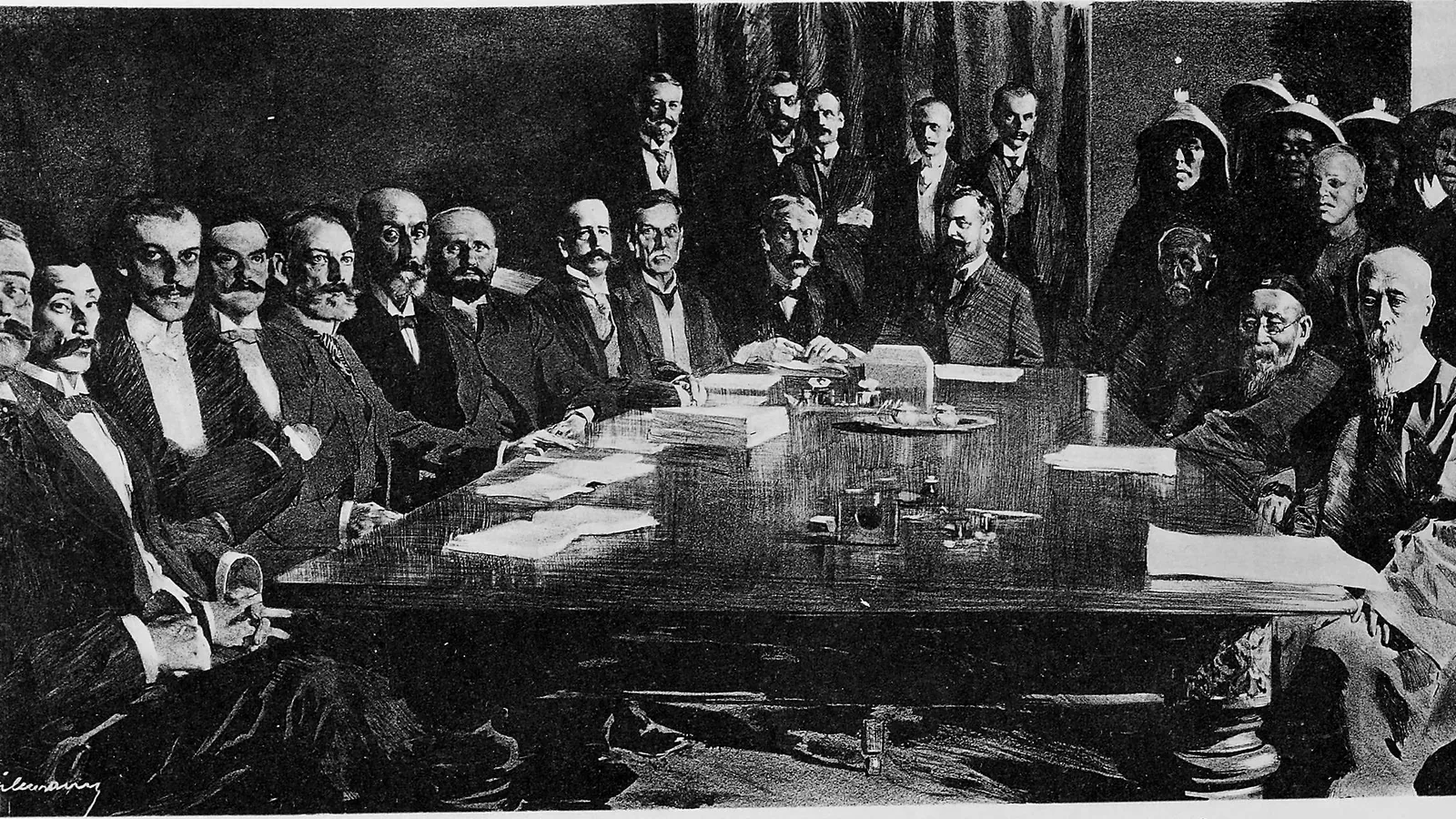
China agreed to pay an indemnity of 450,000,000 Haikwan taels under Article VI of the treaty signed at Peking on September 7, 1901. “By an Imperial Edict dated the 29th May, 1901, His Majesty the Emperor of China agreed to pay the Powers an indemnity of 450,000,000 of Haikwan taels,” the article reads. Plenipotentiaries of eleven powers and China signed that day. The document, published in full by the Queen’s University Belfast reparations project, fixed the interest at 4 percent a year and set China to repay the capital over 39 years, from January 1, 1902 through the end of 1940.
Quick facts
- When
- September 7, 1901 (protocol signed at Peking); amortization set to run January 1, 1902 to the end of 1940; May 25, 1908 (joint resolution authorizing US remission)
- Where
- Peking (Beijing) legation quarter; the forts of Taku; twelve points between Peking and the sea, including Tientsin and Shan-hai Kuan
- Who
- Li Hongzhang and Prince Ch'ing (Yikuang) for China; plenipotentiaries of Germany, Austria-Hungary, Belgium, Spain, the United States, France, Great Britain, Italy, Japan, the Netherlands and Russia; Secretary of State Elihu Root; Minister W. W. Rockhill
- Outcome
- China accepted an indemnity of 450,000,000 Haikwan taels at 4 percent over 39 years, razed the Taku forts, opened the legation quarter to foreign guards and sent apology missions to Germany and Japan. In 1908 the United States limited its own bond to a fraction of the sum and called the remainder "an act of friendship."
Peking, June to August 1900
The protocol closed a conflict the Naval History and Heritage Command (NHHC) summarizes this way: the foreign legations in Peking “had been under siege since 20 June, and the legation guard would be forced to hold out for 55 days until an international relief force arrived at Beijing on 14 August.” That force drew troops from the United States, Austria-Hungary, Great Britain, France, Germany, Italy, Japan and Russia. The State Department’s Office of the Historian places the diplomacy of the period around Secretary of State John Hay, whose Open Door circulars of 1899 and 1900 had already set the American position in China; the Office’s Milestones page frames Hay’s China policy as an effort “to preserve Chinese territorial and administrative integrity” while other powers pressed for concessions on the mainland.
The indemnity, the quarter and the forts
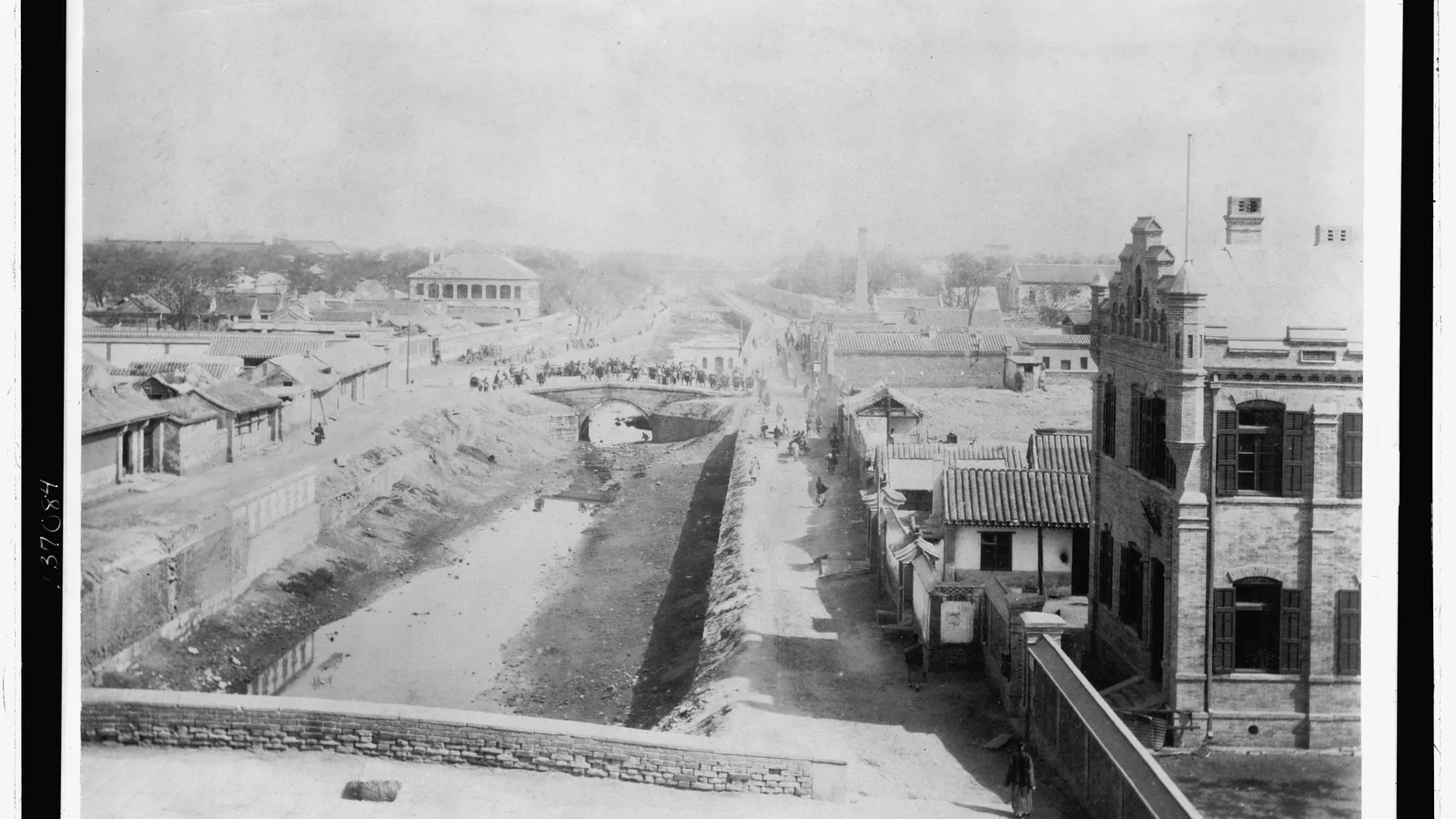
The treaty text itself carries the indemnity’s terms and its collateral. Article VI names the security for repayment as “the balance of the revenues of the Imperial Maritime Customs,” the native customs revenues administered at the open ports, and “the total revenues of the salt gabelle.” Article VII fixed the legation quarter as ground “specially reserved” for the ministers’ “exclusive control,” closed to Chinese residence and permitted to be made defensible; a separate agreement of January 16, 1901 had already recognized each legation’s right to keep a resident guard there. Article VIII recorded that “the Chinese Government has consented to raze the forts of Taku, and those which might impede free communication between Peking and the sea.” Article IX listed twelve points between Peking and the coast, from Huang-tsun and Tientsin to Shan-hai Kuan, where foreign troops could be stationed to keep that road to the sea open. Article XII, at the treaty’s close, reorganized the old Tsungli Yamen into a Ministry of Foreign Affairs, the Wai Wu Pu, ranked above the other six ministries of state, and specified that of the annexed foreign documents “the French text only is authoritative.”
,_Japanese_(on_right)_LCCN2006689697.jpg)
Officials punished, envoys sent
The protocol also fixed a reckoning with individuals. Article II sentenced Prince Tuan and Duke Fu-kuo to trial before the Autumnal Court of Assize, ordered several officials, among them Prince Chuang, to “commit suicide,” and named others condemned to death outright; the text records the dates on which each sentence was carried out, from February 21 to February 26, 1901. The same article suspended official examinations for five years in every city where foreigners had been killed or mistreated. Article I appointed Prince Ch’un as envoy to Berlin “to convey to His Majesty the German Emperor the expression of the regrets” over the assassination of Baron von Ketteler, the German minister, with a memorial arch to be raised on the site; Article III sent Na T’ung to Japan to make “honorable reparation” for the killing of Sugiyama, chancellor of the Japanese legation.
"A tael for each": NHHC's accounting
The NHHC page carries a specific reading of the indemnity’s size: it states that the protocol “mandated that the Chinese would have to pay 450 million taels (about $350 million then, over $11 billion today) over 39 years, a tael for each of China’s estimated population of 450 million.” The protocol text gives no such reasoning, and no other institution’s account confirms that the sum was set to match the population count on purpose. The same NHHC page gives the eventual cost of the 39-year schedule in dollars: “the Chinese had paid an estimated $600-$700 million” by 1940, once interest had accrued, with Russia drawing the largest share, over 28 percent, and the United States about 7 percent.
1908: a partial remission
The Department of State’s published Foreign Relations volume for 1908 prints the text Secretary Root sent Minister Rockhill on May 27 that year: an act of Congress “authorizing the return to the Government of China a portion of the indemnity exacted to repay losses sustained by reason of the Boxer disturbances of 1900.” The joint resolution itself, Public Resolution No. 29, limited the American bond of December 15, 1906 so that “the total payment to be made by China under the said bond shall be limited to the sum of thirteen million six hundred and fifty-five thousand four hundred and ninety-two dollars and sixty-nine cents and interest,” down from twenty-four million four hundred forty thousand seven hundred seventy-eight dollars and eighty-one cents, with the remainder released “as an act of friendship.” Michael H. Hunt’s 1972 article in The Journal of Asian Studies reexamined that gesture and traced Hay’s original 1901 claim of $25 million against China, a figure Hunt concludes was “nearly twice real American claims against China for damages done in the summer of 1900.” Tsinghua University’s own English-language history page states that the school “was established in 1911, originally under the name ‘Tsing Hua Imperial College,’” and does not mention the Boxer indemnity anywhere in its account of that founding. The joint resolution also set aside two million dollars from the 1900 indemnity for pending American claims, with any balance left over “returned to the Chinese Government” once those claims were settled. Root’s cable asked Rockhill to gather “suggestions from the Government of China bearing upon the times and manner in which the remission shall be made.”
Key facts
- The Boxer Protocol was signed at Peking on September 7, 1901, by plenipotentiaries of China and eleven powers, among them Li Hongzhang and Prince Ch’ing (protocol text).
- Article VI set the indemnity at 450,000,000 Haikwan taels, at 4 percent interest, repayable over 39 years, January 1, 1902 to the end of 1940 (protocol text).
- Repayment was secured on Imperial Maritime Customs revenue, native customs revenue at the open ports and the salt gabelle (protocol text, Article VI).
- Article VII placed the Peking legation quarter under the exclusive control of the ministers, closed to Chinese residence (protocol text).
- Article VIII ordered the Taku forts razed; Article IX fixed twelve points between Peking and the sea where foreign troops could be stationed (protocol text).
- NHHC states the indemnity equaled “a tael for each of China’s estimated population of 450 million,” and that interest raised the eventual cost to an estimated $600-$700 million by 1940 (NHHC).
- Public Resolution No. 29, transmitted May 27, 1908, limited the American bond to $13,655,492.69 and released the remainder “as an act of friendship” (FRUS 1908, Document 54).
- Tsinghua University’s own English history page dates its founding to 1911 as “Tsing Hua Imperial College” without mentioning the Boxer indemnity (Tsinghua University).
FAQ
How much was the Boxer Protocol indemnity and over what period was it repaid?
Article VI of the protocol, signed September 7, 1901, set the indemnity at 450,000,000 Haikwan taels, bearing 4 percent annual interest, with the capital to be repaid by China over 39 years, from January 1, 1902 through the end of 1940.
Did the United States return part of the Boxer indemnity?
Yes. A joint resolution transmitted by Secretary of State Elihu Root on May 27, 1908, Public Resolution No. 29, limited the American bond of December 15, 1906 to $13,655,492.69 with interest, releasing the rest of the original $24,440,778.81 obligation "as an act of friendship."
Did the Boxer indemnity fund Tsinghua University?
Tsinghua University's own English-language history page states the school was established in 1911 as "Tsing Hua Imperial College" and does not mention the Boxer indemnity anywhere in that account.
Sources
- Boxer Protocol (Xinchou Treaty), Peking, September 7, 1901, full English text, Queen's University Belfast, "Reparations, Responsibility and Victimhood in Modern History" project
- U.S. Department of State, Office of the Historian, "Milestones in the History of U.S. Foreign Relations: Hay and the Open Door in China"
- U.S. Department of State, Office of the Historian, Foreign Relations of the United States, 1908, Document 54
- U.S. Navy, Naval History and Heritage Command, "The Boxer Rebellion: Bluejackets and Marines in China, 1900-1901"
- Tsinghua University, official English website, "History" page
- Michael H. Hunt, "The American Remission of the Boxer Indemnity: A Reappraisal," The Journal of Asian Studies, vol. 31, no. 3 (May 1972), pp. 539-558
Cite this article
- APA
- Our Earth's History. (2026, September 26). Four hundred fifty million taels: the Boxer Protocol of 1901. Our Earth's History. https://ourearthshistory.com/east-asia/modern/boxer-protocol-september-7-1901-450-million-taels-39-years-1908-remission/
- Chicago
- Our Earth's History. “Four hundred fifty million taels: the Boxer Protocol of 1901.” Our Earth's History, September 26, 2026. https://ourearthshistory.com/east-asia/modern/boxer-protocol-september-7-1901-450-million-taels-39-years-1908-remission/.
- MLA
- “Four hundred fifty million taels: the Boxer Protocol of 1901.” Our Earth's History, 26 Sep. 2026, https://ourearthshistory.com/east-asia/modern/boxer-protocol-september-7-1901-450-million-taels-39-years-1908-remission/.
Text licensed CC BY-NC-ND 4.0. Found an error? Tell us.