Loan 281 JA: the World Bank's $80 million and the first Shinkansen
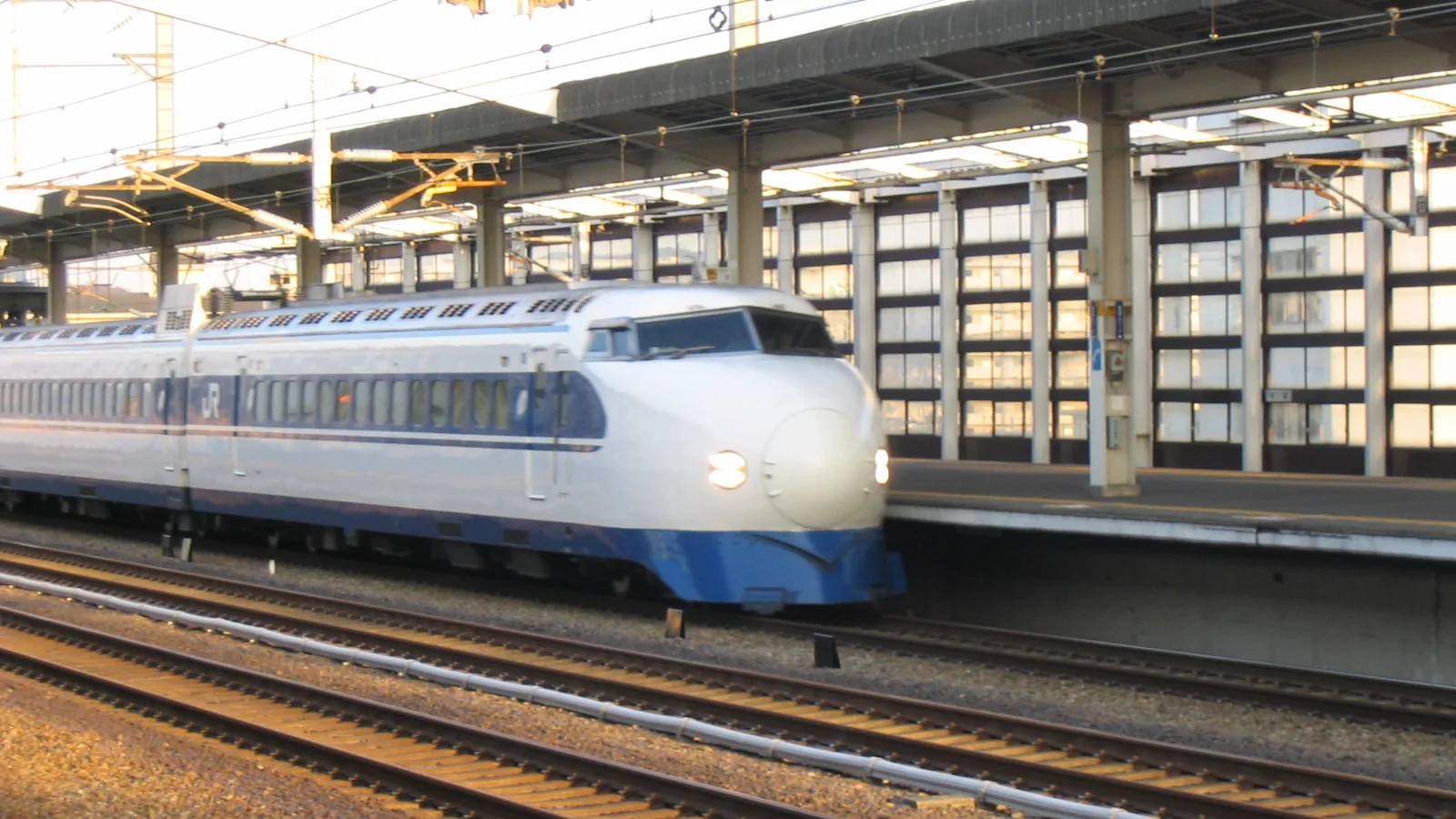

TL;DR — The World Bank lent Japanese National Railways $80 million on May 2, 1961 for a 500-kilometer line; it opened on October 1, 1964 at nearly double its approved budget.
Loan Number 281 JA opens with one sentence: “AGREEMENT, dated May 2, 1961, between INTERNATIONAL BANK FOR RECONSTRUCTION AND DEVELOPMENT (hereinafter called the Bank) and JAPANESE NATIONAL RAILWAYS (hereinafter called the Borrower).” Section 2.01 lends “an amount in various currencies equivalent to eighty million dollars ($80,000,000),” and the signatures at the end of the document are those of W. A. B. Iliff, vice president of the Bank, and Shinji Sogo, president of Japanese National Railways (JNR), signing as authorized representative. Schedule 2 describes “about 500 kilometers of double track of standard gauge” between Tokyo and Osaka and expects the project “completed by mid-1964.” The line, the Tokaido Shinkansen, opened on October 1, 1964. Hideo Shima, the JNR engineer who explained the plan in Washington, wrote in 1994 that the Cabinet had approved ¥194.8 billion in December 1958 and that “the budget was increased twice to 380 billion yen.”
Quick facts
- When
- May 10, 1956 (JNR feasibility team) · December 19, 1958 (project authorized) · April 20, 1959 (construction begins) · March 24, 1961 (World Bank appraisal) · May 1, 1961 (loan approved) · May 2, 1961 (loan agreement signed) · October 1, 1964 (line opens) · November 15, 1964 (first repayment due) · 1972 (San'yo Shinkansen opens)
- Where
- A new standard-gauge double-track line between Tokyo and Osaka via Yokohama, Nagoya and Kyoto, in Japan; the agreement was signed in Washington, D.C.
- Who
- Shinji Sogo, president of Japanese National Railways from 1955 to 1963; Hideo Shima, its vice president for engineering; W. A. B. Iliff, vice president of the World Bank; Eisaku Sato, minister of finance; Koichiro Asakai, ambassador of Japan in the United States
- Outcome
- A line the World Bank described as about 500 kilometers opened on October 1, 1964 at a cost Shima put at ¥380 billion against ¥194.8 billion approved in 1958; Sogo and Shima resigned before the opening
A team in 1956, a Cabinet decision in 1958, a first shovel in 1959
Sogo took office as president of JNR in 1955 and asked Shima, who had left the railways for a private company, to return as vice president for engineering. Shima’s memoir describes the problem they faced: the Tokaido Line, 556 kilometers between Tokyo and Osaka, carried 24 percent of JNR’s passengers on 3 percent of its route and was, in his words, “almost saturated.” A World Bank archives exhibit of 2003 dates JNR’s feasibility team to May 10, 1956, the authorization of the project to December 19, 1958, and the start of construction to April 20, 1959. The same exhibit prints “Service on the line began October 1, 1961,” a slip of three years; the agreement it describes, signed in May 1961, expected completion by mid-1964.
Shima remembered the December 1958 decision in figures: “the Cabinet decided to construct a separate new trunk standard-gauge line along the Tokaido Line with a construction period of 5 years and construction costs of ¥194.8 billion connecting Tokyo with Osaka in about 3 hours.” What worried the two men, he wrote, was money running out midway.
Eisaku Sato's suggestion and a trip to Washington
The minister of finance, Eisaku Sato, had been a manager in the Ministry of Railways in his youth. Shima’s account has Sato reasoning that a project too large for one Cabinet’s term needed a promise no later government could break, and that a World Bank loan, which required a government guarantee of completion, supplied it. JNR decided to ask for $80 million, and early in 1960 Shima went to the United States to answer questions on JNR’s finances, the profitability of the line, the choice of standard gauge and the need for foreign money.
One Bank rule excluded experimental techniques from loans. Shima wrote that he “persuaded the World Bank that shinkansen techniques included no experimental factor but was an integration of proven advanced technologies achieved under the slogan ‘Safety First’.”
The appraisal of March 24, 1961
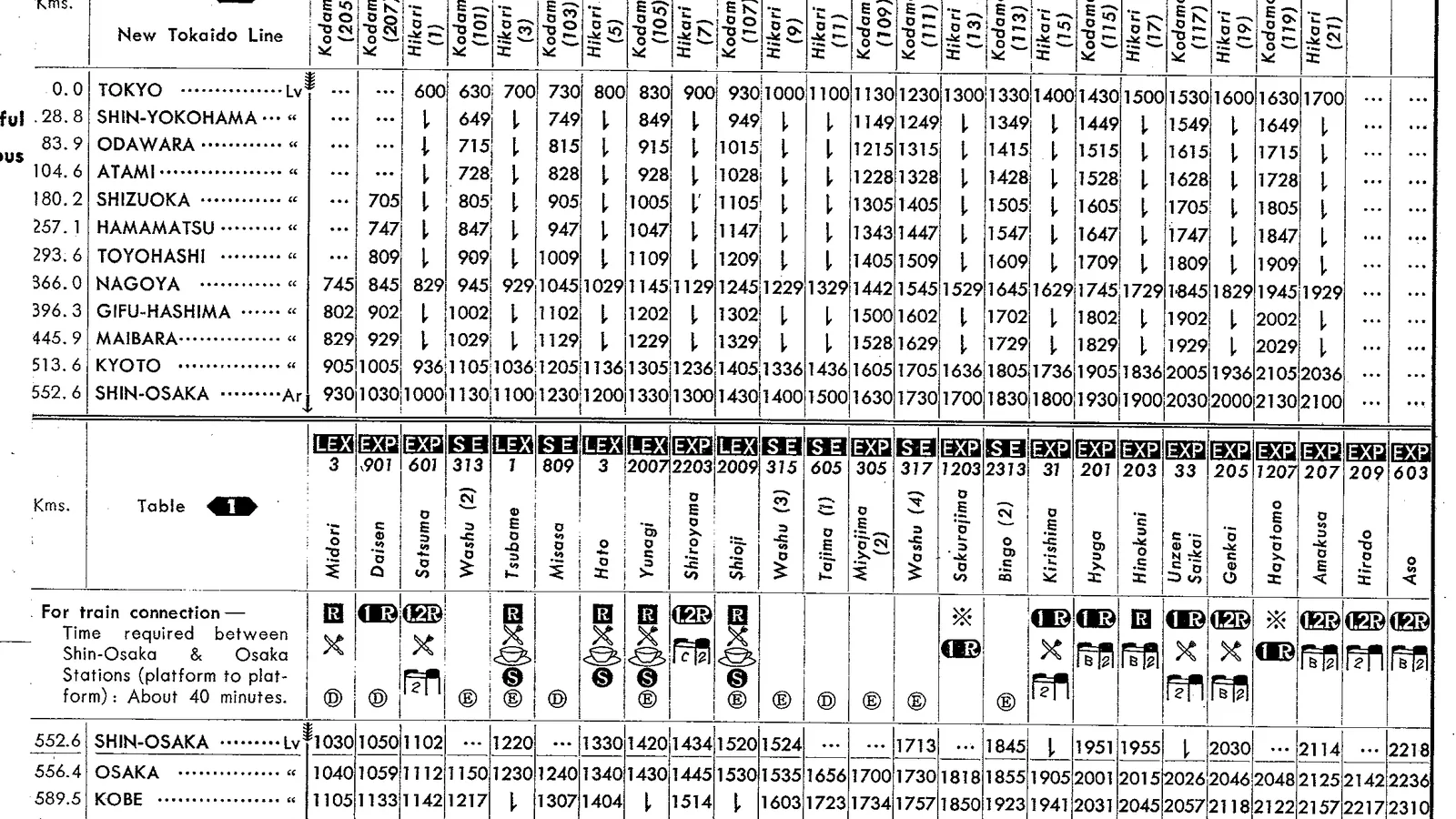
The Bank’s Department of Technical Operations put its findings in Report No. TO-266a. The new line would cut the railroad distance between Tokyo and Osaka “by 56 kms to 500 kms.” It would need 80 tunnels totaling 62 kilometers, the longest the Tanna Tunnel at 7.9 kilometers, plus 18.1 kilometers of bridges and a 2.2-kilometer subway under Tokyo. Passenger trains would run at 200 kilometers per hour by day and freight at 150 by night; the press release of May 2 gave the same design maximums as 125 and 94 miles an hour. Trains would run in sets of up to 16 cars seating about 1,250.
The report’s timetable set the existing line’s express and limited express, 8 hours 45 minutes and 6 hours 30 minutes, against the new line’s planned 4 hours and 3 hours. JNR’s estimate of the cost was ¥197,193 million, or $548 million at 360 yen to the dollar, including interest during construction. In JNR’s cash requirements for 1959/60 to 1965/66, ¥1,377.8 billion in all, the Bank loan amounted to 2.1 percent; the press release described it as about one seventh of the project’s cost, with the rest to come from JNR’s borrowings in Japan.
Twenty years at 5¾ percent
Press Release No. 682 announced “the fastest train service in the world,” 311 miles through the industrial heart of Japan, with service over the whole line planned “by the spring of 1964.” The loan ran 20 years at 5¾ percent a year, including a 1 percent commission for the Bank’s Special Reserve, and Japan guaranteed it; Koichiro Asakai, ambassador of Japan in the United States, signed for the guarantor. Schedule 1 of the agreement lists the repayments: $1,419,000 due on November 15, 1964, six weeks after the line opened, rising to $3,615,000 on May 15, 1981.
October 1, 1964, without the two men who planned it
Ryo Takagi, writing in Japan Railway & Transport Review in 2005, dated the opening to October 1, 1964, and called the Tokaido Shinkansen “the world’s first high-speed railway.” No two sources give the line the same length: about 500 kilometers in the World Bank appraisal, 513 kilometers in Hiroshi Okada’s 1994 article in the same journal, and 552.6 kilometers in the table of operating kilometers on JR Central’s site. None of these documents explains the gap between them. The Nationwide Shinkansen Development Law of 1970 led to the San’yo Shinkansen in 1972, JNR was divided and privatized in 1987, and JR Central’s own page counts approximately 7.0 billion passengers since 1964, a fastest Tokyo to Shin-Osaka time of 2 hours 21 minutes as of March 2023, and “No accidents resulting in fatalities or injuries of passengers on board since operations commenced.”
Shima’s memoir gives the cost of finishing on time. “It was a supreme priority to open the shinkansen before October 1964, when the Tokyo Olympic Games were to be held,” he wrote. “However, the budget approved by the government was cut due to political considerations, and the shortage became clear as construction progressed. It was a serious political problem. In the end, the budget was increased twice to 380 billion yen. Assuming responsibility for this matter, President Sogo resigned just before the completion of the shinkansen. I also left with him. Therefore, Mr. Sogo, who conceived the shinkansen and myself, who helped design it, did not attend the opening ceremony.” The journal’s note on its author records that both men left JNR in 1963.

Key facts
- Loan Number 281 JA, dated May 2, 1961, lent JNR “an amount in various currencies equivalent to eighty million dollars ($80,000,000)”; W. A. B. Iliff signed for the Bank and Shinji Sogo for JNR.
- The World Bank’s archives exhibit dates the feasibility team to May 10, 1956, authorization to December 19, 1958, the start of construction to April 20, 1959 and loan approval to May 1, 1961; it misprints the opening year as 1961.
- The Cabinet decision of December 1958 set five years and ¥194.8 billion for a Tokyo to Osaka run of about three hours (Shima, 1994).
- The appraisal of March 24, 1961 counted 80 tunnels over 62 kilometers, the Tanna Tunnel at 7.9 kilometers, 18.1 kilometers of bridges and a 2.2-kilometer subway in Tokyo.
- Design speeds: 200 kilometers per hour for passenger trains and 150 for freight (appraisal), or 125 and 94 miles an hour (press release); trains of up to 16 cars seating about 1,250.
- Estimated cost: ¥197,193 million, $548 million equivalent, including interest during construction; the Bank loan was 2.1 percent of JNR’s cash requirements for 1959/60 to 1965/66 and about one seventh of the project cost.
- Terms: 20 years at 5¾ percent including a 1 percent commission, guaranteed by Japan; the first repayment of $1,419,000 fell due on November 15, 1964, the last of $3,615,000 on May 15, 1981.
- Line length: about 500 kilometers (World Bank, 1961), 513 kilometers (Okada, 1994), 552.6 operating kilometers (JR Central); the line opened October 1, 1964 and the San’yo Shinkansen followed in 1972.
FAQ
How much did the World Bank lend for the Tokaido Shinkansen?
Eighty million dollars, under Loan Number 281 JA dated May 2, 1961, for 20 years at 5¾ percent. The Bank's own appraisal put the loan at 2.1 percent of JNR's cash requirements for 1959/60 to 1965/66, and its press release at about one seventh of the New Tokaido Line's estimated cost of $548 million.
How long is the Tokaido Shinkansen?
The figure depends on who is counting. The World Bank's 1961 documents describe about 500 kilometers, 56 kilometers shorter than the older Tokaido Line. Hiroshi Okada gave 513 kilometers in 1994. JR Central lists 552.6 operating kilometers. None of the three documents explains the differences.
Why did Shinji Sogo and Hideo Shima miss the opening on October 1, 1964?
Shima wrote that the government-approved budget had been cut, that the shortfall became clear during construction, and that the budget was raised twice to ¥380 billion against ¥194.8 billion approved in 1958. Sogo resigned to take responsibility shortly before completion; Shima left with him, and neither attended the opening ceremony.
Sources
- World Bank, Loan Agreement (New Tokaido Line Project), Loan Number 281 JA, between International Bank for Reconstruction and Development and Japanese National Railways, dated May 2, 1961 (conformed copy, 13 pages).
- World Bank, Department of Technical Operations, Appraisal of the Japanese National Railways New Tokaido Line Project, Japan, Report No. TO-266a, March 24, 1961.
- World Bank, Press Release No. 682, "$80 million loan for Japanese Railways," May 2, 1961.
- World Bank Group Archives, Exhibit Series No. 009, "The Bank and Japan's Bullet Trains" (February 2003; reissued January 2016).
- Hideo Shima, "Birth of The Shinkansen: A Memoir," Japan Railway & Transport Review no. 3 (October 1994), pp. 45–48, East Japan Railway Culture Foundation.
- Hiroshi Okada, "Features and Economic and Social Effects of The Shinkansen," Japan Railway & Transport Review no. 3 (October 1994), pp. 9–16.
- Ryo Takagi, "High-speed Railways: The Last 10 Years," Japan Railway & Transport Review no. 40 (March 2005), pp. 4–7.
- Takashi Kitagawa, "Extending the Shinkansen Network," Japan Railway & Transport Review no. 40 (March 2005), pp. 14–17.
- Central Japan Railway Company (JR Central), "About the Shinkansen" (figures as of FY2023 and the March 2023 timetable revision).
- Central Japan Railway Company (JR Central), "Operating Area" (operating kilometers by line).
Cite this article
- APA
- Our Earth's History. (2026, September 22). Loan 281 JA: the World Bank's $80 million and the first Shinkansen. Our Earth's History. https://ourearthshistory.com/east-asia/contemporary/tokaido-shinkansen-1964-first-bullet-train/
- Chicago
- Our Earth's History. “Loan 281 JA: the World Bank's $80 million and the first Shinkansen.” Our Earth's History, September 22, 2026. https://ourearthshistory.com/east-asia/contemporary/tokaido-shinkansen-1964-first-bullet-train/.
- MLA
- “Loan 281 JA: the World Bank's $80 million and the first Shinkansen.” Our Earth's History, 22 Sep. 2026, https://ourearthshistory.com/east-asia/contemporary/tokaido-shinkansen-1964-first-bullet-train/.
Text licensed CC BY-NC-ND 4.0. Found an error? Tell us.