Chinese jars in a mosque platform: David Whitehouse at Siraf, 1966

TL;DR — Excavations at Siraf, 1966 to 1973, found Chinese stoneware in a mosque platform of about 800; Aubin and a 2020 thesis traced its decline to pirates and the sea.
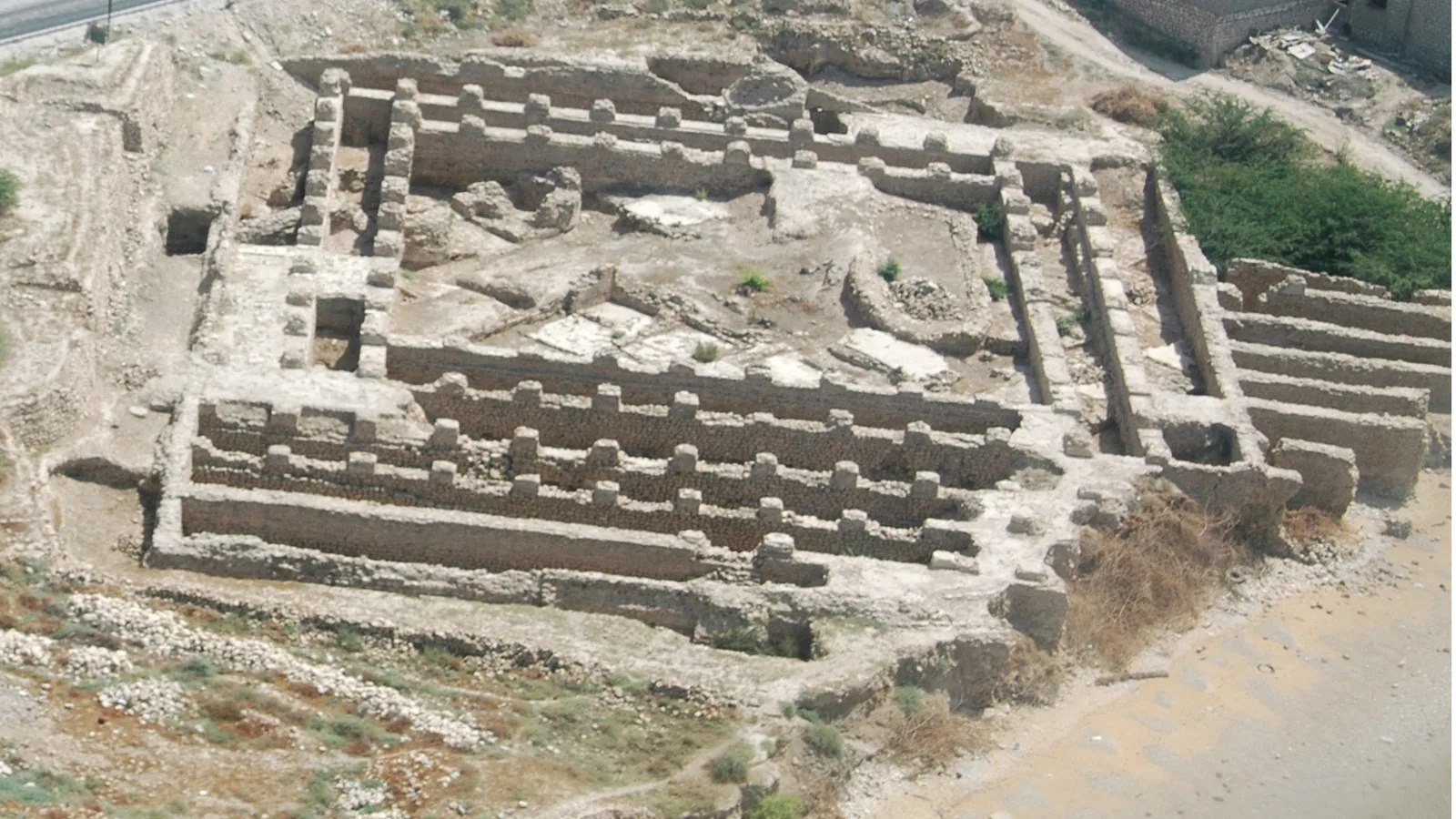
“The platform of the principal mosque, built ca. 184-94/800-10, contained pieces of Chinese stoneware storage jars and stoneware bowls with underglaze-painted ornament.” David Whitehouse wrote that sentence for the Encyclopaedia Iranica in 1991, about a building he had dug himself. From 1966 to 1973 he led six seasons of excavation for the British Institute of Persian Studies at Siraf, a port on the north coast of the Persian Gulf about 200 km south of Bushehr, in what is now Iran. Two Arabic accounts of 851 and about 916 describe the same harbor from the water side. The port’s end is harder to date, and three scholars writing between 1959 and 2020 gave three different accounts of it.
Quick facts
- When
- 1966 to 1973 (six excavation seasons) · about 800 to 810 (mosque platform built) · 851 and about 916 (the two Arabic accounts) · 977 (earthquake) · 1972/73 (hinterland survey)
- Where
- Siraf, on the north coast of the Persian Gulf about 200 km south of Bushehr, in what is now Iran
- Who
- David Whitehouse and the British Institute of Persian Studies; T. J. Wilkinson; the merchant Sulayman; Abu Zayd al-Hasan of Siraf; the historian Jean Aubin; the geoarchaeologist Majid Pourkerman
- Outcome
- The excavations found Chinese stoneware in the platform of the principal mosque, built about 800 to 810, and later Chinese white wares above it. Jean Aubin held that neither the 977 earthquake nor the pull of Suhar ended the port, and a 2020 thesis linked its decline to sea level and coastal erosion
Six seasons inside the city walls
T. J. Wilkinson set out the project’s frame in Paléorient in 1974. The work ran “over six seasons from 1966-1973,” and most of the digging was concentrated within the city walls. The site measured about 4 by 0.5 km, a strip of coastal plain under the southern Zagros mountains. By about 850, in his summary, Siraf was a flourishing entrepôt with palaces, wealthy merchants’ quarters, a citadel and numerous mosques, and the city had grown with sea trade between the Middle East and China, India and East Africa.
The excavations also found a Sasanian Siraf and a small settlement of around the 15th century. Much of the ground was deserted in his day, but a village of about 2,000 people lived in the eastern part of the old city.
Stoneware beneath the principal mosque
In Whitehouse’s account the platform, built about 800 to 810, held Chinese stoneware jars and bowls. “White ware was completely absent, however,” he added. Later deposits, probably of the ninth century, yielded many Chinese cream or white stoneware bowls with ridged and indented rims, which he called the prototypes of Islamic white-glazed bowls, along with green-ware ewers.
He used the Siraf layers to order the local glazed pottery as well, from white-glazed wares in the ninth century to luster painting perhaps as late as the early tenth. Around 1025 to 1050 a hard red incised ware appeared, known in the Siraf reports as “style III.” Whitehouse counted unglazed pottery as more than 90 percent of all tenth-century pottery found at Siraf.
Sulayman the merchant and Abu Zayd of Siraf
A 1922 review in the Bulletin de l’École française d’Extrême-Orient, of G. Ferrand’s new French translation, dated the text of the merchant Sulayman to 851 and the remarks of Abu Zayd of Siraf to about 916, the second an appendix to the first. The reviewer called Siraf the great emporium from which ships left for Canton, and faulted the earlier translations by Eusèbe Renaudot and by Reinaud for serious geographical errors.
An English version of Renaudot’s work, printed in London in 1733, gives the sailing order. “Most of the Chinese Ships take in their Cargo at Siraf,” it reads, and “From Basra to Siraf is 120 Leagues, and when Ships have loaded at this last Place, they there water also.” From there the ships sailed for a place it calls Mascat, in Oman, about 200 leagues from Siraf. In China, “Canfu is the Port for all the Ships and Goods of the Arabs, who trade in China.”
Abu Zayd’s part adds the hulls. “[N]one but the Ships of Siraf are so put together that the Planks are not nailed [or bolted], but joined together in an extraordinary Manner as if they were sewn,” the translation reads, where the ships of the Mediterranean and the Syrian coast were nailed. He also wrote that a revolt in China, led by a man the translation calls Baichu, had “interrupted the ordinary Navigation from Siraf to China.” The text gives no year for it.
977: an earthquake, the pirates of Qays and a rising sea
Wilkinson’s 1974 summary put three events side by side: “in A.D. 977 an earthquake damaged the city, the political climate changed and a period of rapid decline followed.” Trade, he wrote, was diverted to Qais, an island over 200 km away, and only a small population stayed on in the ruins.
Jean Aubin, writing in the Cahiers de civilisation médiévale in 1959, had already rejected the earthquake as the cause. Neither the earthquake that damaged the city in 977 nor the drift of trade to Suhar, in Oman, had brought Siraf down, he argued. Once the Buyid dynasty was gone, pirates from the island of Qays made the sea unsafe, and “Sîrâf ne pouvait subsister dès lors que ses communications étaient paralysées”: Siraf could not survive once its communications were paralyzed. Aubin added that the geographer Muqaddasi had noted the first signs of decline at the end of the tenth century, and that part of the population moved to Qays. By the end of the 11th century, after a Seljuk governor of Fars had tried and failed to revive it, Siraf had fallen to a local port.
Majid Pourkerman’s geoarchaeology thesis, defended at Aix-Marseille Université on December 11, 2020, looked at the shore. Its published abstract links a rise in relative sea level and increasing coastal erosion under the winter Shamal winds to “the degradation of harbour potentialities” at Siraf, possibly the origin of its economic decline over a period of about 150 years. The abstract names no earthquake.

"Wells, cisterns and conduits"
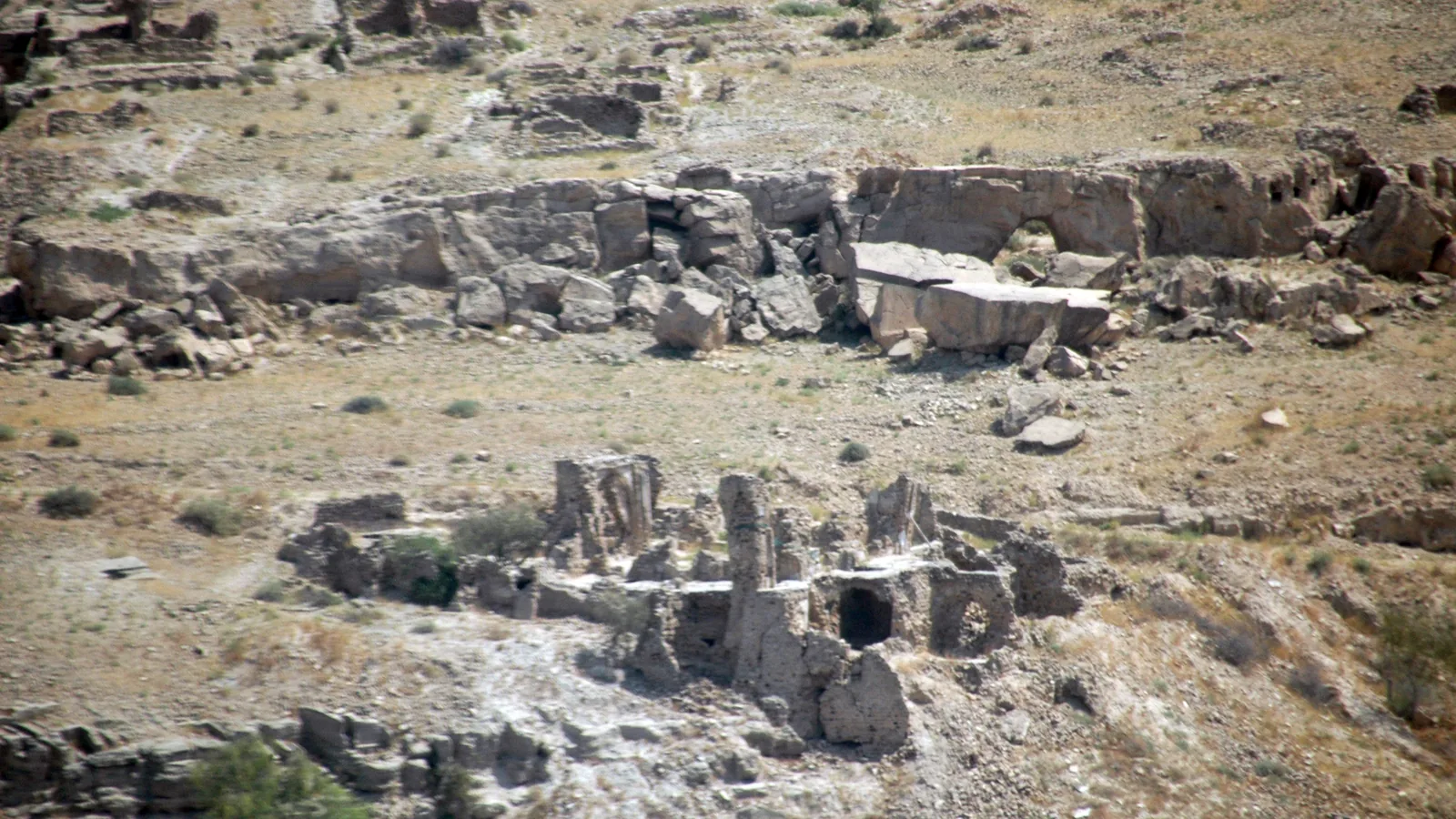
The sixth season, in 1972/73, left the city walls for the hinterland. The tenth-century writer Istakhri, as Wilkinson summarized him, had reported water, fruit and vegetables in short supply at Siraf, with vegetables brought from the district of Jam. Water “was provided by wells, cisterns and conduits,” the conduits being “shallow, mortar-lined open channels measuring about 40 cm in width and 25 cm in depth,” which carried water from pools in the river headwaters to the fields and the city. Inland travel went by rough donkey tracks over high passes to the valleys of Jam and Galehdar. In the Doband valley Wilkinson estimated the loss: at least 1,000 by 300 meters of land had been removed since the ninth and tenth centuries.
Whitehouse’s Siraf III, on the congregational mosque and the other mosques of the ninth to 12th centuries, appeared in London in 1980, and Nicholas Lowick’s Siraf XV, on the coins and monumental inscriptions, in 1985. In 2009 Oxbow Books issued Siraf: History, topography & environment by Whitehouse, Donald Whitcomb and Wilkinson, the first volume of the institute’s Archaeological Monograph Series.
Key facts
- The British Institute of Persian Studies excavated Siraf under David Whitehouse over six seasons from 1966 to 1973 (Wilkinson, 1974).
- The site measured about 4 by 0.5 km; by about 850 the city had palaces, merchants’ quarters, a citadel and numerous mosques (Wilkinson, 1974).
- The platform of the principal mosque, built about 800 to 810, held Chinese stoneware jars and bowls but no white ware (Whitehouse, Encyclopaedia Iranica).
- Chinese cream or white stoneware bowls appeared in later deposits, probably of the ninth century (Whitehouse).
- Unglazed pottery made up more than 90 percent of tenth-century pottery found at Siraf (Whitehouse).
- The merchant Sulayman’s account is dated to 851 and Abu Zayd’s remarks to about 916; Abu Zayd described Siraf’s ships as sewn rather than nailed (1922 review; Renaudot translation).
- Jean Aubin wrote in 1959 that neither the 977 earthquake nor the loss of trade to Suhar ended Siraf, and blamed piracy from Qays after the fall of the Buyids.
- A 2020 thesis by Majid Pourkerman linked Siraf’s decline to relative sea level and coastal erosion under winter Shamal winds.
FAQ
Did the earthquake of 977 destroy Siraf?
It damaged the city, according to both Wilkinson and Aubin. Aubin wrote in 1959 that the earthquake did not bring the port down, and placed the cause in piracy from the island of Qays after the Buyids fell. A 2020 thesis by Majid Pourkerman pointed to sea level and coastal erosion and did not mention the earthquake.
What did the excavations under the Siraf mosque find?
The platform of the principal mosque, built about 800 to 810, contained pieces of Chinese stoneware storage jars and bowls with painted decoration under the glaze. Whitehouse recorded that white ware was absent from that platform and appeared in later deposits of the ninth century.
Who were Sulayman and Abu Zayd al-Sirafi?
Sulayman was a merchant whose account of India and China is dated to 851. Abu Zayd al-Hasan, a native of Siraf, added remarks to it around 916. A 1922 review of G. Ferrand's translation described him as an amateur of geography who gathered reports from sailors in his home port.
Sources
- T. J. Wilkinson, "Agricultural Decline in the Siraf Region, Iran," Paléorient 2/1 (1974), pp. 123-132 (Persée).
- David Whitehouse, "Ceramics xiii. The Early Islamic Period, 7th-11th Centuries," Encyclopaedia Iranica, vol. V, fasc. 3 (1991).
- British Institute of Persian Studies, Monograph Series (publication list).
- Review of G. Ferrand, Voyage du marchand arabe Sulaymân en Inde et en Chine, rédigé en 851, suivi de remarques par Abû Zayd Hasan (vers 916), Bulletin de l'École française d'Extrême-Orient 22 (1922), p. 328 (Persée).
- Ancient Accounts of India and China, by Two Mohammedan Travellers, trans. Eusebius Renaudot (London, 1733), full text on the Internet Archive.
- Jean Aubin, "La ruine de Sîrâf et les routes du Golfe Persique aux XIe et XIIe siècles," Cahiers de civilisation médiévale 2/7 (1959), pp. 295-301 (Persée).
- Majid Pourkerman, Geoarchaeology of some Persian Gulf ancient harbours, doctoral thesis, Aix-Marseille Université, defended December 11, 2020; abstract in Ecologia Mediterranea 46/2 (2020), pp. 115-116 (Persée).
Cite this article
- APA
- Song Letter. (2026, September 30). Chinese jars in a mosque platform: David Whitehouse at Siraf, 1966. Our Earth's History. https://ourearthshistory.com/west-asia/medieval/siraf-1966-whitehouse-persian-gulf-port/
- Chicago
- Song Letter. “Chinese jars in a mosque platform: David Whitehouse at Siraf, 1966.” Our Earth's History, September 30, 2026. https://ourearthshistory.com/west-asia/medieval/siraf-1966-whitehouse-persian-gulf-port/.
- MLA
- Song Letter. “Chinese jars in a mosque platform: David Whitehouse at Siraf, 1966.” Our Earth's History, 30 Sep. 2026, https://ourearthshistory.com/west-asia/medieval/siraf-1966-whitehouse-persian-gulf-port/.
Get the week in history
One email a week: the new articles, and what was happening elsewhere at the same moment. Free, no ads, unsubscribe any time. How we handle your email.
Text licensed CC BY-NC-ND 4.0. Found an error? Tell us.