Four sealed translations in 1857: Rawlinson, Behistun and cuneiform

TL;DR — Rawlinson copied Darius’s trilingual Behistun text in 1835-47; in 1857 four sealed translations of an Assyrian text were opened and found closely alike.
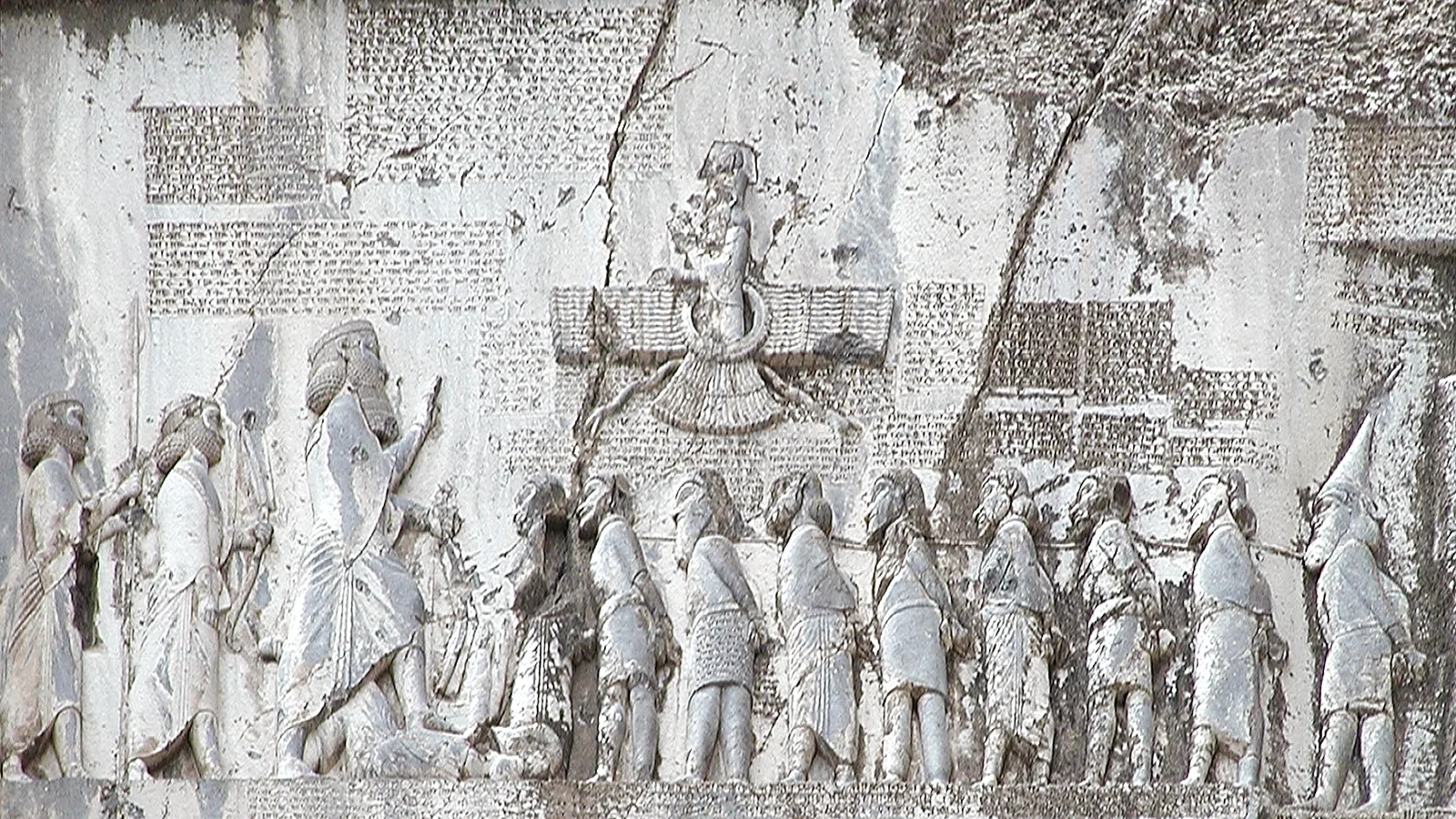
Iranica’s “BISOTUN iii” states that Darius “had the stairway removed and the path and part of the cliff sheared off, eliminating all means of access to the relief and inscriptions.” The order came once the monument was finished. Henry Creswicke Rawlinson first saw the cliff in April 1835, after copying the Darius and Xerxes inscriptions at Mount Alvand near Hamadan. Iranica’s “RAWLINSON ii” (Peter T. Daniels) records that “his military duties prevented him from investigating the inscriptions (DB) until more than a year later.” Behistun is spelled Bisotun in Iranica’s own articles.
Quick facts
- When
- 1835 (Rawlinson's first sight of the cliff) - 1836-37, 1844 and 1847 (his copying campaigns) - May 29, 1857 (the Royal Asiatic Society's sealed-translation test)
- Where
- Bisotun cliff, near Kermanshah, western Iran
- Who
- Henry Creswicke Rawlinson; Georg Friedrich Grotefend; Edward Hincks; Jules Oppert; W. H. Fox Talbot; Edwin Norris; A. H. Sayce
- Outcome
- The Royal Asiatic Society's jury compared four independently sealed translations of a Tiglath-Pileser I inscription and pronounced the decipherment of cuneiform a success
Ctesias measured the cliff in stades
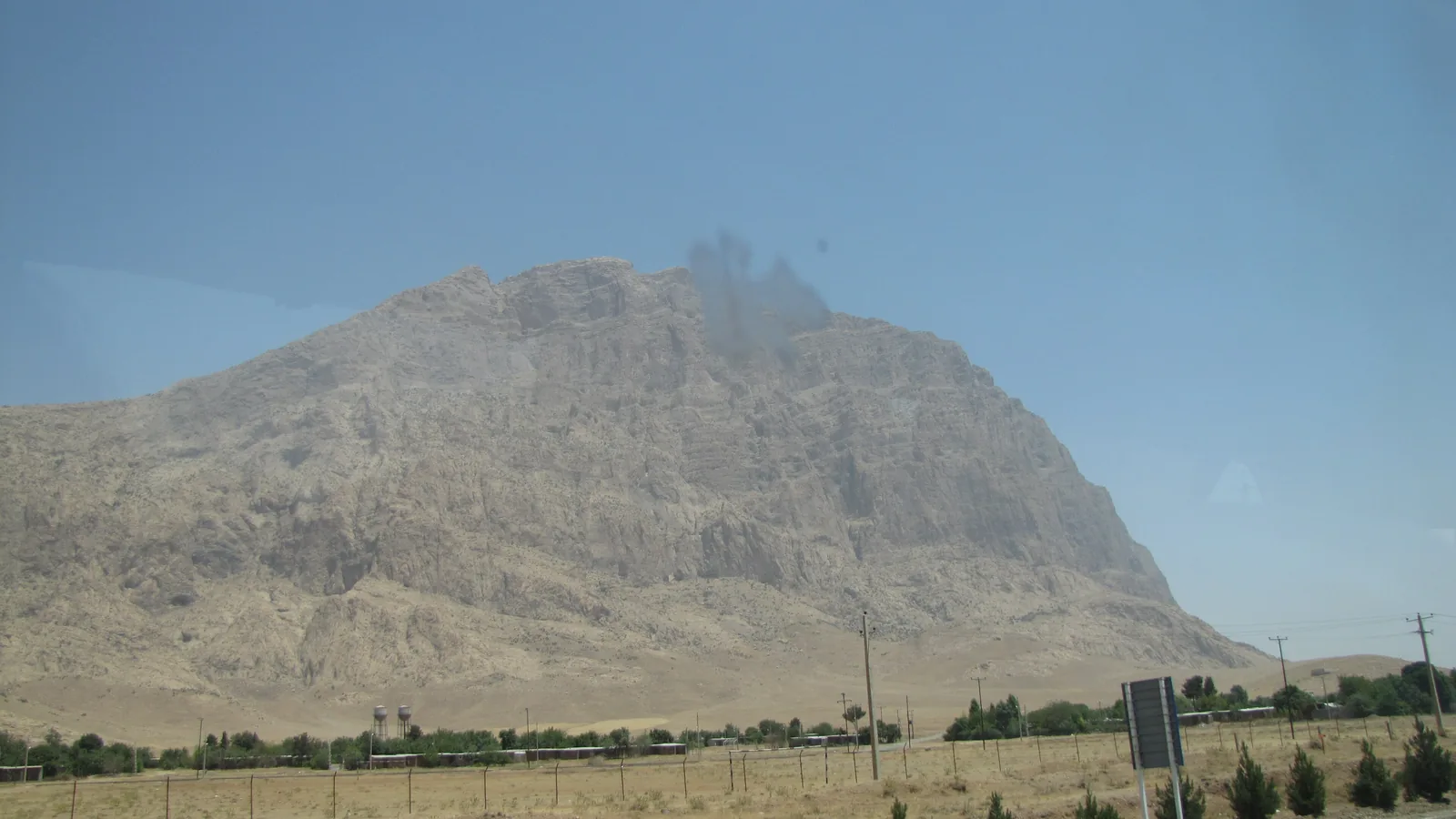
The ancient description, via Diodorus quoting Ctesias, gives “Mt. Bagistanon with its sheer cliffs rising to a height of 17 stades.” The relief itself sits about 66 m above the springs on the plain and measures roughly 3 m by 5.5 m; local people call it “The Nine Dervishes.” The trilingual text beneath and around it runs to five columns of Old Persian totaling 414 lines, a first Elamite version of 323 lines, a second Elamite version of 260 lines and a Babylonian version of 112 lines, the whole inscribed area about 7.80 m high and 22 m wide. Darius’s own text proclaims his right to the throne and lists the nine rebels he put down after 522 BC.
Grotefend read ten signs in 1802
Iranica’s “CUNEIFORM SCRIPT” traces the path to that reading: Carsten Niebuhr published more precise copies in 1778, O. G. Tychsen identified the oblique wedge as a word divider in 1798, and Friedrich Münter attributed the texts to the Achaemenid kings in 1802. Grotefend, working from the pattern of Sasanian royal inscriptions that Antoine Silvestre de Sacy had deciphered a few years earlier, “was able to ascertain the approximate phonic values of about ten signs” and presented his paper to the Göttingen Academy of Sciences on September 4, 1802. He “regarded himself only as the decipherer of the texts and did not attempt to interpret them from philological and historical viewpoints.” Rawlinson began his own work in 1835 “aware that Professor Grotefend had decyphered some of the names of the early sovereigns of the house of Achaemenes,” and reached the same result independently.
1837 to 1847: three campaigns on the rock
Rawlinson copied at Behistun across three periods: 1835-37, 1844 and 1847. By early 1837 “he transcribed almost half of the Old Persian and finished the rest of it in the first week in September.” He returned September 4-10, 1844, to recopy the Old Persian, take paper squeezes of the Elamite and the detached Babylonian labels, and carve his name below the inscriptions. On how he reached the ledge, Iranica’s own “BISOTUN iii” states that he “had himself let down by ropes from the top of the cliff.” Daniels, in “RAWLINSON ii,” gives a different account of the same May 1836 climb: “on no occasion was he ‘let down by ropes,’” writing instead that Rawlinson “climbed repeatedly up to the ledge.” Not until September 1847 did Rawlinson copy the main Babylonian text, first “by telescope twice over,” then by hiring a “wild Kurdish boy” (Daniels notes that “in early accounts, two boys” are mentioned) “to scramble up the cliff, rig a sort of bosun’s chair and make squeezes.”

Print reached readers across a decade
Rawlinson’s Old Persian text and translation ran in the Journal of the Royal Asiatic Society in installments: volume 10 from September 1846 through 1847, and volume 11 in 1849. His analysis of the Babylonian text followed in volume 14 in 1851. The Elamite version was published separately, from Rawlinson’s paper impressions, by Edwin Norris in volume 15 in 1855. “BISOTUN iii” credits Rawlinson: by making his copies of the trilingual inscription available to scholars, he “paved the way for the decipherment of the Elamite and Babylonian writing systems.” Daniels disputes the claim on dates alone: the facsimiles of the Elamite and Babylonian texts, taken by pantograph from the squeezes, “were not published until 1855” and “after 1866” respectively. Rawlinson and Edward Hincks, working independently, arrived at the syllabic nature of the script at the same time, both writing to Norris at the Royal Asiatic Society in August 1846.
Sayce reported a match in 1888
In 1857 W. H. Fox Talbot, who had received a prepublication lithograph copy of a Tiglath-Pileser I inscription, submitted a sealed translation to the Royal Asiatic Society and suggested that Rawlinson and Hincks also submit theirs. Hincks received the text too late to complete it; Jules Oppert supplied a fourth translation from his own incomplete copy. Daniels writes that the examiners were “England’s most distinguished intellectuals,” without naming them. A. H. Sayce, editing Records of the Past in 1888, described the outcome: the four translations were “submitted under seal to the secretary of the Society,” and “when opened and compared, it was found that they exhibited a remarkable resemblance to one another as regards both the transliteration of proper names and the rendering of individual passages.”
Key facts
- Darius ordered the stairway removed and part of the cliff sheared off after the monument was finished, per Iranica’s “BISOTUN iii.”
- Ctesias, via Diodorus, described the cliffs as “rising to a height of 17 stades.”
- The Old Persian text runs 414 lines in five columns; the Babylonian version runs 112 lines; the full inscribed area is about 7.80 m high and 22 m wide.
- Grotefend read the approximate values of about ten signs and presented them to the Göttingen Academy on September 4, 1802.
- Rawlinson finished transcribing the Old Persian text in the first week of September 1837, after starting in 1836.
- Iranica’s “BISOTUN iii” says Rawlinson was lowered by ropes; Daniels’s “RAWLINSON ii” states this never happened and describes repeated climbs to the ledge instead.
- A “wild Kurdish boy” reached the Babylonian text with a bosun’s chair in September 1847; Daniels notes early accounts mention two boys.
- On May 29, 1857, the Royal Asiatic Society’s jury compared four sealed translations by Rawlinson, Hincks, Oppert and Fox Talbot and reported them closely matched.
FAQ
Was Rawlinson lowered by ropes at Behistun?
Sources disagree. Iranica's "BISOTUN iii" states he "had himself let down by ropes from the top of the cliff." Iranica's "RAWLINSON ii," by Peter T. Daniels, states that this never occurred and that he instead climbed repeatedly to the ledge in May 1836.
What was the 1857 Royal Asiatic Society test?
Four scholars — Rawlinson, Hincks, Oppert and Fox Talbot — independently translated a Tiglath-Pileser I inscription and submitted their versions under seal. Compared on May 29, 1857, the translations matched closely enough that the jury pronounced the decipherment method a success.
When was the Elamite version of the Behistun inscription published?
Edwin Norris published it from Rawlinson's paper impressions in the Journal of the Royal Asiatic Society, volume 15, in 1855.
Sources
- Rüdiger Schmitt, "BISOTUN i. Introduction," Encyclopaedia Iranica
- Rüdiger Schmitt, "BISOTUN iii. Darius' Inscriptions," Encyclopaedia Iranica
- Peter T. Daniels, "RAWLINSON, HENRY ii. Contributions to Assyriology and Iranian Studies," Encyclopaedia Iranica
- A. H. Sayce (ed.), Records of the Past, 2nd series, vol. I, 1888, hosted by sacred-texts.com
- Rüdiger Schmitt, "GROTEFEND, GEORG FRIEDRICH," Encyclopaedia Iranica
- Rüdiger Schmitt, "CUNEIFORM SCRIPT," Encyclopaedia Iranica
Cite this article
- APA
- Our Earth's History. (2026, September 25). Four sealed translations in 1857: Rawlinson, Behistun and cuneiform. Our Earth's History. https://ourearthshistory.com/west-asia/modern/behistun-rawlinson-1835-1847-copies-1857-sealed-translations-test/
- Chicago
- Our Earth's History. “Four sealed translations in 1857: Rawlinson, Behistun and cuneiform.” Our Earth's History, September 25, 2026. https://ourearthshistory.com/west-asia/modern/behistun-rawlinson-1835-1847-copies-1857-sealed-translations-test/.
- MLA
- “Four sealed translations in 1857: Rawlinson, Behistun and cuneiform.” Our Earth's History, 25 Sep. 2026, https://ourearthshistory.com/west-asia/modern/behistun-rawlinson-1835-1847-copies-1857-sealed-translations-test/.
Text licensed CC BY-NC-ND 4.0. Found an error? Tell us.