Was Troy real? Nine layers at Hisarlık and a kingdom called Wilusa

TL;DR — A city stood at Hisarlık for over 3,000 years; Hittite texts name its kingdom Wilusa, while its size and any link to Homer’s war stayed argued.
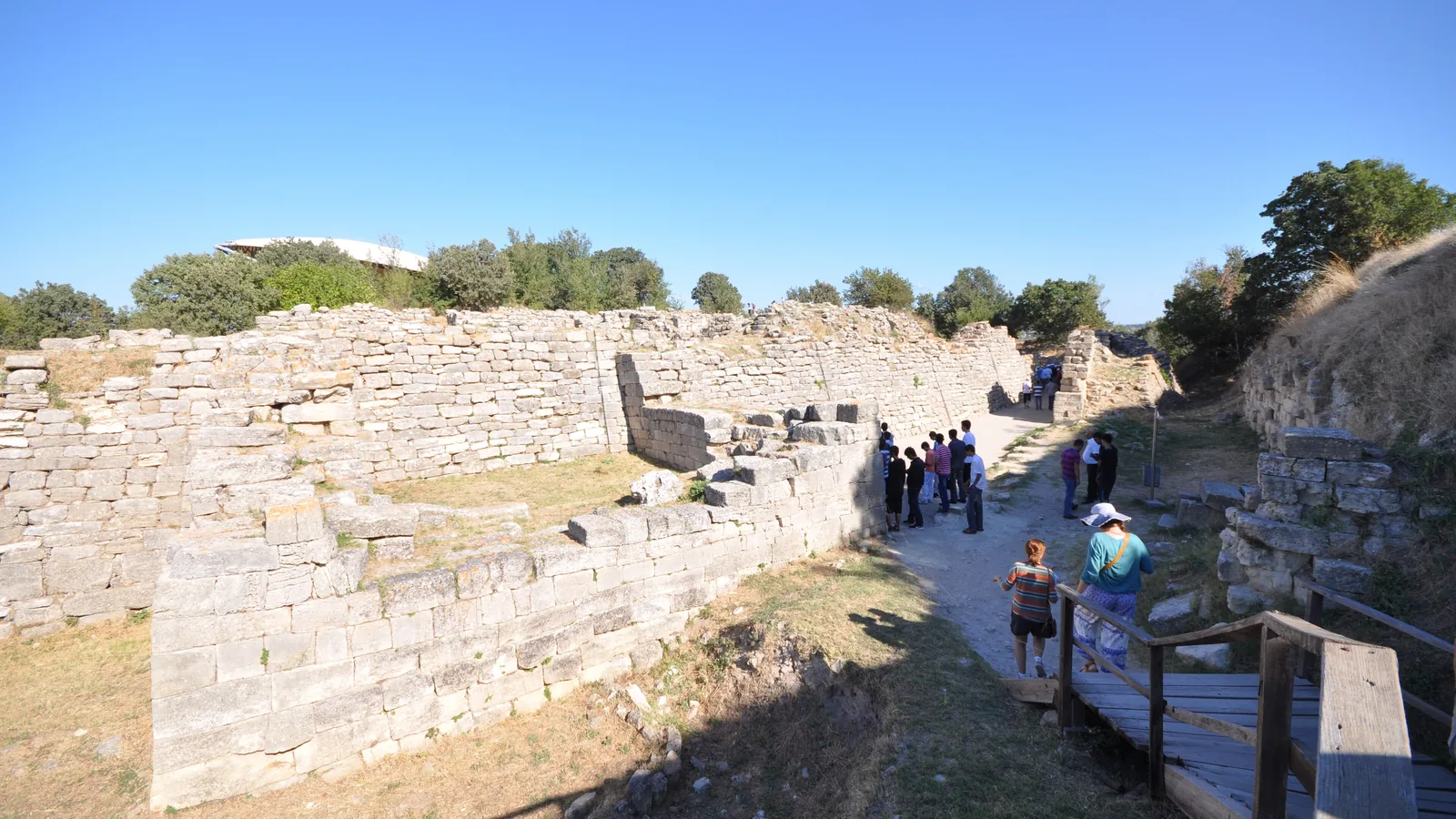
Frank Calvert began digging at Hisarlık, a mound in Çanakkale province in what is now Turkey, in 1863, and the excavators who followed him found nine settlement layers spanning more than 3,000 years. The Turkish Ministry of Culture and Tourism dates the earliest layer of Troy to 3000–2500 BC, and UNESCO added it to the World Heritage List in 1998. Hittite texts of the 13th century BC name a western Anatolian kingdom called Wilusa, and a 2002 paper in the journal Anatolian Studies concluded that Wilusa and Hisarlık were the same place. The size of that Late Bronze Age town was fought over in 2001 and 2002 by two Tübingen professors, the excavator Manfred Korfmann and the ancient historian Frank Kolb.
Quick facts
- When
- 1863 (Calvert begins digging) · 1870 or 1871 (Schliemann's first excavation, by different sources) · 1932–1938 (Blegen) · 1987–1988 (Tübingen and Cincinnati begin) · 1995 (bronze seal found) · 1998 (UNESCO listing) · July 2001 (Kolb interview) · February 15–16, 2002 (Tübingen symposium) · 2012 (permit cancelled) · 2013 (Aslan's license) · October 2018 (Troy Museum completed)
- Where
- The mound of Hisarlık in Çanakkale province, Turkey; the Hittite kingdom of Wilusa in western Anatolia
- Who
- Frank Calvert; Heinrich Schliemann; Wilhelm Dörpfeld; Carl Blegen; Manfred Korfmann; C. Brian Rose; Frank Kolb; Dieter Hertel; Ernst Pernicka; Rüstem Aslan; Muwattalli II and Alaksandu of Wilusa
- Outcome
- Nine settlement layers from 3000 BC to AD 400 were excavated. Easton, Hawkins, Sherratt and Sherratt reaffirmed in 2002 that Hisarlık was Hittite Wilusa; Hertel denied it. The size of the Late Bronze Age town and its link to the Trojan War stayed in dispute
1870 or 1871: from Schliemann to the Tübingen team
Tübingen University’s page on the project lists the succession of diggers: Calvert from 1863, Heinrich Schliemann from 1870 to 1890, Wilhelm Dörpfeld in 1893–1894 and Carl Blegen in 1932–1938. The 2002 Anatolian Studies paper, by D. F. Easton, J. D. Hawkins, A. G. Sherratt and E. S. Sherratt, also dates Schliemann’s work from 1870 and calls Blegen’s University of Cincinnati seasons “a campaign of sober reassessment.” The ministry’s heritage directorate gives a different year on its own page for the site: Schliemann, it states, first excavated the mound in 1871. The ministry’s Çanakkale provincial office uses 1870.
Tübingen’s own work began with preparatory seasons in 1987, followed by annual excavations until 2012. The work was shared with C. Brian Rose of the University of Cincinnati: the Tübingen team took the Bronze Age, the Cincinnati team the classical levels. Rose, writing in the Penn Museum’s Expedition magazine in 2020, gave his years as co-director as 1988 to 2012.
Nine layers, 3000 BC to AD 400
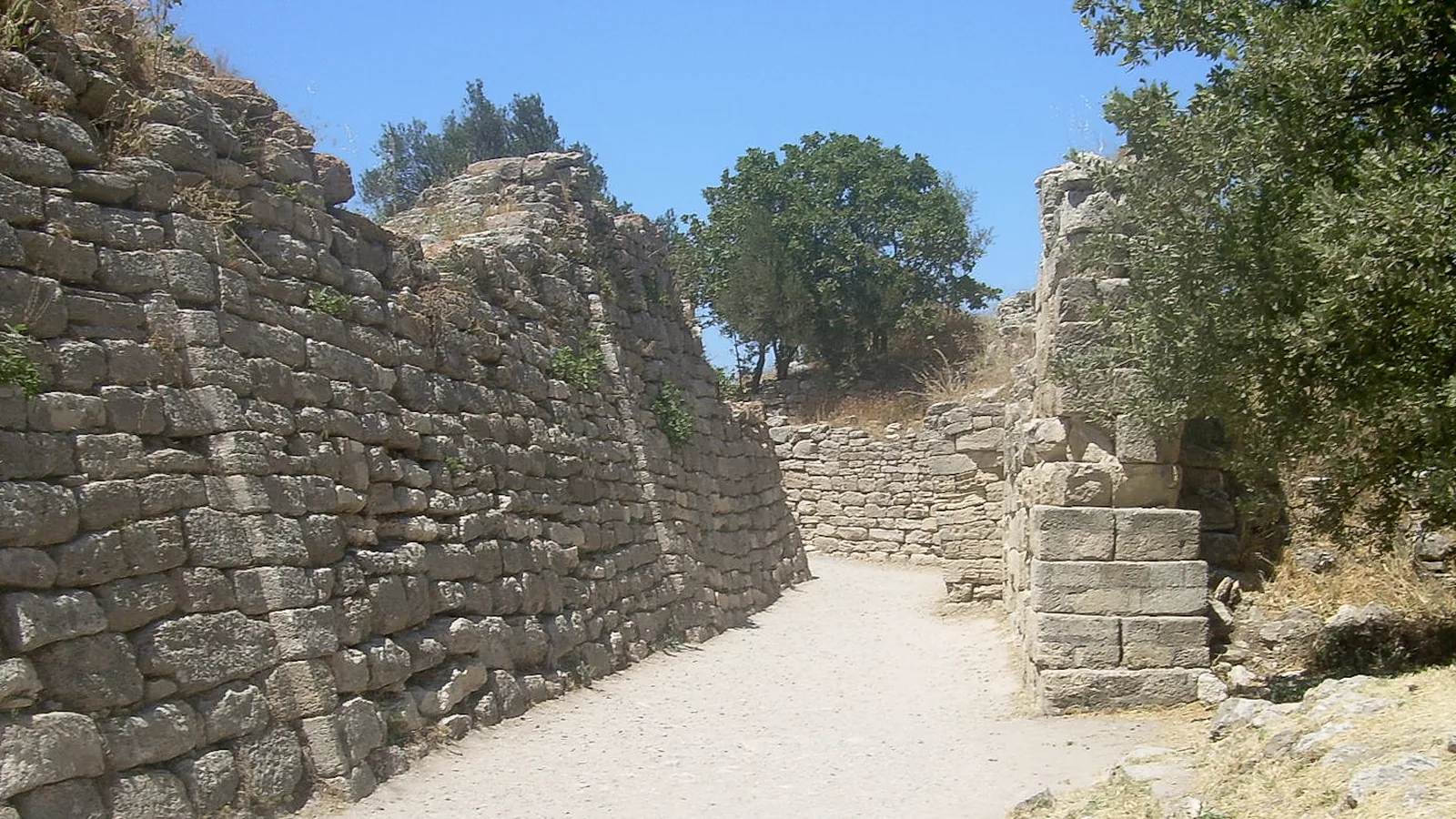
The Çanakkale office publishes a chronology for the mound. Troy I runs from 3000 to 2500 BC, Troy II from 2500 to 2300 BC, Troy III to V from 2300 to 1900 BC and Troy VI from 1900 to 1300 BC. Troy VIIa follows, from 1300 to 1200 BC, then Troy VIII from 900 to 350 BC and Troy IX from 350 BC to AD 400.
The office describes Troy VIIa as the phase accepted as the time of the Trojan wars. Its page names no excavator or study for that view. Easton and his co-authors report “a burnt destruction deposit of late VI date” in their account of a ditch around the lower town, and they do not present it as the remains of Homer’s war.
The oldest writing from the site is a bronze seal 2.3 centimeters across, found in 1995 in a Troy VII level of the 12th century BC, according to the Çanakkale office. One face carries the name of a scribe in Luwian hieroglyphs. The other carries the name of his wife.

Wilusa in a treaty and two letters
In the Hittite archives Wilusa was a kingdom of western Anatolia. Easton and his co-authors write that it appears as “the fourth Arzawa kingdom” in the reign of Muwattalli II, through his treaty with its king, Alaksandu, whose damaged preamble surveys relations between Hatti and Wilusa. One clause, in Gary Beckman’s 1996 translation, binds the vassal: “you (Alaksandu) will campaign with me with your troops and horse.” Wilusa owed troops to the Hittite king.
A letter from Manapa-Tarhunta of the Seha River Land, probably to Muwattalli II, is catalogued AhT 7 and dated to the early 13th century BC by Beckman, Trevor Bryce and Eric Cline in The Ahhiyawa Texts (2011). Its damaged lines read: “[Gassu …] came and brought the Hittite army, [… wh]en they went APPA to smite the land Wilusa.” Easton and his co-authors read the passage as Gassu arriving in the Seha River Land with the Hittite army on the way to a campaign against Wilusa.
The link to Troy is a 20th-century reading. Beckman, Bryce and Cline record that Luckenbill tied Alaksandu to Alexander, the legendary Trojan prince also called Paris, in 1911, and that Kretschmer equated Wilusa with (W)ilios, Troy, in 1924, against Emil Forrer, who placed it at Elaiusa in Cilicia. Dieter Hertel of Munich concluded in a 2001 booklet that Troy was not Wilusa. Easton and his co-authors called the attitudes of Kolb and his supporters to the Hittite sources “mutually contradictory” and concluded: “The identity of Wilusa with Hisarlik-Troy is reaffirmed.”
"Miserable little settlement": Kolb against Korfmann
In a book of 1984 Kolb had called Troy a “miserable little settlement,” which could not “raise a claim to the designation as a city.” In 2001 an exhibition in Stuttgart, Troia, Traum und Wirklichkeit (Troy, Dream and Reality), put Korfmann’s finds before the public. Over that year, Easton’s group wrote, Korfmann “attracted sharp criticism from colleagues, largely through the medium of the press.” In a Berliner Morgenpost interview dated July 17, 2001, Kolb described Korfmann’s reconstructions of a lower town as “fiction” and “figments of fantasy.” The rector of Tübingen University “demanded a public retraction and apology.”
The university then held a symposium, “The meaning of Troy in the Late Bronze Age,” on February 15–16, 2002, with 13 invited speakers. In print, Hertel and Kolb argued that only 2–3 percent of the lower city had been dug, and that Korfmann’s population estimate should be cut to a maximum of 3,000; at the symposium Kolb went as low as 1,000. Members of the excavation team answered them there. Kolb afterward described all such contributions as “laughable.”
The four authors of the Anatolian Studies paper attended the symposium as invited observers. Their verdict on the attack was that “the criticisms of Korfmann are themselves considerably exaggerated.”
After the symposium: two directors and a museum
Korfmann died in 2005, and Ernst Pernicka of Tübingen led the excavations until 2012, according to the university. The Çanakkale office gives the ending in different terms: Pernicka’s excavation was cancelled in 2012 by a decision of Turkey’s Council of Ministers, with the handover set for June 26–28, 2013. Since 2013 Rüstem Aslan of Çanakkale Onsekiz Mart University has held the license to dig, and Rose and Sheila Murnaghan recorded that Aslan, as director of the Troy excavations, joined their trip to the site in 2023.
The ministry’s page for the Troy Museum states that construction began in 2013 and, after a delay in 2015, the museum was completed in October 2018.
Key facts
- Frank Calvert began digging at Hisarlık in 1863; Schliemann followed from 1870 to 1890 by Tübingen’s dates, from 1871 by the Turkish heritage directorate’s.
- Dörpfeld dug in 1893–1894 and Blegen’s Cincinnati team in 1932–1938.
- The Çanakkale culture office dates nine layers from Troy I (3000–2500 BC) to Troy IX (350 BC to AD 400) and calls Troy VIIa (1300–1200 BC) the phase accepted as the time of the Trojan wars.
- A bronze seal 2.3 centimeters across, found in 1995 in a Troy VII level, carries a scribe’s name in Luwian hieroglyphs and his wife’s name on the back.
- UNESCO listed the site in 1998 as World Heritage property no. 849 under criteria (ii), (iii) and (vi).
- A treaty of Muwattalli II with Alaksandu of Wilusa required Alaksandu to “campaign with me with your troops and horse.”
- Kolb called Troy a “miserable little settlement” in 1984; in 2002 he argued for a population of at most 3,000, and at the Tübingen symposium of February 15–16 even 1,000.
- The Turkish Council of Ministers cancelled Pernicka’s excavation in 2012; Rüstem Aslan has held the license since 2013.
FAQ
Was Troy a real city?
A settlement occupied Hisarlık, in Çanakkale province, Turkey, from about 3000 BC to AD 400 in nine layers. Easton, Hawkins, Sherratt and Sherratt concluded in 2002 that it was the Wilusa of Hittite texts; Dieter Hertel concluded in 2001 that it was not.
Which layer of Troy matches the Trojan War?
The Turkish culture office in Çanakkale names Troy VIIa, 1300–1200 BC, as the phase accepted as the time of the Trojan wars, without citing a study. The 2002 Anatolian Studies paper reports a burnt destruction deposit of late Troy VI without presenting it as the remains of the war.
What was the Korfmann–Kolb debate?
In 2001 the ancient historian Frank Kolb called excavator Manfred Korfmann's reconstructions of a lower town "fiction." Tübingen held a symposium on February 15–16, 2002. Kolb argued for at most 3,000 inhabitants; the four authors of the 2002 Anatolian Studies paper judged the criticisms "considerably exaggerated."
Sources
- Universität Tübingen, Institut für Ur- und Frühgeschichte und Archäologie des Mittelalters, "Troia" (research project page, in German).
- T.C. Kültür ve Turizm Bakanlığı, Kültür Varlıkları ve Müzeler Genel Müdürlüğü, "Troya Arkeolojik Alanı (Çanakkale)" (in Turkish).
- Çanakkale İl Kültür ve Turizm Müdürlüğü, "Troya Ören Yeri" (in Turkish).
- Çanakkale İl Kültür ve Turizm Müdürlüğü, "Troia (Merkez)" (in Turkish).
- T.C. Kültür ve Turizm Bakanlığı, "Troy Museum."
- C. Brian Rose, "Field Trip," Expedition 62, no. 2 (2020), Penn Museum, University of Pennsylvania.
- C. Brian Rose and Sheila Murnaghan, "A Trip to Troy with Homer," Expedition 65, no. 1 (2023), Penn Museum, University of Pennsylvania.
- Gary Beckman, Trevor Bryce and Eric Cline, The Ahhiyawa Texts, Writings from the Ancient World 28 (Atlanta: Society of Biblical Literature, 2011), front matter, introduction and chronology.
- D. F. Easton, J. D. Hawkins, A. G. Sherratt and E. S. Sherratt, "Troy in recent perspective," Anatolian Studies 52 (2002), pp. 75–109, British Institute at Ankara.
Cite this article
- APA
- Song Letter. (2026, October 26). Was Troy real? Nine layers at Hisarlık and a kingdom called Wilusa. Our Earth's History. https://ourearthshistory.com/west-asia/ancient/was-troy-real-hisarlik-schliemann-korfmann-wilusa/
- Chicago
- Song Letter. “Was Troy real? Nine layers at Hisarlık and a kingdom called Wilusa.” Our Earth's History, October 26, 2026. https://ourearthshistory.com/west-asia/ancient/was-troy-real-hisarlik-schliemann-korfmann-wilusa/.
- MLA
- Song Letter. “Was Troy real? Nine layers at Hisarlık and a kingdom called Wilusa.” Our Earth's History, 26 Oct. 2026, https://ourearthshistory.com/west-asia/ancient/was-troy-real-hisarlik-schliemann-korfmann-wilusa/.
Get the week in history
One email a week: the new articles, and what was happening elsewhere at the same moment. Free, no ads, unsubscribe any time. How we handle your email.
Text licensed CC BY-NC-ND 4.0. Found an error? Tell us.