Why did Suleiman turn back from Vienna in 1529, and what came next?

TL;DR — Suleiman reached Vienna on September 26, 1529, and gave up after three weeks as winter came early; he then took Baghdad, wrote law, and built the Süleymaniye.
Suleiman I camped outside Vienna on September 26, 1529, and lifted the siege after three weeks when an early winter and heavy losses made the attack pointless. The Habsburg history portal Die Welt der Habsburger gives those dates and that cause; World History Encyclopedia records only that he “failed to take Vienna.” After a second campaign in 1532 brought “mixed results,” the western frontier settled into a costly stalemate. Suleiman turned east and took Baghdad in the campaign of 1534 to 1535. At home he set dynastic law beside religious law and commissioned the Süleymaniye complex from the architect Sinan. He died on campaign at Szigetvár in Hungary on the night of September 6 to 7, 1566.
Quick facts
- When
- September 30, 1520 (accession) · August 29, 1526 (Mohács) · September 26, 1529 (camp outside Vienna) · 1535 (withdrawal from Mesopotamia except Baghdad) · 1550 to 1557 (Süleymaniye built) · night of September 6 to 7, 1566 (death at Szigetvár)
- Where
- Vienna, the Habsburg capital on the Danube; Buda and Mohács in Hungary; Baghdad in what is now Iraq; Constantinople, the Ottoman capital, now Istanbul
- Who
- Sultan Suleiman I; the Habsburg brothers Ferdinand and Charles V; Count Niklas von Salm, who held Vienna; the grand vizier İbrahim; Hürrem; the architect Sinan; the ambassador Ogier Ghiselin de Busbecq
- Outcome
- Vienna held; Hungary split three ways for 150 years; the Ottomans kept Baghdad; Suleiman built the Süleymaniye and was remembered as Kanuni, the lawgiver; he died on his last campaign in 1566
The young sultan's first campaigns, 1520 to 1526
Suleiman became sultan in the fall of 1520 with no brothers, uncles or nephews to contest the throne. World History Encyclopedia, in an entry contributed by Oxford University Press, describes a 26-year-old unknown to most of the ruling elite who had never commanded troops in battle. His first move, according to the entry, was to present himself as a just ruler, “a virtue his father was not known for.” His second was to aim the army at targets his father had ignored.
Belgrade, then a Hungarian frontier town, fell in 1521. Rhodes was taken from the Knights Hospitaller in 1522. On August 29, 1526, at Mohács in southern Hungary, an Ottoman army that the Habsburg portal puts at 60,000 destroyed a Hungarian force of 25,000 and killed King Louis II. In the same years Suleiman raised a household servant named İbrahim to grand vizier and began his lifelong relationship with a concubine named Hürrem.
Mohács handed the Ottomans a new enemy. Louis’s brother-in-law, Ferdinand of Habsburg, was elected king of Bohemia and Hungary, and a rival Hungarian claimant, John Zápolya, took the Ottoman side.
Vienna, autumn 1529, and the stalemate after
In the summer of 1529 Suleiman left Adrianople, now Edirne, with an army that the Habsburg portal counts at 150,000 men and camp followers. Buda fell on September 8. On September 26 the sultan pitched camp at Kaiserebersdorf, southeast of Vienna’s walls, which still dated largely from the 13th century. Inside stood about 12,000 mercenaries under Count Niklas von Salm and 5,000 imperial troops under the count palatine Philip, who had arrived a day ahead of the sultan.
Several assaults failed, and after three weeks the Ottomans withdrew. Stephan Gruber, writing for the portal, puts the deaths on the winter march back toward Constantinople at some 30,000, a figure he presents as an estimate. Martin Mutschlechner, on the same site, attributes the withdrawal to “the unexpectedly early onset of winter that year.” The Ottoman side is thinner in the sources read here; the Encyclopedia says only that the siege failed.
Ogier Ghiselin de Busbecq, the Holy Roman Emperor’s ambassador at Suleiman’s court from 1555 to 1562, described in his letters how an Ottoman army held back its grain at the start of a campaign, because the troops knew that when the season ended they would retreat across country the enemy had stripped bare. He wrote of campaigns in general, and it fits the Austrian account of 1529.
The war went on. In 1533 Ferdinand bought a ceasefire with a payment, and Buda passed under direct Ottoman rule in 1541. For 150 years, according to Gruber, Hungary stayed split three ways: a Habsburg northwest, an Ottoman center, and a Transylvania under Ottoman sovereignty. Vienna rebuilt its walls.
The eastern front: Baghdad, 1534 to 1535
Colin Paul Mitchell, in the Encyclopaedia Iranica entry on Shah Tahmasp, wrote that news of a large Ottoman invasion led by the sultan in person reached the shah in the spring of 1534, and that Tahmasp’s brother Sam Mirza had been in secret correspondence with Suleiman to be placed on the throne at Tabriz. The plan collapsed. In 1535 Suleiman withdrew from Mesopotamia, keeping Baghdad. The Encyclopedia sums up the campaign as one that “captured large territories, including Baghdad, but failed to decisively defeat the Safavids.” A second invasion followed in 1548, again at a Safavid prince’s invitation, and peace came at Amasya on May 29, 1555.
The lawgiver: kanun, the Süleymaniye and Sinan
By the early 1540s, in the Encyclopedia’s account, Suleiman had gout, grey in his beard, and a stalemate on both fronts. His answer was administration and building. The entry describes an enlarged bureaucracy and “significant attempts at harmonizing the Sharia with dynastic law (kanun),” with justice pressed as the empire’s political ideal. Authors after his death gave him the name Kanuni, “the formulator of dynastic law,” and Turkish speakers still know him by it.
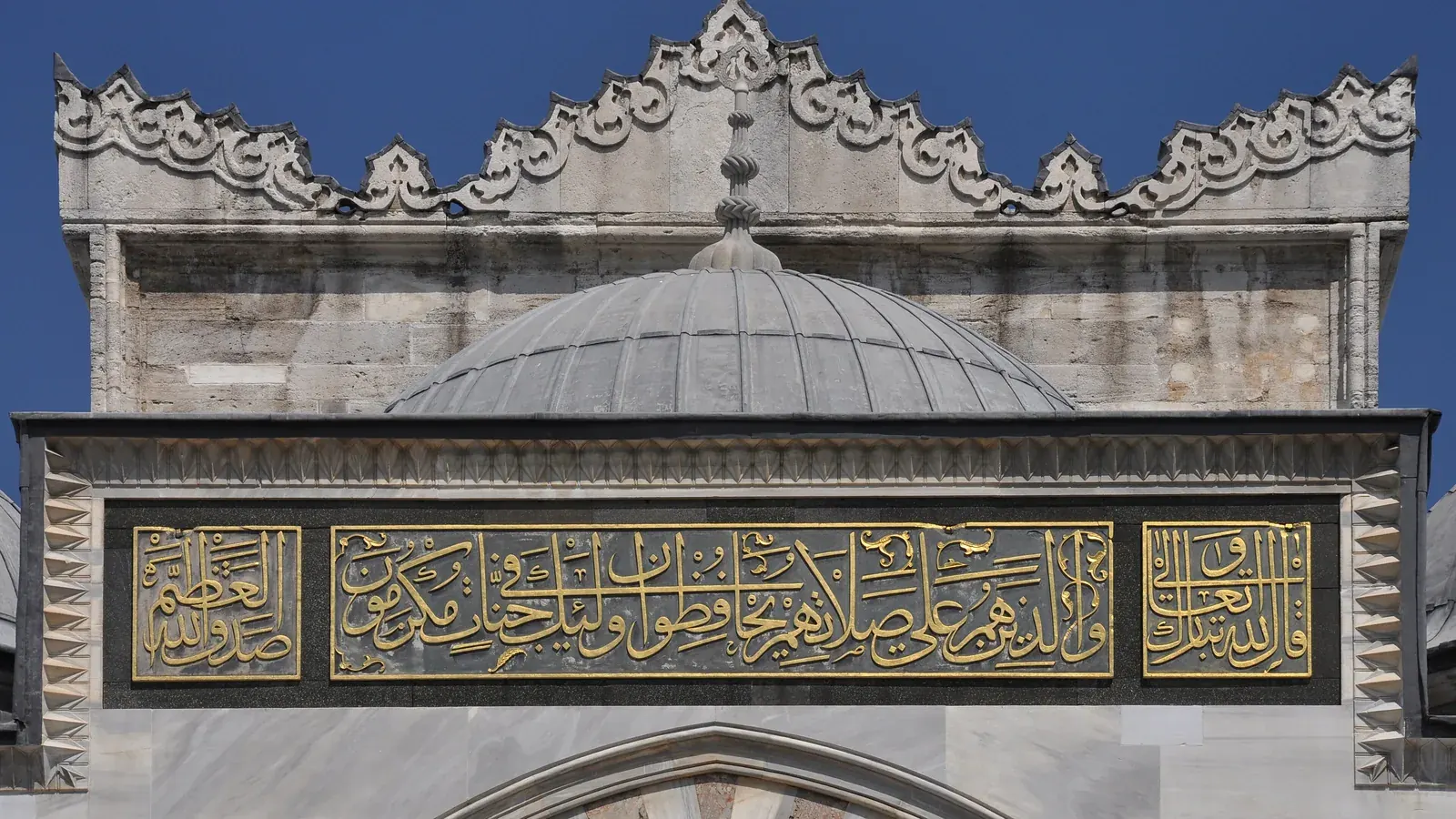
The Süleymaniye complex in Constantinople, designed by the chief architect Sinan and built from 1550 to 1557 according to UNESCO, which lists it within the Historic Areas of Istanbul, was the center of that program. Bridges, aqueducts, pilgrim waystations and soup kitchens followed across the empire. Suleiman also gathered his poems and commissioned the Süleymanname, an illustrated history in Persian verse covering his reign from 1520 to the mid-1550s.
Busbecq saw the system from inside. “No distinction is attached to birth among the Turks,” he wrote in the 1881 Forster and Daniell translation of his letters; the highest officers, he added, were mostly the sons of shepherds and herdsmen, and the sultan kept 12,000 Janissaries at full strength. Kaya Şahin, in a 2013 Cambridge study, argues that this empire competed directly with the Habsburgs and Safavids as an imperial culture.
The court: İbrahim, Hürrem and the sons
The Encyclopedia records that İbrahim was executed on Suleiman’s orders in 1536 and that the sultan’s son-in-law Rüstem took his place. In the 1550s Suleiman ordered the execution of one son on suspicion of rebellion; a few years later another son, Bayezid, rebelled, lost, fled to Tahmasp’s court in 1562, and was executed there on his father’s instructions. Hürrem, whom Suleiman had married, died in the same decade. The sources read here give no date for the first execution.
The end at Szigetvár, 1566
On May 1, 1566, Suleiman left Constantinople at the head of his household troops. By late July he could no longer ride; rain turned the roads to mud and the supply chain broke. He died of natural causes on the night of September 6 to 7, 1566, in front of Szigetvár, a fortress that Syed Muhammad Khan describes as “strategically insignificant yet strongly defended,” just before it fell. His body was buried under his tent and decrees went out in his name until his son Selim could be told. He was reburied in Constantinople beside the Süleymaniye, near Hürrem’s tomb.
Vienna in 1529 was where the campaign season ran out. What Suleiman built after it, in Baghdad, in law and in stone on the Constantinople skyline, outlasted every frontier he failed to move.
Key facts
- Suleiman became sultan on September 30, 1520, and reigned until his death on September 6 to 7, 1566 (World History Encyclopedia).
- At Mohács on August 29, 1526, an Ottoman army of about 60,000 defeated 25,000 Hungarians and killed Louis II (Habsburg portal).
- The 1529 siege of Vienna ran three weeks from September 26; the city held with about 17,000 defenders under Niklas von Salm and Philip of the Rhine.
- Gruber estimates 30,000 Ottoman deaths on the winter retreat; Mutschlechner attributes the withdrawal to an early winter.
- Suleiman invaded Safavid Iran in 1534 and withdrew in 1535, keeping Baghdad (Encyclopaedia Iranica).
- The Süleymaniye complex, by Sinan, was built from 1550 to 1557 (UNESCO).
- Busbecq counted 12,000 Janissaries at full strength in the 1550s.
FAQ
Why did the Ottomans leave Vienna in 1529?
The Austrian historians on the Habsburg portal give an early winter and heavy losses after three weeks of failed assaults. World History Encyclopedia says only that the siege failed.
What does Kanuni mean?
It is the name later authors gave Suleiman, meaning the formulator of dynastic law (kanun), for his effort to set that law beside the Sharia.
How did Suleiman die?
Of natural causes on the night of September 6 to 7, 1566, in his tent outside Szigetvár in Hungary. His death was kept from the army until the fortress fell.
Sources
- World History Encyclopedia — Oxford University Press, "Suleiman the Magnificent" (February 27, 2023).
- World History Encyclopedia — Syed Muhammad Khan, "Battles & Conquests of the Ottoman Empire (1299-1683)" (June 29, 2021).
- World History Encyclopedia — Simeon Netchev, "Map of the Ottoman Empire under Suleiman the Magnificent" (February 7, 2026).
- Die Welt der Habsburger (Schönbrunn Group) — Stephan Gruber, "'The Turk' at the gates of Vienna: Episode 1."
- Die Welt der Habsburger (Schönbrunn Group) — Stephan Gruber, "A new great power in south-east Europe: the Ottoman Empire."
- Die Welt der Habsburger (Schönbrunn Group) — Martin Mutschlechner, "Ferdinand I: new crowns for the Habsburgs."
- Internet Modern History Sourcebook, Fordham University — Ogier Ghiselin de Busbecq, The Turkish Letters, 1555–1562, from C. T. Forster and F. H. B. Daniell, eds., The Life and Letters of Ogier Ghiselin de Busbecq, vol. 1 (London, 1881).
- Encyclopaedia Iranica — Colin Paul Mitchell, "Ṭahmāsp I" (July 15, 2009).
- UNESCO World Heritage Centre — "Historic Areas of Istanbul," World Heritage List no. 356.
- Cambridge University Press — Kaya Şahin, Empire and Power in the Reign of Süleyman (2013), publisher's description.
Cite this article
- APA
- Our Earth's History. (2026, September 20). Why did Suleiman turn back from Vienna in 1529, and what came next? Our Earth's History. https://ourearthshistory.com/west-asia/early-modern/suleiman-vienna-1529-and-the-law/
- Chicago
- Our Earth's History. “Why did Suleiman turn back from Vienna in 1529, and what came next?” Our Earth's History, September 20, 2026. https://ourearthshistory.com/west-asia/early-modern/suleiman-vienna-1529-and-the-law/.
- MLA
- “Why did Suleiman turn back from Vienna in 1529, and what came next?” Our Earth's History, 20 Sep. 2026, https://ourearthshistory.com/west-asia/early-modern/suleiman-vienna-1529-and-the-law/.
Text licensed CC BY-NC-ND 4.0. Found an error? Tell us.