Dear Lord Rothschild: the 67 words of November 2, 1917
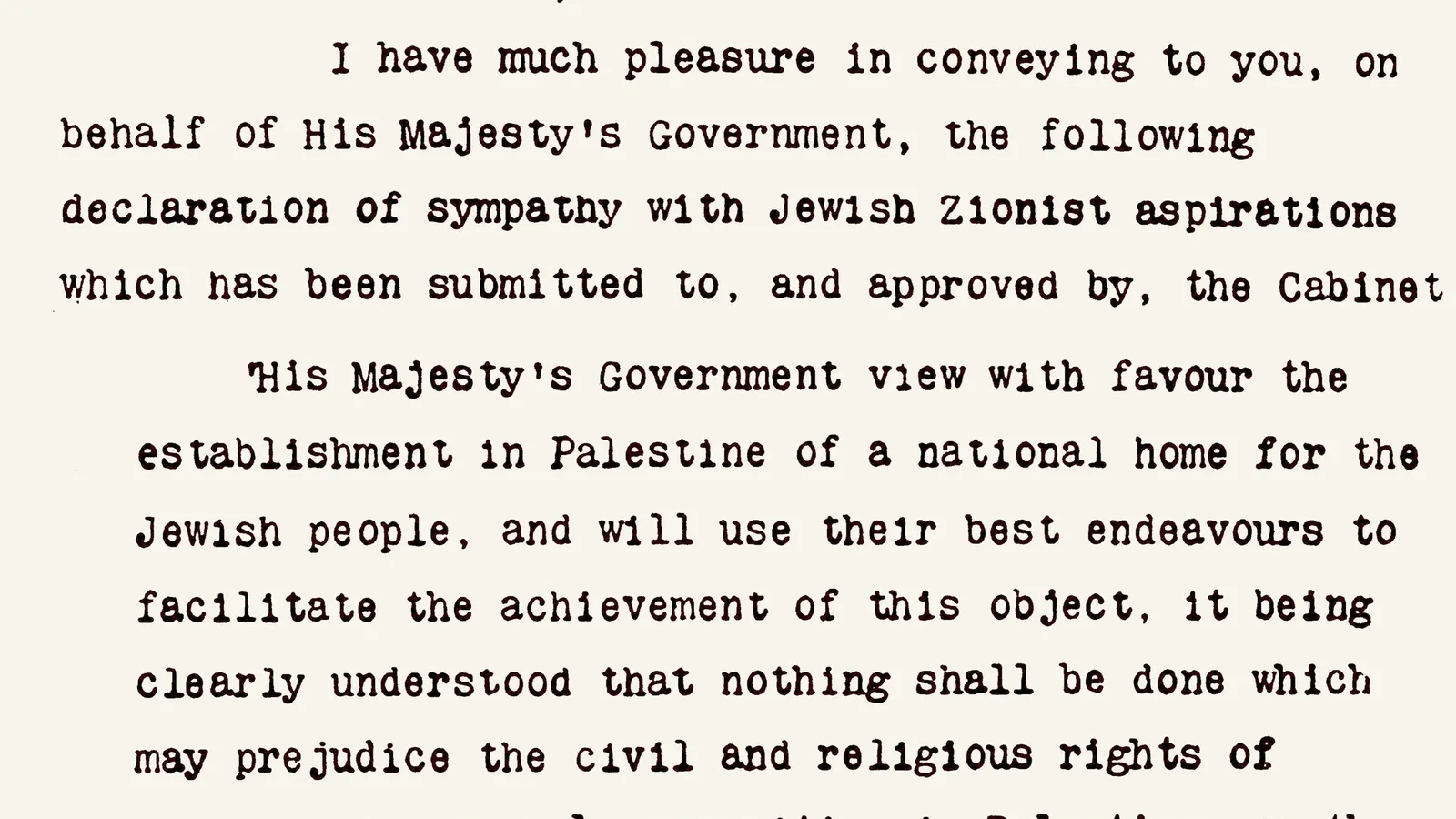

TL;DR — On November 2, 1917, Balfour wrote to Rothschild that Britain viewed “with favour” a Jewish national home in Palestine; the sentence entered the 1922 mandate and was contested in 2017.
“His Majesty’s Government view with favour the establishment in Palestine of a national home for the Jewish people, and will use their best endeavours to facilitate the achievement of this object, it being clearly understood that nothing shall be done which may prejudice the civil and religious rights of existing non-Jewish communities in Palestine, or the rights and political status enjoyed by Jews in any other country.” That sentence sits inside a letter dated November 2, 1917, which opens “Dear Lord Rothschild” and is signed “Arthur James Balfour,” the British foreign secretary. The letter presents it as a “declaration of sympathy with Jewish Zionist aspirations which has been submitted to, and approved by, the Cabinet.” Theresa May, the British prime minister, called it in 2017 “just 67 words and one single sentence.” The papers around it run from a letter to the sherif of Mecca in 1915 to three statements of 2017.
Quick facts
- When
- October 24, 1915 (McMahon's letter to Sherif Hussein) · 1916 (Sykes-Picot agreement) · October 31, 1917 (War Cabinet) · November 2, 1917 (Balfour's letter) · December 11, 1917 (Allenby enters Jerusalem) · April 25, 1920 (San Remo) · July 24, 1922 (mandate signed at London) · 1939 (White Paper, Cmd. 6019) · November 2, 2017 (centenary)
- Where
- London (Foreign Office, War Cabinet, both Houses of Parliament); Cairo and Mecca; Jerusalem; San Remo; the Balfour Centenary Dinner in London
- Who
- Arthur James Balfour; Lord Rothschild; Sir Henry McMahon; Sherif Hussein of Mecca; Edwin Montagu; Lord Curzon; General Edmund Allenby; Lord Islington; Sir William Joynson-Hicks; Winston Churchill; Theresa May; Alistair Burt; Saeb Erekat; Benjamin Netanyahu
- Outcome
- A one-sentence declaration in a letter became the preamble of the League of Nations mandate signed on July 24, 1922; the Lords voted against the mandate on June 21, 1922, and the Commons rejected a challenge to it on July 4 by 292 votes to 35; a 1939 White Paper stated that a Jewish state was not British policy; in 2017 Britain refused to apologize and the PLO demanded that it should
October 24, 1915, and the brown area of 1916
On October 24, 1915, Sir Henry McMahon, the British high commissioner at Cairo, wrote to Sherif Hussein of Mecca. The letter, printed by the British government in 1939 as Cmd. 5957, cut from the Arab claim “the two districts of Mersina and Alexandretta and portions of Syria lying to the west of the districts of Damascus, Homs, Hama and Aleppo,” which “cannot be said to be purely Arab.” The clause does not name Palestine. A British-Arab committee of 1939 (Cmd. 5974, quoted in a 1978 study prepared for the UN Committee on the Exercise of the Inalienable Rights of the Palestinian People) recorded that the British delegates still held that “Palestine was in fact excluded,” while agreeing that the wording “was not so specific and unmistakable as it was thought to be at the time.”
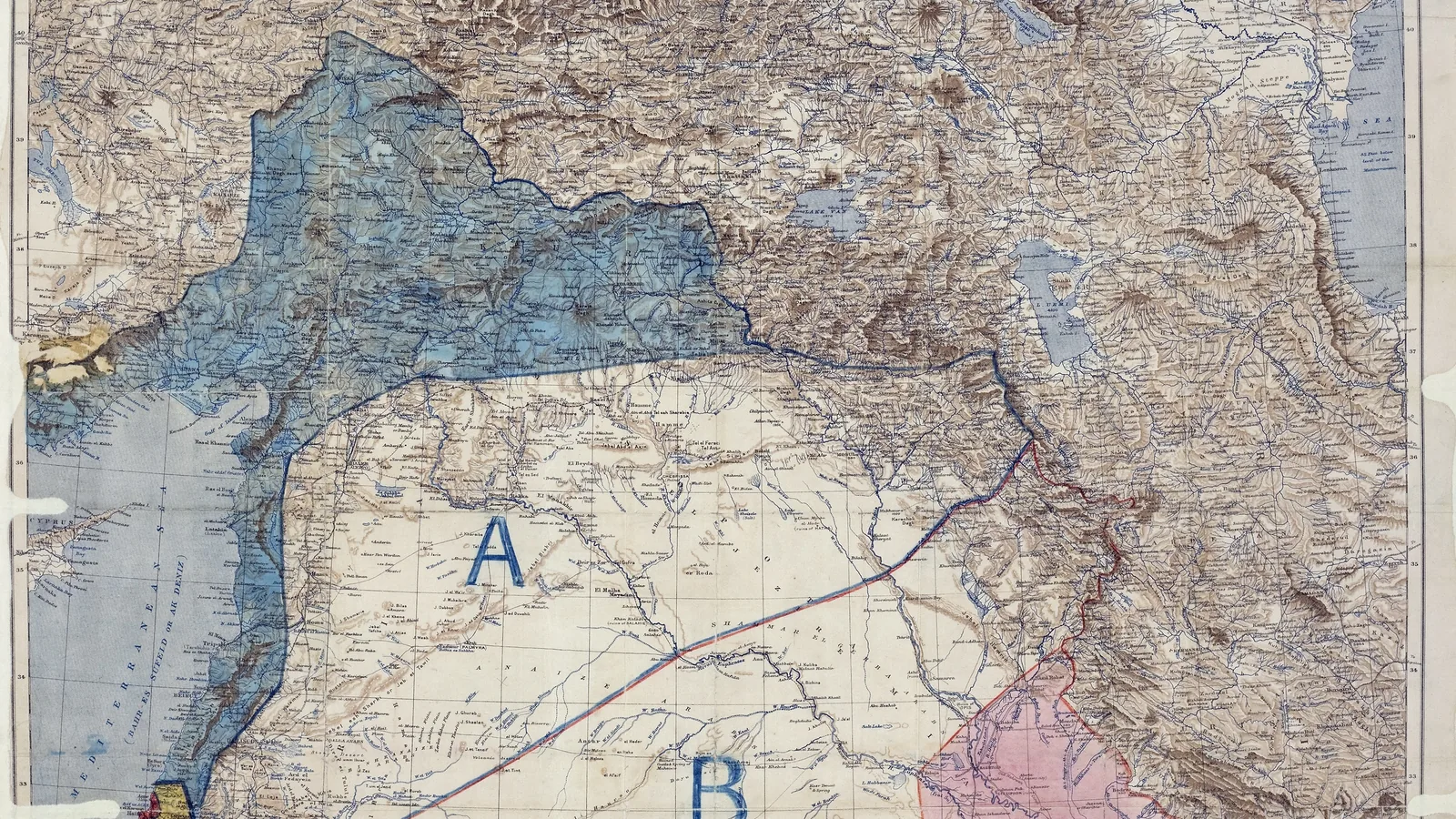
The Sykes-Picot agreement between Britain and France, drawn up in 1916, dealt with the same ground by color: “in the brown area there shall be established an international administration,” and Britain was to have “the ports of Haifa and Acre.”

Six drafts, one memorandum and the War Cabinet of October 31
The UN study counts “six drafts exchanged and discussed between the British Government and the Zionist movement,” and adds: “There was no thought of consulting the Palestinians.” The draft Rothschild sent Balfour read that the government “accept(s) the principle that Palestine should be reconstituted as the national home of the Jewish people.” The letter says “the establishment in Palestine of a national home”: a home, not the home, established rather than reconstituted.
The War Cabinet had the question on its table from September 3, 1917, together with a memorandum by Edwin Montagu, the secretary of state for India, titled “The Anti-Semitism of the present Government.” Montagu wrote that Zionism was “a mischievous political creed” and that “Palestine will become the world’s ghetto.” Minutes of the meeting of October 31, transcribed by the Britain Palestine Project, record Balfour arguing that a declaration would allow “extremely useful propaganda both in Russia and America,” and that a national home “did not necessarily involve the early establishment of an independent Jewish State.” Lord Curzon said he could not agree with Montagu, yet feared “false expectations which could never be realised.”
"It is not possible at this stage to forecast": the Commons, November 1917
In the House of Commons on November 14, 1917, a member named King asked whether a national home for Jewry “entails a State with independence or autonomous rule.” Balfour answered: “It is not possible at this stage to forecast the future constitution of Palestine.” On November 19 he added that the government hoped the national home “will result from the present war.”
On December 11, 1917, General Edmund Allenby entered Jerusalem by the Jaffa Gate, the scene of a James McBey oil in the Imperial War Museums dated in its title “11th December 1917.” From that month, the UN study states, Palestine was under British military occupation.
Curzon's mandate, 1920 to 1922: San Remo, London and two votes
The Allied Supreme Council assigned Palestine to Britain at San Remo on April 25, 1920, the UN study records. Curzon, by then foreign secretary, told the House of Lords on June 29, 1920, that Britain had “very reluctantly, accepted a mandate for Palestine.” The mandate’s preamble carried the sentence of 1917 into League of Nations law: the Mandatory “should be responsible for putting into effect the declaration originally made on November 2nd, 1917.” The text closes “Done at London the twenty-fourth day of July, one thousand nine hundred and twenty-two.”
Parliament divided on it twice that summer. On June 21, 1922, Lord Islington moved in the Lords that the mandate “in its present form is inacceptable to this House”; Hansard prints the result as “Resolved in the affirmative,” without a division count. On July 4, in the Commons, Sir William Joynson-Hicks moved to cut the colonial secretary’s salary by 100 pounds. Winston Churchill, the colonial secretary, answered: “I am bound to ask the Committee to take the vote which is about to be given as a vote of confidence,” and pointed to “the adverse vote recorded in another place a few days ago.” The cut fell, Ayes 35, Noes 292.
White Paper of 1939, centenary of 2017
In 1939 a White Paper (Cmd. 6019, quoted in the UN study) closed the question Balfour had declined to forecast: “His Majesty’s Government therefore now declare unequivocally that it is not part of their policy that Palestine should become a Jewish State.” In the UN study’s summary, immigration would end “after the admission of 75,000 new immigrants over the first five years.”
On October 25, 2017, Alistair Burt, the minister for the Middle East, told a Westminster Hall debate that Britain would mark the centenary “with pride and respect, but also with a degree of sadness,” and that “Israeli settlement activity is illegal under international law.” The UN General Assembly’s summary of Benjamin Netanyahu’s statement of September 19, 2017, records the Israeli prime minister saying that the declaration “had advanced Theodor Herzl’s vision for a homeland.” On November 2, 2017, at the Balfour Centenary Dinner, which Netanyahu attended, May said: “So when some people suggest we should apologise for this letter, I say absolutely not.” The same day Saeb Erekat of the PLO Negotiations Affairs Department wrote that Britain “should apologize for this shameful declaration and take concrete measures to fulfill its moral and political obligations towards the people of Palestine.”
Key facts
- The declaration is one sentence inside a letter dated November 2, 1917, from Arthur James Balfour to Lord Rothschild, “submitted to, and approved by, the Cabinet” (Avalon Project).
- Theresa May called it “just 67 words and one single sentence” on November 2, 2017 (GOV.UK).
- McMahon’s letter of October 24, 1915, excluded “Mersina and Alexandretta and portions of Syria lying to the west of the districts of Damascus, Homs, Hama and Aleppo” from the Arab claim (Cmd. 5957).
- The Sykes-Picot text of 1916 placed “the brown area” under “an international administration” and gave Britain “the ports of Haifa and Acre” (Avalon Project).
- The UN study counts six drafts; Rothschild’s draft said “reconstituted as the national home,” the letter says “the establishment in Palestine of a national home.”
- Balfour told the Commons on November 14, 1917, “It is not possible at this stage to forecast the future constitution of Palestine” (Hansard).
- The mandate preamble binds the Mandatory to “the declaration originally made on November 2nd, 1917”; the text is dated at London, July 24, 1922 (Avalon Project).
- The Lords carried Islington’s motion against the mandate on June 21, 1922; the Commons rejected Joynson-Hicks’s salary cut on July 4, 1922, Ayes 35, Noes 292 (Hansard).
FAQ
What did the Balfour Declaration of November 2, 1917, say?
That the British government "view with favour the establishment in Palestine of a national home for the Jewish people," would use "their best endeavours" to bring it about, and that nothing should prejudice "the civil and religious rights of existing non-Jewish communities in Palestine" or the rights of Jews elsewhere. The sentence sits in a letter from Balfour to Lord Rothschild, approved by the Cabinet.
Did the McMahon letter of 1915 promise Palestine to the Arabs?
The letter of October 24, 1915, excluded "portions of Syria lying to the west of the districts of Damascus, Homs, Hama and Aleppo" and did not name Palestine. A British-Arab committee in 1939 recorded that the British delegates held that Palestine "was in fact excluded," while agreeing the wording "was not so specific and unmistakable as it was thought to be at the time."
How did the declaration become part of the Palestine mandate?
The Allied Supreme Council assigned the mandate to Britain at San Remo on April 25, 1920, and the League of Nations mandate text, dated at London on July 24, 1922, made the Mandatory "responsible for putting into effect the declaration originally made on November 2nd, 1917."
Sources
- Yale Law School, Avalon Project, "Balfour Declaration November 2, 1917" (full text of the letter).
- British Government, Correspondence between Sir Henry McMahon, His Majesty's High Commissioner at Cairo, and the Sherif Hussein of Mecca, July 1915–March 1916, Cmd. 5957, Miscellaneous No. 3 (1939), letter No. 4 of October 24, 1915 (full text on the Internet Archive).
- Yale Law School, Avalon Project, "The Sykes-Picot Agreement: 1916" (text of the agreement; the page gives no signing date).
- United Nations, UNISPAL, Origins and Evolution of the Palestine Problem: 1917–1947 (Part I), a 1978 study prepared for the UN Committee on the Exercise of the Inalienable Rights of the Palestinian People; used for the documents it quotes (Cmd. 5974, the Rothschild draft, Montagu's memorandum, San Remo, Cmd. 6019), not for its own judgments.
- Britain Palestine Project, "War cabinet minutes leading to the Balfour Declaration, 1917" (minutes of War Cabinet 227, 245, 259 and 261, transcribed by the Britain Palestine Project; original TNA CAB 23/4 not consulted).
- UK Parliament, Historic Hansard, "Palestine (Jews' National Home)," HC Deb 14 November 1917 vol 99 cc382-3, and "Palestine (Jews)," HC Deb 19 November 1917 vol 99 c838 (Balfour's answers).
- Imperial War Museums, James McBey, "The Allies Entering Jerusalem, 11th December 1917: General Allenby, with Colonel de Piépape Commanding the French Detachment, and Lieut-Colonel d'Agostio Commanding the Italian Detachment, Entering the City by the Jaffa Gate" (Art.IWM ART 2599).
- Historic Hansard, "Palestine," HL Deb 29 June 1920 vol 40 cc1005-38 (Curzon's reply).
- Yale Law School, Avalon Project, "The Palestine Mandate" (preamble, articles and closing formula).
- Historic Hansard, "Palestine Mandate," HL Deb 21 June 1922 vol 50 cc994-1033 (Islington's motion and its result).
- Historic Hansard, "Class II. Colonial Office," HC Deb 04 July 1922 vol 156 cc221-343 (Joynson-Hicks's motion, Churchill's speech, division Ayes 35, Noes 292).
- UK Parliament, Hansard, "Centenary of the Balfour Declaration," Westminster Hall, vol. 630, 25 October 2017 (Alistair Burt's reply).
- GOV.UK, Prime Minister's Office, "PM speech at Balfour Centenary Dinner," 2 November 2017 (full text).
- PLO Negotiations Affairs Department, "Dr. Saeb Erekat: 'Nothing is More Shameful than Celebrating Colonialism'," 2 November 2017.
- United Nations, General Assembly General Debate, 72nd session, "Statement: Israel, Benjamin Netanyahu, 19 September 2017" (UN summary, not a verbatim transcript).
Cite this article
- APA
- Our Earth's History. (2026, September 22). Dear Lord Rothschild: the 67 words of November 2, 1917. Our Earth's History. https://ourearthshistory.com/west-asia/contemporary/balfour-declaration-november-2-1917-sixty-seven-words/
- Chicago
- Our Earth's History. “Dear Lord Rothschild: the 67 words of November 2, 1917.” Our Earth's History, September 22, 2026. https://ourearthshistory.com/west-asia/contemporary/balfour-declaration-november-2-1917-sixty-seven-words/.
- MLA
- “Dear Lord Rothschild: the 67 words of November 2, 1917.” Our Earth's History, 22 Sep. 2026, https://ourearthshistory.com/west-asia/contemporary/balfour-declaration-november-2-1917-sixty-seven-words/.
Text licensed CC BY-NC-ND 4.0. Found an error? Tell us.