November 6, 1991: the last of Kuwait's burning oil wells is capped
.jpg)
TL;DR — On November 6, 1991, the Emir of Kuwait extinguished the last of the oil-well fires Iraqi forces had set; Texas and Canadian crews finished in about nine months.
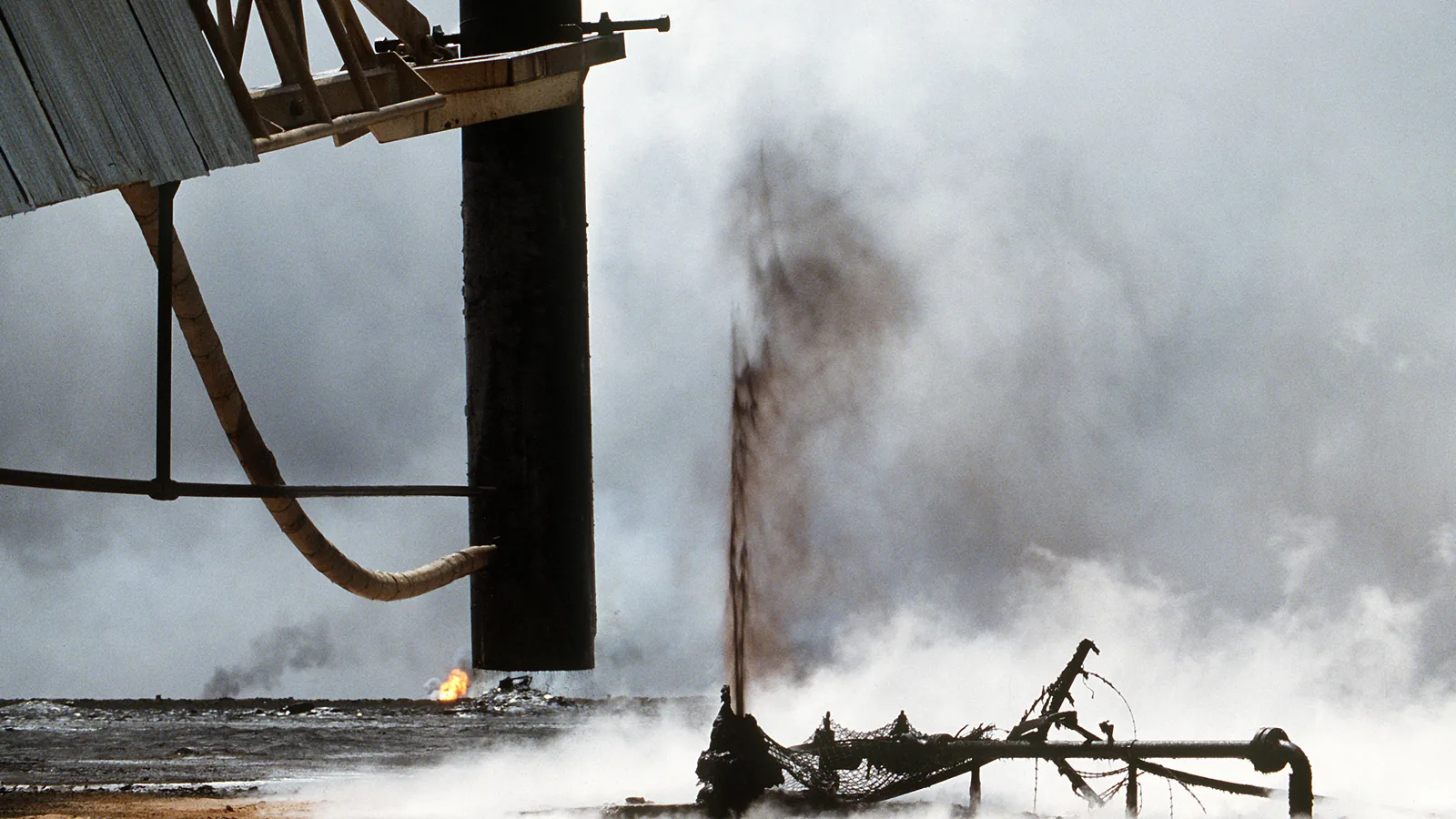
On November 6, 1991, Sen. Joseph I. Lieberman told the Senate, “I rise to call the attention of my colleagues to a significant event that has happened today . . . the extinguishing of the last oil-well fire in Kuwait.” A formal ceremony was held that day at the Burgan oilfield outside Kuwait City, where the Emir of Kuwait extinguished the fire himself, the Congressional Record states. Iraqi forces retreating from Kuwait had set fire to what that record calls “hundreds” of oil wells; a 2026 review in Toxicology Reports gives “over 500 oil wells.” Four firefighting companies, three from Texas and one from Canada, finished the work in about nine months, a pace Lieberman said some had believed would take four or five years.
Quick facts
- When
- February 22, 1991 (Bush announces the fires) · October 1, 1991 (more than half the fires reported out) · November 6, 1991 (last fire extinguished) · January 16, 1992 (Bush's anniversary statement)
- Where
- Kuwait; the Burgan oilfield outside Kuwait City; the Raudhatain, Sabriyah and Minagish oilfields
- Who
- President George Bush; Sen. Joseph I. Lieberman; the Emir of Kuwait; Red Adair Co., Boots and Coots and Wild Well Control (Texas); Safety Boss, Ltd. (Canada); Santa Fe International; Bechtel Group, Inc.
- Outcome
- The last oil-well fire set by retreating Iraqi forces was extinguished on November 6, 1991, in a ceremony at the Burgan oilfield, about nine months after the fires were set
February 22, 1991: a scorched-earth policy
Iraqi forces had occupied Kuwait since August 2, 1990, when Saddam Hussein invaded, and the occupation lasted until an American-led coalition liberated the country in February 1991, Lieberman recounted in his November 6 remarks. On February 22, 1991, two days before the coalition’s ground offensive began, President Bush told reporters, “we learned this morning that Saddam has now launched a scorched-earth policy against Kuwait . . . He is wantonly setting fires to and destroying the oil wells, the oil tanks, the export terminals, and other installations of that small country,” the American Presidency Project’s record of his remarks on the Persian Gulf conflict shows. Bush made the statement in the same address in which he set a final withdrawal deadline of Saturday noon for Iraqi forces.
Red Adair's teams take on the wells
Red Adair Co., Boots and Coots and Wild Well Control, all of Texas, worked alongside Safety Boss, Ltd., of Canada, Lieberman told the Senate on November 6, crediting the four companies with a task “some believed would take 4 or 5 years” that they finished in about nine months. The next day he added two more names to the record: Santa Fe International of Alhambra, California, and Bechtel Group, Inc., of San Francisco, which he said handled “the logistics of supplying massive amounts of equipment and materials,” calling it “a herculean task.” Progress had been slower earlier in the effort. Lieberman said a Senate task force learned that “bureaucratic and administrative problems” were delaying equipment and supplies “days and even weeks at a time,” and that Red Adair testified the shortage of heavy equipment was slowing every team, warning that without more support the effort “might drag on for years.” The task force turned to the Military Airlift Command, which delivered bulldozers and other heavy machinery directly to the firefighters, Lieberman said.

'Hundreds' of wells, or 'over 500'
The Congressional Record does not give an exact count of the wells Iraqi forces set alight. Lieberman’s November 6 remarks describe “the premeditated igniting of hundreds of Kuwaiti oil-well fires as acts of vengeance by a retreating army,” without a specific total. A 2026 review article in Toxicology Reports, by Markis D. Hamilton, Ritu Chauhan, Anthony E. Archibong and Aramandla Ramesh, states that Iraqi forces “set fires to over 500 oil wells” during the war. Lieberman offered one personal data point from his own visit to Kuwait in August 1991: “the day I was there, the firefighters put out their 300th fire,” he said, when the temperature was “118 degrees.”
Landsat records the smoke
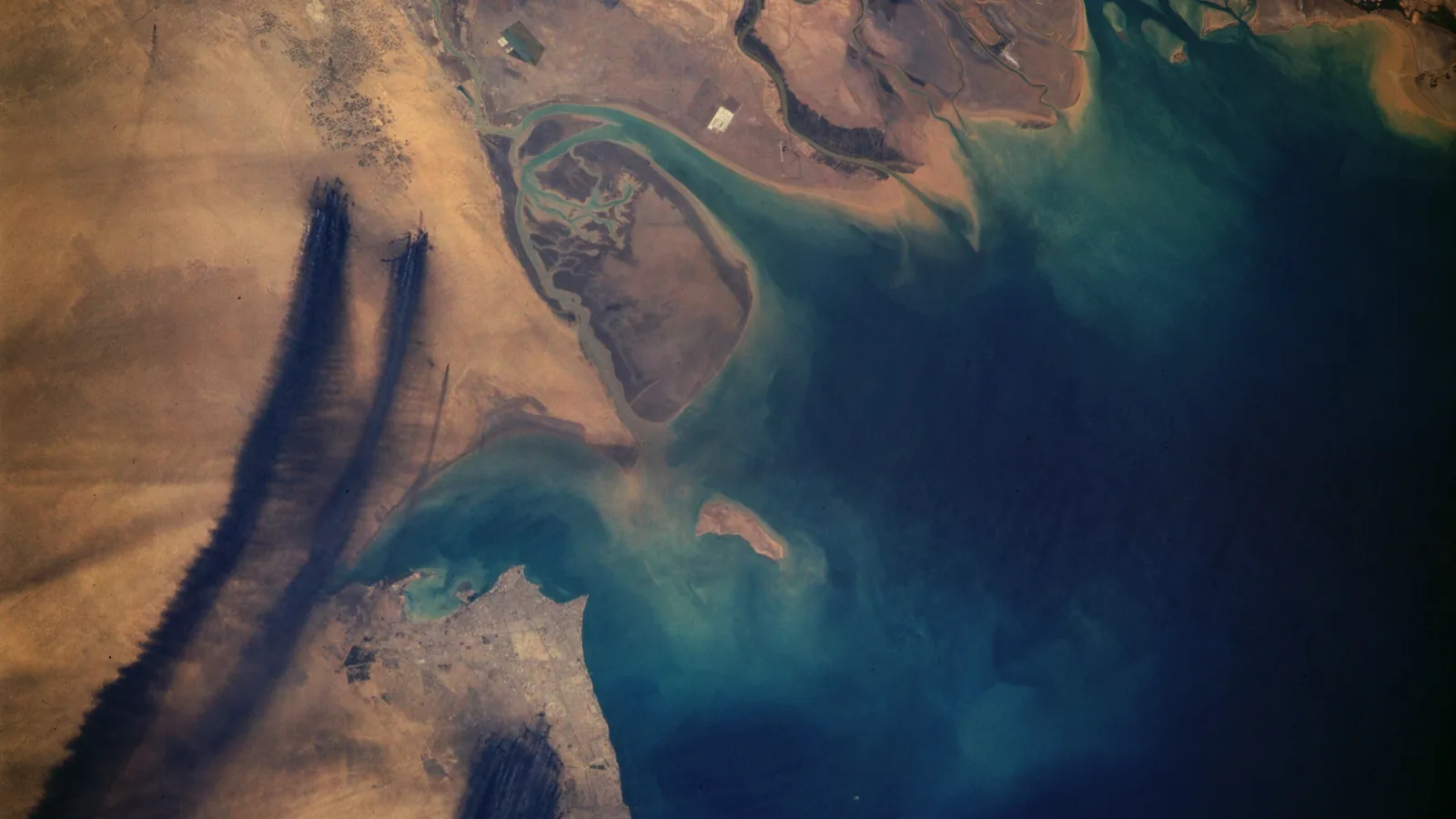
NASA scientists tracked the fires from orbit and from research aircraft. R. F. Cahalan of NASA’s Goddard Space Flight Center wrote in the Journal of Geophysical Research that a Landsat image mosaic from May 30, 1991, “reveals a dark smoke plume 30-60 km wide extending hundreds of kilometers south of Kuwait City along the Persian Gulf,” with smoke from the Raudhatain and Sabriyah oilfields crossing Kuwait Bay and merging with plumes from the Greater Burgan and Minagish fields. Cahalan’s abstract adds that “the last of the Kuwait fires was reportedly extinguished in November of 1991.” W. R. Cofer III of NASA Langley and coauthors measured the smoke’s chemistry and reported that combustion was “surprisingly efficient,” converting more than 93 percent of the burned hydrocarbons to carbon dioxide, with carbon monoxide and soot each near 2 percent by weight. Flying through the plume between May 16 and June 2, 1991, P. Pilewskie and F. P. J. Valero of NASA Ames found that on May 18, about 100 kilometers downwind, the smoke let only 8 percent of sunlight reach the surface while absorbing 78 percent, and calculated an instantaneous heating rate of 24 kelvins per day inside the plume. M. D. King of Goddard measured the smoke layer’s reflectance at about 12 percent looking straight down, with brightening toward the horizon, a pattern he attributed to spherical droplets of oil suspended in the plume.
October 1 to November 6: the count comes down to one
By October 1, 1991, Bush could tell reporters after meeting Kuwait’s Amir Jabir al-Ahmad al-Jabir al-Sabah that “considerably more than half of the oil fires are out, and oil exports have resumed, and schools have reopened,” seven months after liberation. Lieberman recalled that when he visited Kuwait in August, “it was beginning to look like all the fires might be under control in time for the first anniversary of the war’s end, next February,” but the work went faster than expected: “even the most optimistic prophets were not optimistic enough. The fires are all out, less than 9 months since the end of the war,” he told the Senate on November 6. The following day he confirmed the count of firefighting teams once more: “I personally thanked the three American companies and one Canadian firm for their extraordinary efforts in fighting the fires.” On January 16, 1992, marking the first anniversary of Operation Desert Storm, Bush summarized the outcome in a public statement: “Kuwait is liberated, and the legitimate government restored; the fires set by Saddam’s retreating army are extinguished; the flow of oil from the Gulf is secure from political and economic blackmail.”
Key facts
- On February 22, 1991, Bush said Iraq had “launched a scorched-earth policy against Kuwait,” setting fire to its oil wells (American Presidency Project).
- Iraqi forces had occupied Kuwait from the August 2, 1990 invasion until the coalition’s liberation in February 1991 (Congressional Record, Nov. 6, 1991).
- The Congressional Record describes “hundreds” of oil-well fires without a specific total; a 2026 Toxicology Reports review counts “over 500 oil wells.”
- Four firefighting companies worked the wells: Red Adair Co., Boots and Coots and Wild Well Control, all of Texas, and Safety Boss, Ltd., of Canada.
- Santa Fe International of Alhambra, California, and Bechtel Group, Inc., of San Francisco, handled logistics for the effort (Congressional Record, Nov. 7, 1991).
- The last oil-well fire was extinguished on November 6, 1991, in a ceremony at the Burgan oilfield where the Emir of Kuwait put it out himself (Congressional Record).
- NASA’s R. F. Cahalan reported a Landsat-observed smoke plume 30 to 60 kilometers wide extending hundreds of kilometers south of Kuwait City on May 30, 1991.
- NASA researchers measured the smoke absorbing 78 percent of sunlight about 100 kilometers downwind on May 18, 1991, with an instantaneous heating rate of 24 kelvins per day.
FAQ
How many oil wells did Iraqi forces set on fire in Kuwait?
The Congressional Record of November 6, 1991, describes "hundreds" of oil-well fires without giving an exact number. A 2026 review in Toxicology Reports states that Iraqi forces "set fires to over 500 oil wells," without citing a source for that figure.
When was the last Kuwait oil-well fire put out?
On November 6, 1991, at a ceremony in the Burgan oilfield outside Kuwait City, where the Emir of Kuwait extinguished the fire himself, according to the Congressional Record.
Which companies fought the Kuwait oil-well fires?
Red Adair Co., Boots and Coots and Wild Well Control, all of Texas, and Safety Boss, Ltd., of Canada, according to the Congressional Record of November 6 and 7, 1991. Santa Fe International and Bechtel Group, Inc., handled logistics.
Sources
- U.S. Senate, Congressional Record, Vol. 137, Part 21, proceedings of November 6, 1991, pp. 30418-30420, Sen. Joseph I. Lieberman, "THE KUWAITI OIL FIRES"
- U.S. Senate, Congressional Record, Vol. 137, Part 21, proceedings of November 7, 1991, p. 30922, Sen. Joseph I. Lieberman, "OIL WELL FIRES IN KUWAIT"
- The American Presidency Project, George Bush, "Remarks on the Persian Gulf Conflict," February 22, 1991
- The American Presidency Project, George Bush, "Remarks Following Discussions With Amir Jabir al-Ahmad al-Jabir al-Sabah of Kuwait," October 1, 1991
- The American Presidency Project, George Bush, "Statement on the Anniversary of Operation Desert Storm," January 16, 1992
- NASA Technical Reports Server, R. F. Cahalan, "The Kuwait oil fires as seen by Landsat," Journal of Geophysical Research
- NASA Technical Reports Server, W. R. Cofer III et al., "Kuwait oil fires - Compositions of source smoke," Journal of Geophysical Research
- NASA Technical Reports Server, P. Pilewskie and F. P. J. Valero, "Radiative effects of the smoke clouds from the Kuwait oil fires," Journal of Geophysical Research
- NASA Technical Reports Server, M. D. King, "Directional and spectral reflectance of the Kuwait oil-fire smoke," Journal of Geophysical Research
- Hamilton, Chauhan, Archibong and Ramesh, "Polycyclic aromatic hydrocarbon exposure in battlefield and beyond: Implications for environmental- and human health," Toxicology Reports, 2026 (PMC12874435)
Cite this article
- APA
- LETTER. (2026, September 28). November 6, 1991: the last of Kuwait's burning oil wells is capped. Our Earth's History. https://ourearthshistory.com/west-asia/contemporary/kuwait-oil-fires-1991-last-well-november-6-burgan-firefighters/
- Chicago
- LETTER. “November 6, 1991: the last of Kuwait's burning oil wells is capped.” Our Earth's History, September 28, 2026. https://ourearthshistory.com/west-asia/contemporary/kuwait-oil-fires-1991-last-well-november-6-burgan-firefighters/.
- MLA
- LETTER. “November 6, 1991: the last of Kuwait's burning oil wells is capped.” Our Earth's History, 28 Sep. 2026, https://ourearthshistory.com/west-asia/contemporary/kuwait-oil-fires-1991-last-well-november-6-burgan-firefighters/.
Text licensed CC BY-NC-ND 4.0. Found an error? Tell us.