6:50 p.m., November 9, 1989: 'sofort, unverzüglich' and the Wall opens
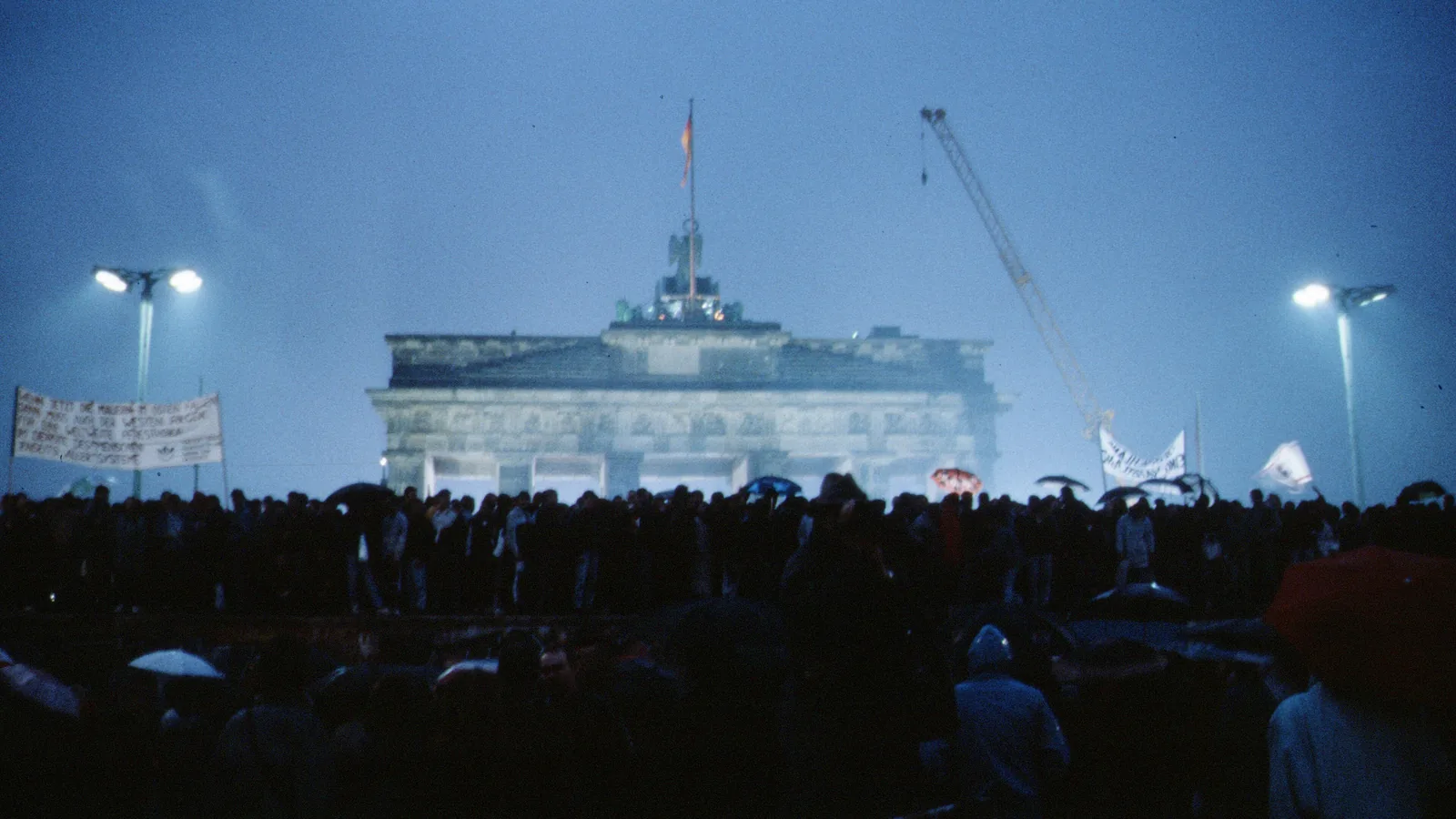

TL;DR — Asked when a new travel rule took effect, Günter Schabowski said “sofort, unverzüglich” at 6:50 p.m., November 9, 1989; by 11:30 p.m. Bornholmer Straße was open.
“Das tritt nach meiner Kenntnis ist das sofort, (leiser Zuruf: unverzüglich), unverzüglich.” That is how Chronik der Mauer prints the answer Günter Schabowski gave at a press conference in East Berlin on the evening of November 9, 1989, when a journalist asked when a new travel regulation came into force. Word for word: “That takes effect, to my knowledge, is that immediately, (quiet interjection: without delay), without delay.” Schabowski, a Politburo member of the Socialist Unity Party (SED) and its Central Committee’s spokesman, was leafing through his papers. The paper he had read from was a draft resolution of the Council of Ministers, handed to him at 5:30 p.m. by the party’s general secretary, Egon Krenz. The timeline puts the exchange at 6:50 p.m.; at 7:05 p.m. the Associated Press flashed “GDR opens border,” and at about 11:30 p.m. passport control at the Bornholmer Straße crossing stopped.
Quick facts
- When
- May 2, 1989 (Hungary cuts its border fence) · September 4 to October 23 (Leipzig Monday demonstrations grow from 1,200 to 300,000) · October 17 to 18 (Honecker resigns) · November 4 (Alexanderplatz rally) · November 9, 5:30 p.m. (Krenz hands Schabowski the draft) · 6:50 p.m. (the answer) · 7:05 p.m. (AP flash) · 11:30 p.m. (Bornholmer Straße) · October 3, 1990 (reunification)
- Where
- East Berlin, where the SED Central Committee's press conference was broadcast live; the Bornholmer Straße, Invalidenstraße and Heinrich-Heine-Straße crossings; the Brandenburg Gate; Leipzig's Nikolaikirche; the Hungarian-Austrian border
- Who
- Günter Schabowski, Politburo member and spokesman for the SED Central Committee; Egon Krenz, SED general secretary; Willi Stoph, chairman of the Council of Ministers; the journalists Riccardo Ehrman, Krzysztof Janowski, Peter Brinkmann and Ralph T. Niemeyer; Helga Labs and Gerhard Beil on the podium; Harald Jäger, head of passport control at Bornholmer Straße
- Outcome
- A temporary travel regulation drafted that morning, still awaiting confirmation by the Council of Ministers and scheduled for release on November 10, was read out live and described as taking effect at once; crowds gathered at the crossings, passport control at Bornholmer Straße stopped at about 11:30 p.m., and Germany reunified on October 3, 1990
What Krenz handed Schabowski at 5:30 p.m.
The document Chronik der Mauer publishes as “Schabowskis Zettel,” Schabowski’s note, is a circulation slip of the Council of Ministers dated Berlin, November 9, 1989, under the name of its chairman, Willi Stoph. It asks the ministers to confirm the attached draft “bis heute, Donnerstag den 9. November 1989, 18.00 Uhr im Umlaufverfahren,” by 6 p.m. that Thursday, by passing the paper around instead of meeting. The draft begins “Ab sofort,” from now on: visas for permanent departure were to be issued “unverzüglich,” and departure could take place “über alle Grenzübergangsstellen der DDR zur BRD bzw. zu Berlin (West),” through every East German crossing to West Germany or West Berlin. Its last line orders the attached press release to be published on November 10.
The text was hours old. Four officers of the Interior Ministry and the Ministry of State Security had drafted it from 9 a.m., Politburo members had confirmed it at noon during a smoking break at the Central Committee meeting, and Krenz had read it to the Central Committee at 4 p.m. The press conference began at 6 p.m., live on East German television and radio.
Eight minutes on tape
Hans-Hermann Hertle’s transcript of the camera recording, printed by Chronik der Mauer as an excerpt, starts at 18:52:40. Riccardo Ehrman of the Italian agency ANSA asked whether the draft travel law presented a few days earlier had not been “ein großer Fehler,” a big mistake. Schabowski said no, and added that the law “ist ja immer noch nicht in Kraft, es ist ja ein Entwurf,” was still not in force, was only a draft; a decision had been taken that day, he went on, to put its section on permanent departure into force. Krzysztof Janowski of Voice of America asked “Ab wann tritt das in Kraft?” and Peter Brinkmann of Bild-Zeitung asked “Ab sofort?” Schabowski scratched his head, put on his glasses and read the paragraphs very fast from the sheet.
Then the timing question came again. The transcript attributes “Wann tritt das in Kraft?” to Ralph T. Niemeyer, who gave his outlet as DAPA, with a footnote stating that the attribution rests on Niemeyer’s own statement and has no independent confirmation. Ehrman, who is usually credited with the question, is recorded in the same transcript asking earlier whether the travel law had been a mistake. Schabowski’s answer was the sentence quoted above. Helga Labs, beside him, repeated “unverzüglich” quietly; Gerhard Beil said, also quietly, “Das muss der Ministerrat beschließen,” the Council of Ministers has to decide that. Brinkmann asked whether the rule covered West Berlin, since Schabowski had said only BRD; Schabowski shrugged, looked into his papers and read the line “zur BRD bzw. zu Berlin-West.” The recording ends at 19:00:54.
A summer and autumn of pressure
The Wall had stood since August 13, 1961, when the SED sealed off West Berlin with barbed wire and, days later, concrete; the Berlin Wall Foundation gives its length as 155 kilometers. Hungary cut a demonstrative hole in its fence with Austria on May 2, 1989, and in the night of September 10 to 11 its government, through the foreign minister, Gyula Horn, opened that border to East Germans; tens of thousands crossed to West Germany through Austria in the following weeks.
Leipzig’s Monday demonstrations after the peace prayers at the Nikolaikirche grew from about 1,200 people on September 4, chanting “We want out!,” to 5,000 to 8,000 on September 25, up to 20,000 on October 2, 70,000 on October 9, more than 100,000 on October 16 and 300,000 on October 23, according to Chronik der Mauer’s entries for those dates. On October 17 and 18 a power struggle in the Politburo ended with Erich Honecker’s resignation and Krenz’s election as general secretary. On November 4 between 250,000 and 500,000 people rallied on Alexanderplatz in East Berlin, and on November 7 and 8 the Council of Ministers and then the Politburo resigned.
From 8:15 p.m. to 10:42 p.m.
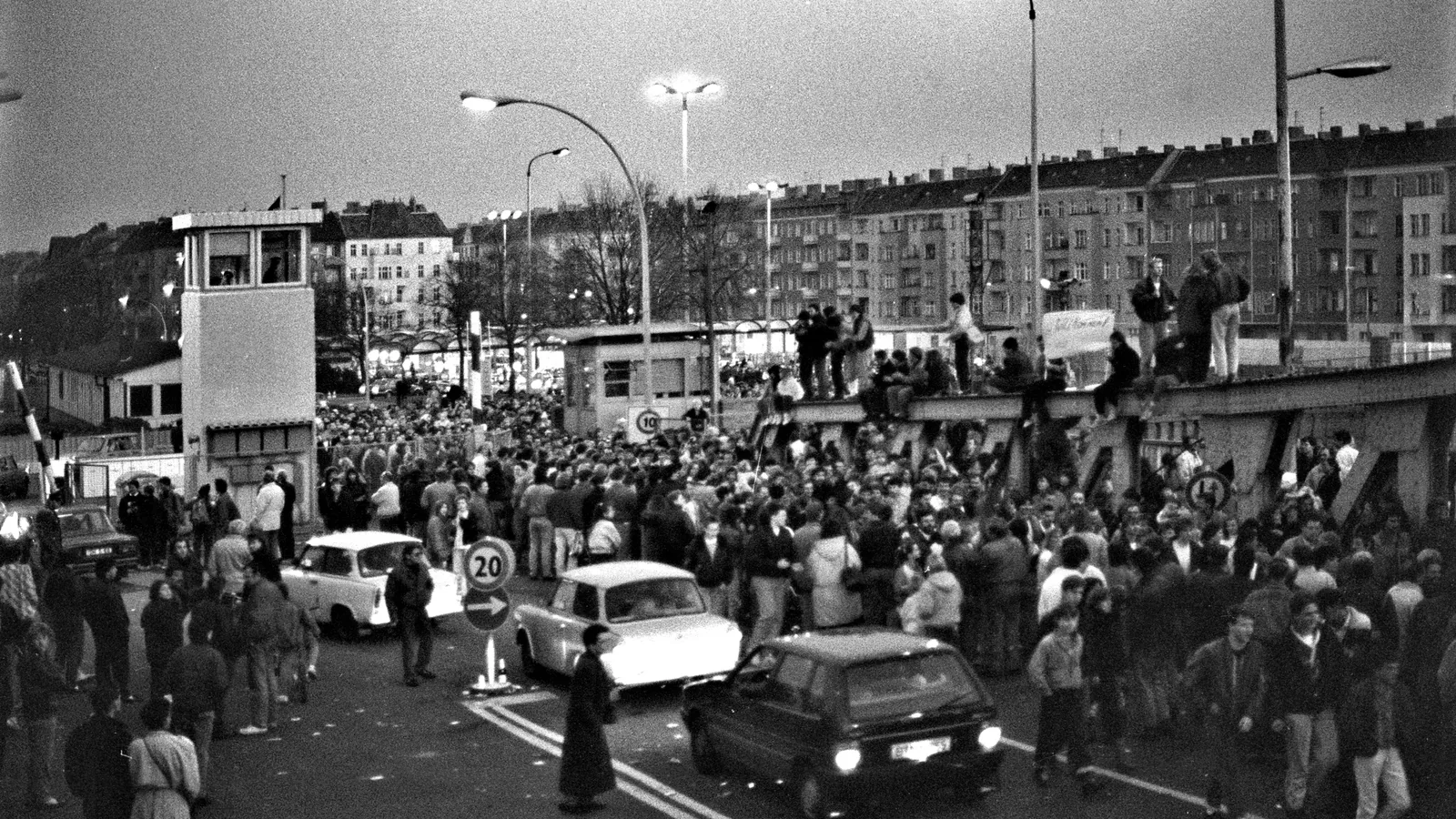
The agency reports led West German television and radio news. At 8:15 p.m. a Volkspolizei situation report counted 80 East Berliners at the Bornholmer Straße, Invalidenstraße and Heinrich-Heine-Straße crossings; the guards were told to put people off until the next day. By 9:30 p.m. between 500 and 1,000 people stood at Bornholmer Straße, and the Ministry of State Security chose a “valve solution,” letting a few through at a time. At 10:42 p.m. Hanns Joachim Friedrichs opened ARD’s “Tagesthemen” by saying that the GDR had announced its borders open to everyone as of now and that “the gates in the Wall are wide open.”
Bornholmer Straße, 11:30 p.m.
At 11:30 p.m., Chronik der Mauer records, thousands were pushing toward the Bornholmer Straße crossing and the valve solution had made the crush worse, since each person let through pressed the rest forward. Harald Jäger, the Ministry of State Security officer who headed passport control there, stopped all inspections, and the crossing opened. At 2 a.m. the Interior Ministry announced by radio that the border could be crossed on an identity card until 8 a.m.
The first crossing opened at about 11:30 p.m. on Jäger’s decision, five and a half hours after a draft with a 6 p.m. confirmation deadline had been read out as if it were law. On October 3, 1990, East and West Germans celebrated reunification together, and at midnight the Freedom Bell rang to mark the end of the division. Between 1961 and 1989, the Berlin Wall Foundation states, at least 140 people were killed at the Wall or died there because of the East German border regime: 101 who tried to flee, 30 East and West Germans and one Soviet soldier who had no intention of fleeing, and eight East German border soldiers on duty.

Key facts
- Chronik der Mauer prints Schabowski’s answer as “Das tritt nach meiner Kenntnis ist das sofort, (leiser Zuruf: unverzüglich), unverzüglich,” and its timeline puts the exchange at 6:50 p.m. on November 9, 1989.
- The paper he read from was a Council of Ministers circulation draft under Willi Stoph’s name, to be confirmed by 6 p.m. that day, with its press release scheduled for November 10 (BStU, MfS, Arbeitsbereich Neiber Nr. 553).
- Hertle’s transcript attributes “Wann tritt das in Kraft?” to Ralph T. Niemeyer, with a footnote that this rests on his own statement; Riccardo Ehrman’s recorded question was whether the draft travel law had been a mistake.
- The transcript excerpt runs from 18:52:40 to 19:00:54; the last question was what would now happen to the Wall.
- Leipzig’s Monday demonstrations grew from about 1,200 on September 4 to 300,000 on October 23, 1989; Honecker resigned on October 17 to 18 (Chronik der Mauer).
- AP flashed “GDR opens border” at 7:05 p.m.; 80 people stood at three crossings at 8:15 p.m.; 500 to 1,000 at Bornholmer Straße at 9:30 p.m.; inspections there stopped at about 11:30 p.m.
- The Berlin Wall stood from August 13, 1961, ran 155 kilometers, and at least 140 people died at it between 1961 and 1989 (Berlin Wall Foundation).
FAQ
What exactly did Schabowski say on November 9, 1989?
As printed by Chronik der Mauer from Hans-Hermann Hertle's recording: "Das tritt nach meiner Kenntnis ist das sofort, (leiser Zuruf: unverzüglich), unverzüglich." Literally: "That takes effect, to my knowledge, is that immediately, (quiet interjection: without delay), without delay."
Who asked the question that led to the "sofort, unverzüglich" answer?
The transcript published by Chronik der Mauer attributes "Wann tritt das in Kraft?" to Ralph T. Niemeyer, with a footnote that the attribution rests on Niemeyer's own statement and lacks independent confirmation. Riccardo Ehrman of ANSA, usually credited, is recorded asking earlier whether the draft travel law had been a mistake. Krzysztof Janowski of Voice of America had also asked "Ab wann tritt das in Kraft?" before Schabowski read from the sheet.
When did the first Berlin crossing open?
At about 11:30 p.m. on November 9, 1989, at Bornholmer Straße, where Harald Jäger, head of passport control, stopped all inspections as thousands pushed toward the crossing (Chronik der Mauer). The Interior Ministry's announcement that the border could be crossed on an identity card came at 2 a.m. on November 10.
Sources
- Chronik der Mauer — Internationale Pressekonferenz von Günter Schabowski (in Begleitung der SED-ZK-Mitglieder Helga Labs, Gerhard Beil und Manfred Banaschak), 9. November 1989 (Ton-Abschrift): verbatim transcription of Hans-Hermann Hertle's camera and sound recording, excerpt, with footnote 1 on Ralph T. Niemeyer; from Hertle, Die Berliner Mauer. Biografie eines Bauwerks, 2nd ed. (Berlin: Ch. Links, 2015), pp. 194-195.
- Chronik der Mauer — „Schabowskis Zettel": Zeitweilige Übergangsregelung des DDR-Ministerrates für Reisen und ständige Ausreise aus der DDR, 9. November 1989 (BStU, MfS, Arbeitsbereich Neiber Nr. 553, Bl. 15-19).
- Chronik der Mauer — Chronicle of the Berlin Wall, 1989, November: the timed entries for November 4 to 10, 1989.
- Chronik der Mauer — Chronicle of the Berlin Wall, 1989, September: entries for September 4, 10-11, 18 and 25, 1989.
- Chronik der Mauer — Chronicle of the Berlin Wall, 1989, October: entries for October 2, 9, 16, 17-18 and 23, 1989.
- Stiftung Berliner Mauer (Berlin Wall Foundation) — Victims at the Berlin Wall: the count of at least 140 deaths between 1961 and 1989 and its three categories.
- Stiftung Berliner Mauer (Berlin Wall Foundation) — The Berlin Wall: construction on August 13, 1961, the 155-kilometer length, the order to shoot, and the fall in 1989.
- Die Bundesregierung — Deutsche Einheit: 3. Oktober 1990, Die Einheit ist Wirklichkeit.
Cite this article
- APA
- Our Earth's History. (2026, September 22). 6:50 p.m., November 9, 1989: 'sofort, unverzüglich' and the Wall opens. Our Earth's History. https://ourearthshistory.com/europe/contemporary/berlin-wall-november-9-1989-schabowski-press-conference/
- Chicago
- Our Earth's History. “6:50 p.m., November 9, 1989: 'sofort, unverzüglich' and the Wall opens.” Our Earth's History, September 22, 2026. https://ourearthshistory.com/europe/contemporary/berlin-wall-november-9-1989-schabowski-press-conference/.
- MLA
- “6:50 p.m., November 9, 1989: 'sofort, unverzüglich' and the Wall opens.” Our Earth's History, 22 Sep. 2026, https://ourearthshistory.com/europe/contemporary/berlin-wall-november-9-1989-schabowski-press-conference/.
Text licensed CC BY-NC-ND 4.0. Found an error? Tell us.