Murray's trade sale, November 22, 1859: 1,250 copies of the Origin

TL;DR — Darwin’s diary says all 1,250 copies of the Origin sold on November 24, 1859; Murray’s trade sale two days earlier had taken orders for 1,500.
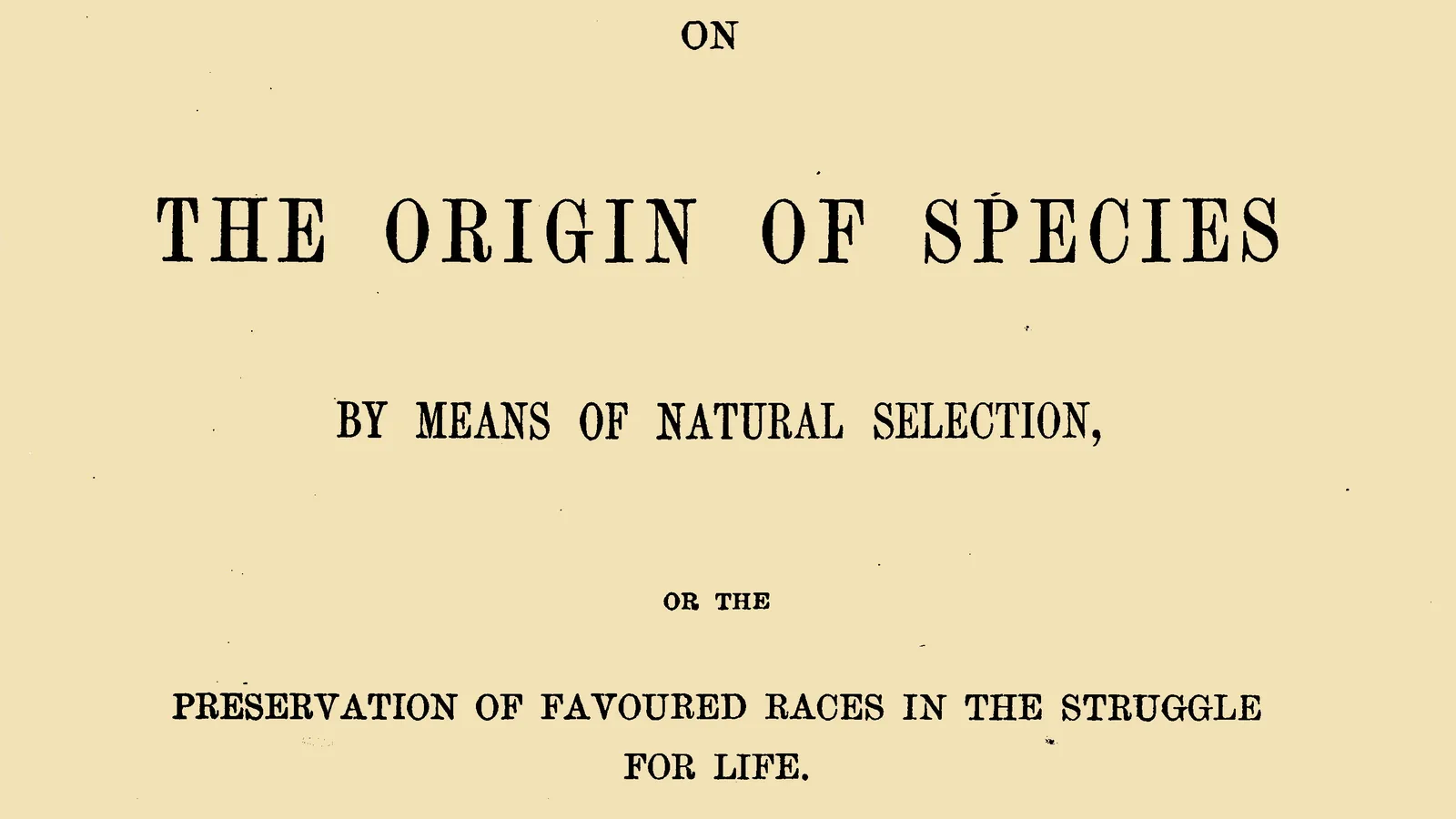
Charles Darwin’s diary entry for his book reads, as the bibliographer R. B. Freeman prints it: “1250 copies printed. The first edition was published on November 24th, and all copies sold first day.” The publisher was John Murray of Albemarle Street, London; 1,250 was the whole printing. The book existed in that form because of a letter. On June 18, 1858, Darwin had written to the geologist Charles Lyell that a manuscript from Alfred Russel Wallace had arrived at Down, in Kent: “Your words have come true with a vengeance that I shd. be forestalled.” Seventeen months later the Origin was in the shops; the fight over it moved to Oxford the next summer.
Quick facts
- When
- June 18, 1858 (Darwin's letter to Lyell about Wallace's essay) · July 1, 1858 (joint paper read at the Linnean Society) · July 20, 1858 (writing begun at Sandown) · November 22, 1859 (Murray's trade sale) · November 24, 1859 (publication) · January 7, 1860 (second edition) · June 26 to July 3, 1860 (British Association at Oxford) · 1869 and 1872 (fifth and sixth editions)
- Where
- Down House, Kent; Sandown, Isle of Wight; the Linnean Society, London; John Murray's house at Albemarle Street, London; Ilkley, Yorkshire; Oxford
- Who
- Charles Darwin; Alfred Russel Wallace; Charles Lyell; Joseph Dalton Hooker; the publisher John Murray; Whitwell Elwin; Adam Sedgwick; John Herschel; Thomas Henry Huxley; Samuel Wilberforce, bishop of Oxford; Richard Owen
- Outcome
- 1,250 copies printed and taken up by the trade before publication; a second edition of 3,000 on January 7, 1860; six editions by 1872, with "survival of the fittest" from 1869 and "evolution" from 1872
A manuscript from Wallace, June 1858
Wallace’s paper carried the title “On the Tendency of Varieties to depart indefinitely from the Original Type.” Darwin dated his letter to Lyell June 18, 1858; the Darwin Correspondence Project notes that the date he received Wallace’s essay cannot be settled. “If Wallace had my M.S. sketch written out in 1842 he could not have made a better short abstract! Even his terms now stand as Heads of my Chapters.” He expected that “all my originality, whatever it may amount to, will be smashed.”
Lyell and the botanist Joseph Dalton Hooker arranged a joint reading. On July 1, 1858, Wallace’s essay, part of Darwin’s early sketch and an abstract of his views sent to Asa Gray in 1857 were read at the Linnean Society of London. Darwin stayed at Down. His eldest daughter, Henrietta, had come down with diphtheria on June 18, and the baby, Charles Waring Darwin, aged 18 months, caught scarlet fever and died on June 28. The Correspondence Project calls his absence from the meeting “not surprising.”
Thirteen months from Sandown to corrected proof
Darwin started the book on Tuesday, July 20, 1858, on holiday at Sandown on the Isle of Wight. He expected an abstract of perhaps thirty pages for the Linnean Society’s journal. By October 12 he told Hooker it would need a “small volume.” Murray agreed to publish it, the Correspondence Project writes, without seeing the manuscript, then had second thoughts and sent it to Whitwell Elwin, editor of his own Quarterly Review; Darwin kept to his plan. The rough title page Darwin drew up read “An abstract of an Essay on the Origin of Species and Varieties Through natural selection.” Murray thought it too long, and on his advice the words “an abstract” went. The text was in corrected proof by September 11, 1859, and Darwin left for a water cure at Ilkley in Yorkshire.

Tuesday, November 22: Murray's trade sale
Freeman’s count of the printing is exact. Of the 1,250 copies, 12 went to the author, 41 to reviewers and five to Stationers’ Hall for copyright, leaving 1,192 for sale; Darwin took at least 20 more for presentation, so about 1,170 reached the trade. Murray offered them at his autumn sale on November 22. The Athenaeum of November 26 reported that “Mr. Murray’s trade sale came off on Tuesday” and listed “Mr. Charles Darwin’s work ‘On the Origin of Species,’ 1,500,” a few lines below the 7,600 copies of Captain McClintock’s narrative of the search for Franklin. The Correspondence Project puts the orders at 250 above the printing.
The diary entry records what the trade took before publication; Freeman is dry about it: “once copies had reached the bookshops, up and down the country, how could anyone know whether they were sold or not.” Murray’s letter reached Ilkley on November 24, and Darwin wrote to Thomas Henry Huxley the same day, “I have heard from Murray today that he sold the whole edition of my book the first day.” Murray did not reprint but asked for corrections, and the second edition, 3,000 copies, the largest printing of Darwin’s lifetime, came out on January 7, 1860. The price fell to 14 shillings.
Sedgwick, Herschel and an unsigned Quarterly
The first letters were hard. The geologist Adam Sedgwick wrote on November 24, 1859, that Darwin had abandoned the “true method of induction.” John Herschel, the Correspondence Project records, called natural selection the “law of higgledy-piggledy.” Darwin answered Sedgwick on November 26 with one sentence he would repeat: “I cannot think a false theory would explain so many classes of facts, as the theory seems to me to do.” Late in December The Times printed a favorable review, and Huxley admitted to Darwin that he had written it.
An anonymous review in the Quarterly Review of July 1860, usually attributed to Samuel Wilberforce, bishop of Oxford, praised the writing and then turned: “With Mr. Darwin’s ‘argument’ we may say in the outset that we shall have much and grave fault to find.” It quoted the anatomist Richard Owen to argue “that man is not and cannot be an improved ape.”
Oxford, June 26 to July 3, 1860
The British Association for the Advancement of Science met at Oxford from June 26 to July 3, 1860. Darwin did not go; he spent the week at a water-cure house at Sudbrook Park in Surrey. The Athenaeum covered the zoology and botany section, and the Correspondence Project reprints its report, though the Project’s page dates the exchange to a Saturday, July 7, outside the meeting dates it gives. In the Athenaeum’s account, “The BISHOP OF OXFORD stated that the Darwinian theory, when tried by the principles of inductive science, broke down,” and cited Darwin’s own pigeons: “no sooner were these animals set free than they returned to their primitive type.” Huxley “defended Mr. Darwin’s theory from the charge of its being merely an hypothesis,” comparing it to the wave theory of light. Hooker said the bishop “had, as it appeared to him, completely misunderstood Mr. Darwin’s hypothesis.”
The book kept changing under the argument. The fifth edition, of 1869, used Herbert Spencer’s phrase “survival of the fittest” for the first time, in the heading of chapter IV; the sixth, of February 1872, was the first to contain the word “evolution,” as Freeman records. The last sentence of the first edition ran: “There is grandeur in this view of life, with its several powers, having been originally breathed into a few forms or into one; and that, whilst this planet has gone cycling on according to the fixed law of gravity, from so simple a beginning endless forms most beautiful and most wonderful have been, and are being, evolved.” The second edition of January 1860 reads “breathed by the Creator into a few forms or into one”; those three words are absent from the 1859 text.
Key facts
- Darwin’s diary, as Freeman prints it: “1250 copies printed. The first edition was published on November 24th, and all copies sold first day.”
- Of 1,250 copies, 1,192 were for sale after 12 author’s copies, 41 for review and five for Stationers’ Hall; about 1,170 reached the trade.
- The Athenaeum of November 26, 1859, reported 1,500 copies taken at Murray’s trade sale on Tuesday, November 22.
- Darwin’s letter to Lyell about Wallace’s essay is dated June 18, 1858; the joint paper was read at the Linnean Society on July 1, 1858, without Darwin, whose infant son had died on June 28.
- Writing began at Sandown, Isle of Wight, on July 20, 1858; corrected proofs were done by September 11, 1859.
- The second edition, 3,000 copies, appeared on January 7, 1860, at 14 shillings.
- “Survival of the fittest” entered in the fifth edition (1869); the word “evolution” in the sixth (February 1872).
- The 1859 text ends “breathed into a few forms or into one”; the 1860 text reads “breathed by the Creator into a few forms or into one.”
FAQ
Did the first edition of the Origin really sell out in a day?
Darwin's diary says so, and he told Huxley on November 24, 1859, that Murray "sold the whole edition of my book the first day." Freeman shows what that meant: the trade took orders for more than the 1,250 printed at Murray's sale on November 22, before the book reached readers.
What did Wallace send Darwin in 1858?
A manuscript titled "On the Tendency of Varieties to depart indefinitely from the Original Type." Darwin wrote to Lyell on June 18, 1858, that Wallace "could not have made a better short abstract" of his own 1842 sketch. It was read with extracts from Darwin's work at the Linnean Society on July 1, 1858.
When did "survival of the fittest" enter the book?
In the fifth edition of 1869, in the heading of chapter IV, according to Freeman. The phrase was Herbert Spencer's. The noun "evolution" appeared only in the sixth edition of 1872, although "evolved" had been the last word of the text from 1859.
Sources
- R. B. Freeman, "On the Origin of Species: an introduction," from The Works of Charles Darwin: An Annotated Bibliographical Handlist (2nd ed., 1977), as published on Darwin Online; print runs, dates and Darwin's diary entry.
- Darwin Correspondence Project, letter no. DCP-LETT-2285, Charles Darwin to Charles Lyell, 18 [June 1858], with the editors' footnotes on Wallace's manuscript and the debate over its date of arrival.
- Darwin Correspondence Project, "The writing of 'Origin'," from the introduction to The Correspondence of Charles Darwin, vol. 7; the Linnean reading, Murray and Elwin, the trade sale of November 22, 1859, Sedgwick, Herschel and The Times.
- Darwin Correspondence Project, "Alfred Russel Wallace's essay on varieties," with the text of "On the Tendency of Varieties to depart indefinitely from the Original Type."
- Darwin Correspondence Project, "British Association meeting 1860," from The Correspondence of Charles Darwin, vol. 8, Appendix VII; the meeting dates and the Athenaeum's reports of July 7 and 14, 1860.
- Charles Darwin, On the Origin of Species by Means of Natural Selection (London: John Murray, 1859), first edition, page 490, text on Darwin Online (F373).
- Charles Darwin, On the Origin of Species by Means of Natural Selection (London: John Murray, 1860), second edition, page 490, text on Darwin Online (F376).
- The Quarterly Review, vol. 108, no. 215 (July 1860), Art. VII, "On the Origin of Species," pp. 225-264, unsigned; scan and OCR on the Internet Archive.
- The Athenaeum, no. 1674, November 26, 1859; John Murray's "This day" advertisement and the report of Murray's trade sale; scan and OCR on the Internet Archive.
Cite this article
- APA
- Our Earth's History. (2026, September 22). Murray's trade sale, November 22, 1859: 1,250 copies of the Origin. Our Earth's History. https://ourearthshistory.com/europe/modern/origin-of-species-1859-november-24-john-murray/
- Chicago
- Our Earth's History. “Murray's trade sale, November 22, 1859: 1,250 copies of the Origin.” Our Earth's History, September 22, 2026. https://ourearthshistory.com/europe/modern/origin-of-species-1859-november-24-john-murray/.
- MLA
- “Murray's trade sale, November 22, 1859: 1,250 copies of the Origin.” Our Earth's History, 22 Sep. 2026, https://ourearthshistory.com/europe/modern/origin-of-species-1859-november-24-john-murray/.
Text licensed CC BY-NC-ND 4.0. Found an error? Tell us.