London Gazette no. 85: Pudding Lane, an east wind and a pillar

TL;DR — The London Gazette no. 85 dated the fire to 1 a.m. on September 2, 1666, in Pudding Lane; an Act of 1666 set a yearly fast and ordered a pillar.
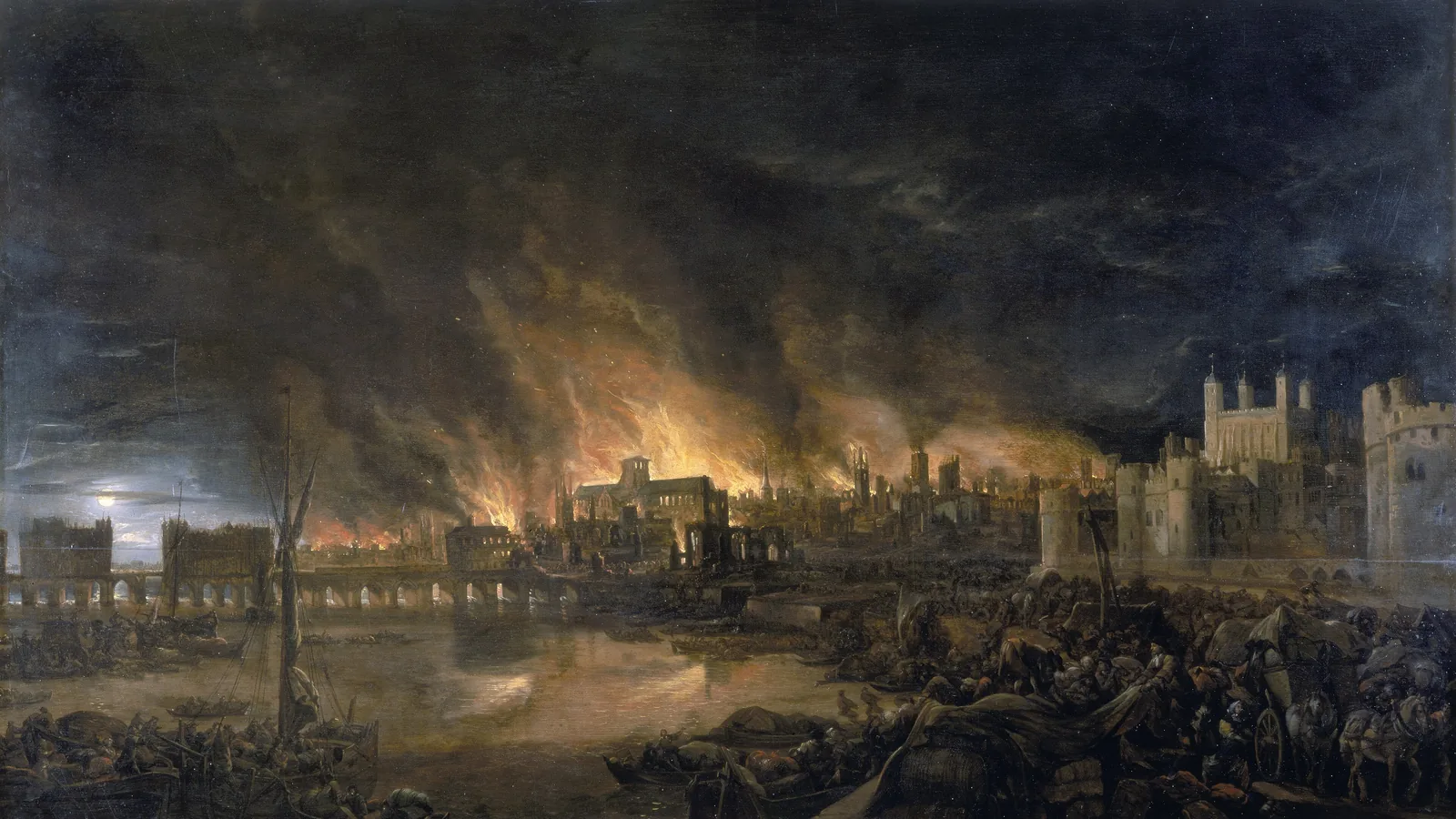
The London Gazette no. 85, covering Monday, September 3, to Monday, September 10, 1666, reported that the fire had broken out “at one of the clock in the Morning” on September 2, in “Pudding-lane neer New Fishstreet.” An east wind drove it through the City of London until, by the paper’s account, it was put out on Thursday, September 6. The same issue reported that “Divers Strangers, Dutch and French” had been arrested on suspicion of starting it. Parliament’s Act for rebuilding the city, printed on legislation.gov.uk as the Rebuilding of London Act 1666, required new houses of brick or stone, made September 2 a yearly fast and ordered a pillar near the place where the fire began.
Quick facts
- When
- September 2, 1666 (fire breaks out about 1 a.m., by the London Gazette's account) to Thursday, September 6 (put out, by the same account) · London Gazette no. 85 covers September 3 to 10, 1666 · the Monument begun in 1671 and completed in 1677 (City of London)
- Where
- Pudding Lane near New Fish Street, in the City of London; the Tower, Whitehall, the Bankside in Southwark, the Temple, Islington and Highgate
- Who
- Samuel Pepys; John Evelyn; King Charles II and James, Duke of York; Lord Mayor Sir Thomas Bludworth; Lord Chief Justice Keeling; the baker Thomas Farriner (Farynor); Christopher Wren and Robert Hooke
- Outcome
- The City of London's Monument page counts one third of all buildings in London destroyed and 130,000 people homeless; Royal Museums Greenwich counts more than 13,000 houses destroyed, up to 100,000 homeless and six known deaths. The Rebuilding of London Act 1666 required brick or stone, made September 2 a yearly fast and ordered a pillar near the place where the fire began
September 2: Pepys at the Tower and at Whitehall
At about three in the morning of Sunday, September 2, a woman of Samuel Pepys’s household named Jane woke him to see a fire in the City; he judged it far off and went back to bed. By seven Jane had heard “that above 300 houses have been burned down to-night,” and Pepys climbed to a high place at the Tower, where he saw the houses at the end of London Bridge burning. The Lieutenant of the Tower told him that it had begun “in the King’s baker’s’ house in Pudding-lane” and had already burned St. Magnus’s Church.
Royal Museums Greenwich names the baker’s family as the Farynors, who escaped through an upper window while their maid stayed behind and died. The City of London’s page for the Monument spells the baker Thomas Farriner and places his bakery 202 feet from the column that stands there now.
Pepys took a boat to Whitehall and told King Charles II and James, Duke of York, “that unless his Majesty did command houses to be pulled down nothing could stop the fire.” The king sent him to the Lord Mayor, Sir Thomas Bludworth, with an order to “spare no houses, but to pull down before the fire every way.” Pepys found him in Canning Street “like a man spent, with a handkercher about his neck,” and wrote down his answer: “Lord! what can I do? I am spent: people will not obey me.” That evening, from an alehouse on the Bankside, Pepys watched “one entire arch of fire” more than a mile long. “It made me weep to see it,” he wrote. In his entry for September 4 he recorded that “the practice of blowing up of houses in Tower-streete” had begun near the Tower.
Evelyn on the Bankside, September 3 to 7
John Evelyn’s diary gives a different hour. His entry for September 2 reads: “This fatal night, about ten, began the deplorable fire, near Fish street, in London.” On September 3 he took a coach with his wife and son to the Bankside in Southwark and watched the city burn from across the Thames. “God grant mine eyes may never behold the like, who now saw above 10,000 houses all in one flame!” he wrote. The number was his estimate from the far bank, and the same entry puts the smoke at “near fifty miles in length.”
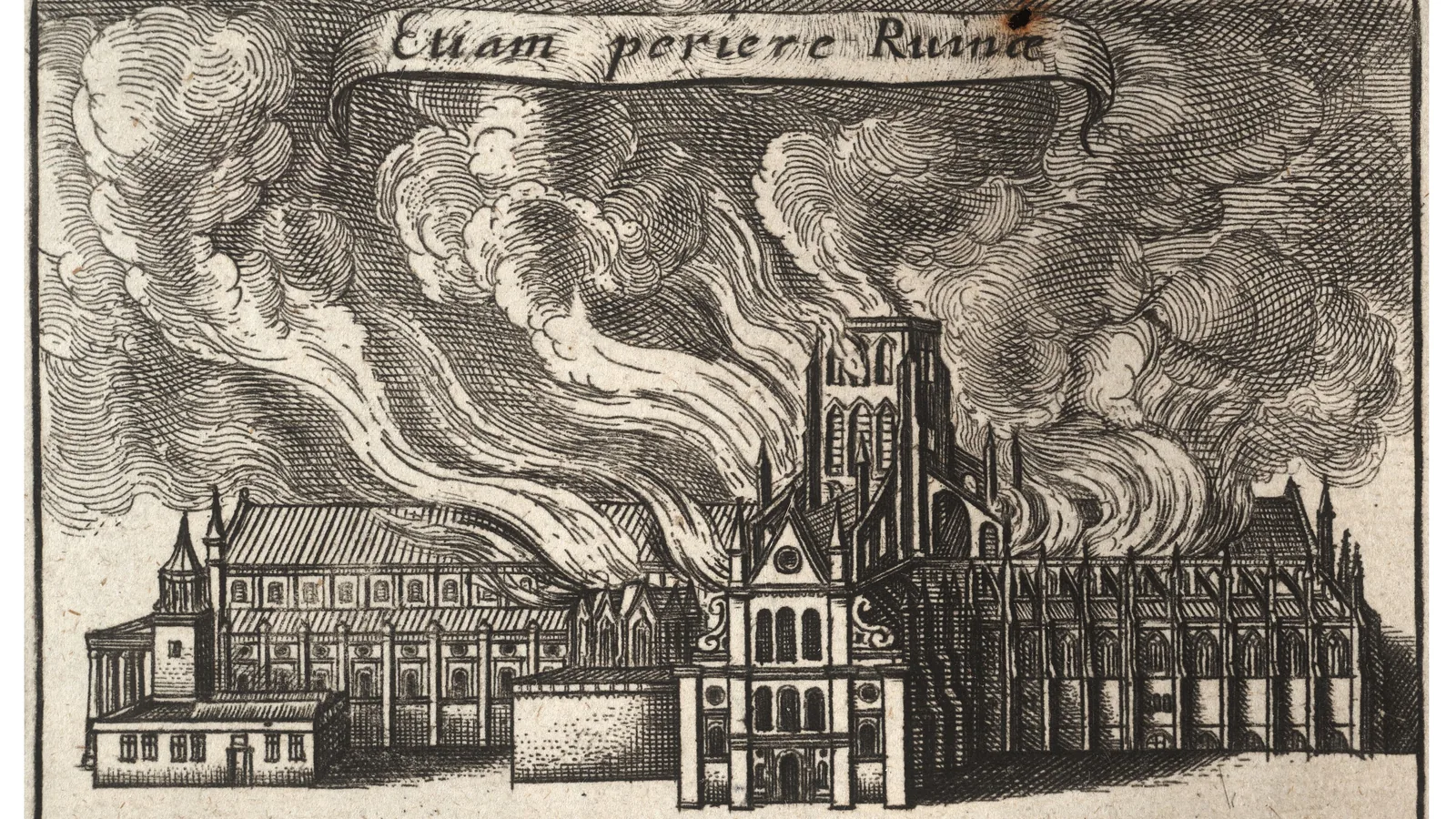
On September 7 he walked through the ruins. At St. Paul’s he found the portico split and the roof gone: “a sheet of lead covering a great space (no less than six acres by measure) was totally melted.” Going on toward Islington and Highgate, he saw “200,000 people of all ranks and degrees dispersed,” lying beside the goods they had saved. In the same entry he described a rumor that French and Dutch forces, then at war with England, had landed and were entering the city. Crowds fell on people of those nations they happened to meet, “without sense or reason,” Evelyn wrote, until troops and guards were sent to calm them.
_(State_4).jpg)
"Divers Strangers, Dutch and French"
The Gazette’s account was dated at Whitehall on September 8. The fire had started in “a quarter of the Town so close built with wooden pitched houses” that it spread before day, and “a violent Easterly wind fomented it.” When the flames reached brick buildings at the Temple they lost force, and on Wednesday a stop was put to them at the Temple Church, near Holborn Bridge, at Aldersgate, Cripplegate and the Tower dock, among other places. On Thursday the fire “was wholy beat down and extinguished,” burst out again that evening at the Temple, and was put out before day by using powder to blow up the houses around it.
Then the paper turned to the arrests. “Divers Strangers, Dutch and French, were, during the fire, apprehended, upon suspition that they contributed mischievously to it, who are all imprisoned,” it reported, with “Informations prepared to make a severe inquisition thereupon by my Lord Chief Justice Keeling,” assisted by members of the Privy Council and leading men of the City. In the same paragraph the government gave its own view of the cause: “the manner of the burning all along in a Train, and so blowen forwards in all its way by strong winds, makes us conclude the whole was an effect of an unhappy chance, or to speak better, the heavy hand of God upon us for our sins.” Royal Museums Greenwich writes that from Monday, September 3, Dutch and French residents and anyone who looked foreign were attacked in the streets or jailed, sometimes for their own protection.
Two counts of houses, churches and the homeless
The Gazette’s front-page account gives no count of houses or of the dead. Two institutions give different figures. The City of London’s Monument page states that the fire “raged for four days,” destroyed one third of all buildings in London, burned 86% of the City to the ground and left 130,000 people homeless; it counts 85 churches destroyed, St. Paul’s Cathedral among them. Royal Museums Greenwich counts 87 churches, 52 company halls and “more than 13,000 houses,” with as many as 100,000 people homeless and 85% of the City destroyed, and it dates the fire from September 2 to September 6, five days in all.
On the dead the two pages agree in outline. Royal Museums Greenwich writes that “only six people are known to have died,” adding that many deaths doubtless went unrecorded. The Monument page says there was “limited loss of life” and mentions only one victim, the maid who discovered the fire.
Clauses XXVI and XXVII: a fast day and a pillar
Parliament’s answer was “An Act for rebuilding the Citty of London,” chapter 8 of the session of 18 and 19 Charles II. Clause III allowed “onely fower sortes of Buildings and noe more,” graded from houses on by-lanes to mansions, and clause V required that the outsides of all buildings be made of brick or stone, with oak allowed only for door cases, window frames and shop fronts. Clause XXIX capped the parish churches to be rebuilt at “thirty nine.”
Clause XXVI turned the date into a public observance. September 2, or the next day when it fell on a Sunday, was to be “yearely for ever hereafter observed as a day of Publique Fasting and Humiliation within the said Citty.” Clause XXVII followed: “a Columne or Pillar of Brase or Stone be erected on or as neere unto the place where the said Fire soe unhappily began as conveniently may be,” with an inscription to be chosen later by the Lord Mayor and the Court of Aldermen.
The City of London’s Monument page records that Robert Hooke and Christopher Wren produced the final design and that construction began in 1671. Work took six years, slowed by the search for Portland stone of the required size and by the war with the Dutch of 1672 to 1674. The column was completed and opened in 1677.
Key facts
- The London Gazette no. 85 (September 3 to 10, 1666) dated the outbreak to “one of the clock in the Morning” on September 2, in Pudding Lane near New Fish Street; John Evelyn’s diary gives “about ten” the previous night.
- Pepys told Charles II on September 2 that “unless his Majesty did command houses to be pulled down nothing could stop the fire,” and was sent to the Lord Mayor with that order.
- Evelyn estimated “above 10,000 houses all in one flame” on September 3 and “200,000 people” camped toward Islington and Highgate on September 7.
- The Gazette reported that Dutch and French strangers were imprisoned on suspicion, with an inquiry by Lord Chief Justice Keeling, and concluded the fire was “an effect of an unhappy chance.”
- The City of London’s Monument page gives four days, one third of London’s buildings, 85 churches and 130,000 homeless; Royal Museums Greenwich gives five days, 87 churches, more than 13,000 houses and up to 100,000 homeless.
- Royal Museums Greenwich writes that six people are known to have died, with many deaths doubtless unrecorded.
- The Rebuilding of London Act 1666 made September 2 a yearly fast (clause XXVI) and ordered a pillar near where the fire began (clause XXVII); the Monument was begun in 1671 and completed in 1677.
FAQ
Where did the Great Fire of London start?
In a baker's house in Pudding Lane, near New Fish Street, in the early hours of Sunday, September 2, 1666. Pepys was told it was the house of "the King's baker"; the City of London names him as Thomas Farriner, and Royal Museums Greenwich spells the family name Farynor.
How many people died in the Great Fire of London?
Royal Museums Greenwich states that only six people are known to have died and that many deaths doubtless went unrecorded. The City of London's Monument page gives no total and mentions one victim, the maid who discovered the fire.
Who was blamed for the fire in 1666?
During the fire Dutch and French residents were arrested on suspicion, and the London Gazette announced an inquiry by Lord Chief Justice Keeling. The same issue concluded from the way the fire burned and the strong winds that it was "an effect of an unhappy chance."
Why was the Monument built?
Clause XXVII of the Rebuilding of London Act 1666 ordered a column of brass or stone near the place where the fire began, to preserve its memory. Hooke and Wren designed it; building began in 1671 and it opened in 1677.
Sources
- The London Gazette, Numb. 85, From Monday, September 3, to Monday, September 10, 1666, page 1 (dated White-hall, September 8): account of the fire, the east wind, the stop at the Temple and the arrest of Dutch and French strangers.
- Samuel Pepys, The Diary of Samuel Pepys, ed. Henry B. Wheatley, entries for September 2 to 4, 1666 (Project Gutenberg ebook no. 4200).
- John Evelyn, The Diary of John Evelyn, Volume 2, entries for September 2 to 7, 1666 (Project Gutenberg ebook no. 42081).
- Rebuilding of London Act 1666 (1666 c. 8, 18 and 19 Cha 2), "An Act for rebuilding the Citty of London," original text as enacted, clauses I, III, V, XXVI, XXVII and XXIX, legislation.gov.uk (The National Archives).
- The Monument (City of London), "History": the bakery 202 feet from the Monument, four days, one third of buildings, 86% of the City, 130,000 homeless, 85 churches, the design by Hooke and Wren, 1671 to 1677.
- Royal Museums Greenwich, "The Great Fire of London": the Farynor household, attacks on Dutch and French residents, 87 churches, 52 company halls, more than 13,000 houses, up to 100,000 homeless, six known deaths, September 2 to 6.
Cite this article
- APA
- LETTER. (2026, September 28). London Gazette no. 85: Pudding Lane, an east wind and a pillar. Our Earth's History. https://ourearthshistory.com/europe/early-modern/great-fire-london-1666-gazette-85-rebuilding-act/
- Chicago
- LETTER. “London Gazette no. 85: Pudding Lane, an east wind and a pillar.” Our Earth's History, September 28, 2026. https://ourearthshistory.com/europe/early-modern/great-fire-london-1666-gazette-85-rebuilding-act/.
- MLA
- LETTER. “London Gazette no. 85: Pudding Lane, an east wind and a pillar.” Our Earth's History, 28 Sep. 2026, https://ourearthshistory.com/europe/early-modern/great-fire-london-1666-gazette-85-rebuilding-act/.
Text licensed CC BY-NC-ND 4.0. Found an error? Tell us.