Why did the Treaty of Versailles satisfy no one?
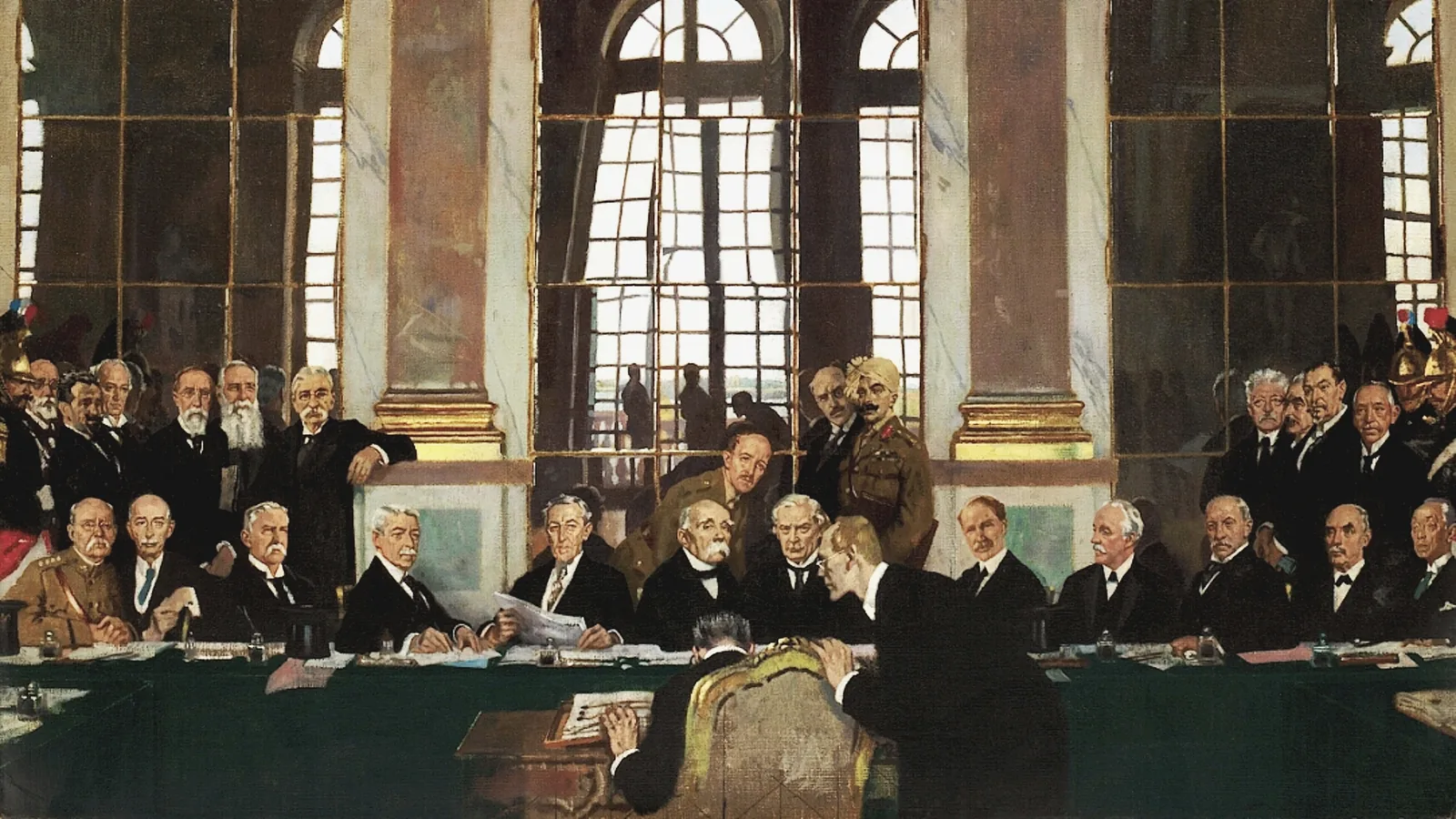

TL;DR — Because the text gave each side less than it wanted: Germany lost land, its army and its case; France still feared German recovery; the U.S. Senate refused to ratify.
The Treaty of Versailles, signed June 28, 1919, satisfied no one: Germany called it a dictated peace, France doubted Germany could pay, and the U.S. Senate refused to ratify it. Germany’s delegation protested a peace “of violence and not of justice”; the Allies replied on June 16 that the treaty was their “last word” and gave five days to sign. John Maynard Keynes, the British Treasury’s man in Paris, resigned and called it a “Carthaginian Peace” beyond Germany’s means. The Reparation Commission set the bill at 132 billion gold marks in 1921; it was cut in 1929 and canceled in 1932. And the Senate, on March 19, 1920, rejected the treaty seven votes short, so the government that had written the League of Nations into Part I never joined it.
Quick facts
- When
- January 1919 (conference opened) · May 7, 1919 (draft handed to the German delegation) · June 16, 1919 (Allied reply) · June 28, 1919 (signature) · March 19, 1920 (U.S. Senate vote) · spring 1921 (132 billion gold marks fixed) · July 1932 (Lausanne)
- Where
- The Palace of Versailles outside Paris; the Rhineland, the Saar, Alsace-Lorraine, Danzig and Upper Silesia; the U.S. Senate in Washington; the Hague and Lausanne
- Who
- Georges Clemenceau, Woodrow Wilson, David Lloyd George and Vittorio Orlando for the Allies; Count Ulrich von Brockdorff-Rantzau for Germany; John Maynard Keynes of the British Treasury; Senator Henry Cabot Lodge; Charles G. Dawes and Owen D. Young
- Outcome
- Germany lost about a tenth of its European territory and all colonies, kept an army of 100,000, and accepted liability under Article 231; the bill was set at 132 billion gold marks in 1921, cut to 121 billion in 1929 and canceled at Lausanne in 1932; the United States never ratified
The room and the date: Versailles, June 28, 1919
The Paris Peace Conference opened in January 1919. The Office of the Historian of the U.S. State Department records that nearly 30 nations took part while four, Britain, France, the United States and Italy, ran the proceedings; Germany was not invited. The draft went to the German delegation on May 7, 1919, according to the United States Holocaust Memorial Museum (USHMM), and the signature took place in the Hall of Mirrors at the Palace of Versailles on June 28, five years to the day after the assassination at Sarajevo.
What the text took from Germany
Part III redrew the borders. Article 51 restored Alsace and Lorraine, taken by Germany in 1871, to France as of November 11, 1918. Article 45 ceded the Saar coal mines to France “in full and absolute possession,” and Article 49 put the Saar under the League as trustee for 15 years, then to a vote. Article 102 made Danzig a Free City. USHMM adds Eupen-Malmedy to Belgium, Hultschin to Czechoslovakia, Poznan, West Prussia and part of Upper Silesia to Poland, and every colony turned into a League mandate. The Office of the Historian puts the loss at about 10 percent of prewar European territory; USHMM says 13 percent.
Part V dismantled the army. Article 160 capped it at 100,000 men after March 31, 1920, “devoted exclusively to the maintenance of order within the territory and to the control of the frontiers.” Article 173 abolished conscription; Article 198 forbade any air force; Article 42 barred fortifications on the left bank of the Rhine and within 50 kilometers of the right.
Then Part VIII. Article 231 read in full: “The Allied and Associated Governments affirm and Germany accepts the responsibility of Germany and her allies for causing all the loss and damage to which the Allied and Associated Governments and their nationals have been subjected as a consequence of the war imposed upon them by the aggression of Germany and her allies.” The words “war guilt” are not in it; the label “War Guilt Clause,” which USHMM uses, came later. Article 232 conceded at once that Germany’s resources “are not adequate” for complete reparation and limited the claim to civilian damage. Article 233 left the sum to a Reparation Commission, to be notified by May 1, 1921, and paid over 30 years.
What Germany said and what the Allies replied
Count Ulrich von Brockdorff-Rantzau led the German delegation, and Keynes wrote that his reply “inevitably took the line that Germany had laid down her arms on the basis of certain assurances, and that the Treaty in many particulars was not consistent with these assurances.” The assurances were Wilson’s Fourteen Points of January 8, 1918, beginning with “open covenants of peace, openly arrived at.”
The Allied reply, signed by Georges Clemenceau on June 16, 1919, and printed for Parliament as Cmd. 258, answered that the war “was the greatest crime against humanity and the freedom of peoples that any nation, calling itself civilised, has ever consciously committed,” and that Germany’s responsibility “is not confined to having planned and started the war. She is no less responsible for the savage and inhuman manner in which it was conducted.” It granted “important practical concessions,” among them a plebiscite in Upper Silesia, then closed: the treaty “must be accepted or rejected,” with a declaration due “within five days,” or the armistice would end. USHMM records that Germany’s new government thereafter called the treaty a Diktat, a dictated peace.
The bill: 1921 to 1932
The treaty named only an interim figure: Article 235 required 20 billion gold marks by the end of April 1921. In spring 1921 the Reparation Commission fixed the total at 132 billion gold marks, about 32 billion U.S. dollars by the Office of the Historian’s conversion. When Germany defaulted in January 1923, France and Belgium occupied the Ruhr and German inflation “spiraled into hyperinflation.”
Keynes had objected before any figure was set. He left the conference on June 7, 1919, “when it became evident that hope could no longer be entertained of substantial modification.” He estimated the claim the Allies could substantiate under Annex I at 40 billion dollars and wrote of Germany’s capacity that “$10,000,000,000 is a safe maximum,” doubting she could pay even that.
The figures then fell. The Dawes Plan of April 1924 lowered the annual payments and left the total “undetermined.” The Young Plan of 1929 cut it to 121 billion gold marks over 58 years and created the Bank for International Settlements to collect them; the bank’s own history dates the plan’s adoption to January 20, 1930. The Hoover Moratorium of July 1931 suspended payments; the Lausanne Agreement of July 1932 ended them. The pages read for this article give the sums demanded; none states how much was collected.
Washington says no: March 19, 1920
Part I was the Covenant of the League, whose Article 10 bound members “to respect and preserve as against external aggression the territorial integrity and existing political independence of all Members.” The Office of the Historian records that the Senate split between “Irreconcilables,” who refused the League on any terms, and “Reservationists” under Henry Cabot Lodge, who argued that Article 10 “ceded the war powers of the U.S. Government to the League’s Council.” Lodge attached 14 reservations in November 1919; on March 19, 1920, the treaty “fell short of ratification by seven votes.” The United States signed a separate Treaty of Berlin on August 25, 1921, leaving out the League.
What remained open
Each party could name its refusal. Germany had signed under a five-day ultimatum. France, USHMM writes, insisted on the reparations while “aware that Germany would probably not be able to pay,” because it “greatly feared rapid German recovery and a new war.” Keynes put Germany’s capacity at a quarter of his own estimate of the claim. The Senate declined the guarantee that was Part I. Even the trials the treaty required ended, USHMM records, in Leipzig “without the Kaiser or other significant national leaders in the dock,” largely in acquittals.
The document of June 28, 1919, bound Germany to a liability its creditors could not agree how to price, on a security its chief author’s legislature declined to underwrite. The sum was set in 1921, cut in 1929 and written off in 1932; the grievances outlasted it.
Key facts
- The draft was handed to the German delegation on May 7, 1919; the Allied reply came on June 16 with a five-day deadline; the treaty was signed at Versailles on June 28, 1919.
- Article 231 made Germany accept “responsibility . . . for causing all the loss and damage”; the words “war guilt” are not in the text.
- Article 232 conceded that Germany’s resources were “not adequate” for complete reparation; Article 233 left the sum to the Reparation Commission, due by May 1, 1921.
- Article 235 demanded 20 billion gold marks by May 1921; the Commission set the total at 132 billion gold marks in spring 1921 (Office of the Historian).
- Article 160 capped the German army at 100,000 men; Article 173 ended conscription; Articles 181 and 198 banned submarines and an air force.
- Keynes estimated the substantiable claim at 40 billion dollars and Germany’s capacity at a “safe maximum” of 10 billion dollars.
- The U.S. Senate rejected the treaty on March 19, 1920, seven votes short; the Treaty of Berlin followed on August 25, 1921.
- The Young Plan cut the total to 121 billion gold marks in 1929; the Lausanne Agreement of July 1932 ended payments.
FAQ
Did Article 231 say Germany was guilty of starting the war?
Not in those words. The article said Germany "accepts the responsibility of Germany and her allies for causing all the loss and damage" that resulted from "the war imposed upon them by the aggression of Germany and her allies." The phrase "War Guilt Clause" is a later label, used by USHMM among others.
How much did Germany pay in reparations?
The sources read here give the sums demanded: 20 billion gold marks under Article 235, 132 billion set by the Reparation Commission in 1921, 121 billion under the Young Plan of 1929, and cancellation at Lausanne in 1932. None of them states the total actually collected.
Why did the United States never ratify the treaty?
The Senate objected to Article 10 of the League Covenant, which opponents read as handing U.S. war powers to the League Council. After Lodge's 14 reservations, the final vote on March 19, 1920, fell seven votes short. The United States made a separate peace with Germany in the Treaty of Berlin of August 25, 1921.
Sources
- The Avalon Project, Yale Law School — "The Versailles Treaty June 28, 1919," Part VIII (Reparation), Articles 231 to 244 and Annexes.
- The Avalon Project, Yale Law School — "The Versailles Treaty June 28, 1919," Part III (Political Clauses for Europe), Articles 42 to 108.
- The Avalon Project, Yale Law School — "The Versailles Treaty June 28, 1919," Part V (Military, Naval and Air Clauses), Articles 160 to 198.
- The Avalon Project, Yale Law School — "The Versailles Treaty June 28, 1919," Part I (The Covenant of the League of Nations), Article 10.
- The Avalon Project, Yale Law School — "President Woodrow Wilson's Fourteen Points," address to Congress, January 8, 1918.
- Internet Archive — Reply of the Allied and Associated Powers to the Observations of the German Delegation on the Conditions of Peace, Cmd. 258, His Majesty's Stationery Office, London, 1919 (OCR text).
- Project Gutenberg — John Maynard Keynes, The Economic Consequences of the Peace (Harcourt, Brace and Howe, 1920), eBook 15776.
- U.S. Department of State, Office of the Historian — "The Paris Peace Conference and the Treaty of Versailles," Milestones 1914 to 1920.
- U.S. Department of State, Office of the Historian — "The Dawes Plan, the Young Plan, German Reparations, and Inter-allied War Debts," Milestones 1921 to 1936.
- Bank for International Settlements — "BIS foundation and crisis (1930-1939)," BIS history pages.
- United States Holocaust Memorial Museum, Holocaust Encyclopedia — "Treaty of Versailles."
Cite this article
- APA
- Our Earth's History. (2026, September 20). Why did the Treaty of Versailles satisfy no one? Our Earth's History. https://ourearthshistory.com/europe/contemporary/treaty-of-versailles-1919-why-no-one-was-satisfied/
- Chicago
- Our Earth's History. “Why did the Treaty of Versailles satisfy no one?” Our Earth's History, September 20, 2026. https://ourearthshistory.com/europe/contemporary/treaty-of-versailles-1919-why-no-one-was-satisfied/.
- MLA
- “Why did the Treaty of Versailles satisfy no one?” Our Earth's History, 20 Sep. 2026, https://ourearthshistory.com/europe/contemporary/treaty-of-versailles-1919-why-no-one-was-satisfied/.
Text licensed CC BY-NC-ND 4.0. Found an error? Tell us.