Why did Korea's 1919 declaration become a nationwide uprising?

TL;DR — Gojong’s death, a Tokyo students’ declaration and a printed text sent to every province turned one reading in Seoul on March 1, 1919 into two months of demonstrations.
The declaration read at the Taehwagwan restaurant in Seoul on March 1, 1919 spread because its organizers had sent copies to every province and timed it to a king’s funeral. The death of the former emperor Gojong, announced on January 22, and a students’ declaration in Tokyo on February 8 gave 33 religious leaders their moment. They read it, telephoned the police and waited; students read the same text in Tapgol Park and marched. Every province had risen by March 19, and Japan answered with troops, then with a new governor-general and a civil police.
Quick facts
- When
- January 22, 1919 (death of Gojong announced) · February 8, 1919 (students' declaration in Tokyo) · February 27, 1919 (declaration printed) · March 1, 1919 (reading at the Taehwagwan, march from Tapgol Park) · March 3, 1919 (state funeral) · April 1, 1919 (67 demonstrations, Aunae market) · April 15, 1919 (Jeam-ri) · April 22, 1919 (Korean National Council statement) · late August 1919 (new governor-general, Imperial Rescript)
- Where
- The Taehwagwan restaurant in Insa-dong and Tapgol Park in Seoul; Pyongyang, Uiju, Wonsan and the other 12 provinces of Korea under Japanese rule; the Korean YMCA hall in Tokyo; Jeam-ri near Suwon; Aunae market in Cheonan; Shanghai
- Who
- Son Byeong-hui, Choe Rin, Lee Jong-il and Han Yong-un among the 33 signatories; Choe Nam-seon, who drafted the text; Jeong Jae-yong, who read it in Tapgol Park; Yu Gwan-sun; Governor-General Hasegawa Yoshimichi and his successor Saito Makoto; F. A. McKenzie and the missionaries who reported to New York
- Outcome
- Demonstrations in all 13 provinces and abroad through April 1919; thousands dead by Park Eun-sik's 1920 count; provisional governments proclaimed in April and merged at Shanghai in September; the gendarmerie police replaced by a civil police under a policy Japan called cultural rule
January to February 1919: a king's death and a students' declaration
Japan had annexed Korea in 1910 and ruled it through a governor-general and a gendarmerie police. Woodrow Wilson’s Fourteen Points of January 8, 1918 said nothing about Asia; the National Institute of Korean History (NIKH) records that Korean activists sent a delegate to Paris as a test of what they called opportunistic diplomacy, not in expectation. F. A. McKenzie, a British journalist writing in 1920, put it differently: one sentence of Wilson’s on “the freedom of small nations” went round among Koreans and “its effect was electrical.”
Students in Tokyo moved first. On February 8, 1919, about 200 of them met at the Korean YMCA hall in Kanda, Baek Gwan-su read a declaration of independence, and Japanese police arrested ten of the eleven organizers. One of them, Song Gye-baek, had already carried a draft to Seoul, where it reached Choe Rin of the Cheondogyo religion.
Then the former emperor died. NIKH’s national history, the Sinpyeon Hanguksa, records that Gojong’s death was announced on January 22, that a gendarmerie report described the country as shocked, and that of the rumors that followed, poisoning by the Japanese had the greatest effect. His funeral was set for March 3; the Maeil Sinbo counted 6,000 arrivals at Namdaemun station on February 27 against a normal 1,500. The organizers chose the Saturday two days before.
March 1 in Seoul: a restaurant and a park
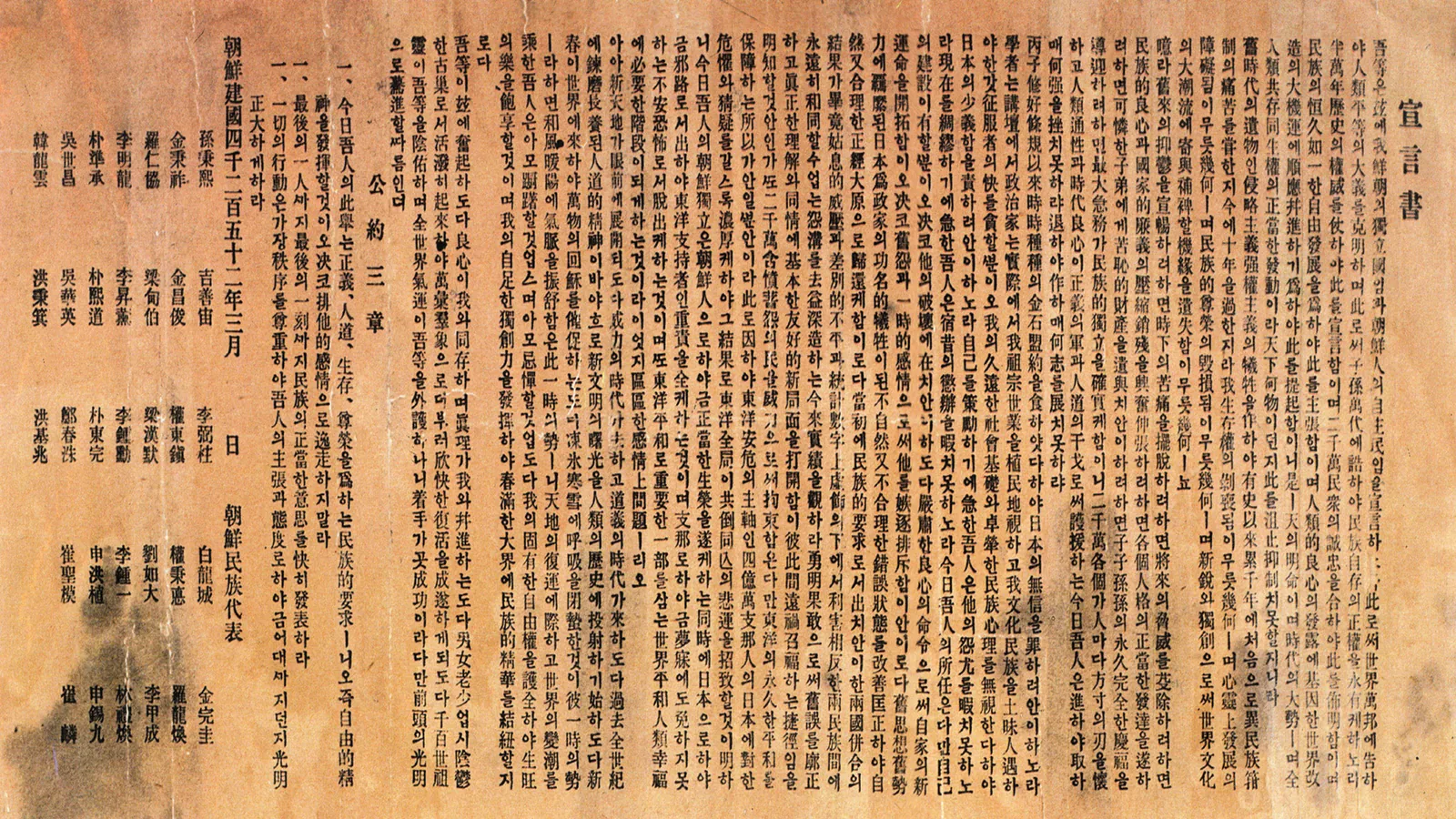
Choe Nam-seon drafted the declaration, the 기미독립선언서. NIKH’s source commentary records that 21,000 copies came off the Cheondogyo-owned Boseongsa press on the night of February 27 and went out to the provinces by courier. On February 28 the signatories moved their reading from Tapgol Park to the Taehwagwan, a restaurant in Insa-dong, because Park Hui-do feared a crowd could turn violent, and agreed to let themselves be arrested.
At noon on March 1, 29 of the 33 gathered there; three were on the road from the north and one was in Shanghai. Lee Jong-il, the printer, read the text, Choe Rin telephoned the police and a messenger carried the declaration to the Government-General. McKenzie wrote that the signers “rang up the Central Police Station . . . and added that they would wait in the restaurant until the police van came to arrest them.”
The text began, in McKenzie’s translation, “We herewith proclaim the independence of Korea and the liberty of the Korean people. We tell it to the world in witness of the equality of all nations and we pass it on to our posterity as their inherent right.” Students waiting in Tapgol Park gave up on the signatories at 2:30 p.m.; Jeong Jae-yong, a school graduate, read the declaration from the platform and the crowd went into the streets. NIKH records that the marchers bowed toward the palace where Gojong’s coffin lay, and that 134 people were arrested that night. Pyongyang and five other northern towns held readings that afternoon.
How it spread: dates by province
NIKH dates the first demonstration in each province: Gaeseong and Hamhung on March 2; Yesan on March 3; Okgu on March 4; Daegu on March 8; Gwangju, Cheorwon and Seongjin on March 10; Busanjin on March 11; Goesan on March 19. On April 1 alone there were 67 demonstrations. NIKH estimates more than 2,000 gatherings and more than 2 million participants, most of them unarmed people waving the Korean flag in market towns; some crowds attacked gendarmerie posts.
On April 1 about 3,000 people gathered at the Aunae market in Cheonan; gendarmes fired and killed 19, among them the father of Yu Gwan-sun, an Ewha student. Her record at the Ministry of Patriots and Veterans Affairs gives a sentence of three years on appeal and her death in Seodaemun prison in September 1920. McKenzie wrote that the movement “was a demonstration, not a riot.”
April: Jeam-ri and the counts
On April 15, at Jeam-ri near Suwon, soldiers gathered the men of the village in the Methodist church, shot them and burned the building. NIKH gives 23 dead in the church and 37 with the neighboring hamlet of Goju-ri. The Korean Situation, a pamphlet of missionaries’ reports published in New York in 1919, printed the account of a Japan Advertiser correspondent who drove out on April 16 with Curtice of the American consulate and the missionary Horace H. Underwood: they found four or five houses standing out of about forty, two burned bodies at the church, and women on the hillside who said the men had been called into the church and shot through the windows.
Park Eun-sik, writing in Shanghai in 1920, gave 7,509 dead, 15,961 wounded and 46,948 arrested, figures that South Korean state textbooks archived by NIKH still print. McKenzie printed the Japanese procurators’ figure of 16,183 people examined between March 1 and June 18, of whom 8,351 were prosecuted; the pages read for this article give no Japanese count of the dead.
Shanghai and "cultural rule"
Provisional governments were proclaimed in the spring of 1919 in Shanghai, Seoul and the Russian Far East; NIKH records that they merged at Shanghai in September. McKenzie wrote that delegates from the 13 provinces met in Seoul on April 23 and adopted a constitution creating the Republic, and he printed a provisional constitution dated “the 1st Year of the Korean Republic, 4th Month” and a National Council statement of April 22.
Japan changed course in August. McKenzie recorded that Governor-General Hasegawa Yoshimichi was recalled, that Admiral Saito Makoto replaced him, that an Imperial Rescript late in August announced reform, and that Prime Minister Hara said the gendarmerie would give way to a police force. NIKH lists what the Japanese called cultural politics: Korean officials, a civil police, freedom of speech, press and assembly. It adds that the aim was to calm feeling and divide Koreans by class, and that Koreans used the opening for cultural and self-strengthening movements of their own.
What remained open
Choe Rin’s autobiography, cited by NIKH, says a hundred copies were laid on the table and the reading was skipped; Lee Jong-il’s diary says he read it, and NIKH’s commentary lists a 2022 study that questions the diary as a made-up source. The print run is 21,000 in NIKH’s source commentary and 35,000 in its older national history. Nine printed copies survive; one was registered as national cultural heritage in 2016.
A text read in a restaurant did not by itself move a country. Copies already in every province, a funeral that filled Seoul, and a plan in which the signers surrendered while the students marched did that, and Park Eun-sik counted the price in thousands.
Key facts
- Gojong’s death was announced on January 22, 1919; his state funeral was held on March 3.
- Korean students in Tokyo read a declaration of independence on February 8, 1919; ten committee members were arrested.
- The Boseongsa press printed the declaration on the night of February 27, 1919; NIKH gives 21,000 copies.
- On March 1, 1919, 29 of the 33 signatories read the text at the Taehwagwan in Insa-dong and waited for the police; students read it in Tapgol Park at 2:30 p.m. and marched.
- Demonstrations began in every province by March 19 and peaked on April 1, 1919 with 67 in one day.
- At Jeam-ri on April 15, 1919, soldiers shot villagers in the church and burned it; NIKH gives 23 dead there and 37 with Goju-ri.
- Park Eun-sik’s 1920 count was 7,509 dead, 15,961 wounded and 46,948 arrested; McKenzie printed 16,183 examined by procurators and 8,351 prosecuted.
FAQ
Why was the declaration read in a restaurant instead of Tapgol Park?
NIKH records the decision of February 28: Park Hui-do argued that a crowd in the park could turn violent, so the signatories moved to the Taehwagwan and agreed to be arrested there together. The students, who had not been told, waited in the park and read the text themselves.
How many people died in the March First Movement?
Park Eun-sik, writing in Shanghai in 1920, gave 7,509 dead, 15,961 wounded and 46,948 arrested. McKenzie printed the Japanese procurators' figures for those examined and prosecuted but no death toll, and no Japanese count of the dead was found on the pages read for this article.
What did Japan change after 1919?
Governor-General Hasegawa was recalled and Admiral Saito Makoto took his place; an Imperial Rescript in late August 1919 announced reform, and the gendarmerie police gave way to a civil force. NIKH lists Korean officials, a civil police and freedom of speech, press and assembly among the contents of the policy Japan called cultural rule.
Sources
- National Institute of Korean History (국사편찬위원회), Sinpyeon Hanguksa vol. 47, "Ⅲ. 3·1운동," 1. 5) (2) 2·8독립선언 (the February 8 declaration in Tokyo).
- National Institute of Korean History, Sinpyeon Hanguksa vol. 47, 1. 5) (3) 광무황제의 붕어와 인산 (the death and funeral of Gojong).
- National Institute of Korean History, Sinpyeon Hanguksa vol. 47, 2. 1) (2) 독립선언서 준비 (drafting and printing of the declaration, with the full text).
- National Institute of Korean History, Sinpyeon Hanguksa vol. 47, 2. 1) (3) 독립선언서의 배포와 최후의 회담 (distribution and the meeting of February 28).
- National Institute of Korean History, Sinpyeon Hanguksa vol. 47, 2. 2) (1) 민족대표의 독립선언 (the reading at the Taehwagwan, March 1).
- National Institute of Korean History, Sinpyeon Hanguksa vol. 47, 2. 2) (2) 만세시위운동의 시작 (Tapgol Park and the seven cities of March 1).
- National Institute of Korean History, Sinpyeon Hanguksa vol. 47, 2. 2) (3) 나. 시위의 전국확산 (the spread by province, daily counts, estimates).
- National Institute of Korean History, Sinpyeon Hanguksa vol. 47, 2. 2) (3) 다. 중부지방 (Gyeonggi and South Chungcheong, with Jeam-ri and Aunae market).
- National Institute of Korean History, Sinpyeon Hanguksa vol. 47, 4. 2) (1) 라. 대한민국 임시정부의 수립 (the Provisional Government).
- National Institute of Korean History, Sinpyeon Hanguksa vol. 47, 4. 2) (1) 사. 무단지배체제의 후퇴 (the retreat of military rule).
- National Institute of Korean History, Saryo-ro bon Hanguksa (사료로 본 한국사) — 「독립선언서」, text and commentary on the March 1 declaration.
- National Institute of Korean History, Saryo-ro bon Hanguksa — 「2·8 독립 선언서」, text and commentary on the Tokyo students' declaration.
- National Institute of Korean History, Saryo-ro bon Hanguksa — 「미국 대통령 윌슨의 14개조 평화 원칙 선언」, text and commentary on how Koreans read Wilson.
- National Institute of Korean History, textbook glossary — 「한국독립운동지혈사」 (Park Eun-sik's 1920 history, Shanghai).
- National Institute of Korean History, archived national textbooks — 고등학교 국사 6차(하), "(1) 3·1 운동" (participation and casualty figures).
- Ministry of Patriots and Veterans Affairs, 공훈전자사료관 — 독립유공자 공적조서·공훈록, 유관순 (Yu Gwan-sun), record no. 3536.
- Korea Heritage Service, 국가유산포털 — 3·1 독립선언서(2016-1), registered cultural heritage, Seoul Calligraphy Art Museum.
- F. A. McKenzie, Korea's Fight for Freedom (1920), chapters XIV to XVIII; Project Gutenberg eBook 13368.
- The Korean Situation. Authentic Accounts of Recent Events by Eye Witnesses (New York; Commission on Relations with the Orient of the Federal Council of the Churches of Christ in America, 1919); OCR text on the Internet Archive.
Cite this article
- APA
- Our Earth's History. (2026, September 20). Why did Korea's 1919 declaration become a nationwide uprising? Our Earth's History. https://ourearthshistory.com/east-asia/contemporary/march-first-movement-1919-korea/
- Chicago
- Our Earth's History. “Why did Korea's 1919 declaration become a nationwide uprising?” Our Earth's History, September 20, 2026. https://ourearthshistory.com/east-asia/contemporary/march-first-movement-1919-korea/.
- MLA
- “Why did Korea's 1919 declaration become a nationwide uprising?” Our Earth's History, 20 Sep. 2026, https://ourearthshistory.com/east-asia/contemporary/march-first-movement-1919-korea/.
Text licensed CC BY-NC-ND 4.0. Found an error? Tell us.