Molasses on Commercial Street, January 15, 1919: the owner was liable

TL;DR — A molasses tank on Boston’s Commercial Street burst on January 15, 1919, killing 21. An auditor’s report of 1925 blamed its owner, not anarchists.
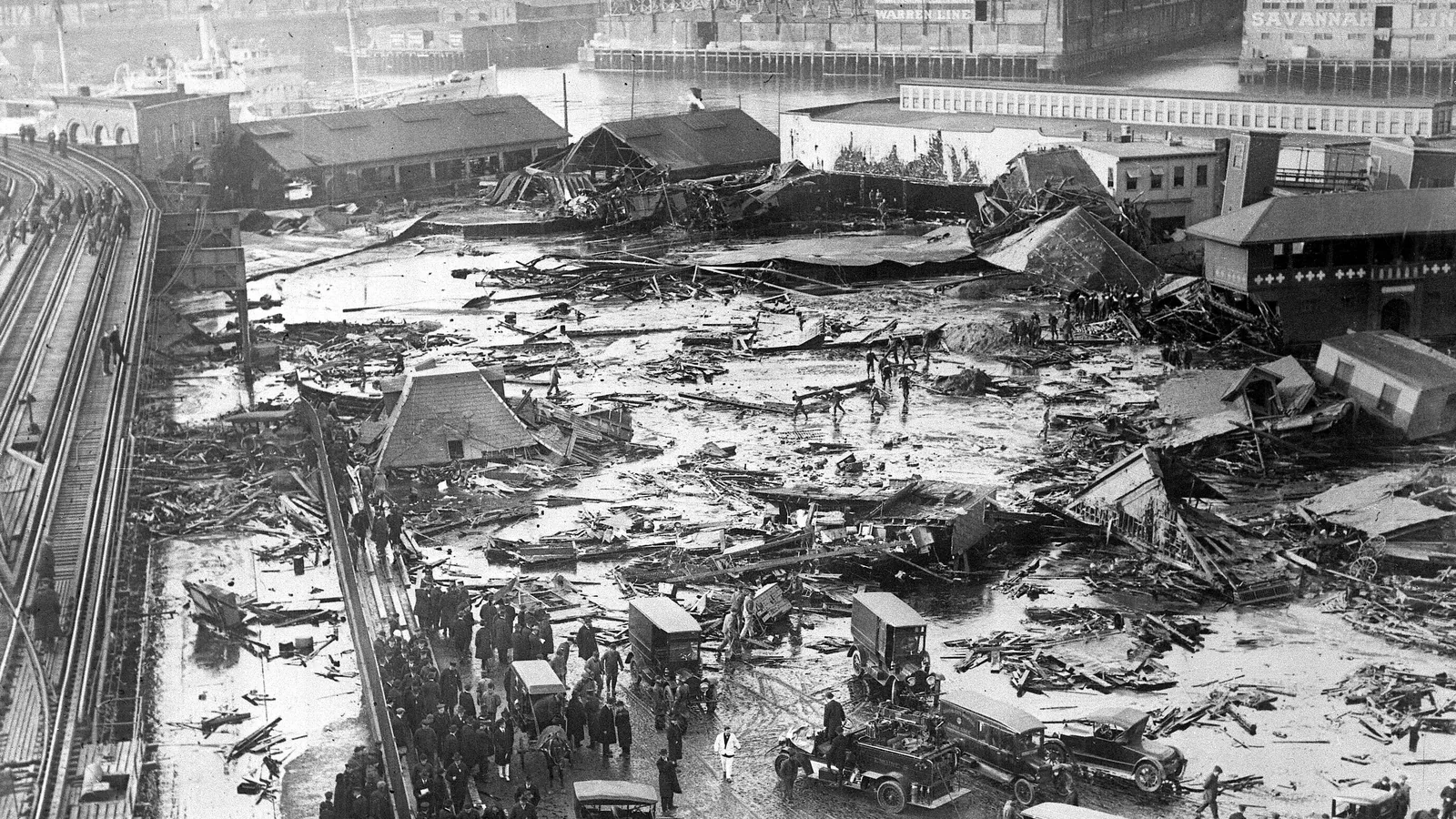
Shortly after 12:40 p.m. on January 15, 1919, a storage tank on Commercial Street, in Boston’s North End, came apart and released its molasses into the streets around it. Mass Moments, the Massachusetts “on this day” history site published by Mass Humanities, gives the tank’s contents as 2,300,000 gallons; a 2016 conference abstract for the American Physical Society gives more than 8.7 million liters. The Massachusetts Historical Society counts 21 dead and 150 injured. The tank’s owner, U.S. Industrial Alcohol, blamed anarchists. Col. Hugh W. Ogden, an auditor appointed to hold hearings on the claims of the victims’ families, rejected that account and held the company liable in a report that Mass Moments dates to April 28, 1925.
Quick facts
- When
- January 15, 1919, shortly after 12:40 p.m. (tank collapse) · January 16, 1919 (Boston Post first account) · April 28, 1925 (Ogden's report, as Mass Moments dates it) · November 21, 2016 (American Physical Society conference talk)
- Where
- Commercial Street, on the waterfront of Boston's North End, beside the elevated railway and below Copp's Hill
- Who
- U.S. Industrial Alcohol, the tank's owner; Bridget Clougherty, 65, one of the dead; Col. Hugh W. Ogden, the court-appointed auditor; Nicole Sharp, Jordan Kennedy and Shmuel Rubinstein, authors of the 2016 abstract
- Outcome
- The Massachusetts Historical Society, Mass Humanities and the 2016 abstract all count 21 dead and 150 injured. After hearings that Mass Moments puts at 341 days of testimony, Ogden rejected the company's sabotage claim and held it liable
Lunchtime on Commercial Street
Mass Moments describes a mild January day and a busy wharf. Horse-drawn wagons and motor trucks made deliveries, employees of the city’s Department of Public Works ate lunch outside, and passenger trolleys ran on the elevated track above the street. The tank stood 50 feet tall, painted brown, and had been built in 1915. No above-ground container in Boston, Mass Moments writes, had ever held more.
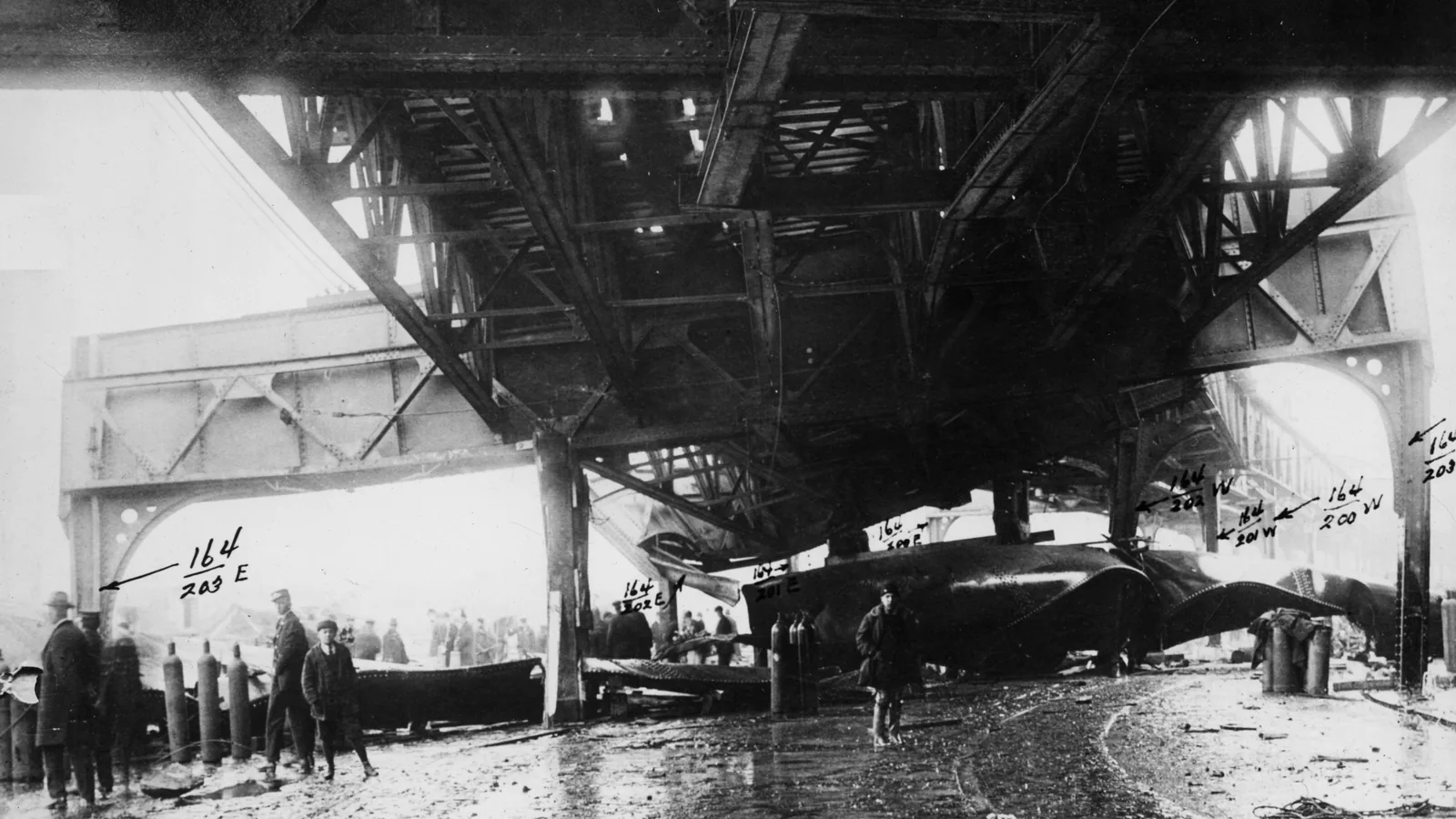
Witnesses heard a rumbling, then a “rat-a-tat-tat” they likened to a machine gun, then tearing metal. The wave covered an area of about two blocks. The Boston Post, in its account the next morning, wrote that the molasses had been “released in some manner yet unexplained, from a giant tank,” and that it swept over Commercial Street from Charter Street to the southern end of North End Park. The Post described what it did to the elevated railway: the wave “smote the huge steel girders of the ‘L’ structure and bent, twisted, and snapped them.” It then struck the tenements at the foot of Copp’s Hill and flowed back toward the harbor.
"Eleven persons" at midnight
“Eleven persons—a woman, a girl, and nine men—were the known dead at midnight,” the Post reported, and “more than 50 injured were in hospitals and at their homes.” The later totals agree across three institutions. The Massachusetts Historical Society gives 21 killed and 150 injured; Mass Moments writes that 21 people died and more than 150 were injured; the 2016 abstract gives 21 killed and 150 injured.
Mass Moments names one of the dead. Bridget Clougherty, 65, had been hanging laundry on her porch across Commercial Street from the wharf. It also counts among the victims employees of the Public Works department, firemen on duty at a nearby station and children who had been playing in the street. The families who pressed claims against the company, it writes, were mostly poor Irish and Italian laborers.
The Boston Elevated Railway Company photographed the damage. The City of Boston Archives holds the pictures in its Boston Elevated Railway photographs collection, number 9800.018. One print, record 9800-018-111, carries the catalog title “Molasses flood, destruction” and the description “Damage caused by the eruption of a molasses tank. Mostly likely from January 15th.”

Fifteen feet or 7.6 meters
The height of the wave depends on the account. Mass Moments describes “a wave of molasses 15 feet high and 160 feet wide” moving at 35 miles per hour. The Post’s first report called it a “50-foot wave,” and later in the same article gave 30 feet at the tenements of Copp’s Hill. The 2016 abstract states: “Contemporary accounts estimated the initial wave was 7.6 meters tall and moved at more than 15 m/s.” That figure is roughly 25 feet, about ten feet higher than the Mass Moments figure.
The abstract comes from the 69th Annual Meeting of the American Physical Society’s Division of Fluid Dynamics. Its authors were Nicole Sharp, listed under FYFD, and Jordan Kennedy and Shmuel Rubinstein of Harvard University, and their talk was scheduled for 6:01 p.m. on November 21, 2016, in a session on non-Newtonian flows. The abstract describes the material: “Molasses is a viscoelastic fluid 1.5 times as dense as water with a viscosity roughly 4000 times greater.” It announces that the talk would explore “the effects of temperature fluctuations and molasses rheology on events leading up to the tank’s collapse and their impact on subsequent rescue efforts.” The abstract gives no results beyond that description, and a conference abstract is not a peer-reviewed paper.
Hugh W. Ogden's report
The newspapers first reported that the tank had exploded. U.S. Industrial Alcohol said anarchists had dynamited it. Mass Moments sets out why the claim found listeners. The company had profited in World War I by turning molasses into alcohol for munitions. Anarchists had bombed some of its facilities in New York earlier in the decade, and there had been 40 explosions in Boston and nearby cities in the year before the flood. One employee reported a bomb threat against the Commercial Street tank.
The families answered that the tank had leaked, or “wept,” molasses since it was built in 1915, that it had made strange sounds and vibrated, and that the company had caulked the leaks and painted the tank brown to hide them. A court appointed Ogden, a former military officer, to hold hearings. Mass Moments puts the testimony at “three-hundred-forty-one days” and the whole proceeding at five and a half years.
Ogden found no evidence of sabotage. Mass Moments summarizes what he found instead: the man who supervised construction had no technical training and could not read a blueprint, and “No engineers or architects were consulted; nor did an architect or engineer ever inspect it.” In the rush to finish, “the strength of the tank was not tested before it was filled,” and the manager ignored employees who warned that it was unsound. Ogden assigned full liability to the United States Industrial Alcohol Company. Mass Moments, the only source here for the amount, writes that he ordered the company to pay $1,000,000 in compensation to the victims. Massachusetts and most other states, it adds, then passed laws to certify engineers and regulate construction. Ogden submitted his report on April 28, 1925, more than six years after the tank came apart.
Key facts
- A molasses tank on Commercial Street in Boston’s North End collapsed shortly after 12:40 p.m. on January 15, 1919 (APS abstract).
- The tank was built in 1915, stood 50 feet tall and held 2,300,000 gallons, according to Mass Moments.
- The Massachusetts Historical Society counts 21 killed and 150 injured; the Boston Post counted 11 known dead at midnight.
- Mass Moments gives the wave as 15 feet high; a 2016 American Physical Society abstract gives 7.6 meters, from contemporary accounts.
- Auditor Hugh W. Ogden heard 341 days of testimony, found no sabotage and held U.S. Industrial Alcohol liable in a report dated April 28, 1925 (Mass Moments).
- Mass Moments alone gives the compensation ordered as $1,000,000.
FAQ
How many people died in the Boston Molasses Flood?
Twenty-one, according to the Massachusetts Historical Society, Mass Moments and the 2016 American Physical Society abstract; all three give about 150 injured. The Boston Post's first count, at midnight on January 15, 1919, was 11 known dead.
Who was found responsible for the Boston Molasses Flood?
The tank's owner, U.S. Industrial Alcohol. Auditor Hugh W. Ogden rejected the company's claim that anarchists had dynamited the tank and found that it had been built without engineers and filled before its strength was tested. His report is dated April 28, 1925.
Why did the molasses make the disaster worse?
The 2016 conference abstract by Sharp, Kennedy and Rubinstein describes molasses as 1.5 times as dense as water with roughly 4,000 times its viscosity, and says their talk examined how temperature changes and the fluid's behavior affected the collapse and the rescue. The abstract does not publish detailed findings.
Sources
- Massachusetts Historical Society, "The Great Boston Molasses Flood of 1919" (event page for a teacher workshop with historian Stephen Puleo)
- Mass Humanities, Mass Moments, "Great Molasses Flood" (January 15, 1919), with the Boston Post account of January 16, 1919, as its primary source
- Mass Humanities, Mass Moments, "Hugh Ogden Issues Report on Cause of the Molasses Flood" (April 28, 1925)
- Nicole Sharp, Jordan Kennedy and Shmuel Rubinstein, "In a sea of sticky molasses: The physics of the Boston Molasses Flood," abstract of an oral presentation, 69th Annual Meeting of the APS Division of Fluid Dynamics, session Non-Newtonian Flows: Applications, November 21, 2016
- City of Boston Archives, Digital Records Portal, "Molasses flood, destruction" (record 9800-018-111, Boston Elevated Railway photographs, 9800.018)
Cite this article
- APA
- LETTER. (2026, September 29). Molasses on Commercial Street, January 15, 1919: the owner was liable. Our Earth's History. https://ourearthshistory.com/americas/contemporary/boston-molasses-flood-1919-ogden-auditor-report/
- Chicago
- LETTER. “Molasses on Commercial Street, January 15, 1919: the owner was liable.” Our Earth's History, September 29, 2026. https://ourearthshistory.com/americas/contemporary/boston-molasses-flood-1919-ogden-auditor-report/.
- MLA
- LETTER. “Molasses on Commercial Street, January 15, 1919: the owner was liable.” Our Earth's History, 29 Sep. 2026, https://ourearthshistory.com/americas/contemporary/boston-molasses-flood-1919-ogden-auditor-report/.
Text licensed CC BY-NC-ND 4.0. Found an error? Tell us.