Who answered for the South Fork Dam and the 1889 Johnstown Flood?
,_South_Fork_Dam_and_club_house_LCCN2002697295.jpg)
TL;DR — No court held anyone liable. A county commission called the dam’s owners, a club of Pittsburgh industrialists, culpable on June 7, 1889, but every lawsuit against the club failed.
No court ever made the South Fork Fishing and Hunting Club pay for the Johnstown Flood. The club, formed in 1879 by Pittsburgh industrialists and businessmen who included Andrew Carnegie and Andrew Mellon, owned the earthen dam that gave way on the afternoon of May 31, 1889, above Johnstown, Pennsylvania. On June 7 a county commission announced that it held the owners “responsible for the fearful loss of life and property,” and several families and businessmen went to court. All of the suits failed. Jed Handelsman Shugerman, in The Yale Law Journal in 2000, tied that failure to the club’s corporate form and traced a line from the flood to strict liability in American courts. A 2016 study in the journal Heliyon concluded that the club’s changes to the dam caused the disaster.
Quick facts
- When
- May 31, 1889 (the dam began to fail at 3:10 p.m.; the flood reached Johnstown at 4:07 p.m.) · June 7, 1889 (county commission finding) · 1891 (ASCE committee report) · 2016 (Heliyon re-analysis)
- Where
- The South Fork Dam on the South Fork of the Little Conemaugh River and the city of Johnstown, about 14 miles downstream, in western Pennsylvania
- Who
- The South Fork Fishing and Hunting Club and its first president, Benjamin Ruff; Daniel J. Morrell of the Cambria Iron Company; Clara Barton and the American Red Cross; the ASCE committee under James B. Francis; Neil M. Coleman, Uldis Kaktins and Stephanie Wojno
- Outcome
- The National Park Service counts 2,209 dead. A county commission held the club's owners responsible on June 7, 1889, but no lawsuit made the club pay; an 1891 engineering committee called the failure inevitable, and a 2016 study concluded that the club's changes to the dam caused it
May 31, 1889: forty minutes at the dam
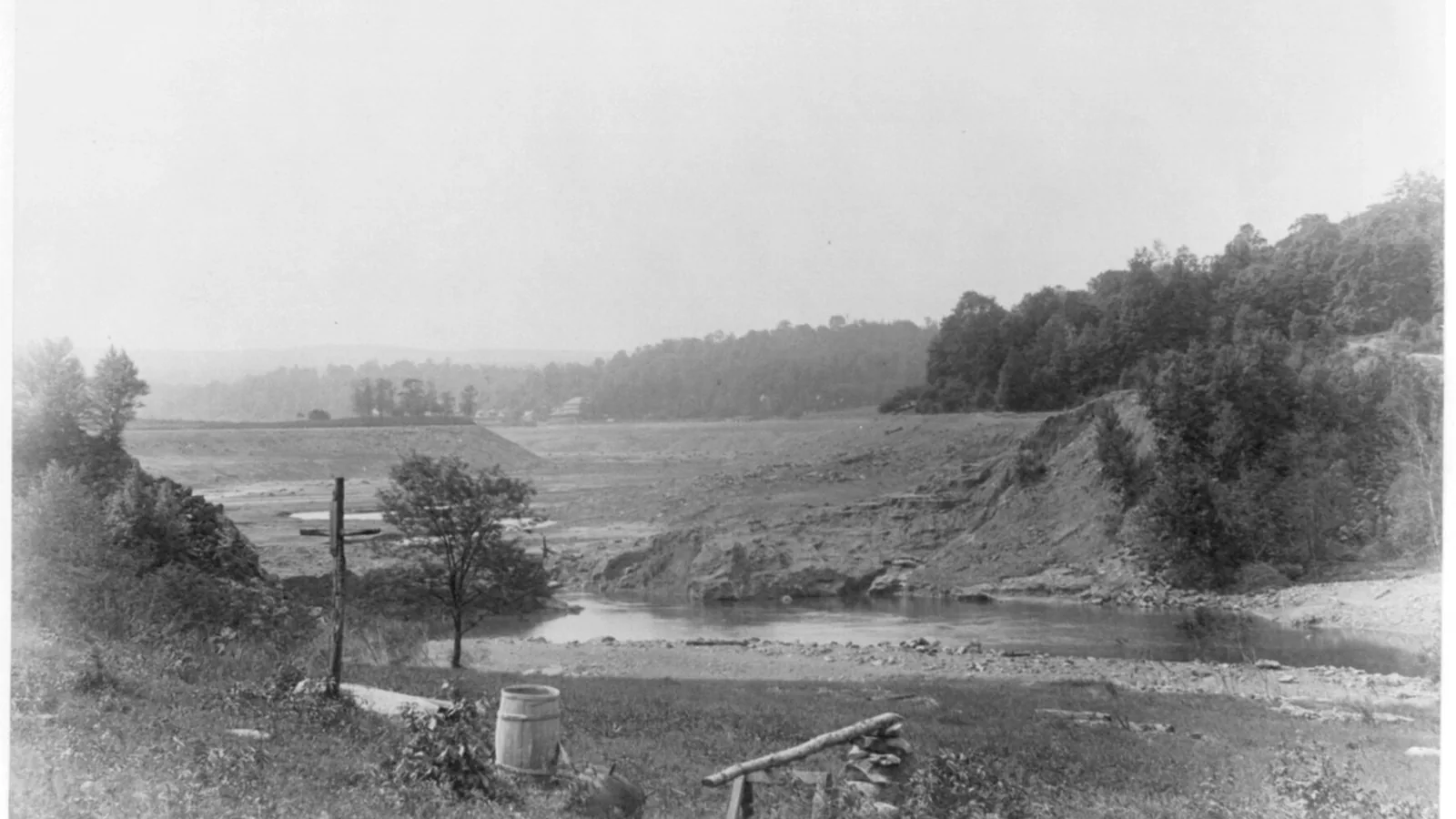
The dam held back Lake Conemaugh, a reservoir the National Park Service describes as nearly three miles long, on the South Fork of the Little Conemaugh River about 14 miles upstream of Johnstown. Rain fell through May 30 and into May 31; Neil M. Coleman, Uldis Kaktins and Stephanie Wojno, the authors of the 2016 study, estimate that the South Fork basin received 6 to 7 inches.
Water ran over the crest for more than three hours, the 2016 study found, before the embankment broke. John Parke, the club’s engineer, later wrote that when the dam started to go at 3:10, “the fearful rushing waters opened the gap with such increasing rapidity that soon after the entire lake leaped out.... It took but forty minutes to drain that three miles of water.” The Park Service’s lesson plan on the flood records that the wave dropped 450 feet in 14 miles, stood at times 70 to 75 feet high and reached 40 miles per hour. It struck Johnstown at 4:07 p.m., 57 minutes after the break. At the stone bridge in town, debris, animals and people piled up and caught fire, and 80 people died there.
The Park Service’s home page for Johnstown Flood National Memorial gives the toll as 2,209. The Park Service does not say how the count was made, and its own lesson plan uses a looser figure: “more than 2,200 people were known to be dead and hundreds more were missing.” The American Red Cross writes “more than 2,200” on one page and “over 2,000” on another. The Red Cross region for Greater Pennsylvania adds that 99 entire families and nearly 400 children died, and that 124 women and 198 men were widowed.
Clara Barton, who had founded the American Red Cross in 1881, was 67 when she reached Johnstown on the Baltimore and Ohio Railroad five days after the flood, with a team of 50 doctors and nurses. Barton set up hospitals and six Red Cross hotels with kitchens, laundries and hot and cold running water. By the Red Cross count the operation served more than 25,000 people, and it gave out nearly half a million dollars in supplies and money, according to the Park Service. Barton and her team left in October, five months after they arrived.
Benjamin Ruff's club and the dam it rebuilt
The Commonwealth of Pennsylvania built the dam between 1838 and 1853 to feed the Western Division of the Pennsylvania Mainline Canal. The Pennsylvania Railroad bought the whole Mainline system in 1857 and, in the Park Service’s words, left the dam and reservoir “virtually unattended.” Benjamin Ruff agreed to take over the property in 1879, and the formal sale to the club followed in March 1880, according to the 2016 study.
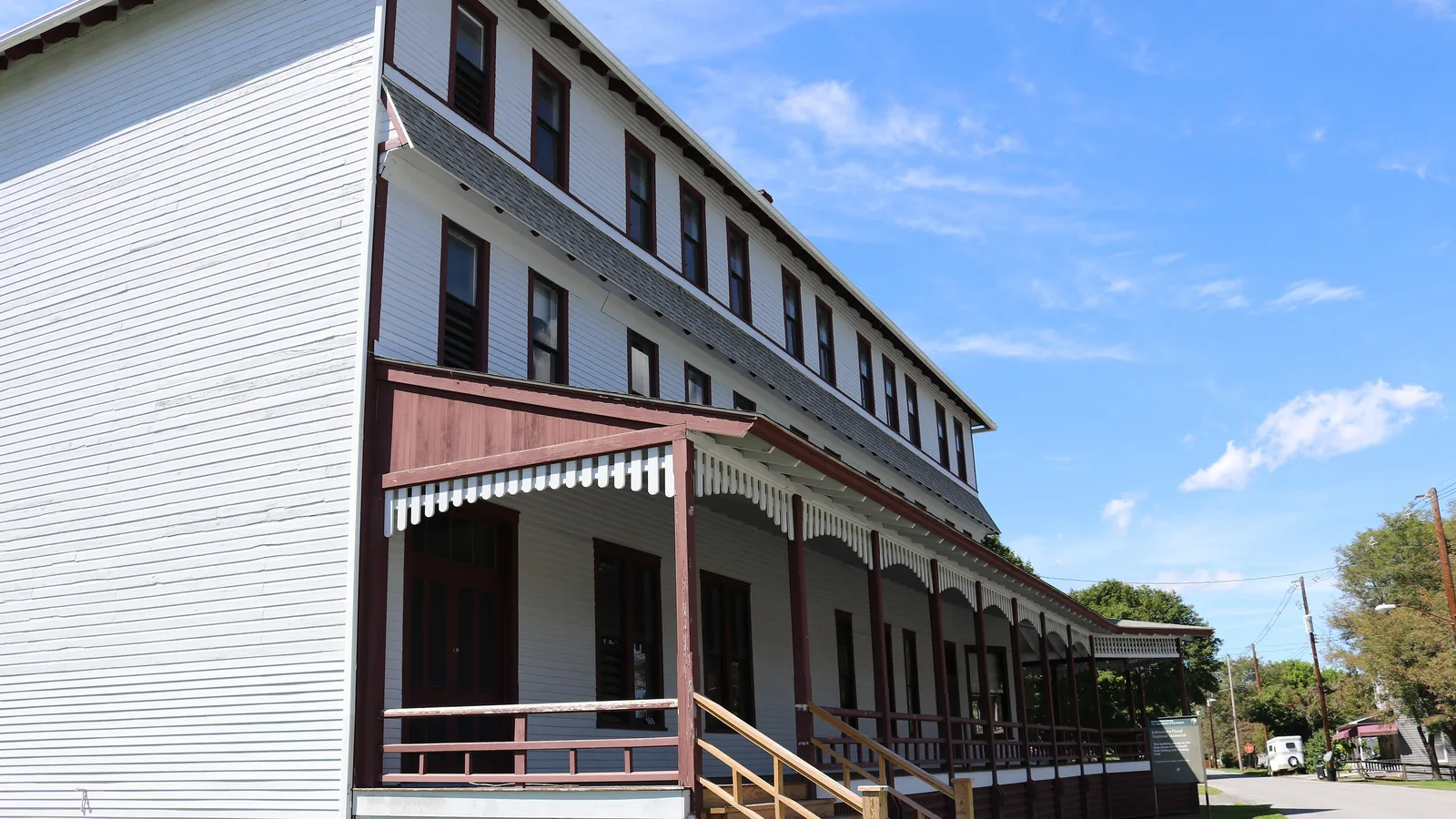
By 1881 the club had repaired the dam “without benefit of an engineer,” the Park Service writes, and filled the lake to capacity. A clubhouse of 47 rooms faced the water. The repairs changed the structure. The club built a fish trap across the spillway, which clogged with debris in heavy rain, left a sag of two to four feet in the middle of the dam, did not replace the discharge pipes and kept up the stone facing poorly.
Daniel J. Morrell, president of the Cambria Iron Company, asked more than once that the dam be strengthened. Ruff, the club’s first president, refused, and the Park Service quotes his reply: “You and your people are in no danger from our enterprise.” Ruff supervised the rebuilding and died two years before the dam failed.
.JPG)
"Culpable": the June 7 finding and the lawsuits
A county commission examined the dam within days. Its statement of June 7, as Shugerman quotes it, found “the owners . . . culpable in not making [the dam] as secure as it should have been, especially in view of the fact that a population of many thousands were in the valley below.” The New York World ran the headline “THE CLUB IS GUILTY” the same day, according to Shugerman, citing David McCullough’s 1968 history.
Several families and businessmen sued the club, and every suit failed. Shugerman wrote that “the true challenge seems to have been the difficulty of piercing the corporate veil,” that is, of reaching past the club as a corporation to the fortunes of its members. The public and the press, in his reading of McCullough, blamed the fault rules of negligence law, which required proof that the owner had been careless. The 2016 Heliyon study adds a narrower reason. Ruff, the man who had overseen the rebuilding, was dead and could not be held to account, and most of the suits had ended before the engineers’ report appeared in 1891.
Shugerman set the flood beside the English case the courts kept returning to. Under Rylands v. Fletcher, which the House of Lords upheld on July 17, 1868, after a mill reservoir burst into a neighbor’s mine shafts, English courts held that proof of negligence was not required for “non-natural” or potentially “mischievous” uses of land. Pennsylvania’s Supreme Court had rejected that rule in 1886, in a coal case. Two months after the flood a note in the American Law Review, a bimonthly Shugerman describes as the era’s most influential legal periodical, described the disaster and argued for Rylands. In 1891, in Robb v. Carnegie Bros., the Pennsylvania Supreme Court applied strict liability against Carnegie Bros. & Co., Andrew Carnegie’s firm. Shugerman counts fifteen states and the District of Columbia that solidly accepted Rylands between the mid-1880s and the early 1910s. He also compared the tolls. The English dam failures of the 1850s and 1860s drowned 348 people; Johnstown, he wrote, killed more than 2,000, and the South Fork dam “merely created a playground for America’s wealthiest capitalists.”
Engineers' verdicts: 1891 and 2016
The American Society of Civil Engineers sent a committee chaired by James B. Francis, a founding member and former president of the society. Its report, published in 1891, found that the club had removed the dam’s five discharge pipes, lowered the embankment about two feet and partly blocked the spillway with gratings to keep fish in. The committee wrote that these changes “materially diminished the security of the dam,” yet “cannot be deemed to be the cause of the late disaster,” because the embankment would have been overtopped and breached anyway.
Coleman, Kaktins and Wojno tested that conclusion against the dam as first built. Using LiDAR survey data, they put the lake at 14.3 million tons when the dam failed, below the usually cited 20 million, and found that more than 65 minutes would have been needed to drain most of it, where most sources give 45. The original dam, with a crest about 0.9 meters higher, a second spillway and five pipes, could have discharged more than twice as much water before overtopping as the rebuilt one. “A properly rebuilt dam would not have overtopped and would likely have survived the runoff event, thereby saving thousands of lives,” the authors wrote. They called the 1891 report state of the art for its time and disagreed with its main finding. Heliyon received the paper on September 9, 2015, and accepted it on May 27, 2016.
Key facts
- The South Fork Dam above Johnstown, Pennsylvania, began to fail at 3:10 p.m. on May 31, 1889, and the flood reached the city at 4:07 p.m. (National Park Service).
- The National Park Service gives the death toll as 2,209; its own lesson plan says “more than 2,200” were known dead with hundreds missing, and the American Red Cross gives both “more than 2,200” and “over 2,000.”
- The South Fork Fishing and Hunting Club, formed in 1879 by Pittsburgh industrialists including Andrew Carnegie and Andrew Mellon, had repaired the dam by 1881 without an engineer (National Park Service).
- Club president Benjamin Ruff turned down Daniel J. Morrell’s requests to strengthen the dam; Ruff died two years before it failed (National Park Service; Coleman, Kaktins and Wojno, 2016).
- On June 7, 1889, a county commission held the owners “responsible for the fearful loss of life and property”; several suits against the club all failed (Shugerman, Yale Law Journal, 2000).
- Clara Barton reached Johnstown five days after the flood with 50 doctors and nurses, built six Red Cross hotels and stayed five months; the Red Cross served more than 25,000 people.
- An 1891 ASCE committee under James B. Francis ruled that the club’s changes did not cause the failure.
- A 2016 Heliyon study found that the dam as first built would have carried more than twice the discharge and would likely have survived the storm.
FAQ
Was anyone found liable for the Johnstown Flood?
No. A county commission said on June 7, 1889, that the dam's owners were culpable, and families and businessmen sued the South Fork Fishing and Hunting Club, but none of the suits succeeded. The club was never found financially liable for the deaths or the damage.
How many people died in the Johnstown Flood?
The National Park Service gives 2,209 dead. The Park Service does not say how the count was made. Its lesson plan says more than 2,200 were known dead and hundreds more were missing, and the American Red Cross uses both "more than 2,200" and "over 2,000."
What did the South Fork club change on the dam?
The 1891 engineering report found that the club removed the five discharge pipes, lowered the embankment about two feet and put gratings across the spillway to hold fish. The National Park Service adds that the club left a sag of two to four feet in the middle of the dam.
What did Clara Barton do at Johnstown?
Barton, founder of the American Red Cross, arrived five days after the flood with 50 doctors and nurses. Her team set up hospitals and six Red Cross hotels, served more than 25,000 people and stayed until October 1889.
Sources
- U.S. National Park Service, Johnstown Flood National Memorial, park home page
- U.S. National Park Service, Teaching with Historic Places, "Run for Your Lives! The Johnstown Flood of 1889" (lesson plan, PDF)
- Neil M. Coleman, Uldis Kaktins and Stephanie Wojno, "Dam-Breach hydrology of the Johnstown flood of 1889: challenging the findings of the 1891 investigation report," Heliyon 2 (2016), e00120 (open-access PDF hosted by the Association of State Dam Safety Officials, damfailures.org)
- Jed Handelsman Shugerman, "The Floodgates of Strict Liability: Bursting Reservoirs and the Adoption of Fletcher v. Rylands in the Gilded Age," The Yale Law Journal 110, no. 3 (2000), 333-377
- U.S. National Park Service, Johnstown Flood National Memorial, "Clara Barton"
- American Red Cross, Greater Pennsylvania Region, "A Look Back at the Great Flood of 1889"
- American Red Cross, "Significant Dates in Red Cross History"
Cite this article
- APA
- LETTER. (2026, September 28). Who answered for the South Fork Dam and the 1889 Johnstown Flood? Our Earth's History. https://ourearthshistory.com/americas/modern/johnstown-flood-1889-south-fork-dam-liability/
- Chicago
- LETTER. “Who answered for the South Fork Dam and the 1889 Johnstown Flood?” Our Earth's History, September 28, 2026. https://ourearthshistory.com/americas/modern/johnstown-flood-1889-south-fork-dam-liability/.
- MLA
- LETTER. “Who answered for the South Fork Dam and the 1889 Johnstown Flood?” Our Earth's History, 28 Sep. 2026, https://ourearthshistory.com/americas/modern/johnstown-flood-1889-south-fork-dam-liability/.
Text licensed CC BY-NC-ND 4.0. Found an error? Tell us.