Diary lines from Keene, 1816, and a Tambora paper withdrawn in 2016
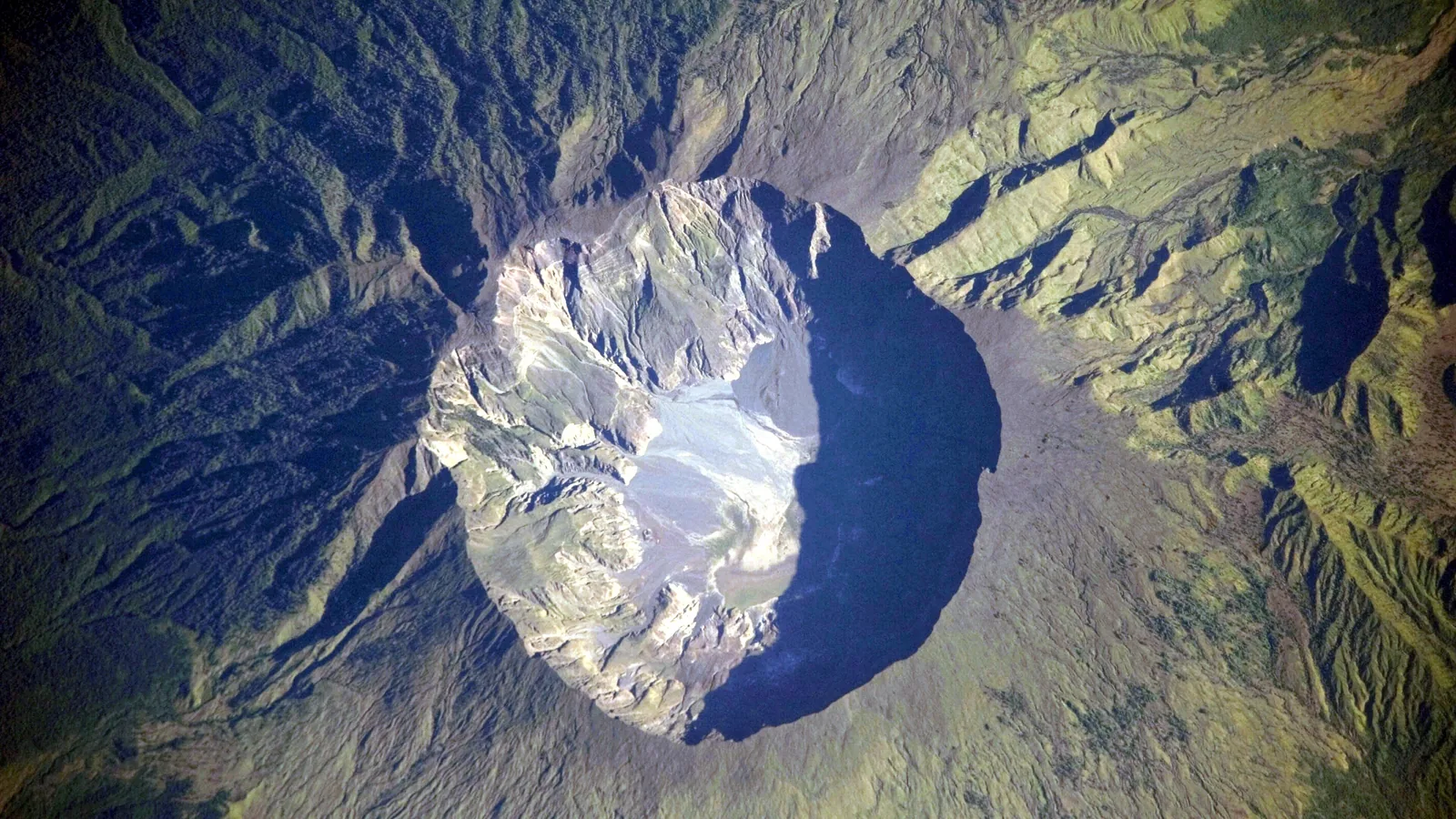

TL;DR — Hannah Dawes Newcomb kept a parlor fire burning in Keene, New Hampshire, through the cold summer of 1816; NASA ties the cold to the 1815 Tambora eruption.
In her diary for May 17, 1816, Hannah Dawes Newcomb of Keene, New Hampshire, wrote: “Very cold, have to keep a large fire in the parlor to keep comfortable.” Her short daily entries, held by the Massachusetts Historical Society, run from “Cold but pleasant” on May 13 to a July 6 line doubting there would be food “sufficient for man or Beast.” The National Park Service records May frost across four northern states, June snow in Albany, New York, and frost in Virginia into late August. NASA Earth Observatory ties the cold to the eruption of Tambora, on Sumbawa Island in what is now Indonesia, on April 10, 1815. A 2016 review accepts that link with stated uncertainties, and a 2016 preprint that tried to show it in the daily weather of that summer was withdrawn by its authors.
Quick facts
- When
- April 10, 1815 (Tambora eruption) · May 13 to 19, 1816 (Newcomb's daily cold entries) · July 4, 1816 (John Quincy Adams's diary, London) · July 6, 1816 (Newcomb's entry on corn and food) · October 30, 1816 (Philadelphia agricultural society meeting) · July 12, 2016 (Brohan preprint posted) · September 27, 2016 (author comment "Paper unsuccessful")
- Where
- Keene, New Hampshire; New York, Massachusetts, New Hampshire and Vermont; Albany, New York; Dennysville, Maine; Cape May, New Jersey; Philadelphia; London; Tambora volcano, Sumbawa Island, in what is now Indonesia
- Who
- Hannah Dawes Newcomb; John Quincy Adams; the curators of the Philadelphia Society for Promoting Agriculture; Christoph C. Raible and co-authors; Philip Brohan and co-authors
- Outcome
- May frost killed most crops in four northern states and snow fell in Albany in June. NASA and a 2016 review attribute the cold to Tambora, the review with large stated uncertainties; a 2016 preprint linking the volcano to daily weather was withdrawn by its authors
Hannah Dawes Newcomb's parlor fire, May 1816
Newcomb kept a diary of short daily reports on her everyday life, according to a 2020 post on The Beehive, the Massachusetts Historical Society’s blog, and from around May her notes on the weather changed. The week that began on May 13 reads, one day at a time: “Cold but pleasant,” “Cold weather,” “Very cold,” “The weather remains very cold.” On May 17 came the fire in the parlor. On May 18 she wrote “Very hard frost last night, very cold this morning,” and the entry for May 19 is five words long: “Very cold for the season.”
A National Park Service article describes the same month across the Northeast. May frost killed most of the crops in New York, Massachusetts, New Hampshire and Vermont. Newcomb’s hard frost of the night of May 17 fell in one of those four states.
"Corn so backward": Keene on July 6
In June, the park service records, heavy snow covered the ground in Albany, New York, and in Dennysville, Maine, while at Cape May, New Jersey, frost lasted five nights in a row. Throughout June and July, the historical society’s post says, Newcomb wrote of crops freezing on the vine and of farm animals dying from the cold.
On July 6 she wrote a longer entry than usual: “Weather continues very cold – all nature appears encircled in gloom – Grass very thin. Corn so backward it does not appear probably there will be food sufficient for man or Beast.” It closed: “Our only hope arises from the promise of seed time and Harvest. We daily keep fire in the parlor.”
In July, according to the park service, lakes and rivers stayed frozen as far south as northwestern Pennsylvania, and temperatures could fall from above-normal summer readings to near freezing within hours. The park service lists three names the year was given: “Year Without Summer,” “Poverty Year” and “Eighteen Hundred and Froze to Death.” In late July Newcomb noted seeing sunspots after church. Many people at the time blamed the weather on sunspots, the historical society writes, and the Vermont Historical Society states that Vermonters “did not know what caused the strange weather.”
October 30, 1816: a resolution in Philadelphia
The Philadelphia Society for Promoting Agriculture held a special meeting on October 30, 1816, and a record of it is also in the Massachusetts Historical Society’s collections. The society’s curators resolved to compile and distribute a newsletter to help farmers pick crops that could survive the cold, and to give instructions in case of future “uncommon occurrences.” The curators would list the trees, grasses and cultivated plants on which the season had “either beneficial or injurious influence,” with the aim of finding “the hardy or tender Grains, Grasses, or Plants, more proper for situations exposed to droughts, wet, or frost.”
The society also holds a London diary from the same summer. On July 4, 1816, John Quincy Adams, then living in London, recorded “Thunder at intervals, and Showers of rain almost incessant through the whole day.” He tried to go out: “I attempted a walk; but was twice overtaken with Showers ingoing to Ealing Church and returning.”
Ash from Sumbawa, April 10, 1815
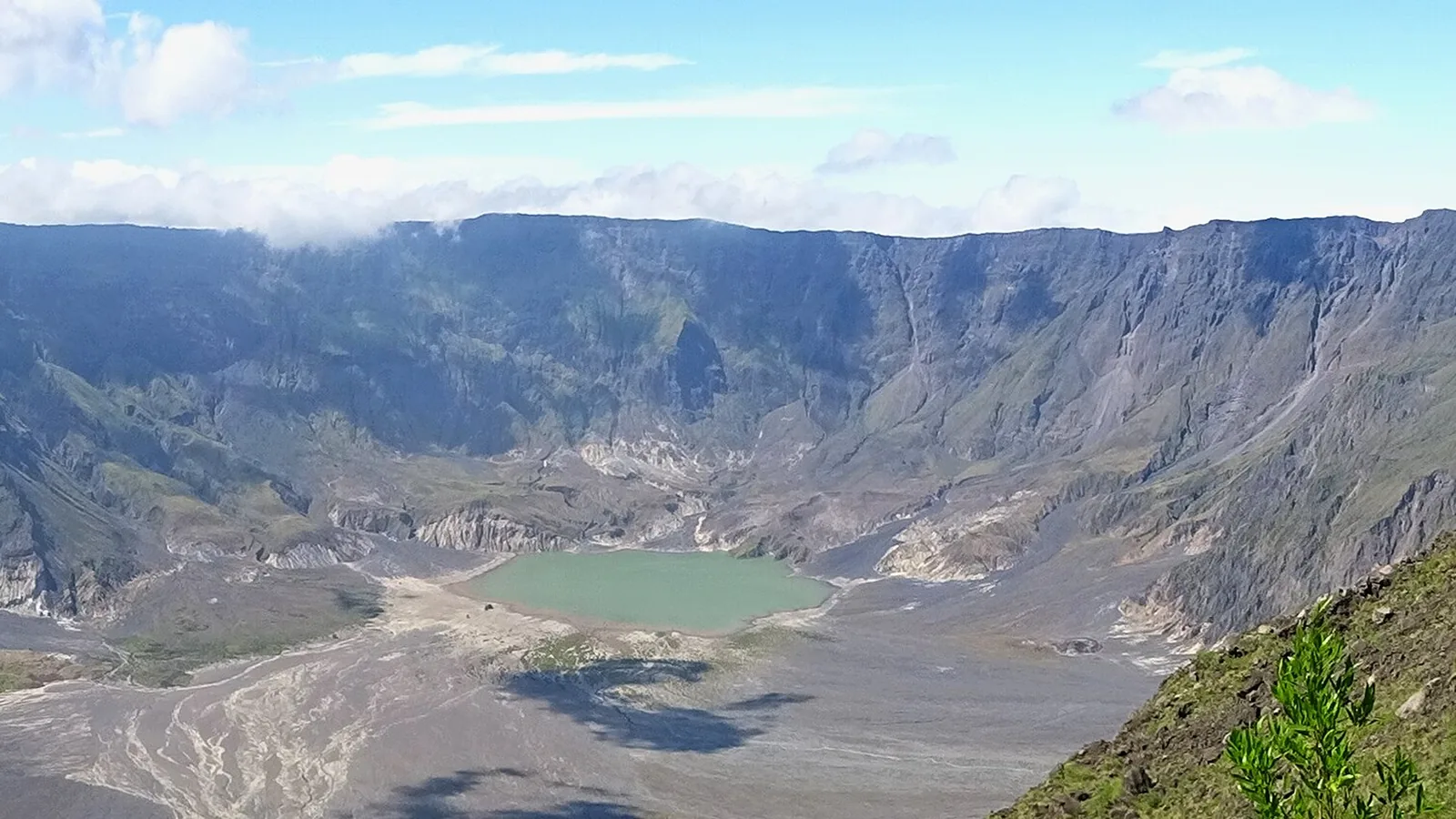
NASA Earth Observatory calls the April 10, 1815, eruption of Tambora “the largest eruption in recorded history.” It gives an estimate of 150 cubic kilometers (36 cubic miles) of tephra, the exploded rock and ash, with ash found at least 1,300 kilometers (808 miles) to the northwest. The 2016 review in Wiley Interdisciplinary Reviews: Climate Change, led by Christoph C. Raible, states that in the following months tens of thousands died of starvation and disease on Sumbawa and neighboring islands.
NASA’s caption draws the line to New England in one sentence: enough ash reached the atmosphere “to reduce incident sunlight on the Earth’s surface, causing global cooling, which resulted in the 1816 ‘year without a summer.’” The Raible review gives the size of that cooling with a different baseline for each figure. At Boston, the review puts the summer of 1816 3.0 degrees Celsius below the 1961 to 1990 average. Model-constrained reconstructions put a large part of eastern North America 2 degrees Celsius below the 1700 to 1890 average. Across the tropics and the extratropical Northern Hemisphere, the review gives an annual cooling of about 0.4 to 0.8 degrees Celsius relative to the preceding 30 years.

Withdrawn: the 2016 reanalysis preprint
The Raible review accepts Tambora as the cause and states its limits. Progress had been made on the eruption and on the sulfur dioxide it released, the authors wrote, “although large uncertainties still exist with respect to altitude and hemispheric distribution of Tambora aerosols.”
A second paper tried to close part of that gap. Philip Brohan and seven co-authors submitted “The 1816 ‘year without a summer’ in an atmospheric reanalysis” to Climate of the Past, and the preprint went up for open discussion on July 12, 2016. Its abstract said that the cold summer “is usually blamed on the eruption of Mount Tambora,” but that “making a link between these two events has proven difficult.” The authors used the few barometer records of the period to reconstruct the daily weather of summer 1816 over much of Europe, and reported that adding Tambora’s aerosol to the reconstruction improved it. New England was outside that reconstruction.
Four anonymous referees posted reviews between July 21 and September 2, 2016. The journal’s page now reads: “this preprint has been withdrawn by the authors.” The last entry in its discussion is an author comment by Brohan, dated September 27, 2016, titled “Paper unsuccessful - we won’t publish in CP.”
Key facts
- Tambora, on Sumbawa Island in what is now Indonesia, erupted on April 10, 1815; NASA Earth Observatory estimates 150 cubic kilometers of tephra.
- Hannah Dawes Newcomb of Keene, New Hampshire, recorded cold every day from May 13 to May 19, 1816, and on May 17 wrote of keeping “a large fire in the parlor.”
- The National Park Service records that May frost killed most crops in New York, Massachusetts, New Hampshire and Vermont, and that heavy snow fell in Albany and in Dennysville, Maine, in June.
- On July 6, 1816, Newcomb wrote that there might not be food “sufficient for man or Beast.”
- The Philadelphia Society for Promoting Agriculture resolved on October 30, 1816, to identify crops suited to “droughts, wet, or frost.”
- The Raible review of 2016 puts Boston’s summer of 1816 3.0 degrees Celsius below the 1961 to 1990 average.
- The same review states that “large uncertainties still exist” about the height and hemispheric spread of Tambora’s aerosols.
- The Brohan preprint, posted July 12, 2016, is marked as withdrawn by its authors; Brohan’s comment of September 27, 2016, is titled “Paper unsuccessful - we won’t publish in CP.”
FAQ
Why is 1816 called the year without a summer?
In the northeastern United States, frost in May killed most crops in four states, snow fell in Albany, New York, in June, and frost lasted in Virginia into late August, according to the National Park Service. The year was also called "Poverty Year" and "Eighteen Hundred and Froze to Death."
What caused the cold summer of 1816 in New England?
NASA Earth Observatory attributes it to ash from the eruption of Tambora on April 10, 1815, which reduced sunlight reaching the ground. A 2016 review led by Christoph C. Raible accepts the link and states that large uncertainties remain about the height and spread of the volcano's aerosols.
Who was Hannah Dawes Newcomb?
She lived in Keene, New Hampshire, and kept a diary of short daily entries. Her entries for 1816 record cold from mid-May, a fire kept in the parlor, and on July 6 a fear that the corn crop would not feed people or animals. The diary is held by the Massachusetts Historical Society.
Sources
- Massachusetts Historical Society, "1816: the Year Without a Summer," The Beehive (the society's blog), by Alex Bush, Reader Services, April 7, 2020. Prints extracts from Hannah Dawes Newcomb's diary, John Quincy Adams's diary for July 4, 1816, and the Philadelphia Society for Promoting Agriculture's resolution of October 30, 1816, all held by the society.
- U.S. National Park Service, Abraham Lincoln Birthplace National Historical Park, "1816 - The Year Without Summer" (last updated April 4, 2023).
- NASA Earth Observatory, "Mount Tambora Volcano, Sumbawa Island, Indonesia," Image of the Day, July 19, 2009.
- Raible, C. C., et al., "Tambora 1815 as a test case for high impact volcanic eruptions: Earth system effects," Wiley Interdisciplinary Reviews: Climate Change 7(4) (2016), 569-589, doi:10.1002/wcc.407 (open access, PubMed Central).
- Brohan, P., Compo, G. P., Brönnimann, S., et al., "The 1816 'year without a summer' in an atmospheric reanalysis," Climate of the Past Discussions, preprint cp-2016-78 (2016), withdrawn by the authors; abstract, interactive discussion and withdrawal notice.
- Vermont Historical Society, "Eighteen Hundred and Froze to Death" (This Place in History video series description), Internet Archive copy of January 22, 2025.
Cite this article
- APA
- LETTER. (2026, September 29). Diary lines from Keene, 1816, and a Tambora paper withdrawn in 2016. Our Earth's History. https://ourearthshistory.com/americas/modern/year-without-a-summer-1816-new-england-diaries/
- Chicago
- LETTER. “Diary lines from Keene, 1816, and a Tambora paper withdrawn in 2016.” Our Earth's History, September 29, 2026. https://ourearthshistory.com/americas/modern/year-without-a-summer-1816-new-england-diaries/.
- MLA
- LETTER. “Diary lines from Keene, 1816, and a Tambora paper withdrawn in 2016.” Our Earth's History, 29 Sep. 2026, https://ourearthshistory.com/americas/modern/year-without-a-summer-1816-new-england-diaries/.
Text licensed CC BY-NC-ND 4.0. Found an error? Tell us.