Twelve books, 2,446 pages: the Florentine Codex Philip II confiscated
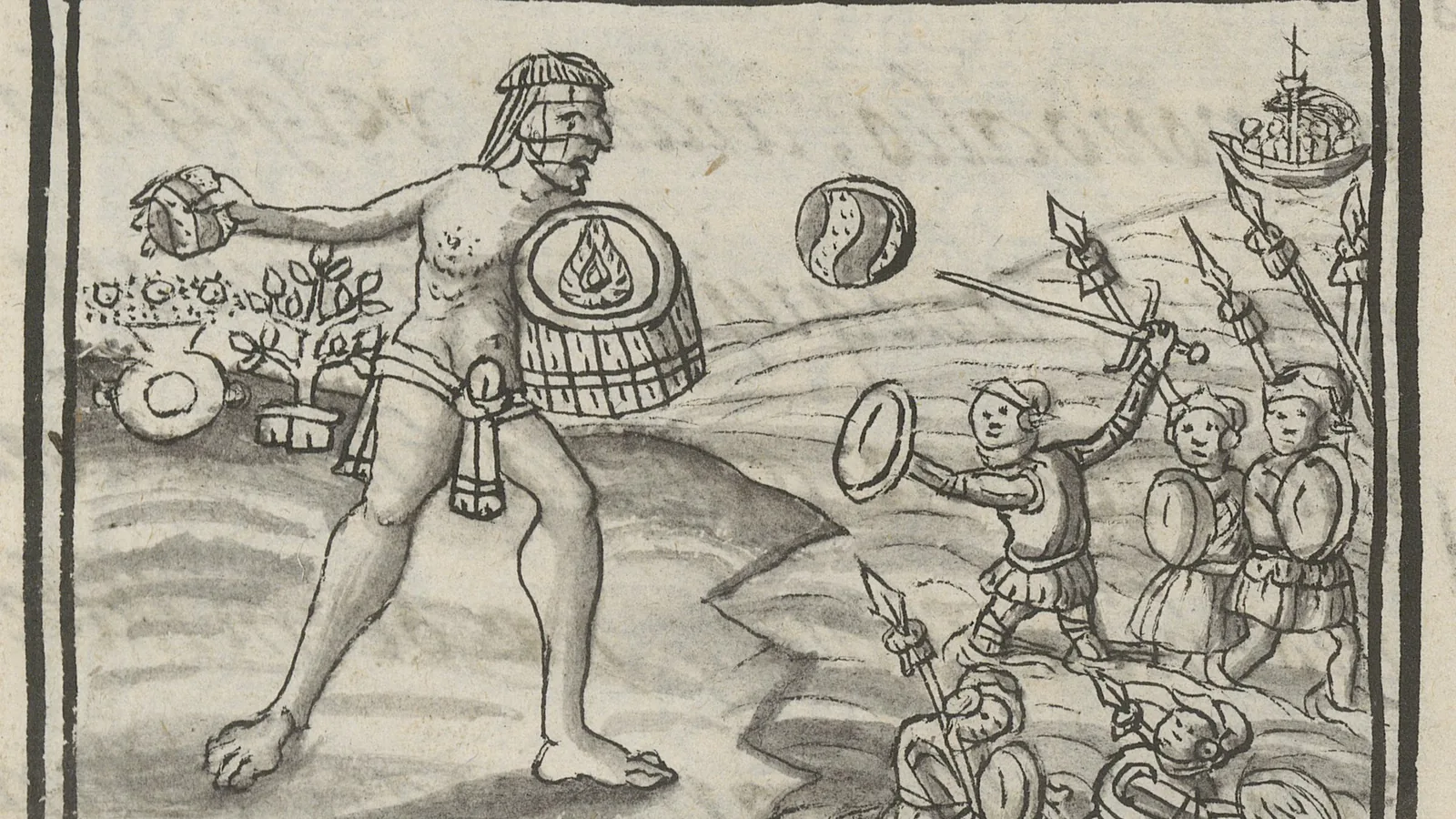

TL;DR — Twelve books, 2,446 pages, Spanish and Nahuatl side by side: finished at Tlatelolco in 1577, ordered to Spain by Philip II, in Medici hands by 1587, in Florence since.
Three volumes marked Mediceo Palatino 218–220 sit in the Biblioteca Medicea Laurenziana in Florence: 12 books, 2,446 pages, Spanish on the left, Nahuatl on the right, nearly 2,500 painted images. The manuscript is the Historia general de las cosas de Nueva España, the General History of the Things of New Spain, finished in 1577 at the Colegio de Santa Cruz in Tlatelolco, in what is now Mexico City, by the Franciscan friar Bernardino de Sahagún and a group of Nahua scholars, scribes and painters. Philip II ordered it sent to Spain the same year. By 1587 it was in the Roman library of Cardinal Ferdinando de’ Medici; in 1783 it reached the Laurenziana, and on October 26, 2023, the Getty Research Institute put it online with a full English translation.
Quick facts
- When
- Inquiries from 1547 · Tepepulco 1558–1561 · completed at Tlatelolco 1577 · royal letters April 22 and May 13, 1577 · Sahagún's letter March 26, 1578 · Medici inventory 1587 · Laurenziana 1783 · Bustamante edition 1829 · digital edition October 26, 2023
- Where
- Tepepulco (now Tepeapulco, Hidalgo); the Colegio de Santa Cruz in Tlatelolco, now Mexico City; Madrid; Rome; the Palazzo Vecchio, the Palazzo Pitti and the Biblioteca Medicea Laurenziana in Florence; the Franciscan convent of Tolosa
- Who
- Bernardino de Sahagún; Antonio Valeriano, Alonso Vegerano, Martín Jacobita and Pedro de San Buenaventura; the scribes Diego de Grado, Bonifacio Maximiliano and Mateo Severino; Philip II; the viceroy Martín Enríquez; fray Rodrigo de Sequera; Cardinal Ferdinando de' Medici; Carlos María de Bustamante
- Outcome
- Twelve books in three volumes, 2,446 pages, Spanish and Nahuatl in parallel columns with nearly 2,500 images, held in Florence as Mediceo Palatino 218–220 and published online with a full English translation in 2023
Tlatelolco, 1547 to 1577: who wrote the twelve books
Sahagún began asking questions in 1547, two years after the epidemic of 1545, according to Baltazar Brito Guadarrama of the Biblioteca Nacional de Antropología e Historia, who works the date back from a note at the end of Book 6: the book was put into Spanish “in this year 1577, thirty years after it was written in the Mexican language.” Between 1558 and 1561, 12 nobles at Tepepulco, now Tepeapulco in Hidalgo, answered his questionnaire and showed their old paintings to back up what they said. The drafts then moved to the college in Tlatelolco, and in 1575 the commissary general fray Rodrigo de Sequera gave Sahagún the means to assemble a final team of translators, scribes and painters.
The Nahua collaborators have names. In the prologue to Book 2, Sahagún listed four former students: Antonio Valeriano of Azcapotzalco, whom he called “the principal and wisest,” Alonso Vegerano and Pedro de San Buenaventura of Cuauhtitlan, and Martín Jacobita of Tlatelolco, who later became rector of the college. Sahagún’s Coloquios of 1564 names Valeriano, Vegerano, Jacobita and a fourth student, Andrés Leonardo, as the college’s most skilled students “in the Mexican language and in the Latin language,” and adds that the text “was also revised with four older men” versed in their antiquities. Three scribes made the clean copies: Diego de Grado and Bonifacio Maximiliano of Tlatelolco, and Mateo Severino of Xochimilco. Twenty-two anonymous painters, by Diana Magaloni Kerpel’s count, made the images. The Getty edition’s citation lists the four students and the three scribes, after Sahagún, as the authors.
A king's letters and a copy hidden under a false title
Philip II had asked since 1573 that Sahagún’s writings go to the chronicler of the Indies for publication. Manuel Aguilar-Moreno of California State University, Los Angeles, traces the change: accusations from within the Franciscan order reached Spain, the king came to see writings in an Indigenous language as a way back to the old beliefs, and from 1577 his repeated requests aimed at confiscating the Historia and stopping its publication, without Sahagún being told. The king’s letters to the viceroy on April 22, 1577, and to the archbishop on May 13, 1577, survive in the Archivo General de Indias in Seville.
Sahagún’s own letter to the king, dated March 26, 1578, says what he thought was happening: the viceroy Martín Enríquez had a cédula ordering that works “I have written in the Mexican and Spanish languages” be sent to the king, and the work, “divided into twelve books, in four volumes,” would go with the fleet. Aguilar-Moreno suspects Sequera had the Spanish column copied in Mexico and carried the copy to Spain in 1580; Luis Nicolau d’Olwer and Georges Baudot hold that Sequera took the original itself. The Spanish copy surfaced in the Franciscan convent of Tolosa, in Guipúzcoa, under the false title Papeles de Sor María de la Antigua, and reached Madrid in 1783. When Carlos María de Bustamante printed it in Mexico City in 1829, his dedication to Pope Pius VIII said the work had been “buried for the space of more than two centuries in the library of the Franciscan fathers of Tolosa in Navarre, Spain.”
Book 12: the war as Tlatelolco told it
The last book, 185 folios in the Getty’s count, tells the Spanish invasion of 1519 to 1521 in Nahuatl, from the Tlatelolco side, in 42 chapters. Arthur J. O. Anderson and Charles E. Dibble translated the Nahuatl column into English between 1950 and 1982; their revised Book 12 of 1975 opens with the omens seen before the Spaniards came. Of the second they wrote: “Quite of its own accord, the house of the demon Uitzilopochtli burned; it flared greatly. No one had set fire to it; only of itself it burst into flames.”
Berenice Alcántara Rojas and Federico Navarrete Linares of the Universidad Nacional Autónoma de México, the Getty edition’s Nahuatl-to-Spanish translators, read the omens as more than reportage. The authors of Book 12, they write, borrowed topoi from Virgil, Lucan, Livy, Tacitus and Josephus, whose works stood in the college library, while keeping the Mesoamerican idea of the tetzahuitl, the omen, so that the fall of Tenochtitlan and Tlatelolco stood beside the collapse of the great empires of antiquity.
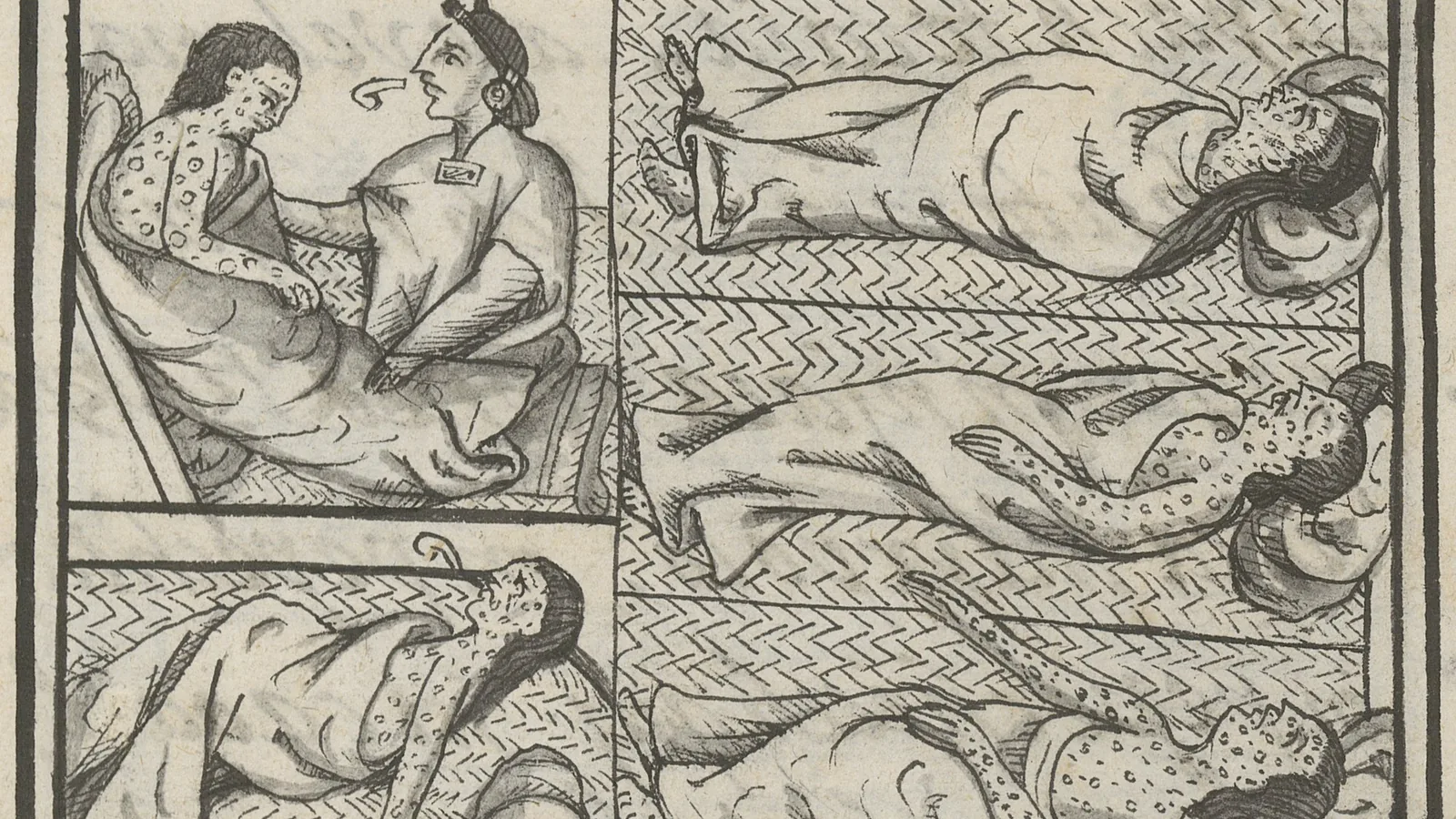
_tending_to_people_suffering_from_smallpox_in_1520_in_Book_12_of_the_Florentine_Codex,_1577.jpg)
Rome, the Palazzo Vecchio, and a shelf in 1783
Ida Giovanna Rao found in the Florentine state archive a 1587 inventory of Cardinal Ferdinando de’ Medici’s library in Rome that lists “three books” she takes to be the three volumes. One hypothesis, put forward by Aguilar-Moreno in the Getty edition, is that Pope Gregory XIII or Pope Sixtus V received the codex from Philip II and gave it to Ferdinando between 1580 and 1587. The Laurenziana’s own page says only that it came into Medici possession by 1588, “probably as a gift.” When Ferdinando gave up his cardinal’s hat on October 19, 1587, to become grand duke of Tuscany, the books went with him to Florence, to the Palazzo Vecchio; in 1737 they moved to the Palazzo Pitti, and in 1783 to the Biblioteca Medicea Laurenziana.
A scan went onto the World Digital Library in 2012. The Getty project began in 2016, signed its agreement with the Laurenziana in 2019, and published the Digital Florentine Codex on October 26, 2023, with, for the first time, the Spanish text of all 12 books in English, Books 1 to 11 translated by León García Garagarza and Book 12 in James Lockhart’s translation of 1993. Until then only the Nahuatl column had been translated in full, by Anderson and Dibble.
Key facts
- The manuscript has 12 books on 2,446 pages, bound in three volumes, with Spanish on the left and Nahuatl on the right and nearly 2,500 painted images (Getty Research Institute; Biblioteca Medicea Laurenziana).
- Sahagún’s prologue to Book 2 names four Nahua collaborators, Antonio Valeriano, Alonso Vegerano, Martín Jacobita and Pedro de San Buenaventura; the scribes were Diego de Grado, Bonifacio Maximiliano and Mateo Severino, and 22 anonymous painters made the images (Brito Guadarrama, citing Magaloni Kerpel).
- A note at the end of Book 6 dates the Spanish translation to 1577, “thirty years after it was written in the Mexican language.”
- Philip II’s letters of April 22 and May 13, 1577, sit among nine letters of 1576 to 1578 in the Archivo General de Indias; Sahagún’s letter of March 26, 1578, describes the work as “twelve books, in four volumes.”
- The Tolosa Manuscript, a copy of the Spanish column, was found in a Franciscan convent under the title Papeles de Sor María de la Antigua and reached Madrid in 1783; Bustamante printed it in 1829.
- Book 12 tells the invasion of 1519 to 1521 in Nahuatl in 42 chapters over 185 folios; Anderson and Dibble’s English translation of the Nahuatl appeared between 1950 and 1982.
- A 1587 inventory places the three volumes in Cardinal Ferdinando de’ Medici’s Roman library; in Florence they went from the Palazzo Vecchio (1587) to the Palazzo Pitti (1737) to the Laurenziana (1783).
- The Digital Florentine Codex launched on October 26, 2023, with the first complete English translation of the Spanish text; León García Garagarza translated Books 1 to 11.
FAQ
Who wrote the Florentine Codex?
Bernardino de Sahagún directed it, and the Getty edition credits as co-authors the Nahua scholars he named in his prologue to Book 2, Antonio Valeriano, Alonso Vegerano, Martín Jacobita and Pedro de San Buenaventura, along with the scribes Diego de Grado, Bonifacio Maximiliano and Mateo Severino. Twenty-two unnamed painters made the images.
Why is it called the Florentine Codex?
Because it has been in Florence since 1587. A 1587 inventory lists it in Cardinal Ferdinando de' Medici's library, and after he became grand duke it was kept in the Palazzo Vecchio, then from 1737 in the Palazzo Pitti, and from 1783 in the Biblioteca Medicea Laurenziana, as Mediceo Palatino 218–220. The Mexican historian Joaquín García Icazbalceta gave it the name.
What does Book 12 contain?
An account in Nahuatl, in 42 chapters, of the Spanish invasion from the omens before 1519 to the fall of Tenochtitlan and Tlatelolco in 1521, written from the Tlatelolco side. Anderson and Dibble translated it into English; the Getty edition of 2023 added a new Nahuatl-to-Spanish translation by Berenice Alcántara Rojas and Federico Navarrete Linares.
Sources
- Getty Research Institute, Digital Florentine Codex (2023) — "About the Project" and the site's introduction: 12 books, 2,446 pages, three volumes, two columns, nearly 2,500 images, completion in 1577, launch on October 26, 2023.
- Getty Research Institute, Digital Florentine Codex — essays: Baltazar Brito Guadarrama, "Nahua Informants, Students, Scribes, and Artists: The Other Authors of the Florentine Codex"; Manuel Aguilar-Moreno, "The Itinerant Life of the Florentine Codex." The named collaborators, the prologue to Book 2, the Coloquios passage, the 22 artists, the royal letters of 1576 to 1578, the Tolosa Manuscript, the 1587 inventory and the route to the Laurenziana.
- Getty Research Institute, Digital Florentine Codex — essays: León García Garagarza, "On the English Translation of the Spanish Text of the Florentine Codex"; Berenice Alcántara Rojas and Federico Navarrete Linares, "The Mexican Conquest, Book 12: Translators' Note (Nahuatl to Spanish)." The first complete English translation of the Spanish column; Book 12's 42 chapters, its classical models and the tetzahuitl.
- Biblioteca Medicea Laurenziana, Florence — "Il Codice Fiorentino della Biblioteca Medicea Laurenziana": the shelfmark Med. Palat. 218–220, the date 1577, Medici possession by 1588, nearly 2,500 illustrations, the 2012 World Digital Library scan and the 2019 agreement with the Getty.
- Bernardino de Sahagún, Florentine Codex: General History of the Things of New Spain, Book 12, The Conquest of Mexico, translated from the Aztec into English by Arthur J. O. Anderson and Charles E. Dibble, second edition, revised (School of American Research and University of Utah, 1975), scanned text on the Internet Archive. The chapter list and the omens of Chapter 1.
- Bernardino de Sahagún, Historia general de las cosas de Nueva España, edited by Carlos María de Bustamante, tomo primero (Mexico City: Imprenta de Alejandro Valdés, 1829), full text on the Internet Archive. The title page and the dedication to Pius VIII naming the Franciscan library of Tolosa.
Cite this article
- APA
- Our Earth's History. (2026, September 22). Twelve books, 2,446 pages: the Florentine Codex Philip II confiscated. Our Earth's History. https://ourearthshistory.com/americas/early-modern/florentine-codex-1577-sahagun-nahua-scholars/
- Chicago
- Our Earth's History. “Twelve books, 2,446 pages: the Florentine Codex Philip II confiscated.” Our Earth's History, September 22, 2026. https://ourearthshistory.com/americas/early-modern/florentine-codex-1577-sahagun-nahua-scholars/.
- MLA
- “Twelve books, 2,446 pages: the Florentine Codex Philip II confiscated.” Our Earth's History, 22 Sep. 2026, https://ourearthshistory.com/americas/early-modern/florentine-codex-1577-sahagun-nahua-scholars/.
Text licensed CC BY-NC-ND 4.0. Found an error? Tell us.