How did Akbar hold together an empire of many faiths?

TL;DR — Akbar put Hindu and Muslim officers into one ranked service, dropped the jizya tax on non-Muslims in 1564, and in 1579 made himself the judge of his clerics’ disputes.
Akbar held the Mughal Empire together from 1556 to 1605 by putting Hindu and Muslim officers into one ranked service and by taking religious authority away from his own clerics. He came to the throne at 13, married into the Rajput house of Amber in 1562, and abolished the jizya, the poll tax on non-Muslims, in 1564. From 1575 he heard Thursday-night debates at Fatehpur Sikri, and in 1579 his jurists signed a document that let him choose between their conflicting opinions. Whether the creed that followed was a religion or a circle of disciples, the sources still argue. The ranks and the land tax outlasted him.
Quick facts
- When
- January 24, 1556 (Humayun died) · February 14, 1556 (Akbar proclaimed) · 1562 (Amber marriage) · 1564 (jizya abolished) · 1575 (Ibadat Khana begun) · 1579 (mahzar decree) · 1585 (capital moved to Lahore) · 1605 (Akbar died)
- Where
- Delhi, Agra and Fatehpur Sikri on the Gangetic plain of northern India; conquests from Gujarat on the west coast to Bengal in the east and Kashmir in the north
- Who
- Akbar, third Mughal emperor; the regent Bayram Khan; Raja Bhar Mal of Amber; the revenue minister Todar Mal; the chronicler Abu'l-Fazl; his critic Badauni; the Jesuit Rodolfo Acquaviva
- Outcome
- One ranked service (mansabdars) for Hindu and Muslim officers, a land tax on ten-year averages, no poll tax on non-Muslims, and an emperor who outranked his own clerics from 1579
A boy on the throne, 1556
Humayun, the second Mughal emperor, died in an accident in Delhi on January 24, 1556. His son Akbar was 13 years and three months old and, according to the historian Fritz Lehmann in the Encyclopaedia Iranica, the first Mughal ruler born in India. He was proclaimed emperor on February 14. Afghan chiefs held most of the Gangetic plain, and in October a Hindu general named Hemu took Delhi.
The regent Bayram Khan defeated Hemu at the second battle of Panipat on November 5, 1556. Akbar dismissed the regent in October 1560; Afghan nobles killed him on the road to Mecca in 1561. By 1564, Lehmann wrote, the emperor ruled for himself.
Rajput marriages and twenty years of conquest
In 1562 Akbar accepted a marriage alliance offered by Raja Bhar Mal of Amber, the Rajput state around what is now Jaipur. Todar Mal, a Khatri who had run the revenue for the earlier ruler Sher Shah Sur, and Birbal, a Brahman, came to court in the same years over the objections of Muslim nobles. In Lehmann’s reading, these men served Akbar more loyally than the older nobility of Central Asian origin did.
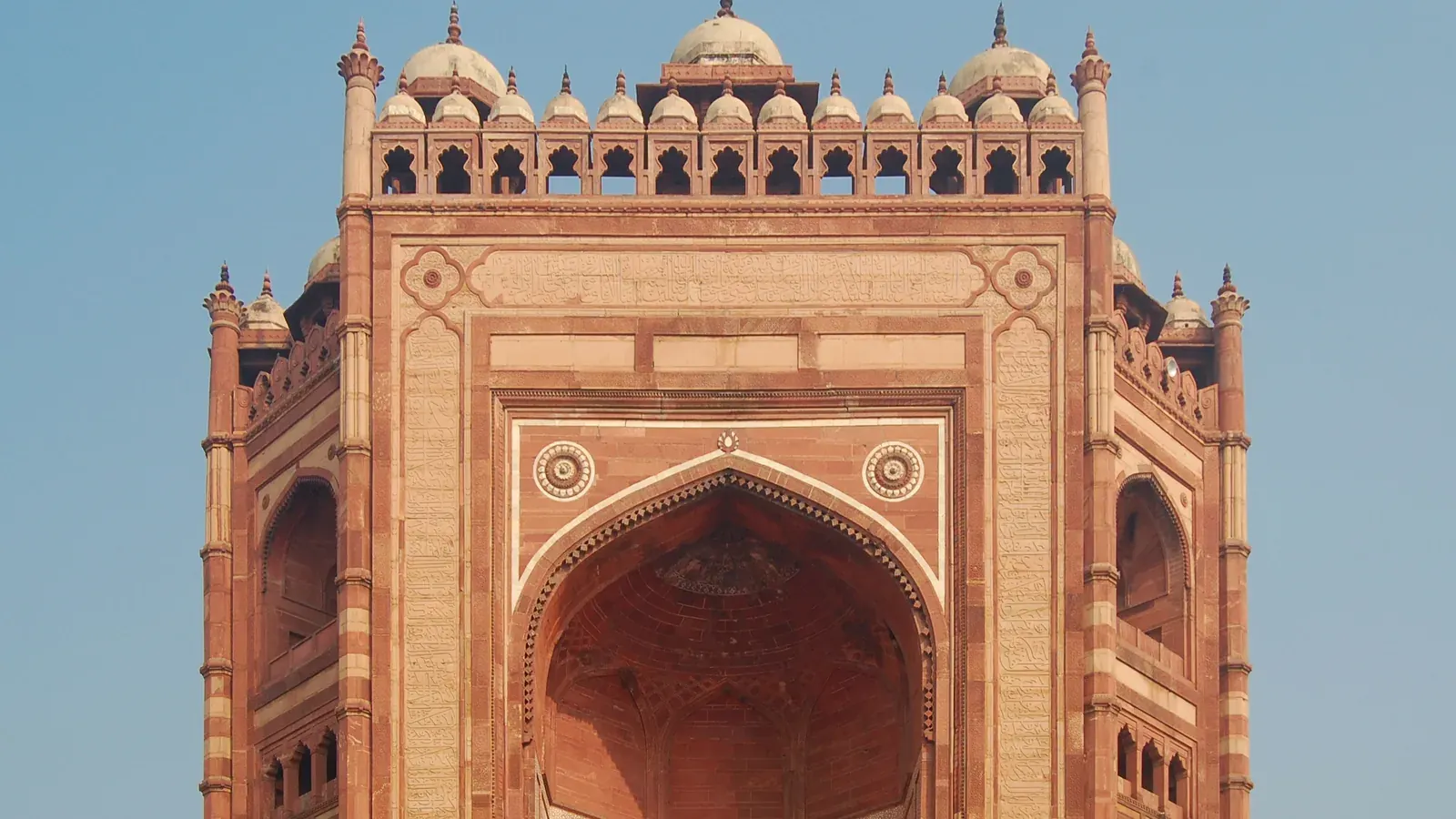
The conquests ran in parallel: Malwa in 1561, the Rajput forts of Chitor in 1568, with the massacre of its garrison, and Ranthambor in 1569, then Gujarat in 1572, Bengal in 1576, Kashmir in 1586 and parts of the Deccan from 1596 to 1601. The Buland Darwaza gate at Fatehpur Sikri, finished in 1575 according to UNESCO’s listing, commemorated the Gujarat victory.
Ranks, horses and a land tax measured over ten years
These men entered the mansabdari system. Every official, civil or military, held a rank expressed as the nominal command of a number of horsemen, from ten up to thousands, and the emperor alone set it. Shireen Moosvi, writing in the Journal of the Royal Asiatic Society in 1981, described how by Akbar’s death the rank carried two numbers, zat for personal pay and status and sawar for the horsemen a holder had to maintain.
In 1574 Shahbaz Khan, one of the emperor’s new men, proposed branding horses so that a commander could not draw pay for cavalry he did not keep; the older Turani nobles resisted. Akbar also tried in 1574 to pay all salaries in cash, gave it up, and went back to jagirs, land assignments in lieu of salary. Lehmann wrote that Irfan Habib and A. L. Srivastava blamed that practice for the empire’s later decline.
The land tax took three attempts. In 1579 to 1580, with Todar Mal, the state settled on one third of average gross produce, assessed on ten-year records of land planted, crops, yields and prices, all kept in Persian. Where it worked, Lehmann wrote, it gave peasants security; where it did not, hereditary local chiefs, the zamindars, kept their hold.
The jizya, the house of worship and a disputed faith
The jizya was the poll tax that Muslim states levied on protected non-Muslims. Richard Eaton’s Iranica article on Abu’l-Fazl places its abolition, with the pilgrimage taxes, between 1562 and 1564; Lehmann gives 1564 and calls the motive primarily reasons of state.
Construction of the Ibadat Khana, the House of Worship, began at Fatehpur Sikri early in 1575 and finished in 1576, according to Manya Rathore in World History Encyclopedia. Debates ran on Thursday evenings. They began as an assembly of Sunni scholars, stopped after less than a year, and resumed in 1578, with the emperor assigning seats himself: nobles to the east, descendants of the Prophet to the west, jurists to the south and Muslim ascetics to the north, as the chronicler Badauni recorded. Shia scholars, Sufis, Hindus, Jains, Parsis and Christians followed, and in 1579 a Jesuit mission under Rodolfo Acquaviva brought the Polyglot Bible of Philip II of Spain.
On June 26, 1579, Akbar read the Friday sermon in his own name, and in August or September Abu’l-Fazl and his father Shaikh Mubarak drafted the mahzar, which the leading jurists signed, Eaton wrote, reluctantly: a just king outranked the interpreters of Islamic law and could choose among their disagreements.
What came after has no agreed name. Rathore wrote that the debates ended in “his new faith Din-i-Ilahi.” Eaton described the same thing, under either name, tawhid-e elahi or din-e elahi, as a cult of loyalty around the emperor modeled on the bond between a Sufi master and his disciple. Bazmee Ansari, in the Iranica entry on Badauni, called it “Akbar’s private religious sect.” Lehmann recorded that D. B. MacDonald, V. A. Smith and I. H. Qureshi read Akbar’s acts as heresy, and that M. Mujeeb and the weight of later scholarship did not. Badauni, a conservative Sunni who lost the emperor’s favor, kept a secret history that faulted the banning of the call to prayer in the palace, yet he wrote that Akbar never renounced Islam. The debates had stopped by 1582.
A library of 24,000 books and a chronicle with 116 paintings
Akbar kept a library of some 24,000 manuscripts, Lehmann wrote, read to him daily, and paid for translations into Persian from Sanskrit, Arabic, Turkish and Latin under a bureau run by Abu’l-Fazl. Badauni, for all his objections, translated part of the Mahabharata in 1582 and the Ramayana between 1584 and 1589.
In 1589 or 1590 Akbar commissioned Abu’l-Fazl to write the Akbarnama, the official chronicle; its third book, the Ain-i Akbari, set out the mansab regulations and the revenue tables. The Victoria and Albert Museum holds a partial royal copy with 116 paintings covering 1560 to 1577, painted between about 1592 and 1594 by at least 49 artists; one leaf, by Basawan and Dharmdas, shows the emperor hunting with cheetahs near Agra in 1561. Iqtidar Alam Khan argued in 1968 that Abu’l-Fazl told the reign as the steady unveiling of the emperor’s personality, and that Badauni, from the opposite side, reinforced the impression.
The end at Agra, 1605
Fatehpur Sikri was left in 1585 when the capital moved to Lahore. Prince Salim, the only surviving son, had Abu’l-Fazl murdered on August 22, 1602. Akbar died at Agra in 1605, reconciled on his deathbed with Salim, who ruled as Jahangir.
What held was the machine: officers of any faith answered to a rank the emperor set, and the treasury drew on a tax fixed by records. The creed built around the emperor’s person did not outlast him, and Lehmann judged that none of his successors carried the settlement through.
Key facts
- Humayun died in Delhi on January 24, 1556; Akbar, aged 13, was proclaimed emperor on February 14 (Lehmann, Encyclopaedia Iranica).
- Bayram Khan’s army defeated Hemu at Panipat on November 5, 1556; Akbar dismissed the regent in October 1560.
- The Amber marriage alliance came in 1562; the jizya was abolished in 1564 (Lehmann) or between 1562 and 1564 (Eaton).
- Mansab ranks ran from commands of ten to thousands of horsemen; by 1605 each carried a zat and a sawar number (Moosvi, 1981).
- The land tax settled in 1579 to 1580 took one third of average produce on ten-year records.
- The Ibadat Khana was begun in 1575 and finished in 1576; the mahzar was signed in 1579; the debates ended by 1582 (Rathore; Lehmann).
- Fatehpur Sikri was built from 1571 and left for Lahore in 1585 (UNESCO); Akbar died at Agra in 1605.
FAQ
What was the Ibadat Khana?
A debating hall at Fatehpur Sikri, begun in 1575, where Akbar heard Sunni, Shia, Sufi, Hindu, Jain, Parsi and Christian speakers on Thursday nights. The debates ran, with a break, until about 1582.
Was Din-i Ilahi a religion?
The sources disagree. World History Encyclopedia calls it Akbar's new faith; Richard Eaton describes a cult of loyalty around the emperor on the model of a Sufi master and his disciples; Bazmee Ansari calls it a private sect. Badauni, a critic of Akbar's religious policy at court, wrote that the emperor never renounced Islam.
What was a mansabdar?
An officer holding a mansab, a numbered rank in the Mughal service. The number fixed his pay and status and, in a second figure, the horsemen he had to keep. The emperor alone granted and changed the rank.
Sources
- Encyclopaedia Iranica — Fritz Lehmann, "AKBAR I" (December 15, 1984).
- Encyclopaedia Iranica — Richard M. Eaton, "ABU'L-FAŻL ʿALLĀMĪ" (December 15, 1983).
- Encyclopaedia Iranica — Richard M. Eaton, "AKBAR-NĀMA" (December 15, 1984).
- Encyclopaedia Iranica — Abd al-Samad Bazmee Ansari, "BADĀʾŪNĪ, ʿABD-AL-QĀDER" (December 15, 1988).
- Encyclopaedia Iranica — "JEZYA," on the poll tax levied on non-Muslims.
- World History Encyclopedia — Manya Rathore, "Ibadat Khana" (April 29, 2020).
- Cambridge Core — Shireen Moosvi, "The Evolution of the Manṣab System Under Akbar Until 1596–7," Journal of the Royal Asiatic Society 113, no. 2 (April 1981), pp. 173–185, extract.
- Cambridge Core — Iqtidar Alam Khan, "The Nobility under Akbar and the Development of his Religious Policy, 1560–80," Journal of the Royal Asiatic Society 100, no. 1 (January 1968), pp. 29–36, extract.
- Victoria and Albert Museum, Explore the Collections — "Akbar hunting with cheetahs," Akbarnama, outline by Basawan, painting by Dharmdas, ca. 1590–95, IS.2:24-1896.
- Victoria and Albert Museum, Explore the Collections — "Akbarnama," text page, Persian, ca. 1590–95.
- UNESCO World Heritage Centre — "Fatehpur Sikri," World Heritage List no. 255.
Cite this article
- APA
- Our Earth's History. (2026, September 20). How did Akbar hold together an empire of many faiths? Our Earth's History. https://ourearthshistory.com/south-asia/early-modern/akbar-mughal-empire-many-faiths/
- Chicago
- Our Earth's History. “How did Akbar hold together an empire of many faiths?” Our Earth's History, September 20, 2026. https://ourearthshistory.com/south-asia/early-modern/akbar-mughal-empire-many-faiths/.
- MLA
- “How did Akbar hold together an empire of many faiths?” Our Earth's History, 20 Sep. 2026, https://ourearthshistory.com/south-asia/early-modern/akbar-mughal-empire-many-faiths/.
Text licensed CC BY-NC-ND 4.0. Found an error? Tell us.