Konark's Sun Temple: a stone chariot, and a hall filled with sand

TL;DR — The Archaeological Survey of India calls Konark’s temple a stone chariot with twelve pairs of wheels; its hall held sand from 1901 until 2022.
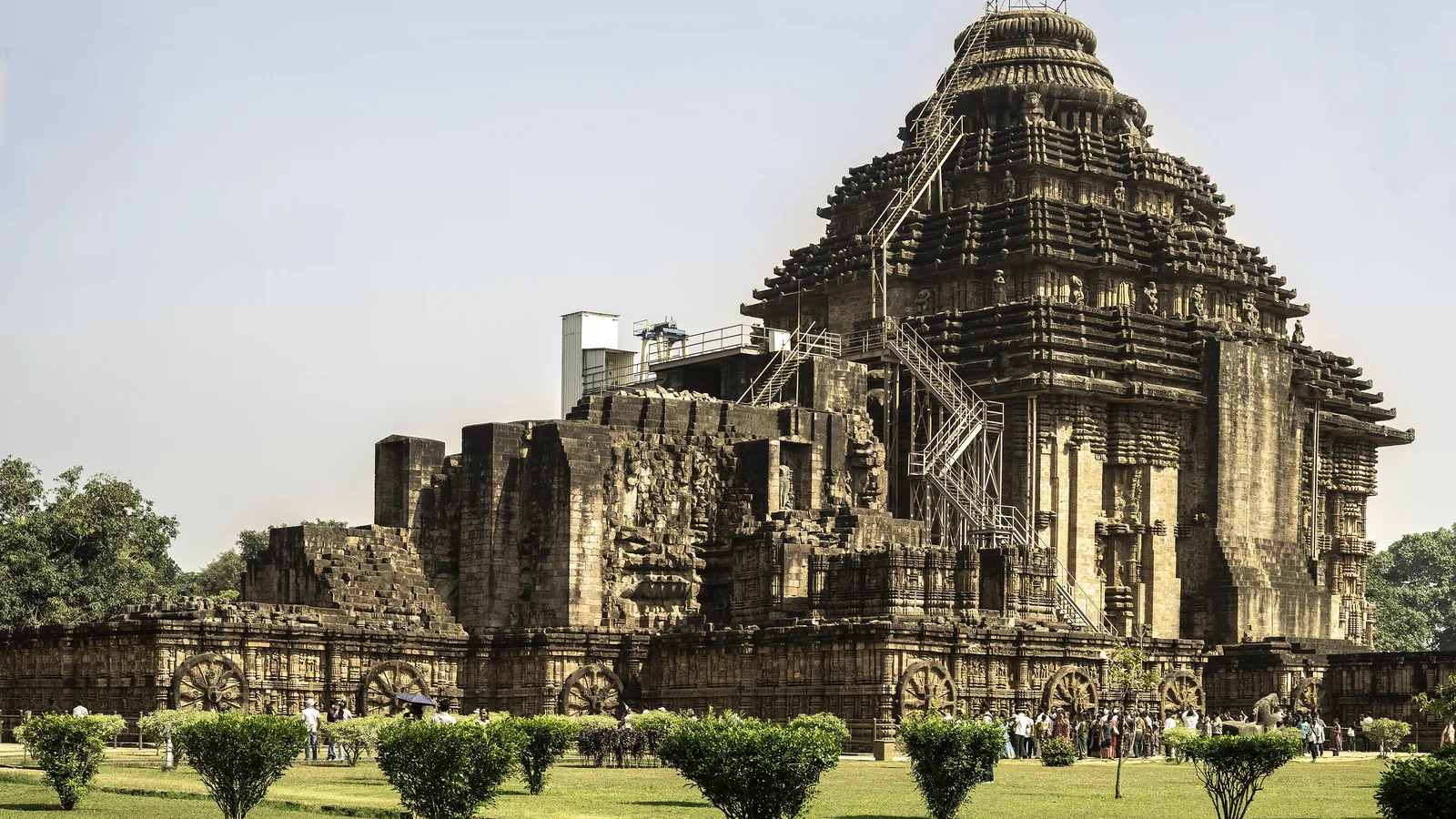
The Archaeological Survey of India calls the Konark Sun Temple “a gigantic solar chariot with twelve pairs of exquisitely-ornamented wheels dragged by seven rearing horses.” Copper plates left by the successors of the Eastern Ganga king Narasimhadeva I name him as the builder, describing him as the ruler who had “a great hut of Ushnarasmeh” built “at the corner of Trikona.” The agency dates his reign to about 1238 to 1264 and places construction in the thirteenth century. Nearly seven centuries later, the building’s main hall still held the sand poured into it to keep it from collapsing further, until the Archaeological Survey of India began removing that sand in September 2022.
Quick facts
- When
- built in the thirteenth century under Narasimhadeva I (reigned about 1238-1264); sand filling of the jagamohana, 1901-1904 (Archaeological Survey of India) or 1903 (The Hindu, 2022); sand removal began September 8, 2022
- Where
- Konark, Odisha, on India's eastern coast
- Who
- Narasimhadeva I of the Eastern Ganga dynasty; Bishan Swarup, executive engineer, 1901-1904; ASI Superintending Archaeologist Arun Malik, 2022
- Outcome
- the main sanctuary's tower collapsed at an unrecorded date before 1848; the assembly hall was filled with sand to keep it standing, and the Archaeological Survey of India began removing that sand in September 2022 in a project planned to take three years
Narasimhadeva I and a debt to his father
The Archaeological Survey of India’s account adds a second, less certain layer to the founding story. An unpublished manuscript called the Madala Panji, which the agency itself treats as unreliable, says Narasimhadeva I built the new temple to atone for a promise his father, Anangabhima, had made to the deity at Puri and failed to keep. The agency does not endorse this account as fact; it records it as a tradition attached to the temple, separate from the copper-plate evidence that names Narasimhadeva I as builder.
Twenty-four wheels and seven horses
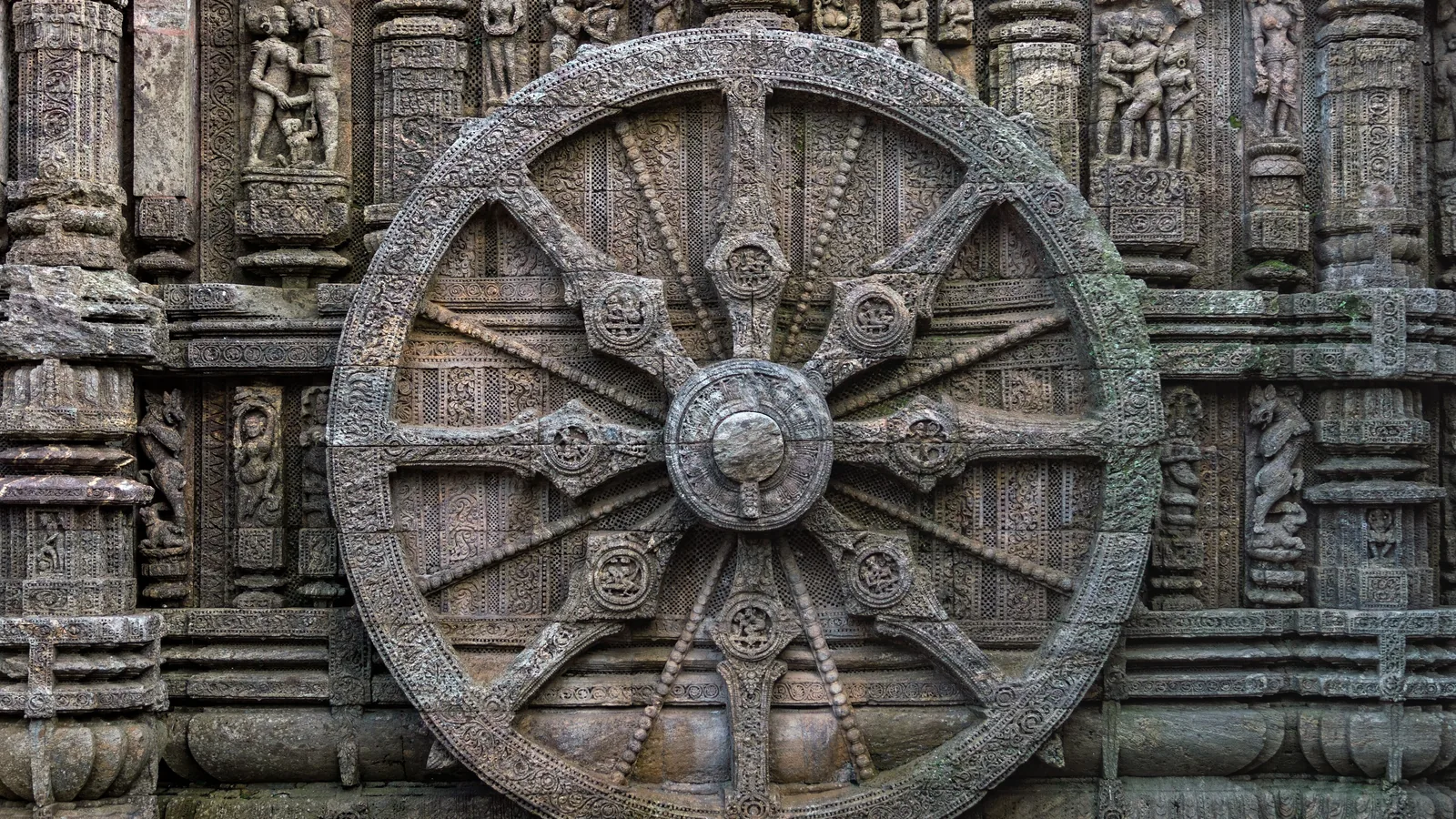
The Ministry of Tourism’s Incredible India website confirms the chariot form independently, describing “twenty-four exquisitely carved stone wheels, each nearly 10 feet in diameter” forming the base of “this celestial vehicle, while seven mighty horses seem poised to pull it across the heavens.” The Archaeological Survey of India records that the sanctuary’s tower, or sikhara, rose “presumably over 68 m,” while the assembly hall, or jagamohana, measured 30 meters square and 30 meters high, its roof built in three tiers, each once carrying life-size female sculptures. The Ministry of Tourism gives a close estimate for the same tower, “an estimated height of 227 feet in its heyday.” The Incredible India page also records that three types of stone, laterite, khondalite and chlorite, went into construction, along with iron strips that once held the structure together and remain visible among the ruins.

A tower that fell without a recorded date
The Archaeological Survey of India rejects one theory about the temple’s end outright. The agency’s conservation page states that the architectural historian Percy Brown “asserted that the temple collapsed even before its completion,” adding that “this theory, is however, not believable.” As evidence, the agency cites a copper plate of Narasimha IV dated Saka year 1305, or AD 1384, showing the temple complete and its deity under worship at that date. The agency also notes that Abul Fazl, chronicler at the Mughal court, described the temple in his Ain-i-Akbari without mentioning ruin or damage, indicating the building was intact during the reign of Akbar, 1556 to 1605. On the cause of the eventual collapse, the agency lists an earthquake, a loose foundation and settlement, and incompleteness, and states that scholars have discarded the incompleteness theory while evidence for uneven settlement is also lacking. The conservation page separately records that James Fergusson attributed the collapse to a marshy foundation, and that another tradition holds the invader Kalapahar, who had desecrated the Jagannath temple at Puri in 1568, also attacked Konark.
Later visitors recorded the tower’s decline without settling on when it fell. The Archaeological Survey of India records visits by A. Stirling in 1825 and later travelers to the surviving tower. James Fergusson in 1837 estimated the height of the surviving stump at 140 to 150 feet, while Kittoe in 1838 put it at 80 to 100 feet. The agency records that “this solitary remnant of the main temple also fell in October 1848 due to a strong gale.” A visit by Rajendralala in 1868 described the site afterward as “only an enormous mass of stones studded with a few papal trees here and there.”
Filling the hall with sand
The conservation page describes how officials chose to stabilize what remained of the hall: “the four entrances were permanently closed, and the interior was filled with sand vertically from the top by drilling a hole and pouring sand through a funnel.” The agency dates the work to 1901-1904, under the supervision of Bishan Swarup, executive engineer. The Hindu’s 2022 account gives a single year instead, reporting that “the British created a wall inside the Jagamohan and filled it with river sand presuming that the sand would start taking the load in 1903,” and adds that the plan did not work: “the sand settled down not fulfilling the objective of supporting the structure. Instead, the sand load exerted a lot of pressure on the side wall.” The two sources also differ on when the Archaeological Survey of India took charge of the site: 1939 by its own account, 1936 by The Hindu’s. Both agree the temple was inscribed as a UNESCO World Heritage Site in 1984.
The Hindu, September 9, 2022
The Hindu reported that the Archaeological Survey of India resumed work on the buried hall in September 2022. “The Archaeological Survey of India began the process of emptying the sand for repairing the vulnerable portion of the structure from Thursday,” the newspaper wrote, adding that “a special puja was performed before commencing” the work. Superintending Archaeologist Arun Malik, of the ASI’s Bhubaneswar Circle, told the newspaper: “We have started the process of the removal of sand from Jagamohan from Thursday. It would take three years for the complete evacuation of sand from the structure.” The Hindu described the planned method: a tunnel cut from the western side at a height of 14 meters to reach the sand, a motorized trolley to carry sand and debris out, and a gantry crane to lower the load to ground level, with a fabricated stainless steel beam fitted inside afterward as permanent support. The newspaper reported a gap of 17 feet between the sand and the top of the hall, sand believed to fill the remaining 19 meters of a hall 130 feet high, and noted that engineers from IIT Madras and the Odisha state government were advising the agency on work that began on September 8, 2022.
Key facts
- Narasimhadeva I of the Eastern Ganga dynasty, who reigned about 1238-1264, is named as builder of the Sun Temple in copper plates left by his successors (Archaeological Survey of India).
- The Archaeological Survey of India describes the temple as “conceived as a gigantic solar chariot with twelve pairs of exquisitely-ornamented wheels dragged by seven rearing horses.”
- The Ministry of Tourism’s Incredible India page counts 24 stone wheels, each nearly 10 feet in diameter, and seven horses, independently confirming the chariot design.
- The sanctuary tower stood “presumably over 68 m” high (Archaeological Survey of India) or about 227 feet (Ministry of Tourism); the jagamohana measured 30 meters square and 30 meters high.
- The Archaeological Survey of India rejects Percy Brown’s theory that the temple collapsed before completion, citing a 1384 copper plate showing it complete and in worship.
- The last visible remnant of the collapsed tower fell in October 1848 during a strong gale, after height estimates by Fergusson (1837, 140-150 feet) and Kittoe (1838, 80-100 feet) had already diverged sharply.
- The jagamohana’s interior was sealed and filled with sand from the top through a drilled hole and funnel, dated 1901-1904 by the Archaeological Survey of India and to 1903 by The Hindu.
- The Archaeological Survey of India began removing that sand on September 8, 2022, a project Superintending Archaeologist Arun Malik said would take three years to complete.
FAQ
Who built the Konark Sun Temple?
Narasimhadeva I of the Eastern Ganga dynasty, who reigned about 1238 to 1264. The Archaeological Survey of India bases this on copper plates left by his successors, which describe him building a great structure dedicated to the sun god at Konark.
Why was the temple's hall filled with sand?
The Archaeological Survey of India states that officials closed the assembly hall's four entrances and filled its interior with sand, poured through a drilled hole, to keep the structure from collapsing further after the main tower had already fallen. The agency dates the work to 1901-1904; The Hindu's 2022 report gives 1903.
When did the Archaeological Survey of India start removing the sand?
On September 8, 2022. Superintending Archaeologist Arun Malik of the ASI's Bhubaneswar Circle told The Hindu the full removal would take three years, using a tunnel, a motorized trolley and a gantry crane, with a steel beam installed afterward for support.
Sources
- Archaeological Survey of India, official website (2011 version), "World Heritage Sites: Konarak - Sun Temple," archived pages "Introduction," "Sun Temple, Konarak, Orissa" and "Aspects of Conservation."
- Ministry of Tourism, Government of India, Incredible India, Konark Sun Temple page (Puri, Odisha).
- Satyasundar Barik, "After a century, ASI starts removing sand from Konark Sun Temple," The Hindu, September 9, 2022.
Cite this article
- APA
- LETTER. (2026, September 28). Konark's Sun Temple: a stone chariot, and a hall filled with sand. Our Earth's History. https://ourearthshistory.com/south-asia/medieval/konark-sun-temple-narasimhadeva-chariot-wheels-1903-sand/
- Chicago
- LETTER. “Konark's Sun Temple: a stone chariot, and a hall filled with sand.” Our Earth's History, September 28, 2026. https://ourearthshistory.com/south-asia/medieval/konark-sun-temple-narasimhadeva-chariot-wheels-1903-sand/.
- MLA
- LETTER. “Konark's Sun Temple: a stone chariot, and a hall filled with sand.” Our Earth's History, 28 Sep. 2026, https://ourearthshistory.com/south-asia/medieval/konark-sun-temple-narasimhadeva-chariot-wheels-1903-sand/.
Text licensed CC BY-NC-ND 4.0. Found an error? Tell us.