Who built Angkor Wat? Suryavarman II, and the tomb of Lu Ban

TL;DR — Angkor Wat was built during the reign of Suryavarman II (anointed 1113). Later visitors called it a Chinese artisan’s tomb, a Roman ruin, or something that “made itself.”
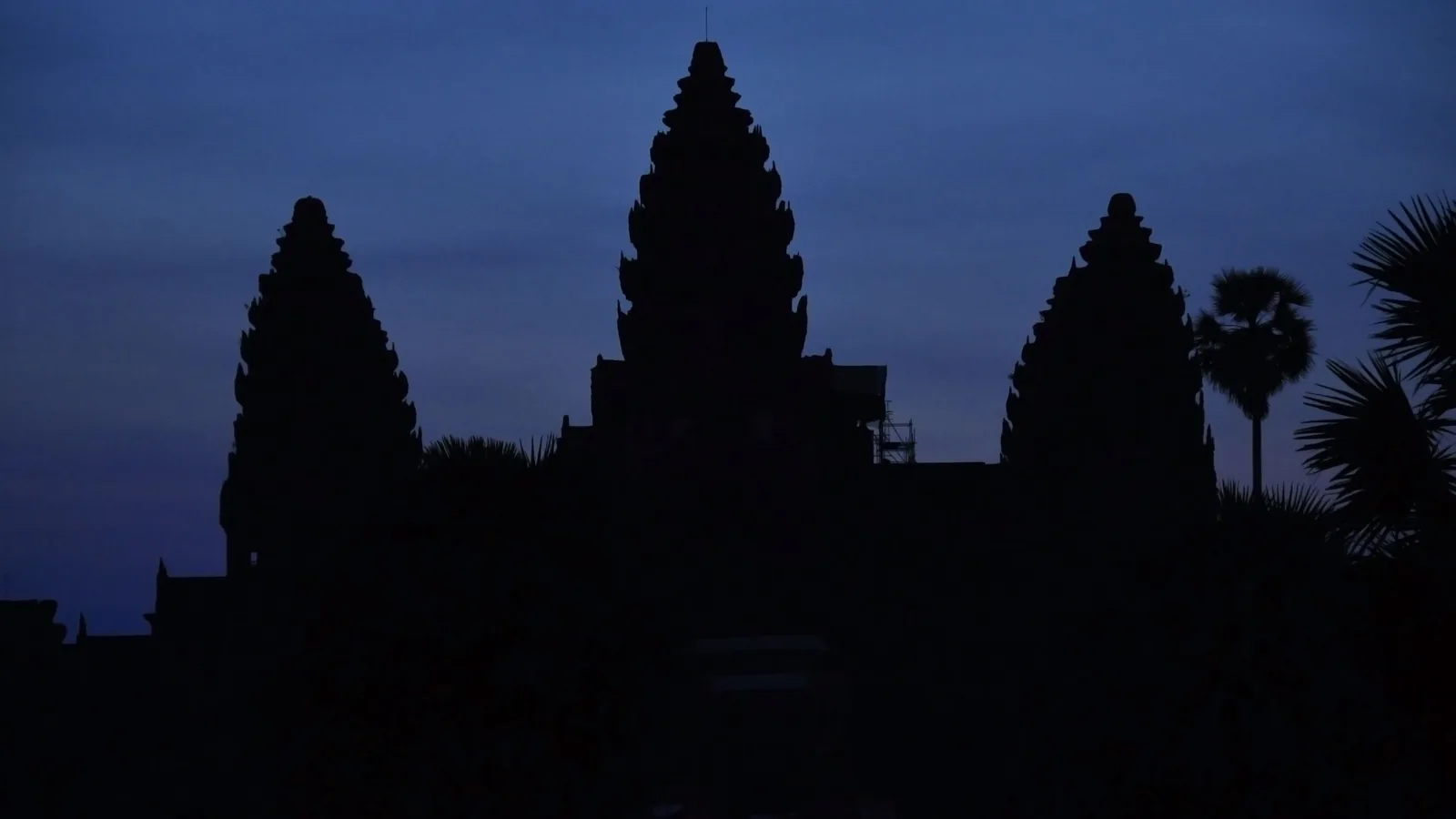
Suryavarman II was anointed king in 1113, and Charles Higham, giving the British Academy’s archaeological lecture in 2002, said that he “was responsible for Angkor Wat.” The temple was built during the reign of Suryavarman II; Damian Evans and Roland Fletcher wrote in 2015 that it was “constructed throughout the first half of the twelfth century AD.” A Chinese envoy of 1296 recorded only a tomb of Lu Ban, a legendary Chinese craftsman, outside the city’s south gate. A Portuguese chronicle dated the ruins’ discovery by a Cambodian king to 1550 or 1551, and books printed in Barcelona in 1601 and Valladolid in 1604 credited Alexander the Great, the Romans or the emperor Trajan. In 1933 French scholars were still arguing in print over whether it was a temple or a tomb.
Quick facts
- When
- Suryavarman II anointed 1113 · Angkor Wat built during his reign, in the first half of the 12th century · Chinese embassy with Zhou Daguan left 1296, back in China 1297 · Couto's chronicle dates the king's find to 1550 or 1551 · Higham dates Antonio da Madalena's visit to 1585 · Ribadeneyra 1601 · San Antonio 1604 · Mouhot's Travels published 1864 · Cœdès on temple or tomb, 1933 · LiDAR survey 2012
- Where
- Angkor, in what is now northwest Cambodia; the moated enclosure of Angkor Wat south of the walled city of Angkor Thom
- Who
- Suryavarman II, king of Angkor; Zhou Daguan, member of a Yuan embassy; Paul Pelliot, Louis Finot and Étienne Aymonier, editors of his text in 1902; Diogo do Couto, Portuguese chronicler; Antonio da Madalena, Capuchin friar; Henri Mouhot, French naturalist; George Cœdès, Jean Przyluski and F. D. K. Bosch; Damian Evans and Roland Fletcher
- Outcome
- Charles Higham attributes the temple to Suryavarman II. Zhou Daguan never named it, and the identification of his tomb of Lu Ban with Angkor Wat belongs to his 1902 editors. In 1933 Cœdès accepted Bosch's term funerary temple
Suryavarman II and a grid of ponds
Suryavarman’s line came to power in 1080, when Jayavarman VI of the Mahidharapura lineage seized the throne. Higham wrote that Jayavarman came from the upper Mun River valley in what is now northeast Thailand, and that two of his successors made “the final additions to bring Angkor to its present form.” Evans and Fletcher placed Suryavarman’s own origins in the area around Phimai, also in present-day Thailand.
The temple’s bas-reliefs, in Higham’s description, show the king in his throne room, “our first image of an Angkorian king in state,” and again with his court in a procession, beside scenes from the Hindu epics such as the battles of Lanka and Kurukshetra.
A LiDAR survey of 2012, an airborne laser scan of the ground beneath the forest, mapped the moated enclosure. Evans and Fletcher found inside it a rigid grid of roads and about 250 to 300 house ponds, enough for at most 4,500 residents. From ratios in the Ta Prohm inscription they estimated a workforce of about 25,000 for the temple and a support population of more than 125,000, figures they called “very preliminary in nature.” South of the moat the survey found squared coils of sand banks, aligned with the temple and of its early 12th-century date; a road cutting showed them “featureless and archaeologically sterile,” and their purpose is unknown.
Temple or tomb, argued in 1933
George Cœdès took up the question of purpose in the Bulletin de l’École française d’Extrême-Orient in 1933. Jean Przyluski had argued, from the direction in which visitors were meant to walk past the reliefs, that Angkor Wat “primitivement, n’était pas un temple, mais un tombeau”: originally not a temple but a tomb.
Cœdès replied by quoting his own article of 1911. He had written there that the temple was consecrated to Vishnu, and had added at once that this cult was “très probablement associé à celui de Paramavisnuloka, forme divine d’un roi mort,” the deified form of a dead king. Paramavishnuloka was the posthumous name Cœdès took to belong to Suryavarman II, and he framed the dispute as whether Angkor Wat was “le temple de Paramavisnuloka ou le tombeau de Suryavarman II.”
His case rested on architecture. Angkor Wat, he wrote, was “un Meru à cinq sommets,” a five-peaked mountain, built on the same plan of five towers as Bakheng, Ta Keo, Pre Rup and Baphuon, which were known to be temples. He ended by accepting the term “temple funéraire,” funerary temple, from F. D. K. Bosch. On the walking direction he wrote only “J’avoue simplement mon ignorance”: he did not know.
1296 and the tomb of Lu Ban
In 1295, Paul Pelliot wrote in 1902, the Yuan court ordered an ambassador to Cambodia. He left in 1296 with Zhou Daguan, and both were back in China in 1297. Zhou’s account of the capital, which Pelliot translated, never names Angkor Wat. Outside the south gate it places a stone tower said to have been raised in one night by Lu Ban (Lou Pan in Pelliot’s spelling), and then “la tombe de Lou Pan,” about one li outside the gate and about 10 li around, with several hundred small stone houses.
Lu Ban, Pelliot noted, was not a Cambodian name: it belonged to a legendary craftsman of the Chinese state of Lu, said to have lived in the time of Confucius. The match with Angkor Wat came from the editors. Louis Finot put the tower at Phnom Bakheng and wrote that in the tomb one could see nothing “autre chose qu’Angkor Vat.” Étienne Aymonier objected that Zhou’s distances did not fit, then agreed that the hundreds of stone buildings inside 10 li “semblent bien indiquer le temple d’Angkor Vat.” Pelliot guessed that Zhou had the legend from Chinese settlers, and that his silence suggested Chinese visitors were barred from the temple.
"A temple called Angar"
The Portuguese chronicler Diogo do Couto described the ruins in chapter 6 of his Twelfth Decade of Asia, a manuscript in a secretary’s hand held in the Torre do Tombo archive in Lisbon. In C. R. Boxer’s translation the chapter dates the find “Just about the years 1550 or 1551,” with a king of Cambodia hunting elephants whose men cut into overgrown buildings. “A half-league from this town is a temple called Angar,” Couto wrote, “one hundred and sixty paces long” and ringed by a moat a musket-shot wide. His witness was a Capuchin friar, Antonio da Madalena, who “told me he had taken in his hands several times the arms of these giants” to see whether the stone figures were carved in the round.
Couto gave no year for the friar’s visit; Higham dated it to 1585, and the year 1586 appears in neither text. In 1601 Marcello de Ribadeneyra published what Higham called the first account of Angkor in a Western language, reporting a ruined city that some credited to “Alexander the Great or the Romans.” Gabriel de San Antonio, three years later, named Alexander or Trajan. “Neither he nor his contemporaries could conceive of the possibility that these monuments were built by Cambodians,” Higham wrote.
Four answers at Ongcor-Wat
The French naturalist Henri Mouhot, traveling in the region between 1858 and 1860, claimed no discovery; he hoped to draw scholars’ attention “to a new scene.” He called one temple “a rival to that of Solomon” and found its inscriptions illegible. Asked who founded Ongcor-Wat, Cambodians gave him one of four replies: “It is the work of Pra-Eun, the king of the angels;” “It is the work of the giants;” “It was built by the leprous king;” or else, “It made itself.” After his death his brother compiled the account from his letters and journal, and John Murray published it in London in 1864.
Key facts
- Higham dates the anointing of Suryavarman II to 1113 and attributes Angkor Wat to him; Evans and Fletcher date its construction to the first half of the 12th century.
- Suryavarman’s line, the Mahidharapura, took power in 1080; Evans and Fletcher place his origins near Phimai, in present-day Thailand.
- Evans and Fletcher counted about 250 to 300 ponds in the main enclosure and estimated a temple workforce of about 25,000 and a support population of more than 125,000.
- Zhou Daguan traveled with a Yuan embassy that left for Cambodia in 1296 and returned to China in 1297; his text names a “tombe de Lou Pan,” never Angkor Wat.
- Louis Finot and Étienne Aymonier identified that tomb with Angkor Wat in their notes to Pelliot’s 1902 translation.
- In 1933 Cœdès set the dispute as temple of Paramavisnuloka or tomb of Suryavarman II, and accepted Bosch’s term “temple funéraire.”
- Diogo do Couto dated the Cambodian king’s find to “1550 or 1551” and described a temple called Angar, 160 paces long; Higham dated Antonio da Madalena’s visit to 1585.
- Mouhot recorded four local answers on who built the temple, from Pra-Eun to “It made itself”; his Travels appeared in London in 1864.
FAQ
Who built Angkor Wat?
The temple was built during the reign of Suryavarman II (anointed 1113). Charles Higham, in a British Academy lecture, said that the king "was responsible for Angkor Wat," and Evans and Fletcher date its construction to the first half of the 12th century.
Was Angkor Wat a temple or a tomb?
Jean Przyluski argued in 1933 that it was first a tomb. George Cœdès answered that it was a temple whose cult was tied to Paramavishnuloka, the deified form of a dead king, and accepted F. D. K. Bosch's term "temple funéraire," funerary temple.
Did Zhou Daguan describe Angkor Wat?
His account of 1296–97 does not name it. It describes a "tombe de Lou Pan" outside the south gate with several hundred small stone houses, and his French editors of 1902, Louis Finot and Étienne Aymonier, identified that tomb with Angkor Wat.
Sources
- Charles F. W. Higham, "The Origins of the Civilisation of Angkor," Albert Reckitt Archaeological Lecture read on May 21, 2002, Proceedings of the British Academy 121 (2003), pp. 41–89.
- George Cœdès, "Ankor Vat, temple ou tombeau?", Bulletin de l'École française d'Extrême-Orient 33 (1933), pp. 303–309, on Persée.
- Paul Pelliot (trans.), with notes by Louis Finot and Étienne Aymonier, "Mémoire sur les coutumes du Cambodge" by Zhou Daguan, Bulletin de l'École française d'Extrême-Orient 2 (1902), pp. 123–177, on Persée.
- Henri Mouhot, Travels in the Central Parts of Indo-China (Siam), Cambodia, and Laos, During the Years 1858, 1859, and 1860, vol. I (London: John Murray, 1864), chapter XII, Project Gutenberg eBook #46559.
- Diogo do Couto, Duodecima Decada da Asia, chapter 6 (Cod. 537, Torre do Tombo, Lisbon), Portuguese text with the English translation of C. R. Boxer (1948) and the French of B.-P. Groslier (1957), Angkor Database Reference Document 1 (2019).
- Damian Evans and Roland Fletcher, "The landscape of Angkor Wat redefined," Antiquity 89, no. 348 (2015), pp. 1402–1419, Cambridge Core.
Cite this article
- APA
- Song Letter. (2026, October 19). Who built Angkor Wat? Suryavarman II, and the tomb of Lu Ban. Our Earth's History. https://ourearthshistory.com/south-asia/medieval/who-built-angkor-wat-suryavarman-ii-zhou-daguan/
- Chicago
- Song Letter. “Who built Angkor Wat? Suryavarman II, and the tomb of Lu Ban.” Our Earth's History, October 19, 2026. https://ourearthshistory.com/south-asia/medieval/who-built-angkor-wat-suryavarman-ii-zhou-daguan/.
- MLA
- Song Letter. “Who built Angkor Wat? Suryavarman II, and the tomb of Lu Ban.” Our Earth's History, 19 Oct. 2026, https://ourearthshistory.com/south-asia/medieval/who-built-angkor-wat-suryavarman-ii-zhou-daguan/.
Get the week in history
One email a week: the new articles, and what was happening elsewhere at the same moment. Free, no ads, unsubscribe any time. How we handle your email.
Text licensed CC BY-NC-ND 4.0. Found an error? Tell us.