A minaret rebuilt in 1127: the Kalyan tower of Bukhara
.jpeg)
TL;DR — A minaret at Bukhara collapsed around 1121-22 and destroyed two-thirds of a new mosque. Arslan Khan Mohammad’s replacement, the 48-meter Kalyan minaret, went up in 1127.
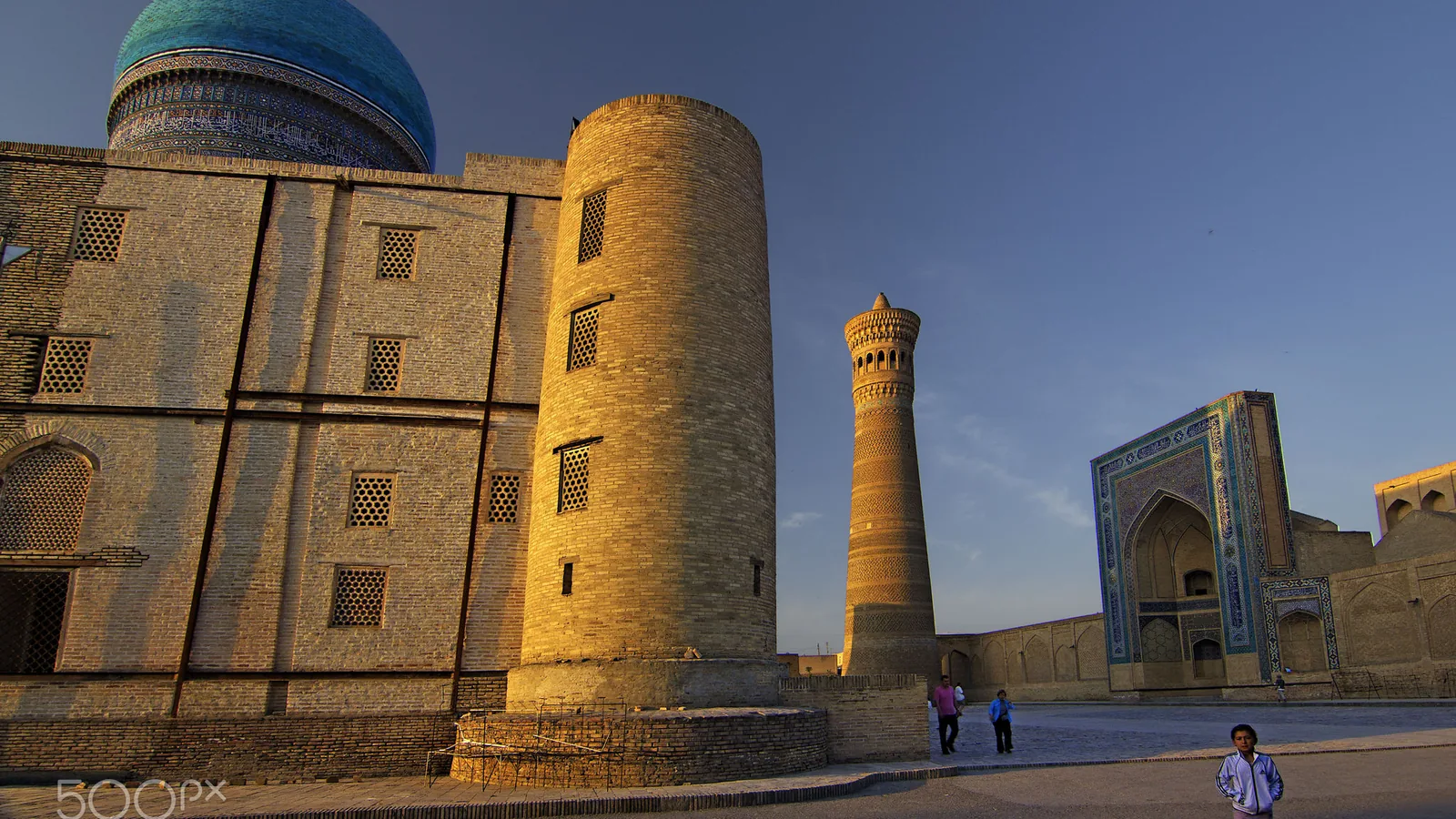
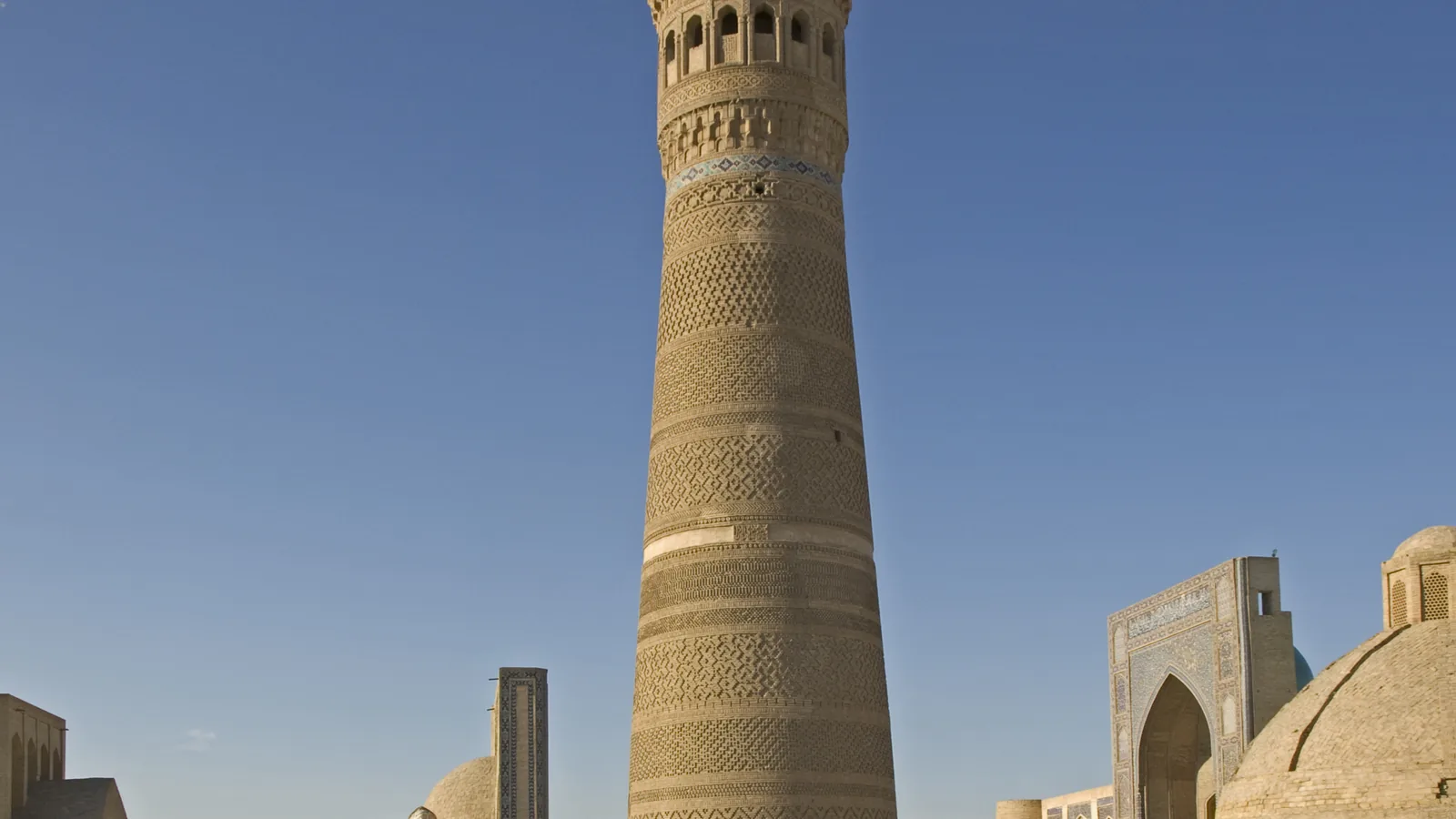
Encyclopaedia Iranica records that in 515 AH (1121-22) a new great mosque was built at Bukhara, reusing woodwork from the older mosque on the site, and that “the adjacent minaret very soon collapsed, however, destroying two-thirds of this mosque.” The sanctuary was rebuilt, and in 521 AH (1127) a new minaret went up in its place: Menar-e Kalan, known today as the Kalyan or Kalon minaret. Iranica gives its height as 48 meters, a “sharply tapering circular shaft” patterned with bands of ornamental brick and topped by a lantern. The tower still stands over Bukhara’s skyline.
Quick facts
- When
- 1121-22 (first minaret collapses) · 1127 (Kalyan minaret built) · 1535-36 (Mir-i Arab madrasa) · 1539 (Kalyan mosque rebuilt)
- Where
- Bukhara, in what is now Uzbekistan
- Who
- Arslan Khan Mohammad ibn Sulayman, Qarakhanid ruler of Bukhara; Sayyed Mir Abd-Allah, known as Mir-i Arab
- Outcome
- The rebuilt minaret survived; it is the only structure from Bukhara's twelfth-century mosques still standing apart from one facade, and it later anchored the Poi Kalyan complex with a madrasa and mosque built four centuries after it
Arslan Khan Mohammad's building program
The minaret rose under Arslan Khan Mohammad ibn Sulayman, a Qarakhanid ruler whose reign Iranica dates to 495-524 AH (1102-1130). Bosworth writes that “the long reign of Arslan Khan Mohammad b. Solayman (495-524/1102-30) brought peace to the city and enabled the khan to embark on an extensive building program there; he rebuilt the citadel and city walls, and erected a new Friday mosque and two new palaces.” That peace followed roughly a century of instability in Bukhara after the fall of the Samanid dynasty, when the city passed to the Western Qarakhanid khanate and, in 436 AH (1044-45), a pro-Fatimid Shiite movement was put down by Bughra Khan Ibrahim ibn Nasr, later known as Tamghach Khan.
“Arslan Khan” was not a personal name. Michal Biran’s Iranica entry on the Ilak-Khanids, the dynasty’s alternate name, explains that the Qarakhanids ran a dual khanate, and the eastern khagan “bore the title Arslan (lion; the totem of the Chegel) Qara Khaqan,” while his western counterpart held the title Boghra (male camel, the totem of the Yaghma tribe) Qara Khaqan. Mohammad ibn Sulayman held the Arslan title in Bukhara.
A tower built to be seen
Biran’s entry places the Bukhara minaret inside a wider Qarakhanid pattern: “The Qara-khanids expressed their loyalty to Islam also in their monumental buildings. The surviving minarets in Bukhara, Ozgand, and Balasaghun, as well as the remains of the palaces and mausoleums of Rebat-e Malek and Ozgand, are among the famous examples of their creations,” and she adds that “at least the imposing minarets must have played a role in enhancing Islamic prestige in a region not yet fully Islamized.” The Bukhara heritage portal meros.uz describes the tower’s fabric: a monolithic cylinder of fired brick narrowing from base to top, capped by a circular rotunda with sixteen arched windows from which the muezzin called the hours of prayer and which doubled as a watch point during sieges. The shaft carries bands of brick set in checkerboard patterns, straight and diagonal, and above a muqarnas cornice runs a frieze of blue-glazed inscription, a technique widespread in Bukhara’s architecture of the period.

"Built twice," by one account
meros.uz frames the collapse differently from Iranica’s account of a mosque minaret destroying its own building. The portal states that “the Kalyan Minaret was built twice. The fact is it collapsed just before it was completed the first time, probably because the builders did not take into account the soft ground underneath, due to the many cultural layers beneath the city.” A new, more durable foundation was laid, and “by 1127, construction of this second minaret was completed,” the portal states, dating the finished tower to the same year Iranica gives for Menar-e Kalan. Both accounts place the tower’s completion in 1127 under Arslan Khan Mohammad.
What else Arslan Khan Mohammad built
Iranica’s entry on Bukhara’s archaeology also records a small open prayer hall, a namazgah, raised on the site of the old Shamsabad garden; its long brick qibla wall carried geometric designs picked out in carved terracotta, and its central mihrab was redecorated with glazed tiles in the fifteenth century, with an arched facade added in the sixteenth. Apart from the Kalyan minaret, Iranica notes, the only surviving element of Bukhara’s twelfth-century mosques is the facade of the small Maghak-e Attari mosque, whose interior was completely rebuilt in the sixteenth century under the Shaybanid ruler Abd-Allah I.
Four centuries later, Poi Kalyan
Sayyed Mir Abd-Allah, a Sufi shaikh known as Mir-i Arab, had come to Bukhara from Esfijab, also called Sayram, sometime after 921 AH (1515). In 942 AH (1535-36) he built the madrasa that bears his name across from the Masjed-e Kalan, Bukhara’s main congregational mosque. By 947 AH (1539) that mosque itself had been completely rebuilt, with six piers, stone columns and 289 vaulted bays, according to Iranica. “The two buildings and the Menar-e Kalan thus formed a unified group, known as Pa-ye Kalan,” the entry states, using the complex’s other transliteration, Poi Kalyan. Later still, under Abd-Allah Khan (991-1006 AH, 1583-98), Bukhara’s western wall was extended to bring the lands of the influential Juybari shaikhs inside the city.
Key facts
- A new Friday mosque went up at Bukhara in 515 AH (1121-22); its minaret collapsed soon after, destroying two-thirds of the mosque (Encyclopaedia Iranica, Bukhara v).
- The replacement minaret, Menar-e Kalan, was built in 521 AH (1127) (Encyclopaedia Iranica, Bukhara v).
- Iranica gives the minaret’s height as 48 meters, a tapering brick cylinder topped by a lantern (Encyclopaedia Iranica, Bukhara v).
- Arslan Khan Mohammad ibn Sulayman ruled Bukhara from 495 to 524 AH (1102-1130) and also rebuilt the citadel, city walls and two palaces (Encyclopaedia Iranica, Bukhara ii).
- “Arslan Khan” was a Qarakhanid title held by the eastern khagan, not Mohammad’s personal name (Encyclopaedia Iranica, Ilak-Khanids).
- meros.uz describes the tower’s rotunda as having sixteen arched windows, used for the call to prayer and as a watch point in wartime.
- The Mir-i Arab madrasa was built in 942 AH (1535-36) opposite the Kalyan mosque, which was itself rebuilt by 947 AH (1539) with 289 vaulted bays (Encyclopaedia Iranica, Bukhara v).
- Apart from the Kalyan minaret, the only surviving trace of Bukhara’s twelfth-century mosques is the facade of the Maghak-e Attari mosque (Encyclopaedia Iranica, Bukhara v).
FAQ
Who built the Kalyan minaret?
Arslan Khan Mohammad ibn Sulayman, a Qarakhanid ruler of Bukhara whose reign Encyclopaedia Iranica dates to 495-524 AH (1102-1130), during a building program that also rebuilt the citadel, city walls and two palaces.
Why was the Kalyan minaret built in 1127?
An earlier minaret attached to a new Friday mosque had collapsed around 1121-22, destroying two-thirds of that mosque, according to Encyclopaedia Iranica. The sanctuary was rebuilt and a new minaret, Menar-e Kalan, replaced it in 1127.
What is the Poi Kalyan complex?
The Kalyan minaret together with the Kalyan mosque, rebuilt by 1539, and the Mir-i Arab madrasa, built in 1535-36, form the Poi Kalyan (Pa-ye Kalan) complex in Bukhara, according to Encyclopaedia Iranica.
Sources
- Encyclopaedia Iranica, C. Edmund Bosworth, "BUKHARA ii. From the Arab Invasions to the Mongols"
- Encyclopaedia Iranica, Michal Biran, "ILAK-KHANIDS"
- Encyclopaedia Iranica, Galina A. Pugachenkova and Edvard V. Rtveladze, "BUKHARA v. Archaeology and Monuments"
- meros.uz (Uzbekistan cultural heritage portal), "The Kalyan Minaret"
Cite this article
- APA
- LETTER. (2026, September 28). A minaret rebuilt in 1127: the Kalyan tower of Bukhara. Our Earth's History. https://ourearthshistory.com/central-asia/medieval/kalyan-minaret-bukhara-1127-arslan-khan-qarakhanid/
- Chicago
- LETTER. “A minaret rebuilt in 1127: the Kalyan tower of Bukhara.” Our Earth's History, September 28, 2026. https://ourearthshistory.com/central-asia/medieval/kalyan-minaret-bukhara-1127-arslan-khan-qarakhanid/.
- MLA
- LETTER. “A minaret rebuilt in 1127: the Kalyan tower of Bukhara.” Our Earth's History, 28 Sep. 2026, https://ourearthshistory.com/central-asia/medieval/kalyan-minaret-bukhara-1127-arslan-khan-qarakhanid/.
Text licensed CC BY-NC-ND 4.0. Found an error? Tell us.