Who actually carried goods along the Silk Road?

TL;DR — Between the AD 300s and 700s, Sogdian merchants from Samarkand and Bukhara carried more Silk Road trade than any other people, from colonies in China’s main towns.
Sogdians, merchants from Samarkand and Bukhara in what is now Uzbekistan, carried more Silk Road goods than any other people between the AD 300s and 700s. Their homeland, Sogdiana, was a patchwork of small principalities with no empire behind it, yet its traders kept colonies from the frontier at Dunhuang to the capitals at Luoyang and Chang’an. The evidence is a mailbag lost in AD 312 or 313, Chinese tax lists and tomb inscriptions, and painted halls at home. The network dissolved in the 700s, after Arab armies took Sogdiana and a general of Sogdian descent nearly destroyed the Tang dynasty.
Quick facts
- When
- Golden age AD 300s–700s · Ancient Letters written about AD 312–313, found 1907 · An Lushan's revolt 755 · Panjikent abandoned in the 770s
- Where
- Sogdiana, the oasis towns of Samarkand, Bukhara and Panjikent in what is now Uzbekistan and Tajikistan, with colonies from Dunhuang to Luoyang in China
- Who
- Sogdian merchant families; Nanai-vandak and Miwnay (letter writers); the sabao An Qie and Shi Jun; the general An Lushan; scholars Nicholas Sims-Williams and Étienne de la Vaissière
- Outcome
- Sogdian networks carried much of the overland trade for four centuries, then dissolved after the Arab conquest of Sogdiana and the rebellion of 755–757
Where Sogdiana was and what its people spoke
Sogdiana lay along the Zerafshan River in present-day Uzbekistan and Tajikistan. Its wealth peaked in the four centuries after AD 300, which Judith A. Lerner and Thomas Wide of the Smithsonian called its golden age. There was no Sogdian state, only small principalities, each with its own ruler and walled towns.
The Sogdians spoke an Iranian language centered on Samarkand and wrote it, right to left, in a script that grew out of Aramaic. Nicholas Sims-Williams of the School of Oriental and African Studies wrote that Sogdian became a lingua franca along the trade routes and that most surviving Sogdian texts were found in the oases of Turfan and Dunhuang in western China.
A mailbag lost in AD 313
In 1907 the explorer Aurel Stein dug into a ruined watchtower west of Dunhuang and found five nearly complete paper letters, with fragments of others. One had been wrapped in silk inside a cloth envelope addressed to Samarkand, about 2,000 miles to the west. Sims-Williams, who edited them, wrote that they read as a mailbag lost in transit, mostly reports from agents abroad to merchants at home, and that they are the oldest substantial texts in Sogdian.
The longest, Letter 2, was written by a merchant named Nanai-vandak in western China to two partners in Samarkand. He reported a famine, the emperor’s flight from Luoyang, and the sack of Luoyang and Ye by the Xiongnu. W. B. Henning matched those events to the Chinese annals for 307 to 311 and dated the letter to 312 or 313. Nanai-vandak’s real concern was the market: one agent sent to Luoyang had reported that the Indians and Sogdians there had all died of starvation. The letter also mentions “100 freemen from Samarkand” in one Chinese town, which Sims-Williams took as evidence of a settled colony.
Two letters were written by a woman named Miwnay. In Letter 1 she told her mother that her husband, Nanai-dhat, had abandoned her in Dunhuang and that she and her daughter lived on charity from the local Zoroastrian priest. In Letter 3 she wrote to the husband himself, angrier with every line. Étienne de la Vaissière of the École des hautes études en sciences sociales read the letters as proof of a network already running from China to Samarkand.
Caravan chiefs with Chinese rank
Civil war wrecked those colonies in the fourth century, but a new network grew in the fifth and sixth, de la Vaissière’s heyday of Sogdian emigration to China. A tax list from Turfan in the 620s records 35 transactions; 29 involved a Sogdian, and in 13 both buyer and seller were Sogdian.
Each community had a head whom Chinese texts called the sabao, from the Sogdian sartapao, itself borrowed through Bactrian from the Sanskrit word for a caravan leader. Two sabao, An Qie and Shi Jun, were buried at Chang’an in 579; Shi Jun’s epitaph is bilingual, in Chinese and Sogdian, and gives his Sogdian name, Wirkak. The title vanished from the records after the mid-600s, when the Tang turned the communities into ordinary counties.
The Chinese gave Sogdian families surnames from their home towns: An for Bukhara, Kang for Samarkand, Shi for Kesh. Chinese histories grouped them as the “nine surnames of Zhaowu,” though Yutaka Yoshida has found no stable list of nine. One family kept the name Shi for at least seven generations.
The general named An
The best-known bearer of the surname An was the frontier general An Lushan, whom Edwin G. Pulleyblank described as the son of a Sogdian father and a Turkish mother. In 755 he rose against the Tang, took Luoyang, proclaimed his own dynasty in 756, and drove the emperor from Chang’an before his son had him murdered early in 757.
Chinese texts called it a Sogdian rebellion, and de la Vaissière wrote that new finds show the rebels themselves said so. Many Sogdians sided with the Tang, but afterward they hid their origins. In 756 the minister of war An Chongzhang asked to change his family name because he was ashamed to share it with the rebel; he became Li Baoyu.
What the painted walls at home show
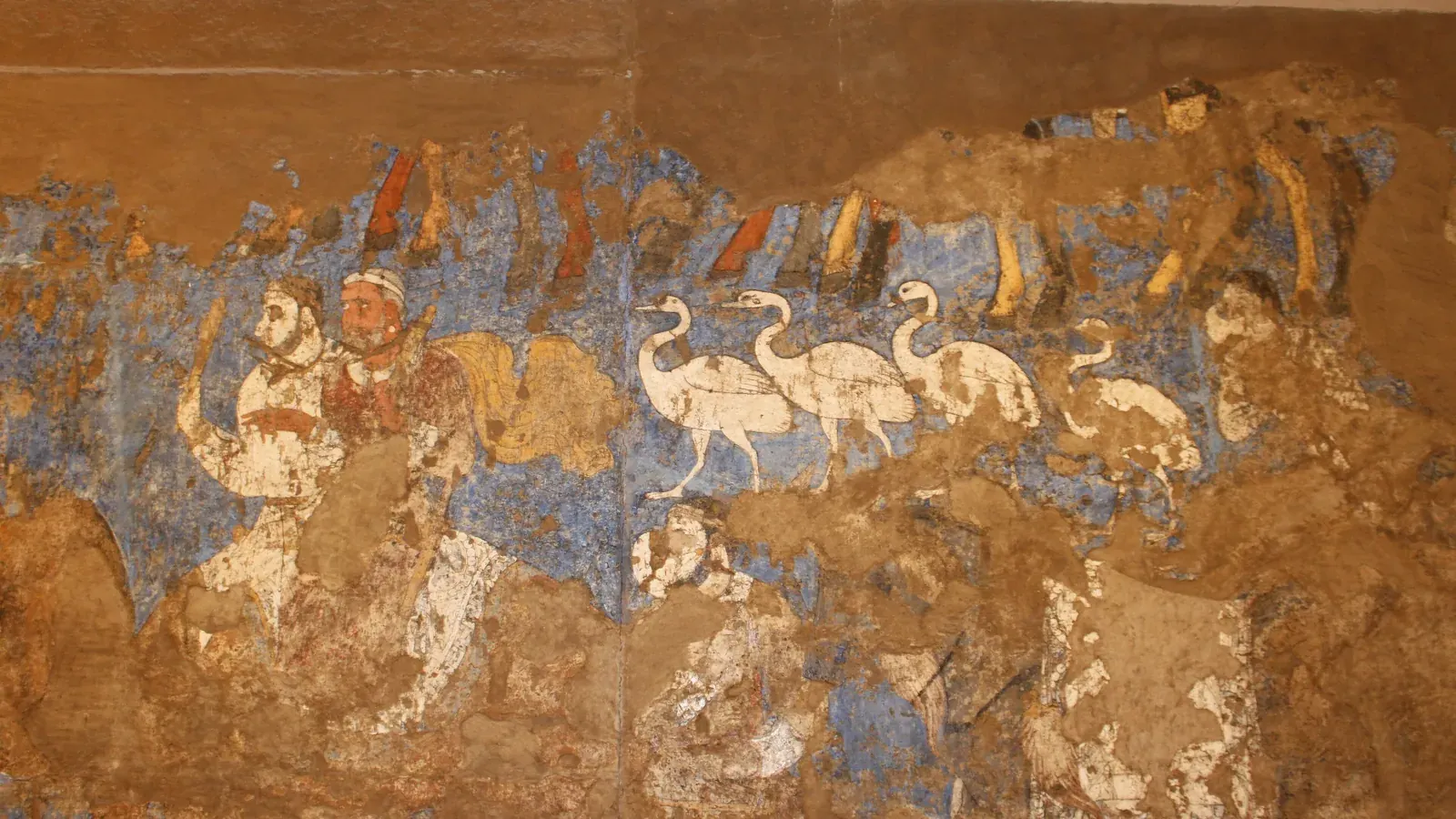
At Afrasiab, the old city of Samarkand, road builders cut into the mound in 1965 and exposed a hall now called the Hall of the Ambassadors. On its main wall, Turkish soldiers escort envoys with gifts: Chinese with silk, Iranians with necklaces, Koreans with feathers in their hats. Inscriptions name Varkhuman as king. Matteo Compareti wrote that the emperor Gaozong recognized Varkhuman as governor of Samarkand between 650 and 655 and sent an envoy to invest him in 658, which places the painting in the mid-600s. The figure the envoys approach is lost, and scholars disagree on it: a New Year coronation of Varkhuman (Compareti, Frantz Grenet), a deity (Boris Marshak), or tribute to his Turkish overlord (Markus Mode, de la Vaissière).
At Panjikent, 60 kilometers east of Samarkand, Soviet excavators found the Rustam Cycle in 1956 and 1957 in a house of average size. The murals, which follow the hero Rustam of the Iranian epic, date to about 740, after the Arabs had executed the town’s ruler, Devastich, in 722. Marshak wrote that the town was inhabited until the 770s; the latest coins found there date from 770 and 776.
How the network faded
The end came from both directions. In Sogdiana, Muslim armies in the 600s and 700s brought down the ruling families, and the country gradually converted to Islam. In China, the rebellion of 755 made Sogdians suspect, and de la Vaissière wrote that long-distance trade was disrupted in the second half of the eighth century and revived only on a small scale, if at all, in the ninth, when Persian traders arriving by sea became the main merchants.
The recovery began with Stein’s watchtower in 1907 and the Soviet digs at Panjikent after 1946, and on September 14, 2019, the Smithsonian’s Freer Gallery of Art launched an online exhibition, The Sogdians: Influencers on the Silk Roads, that gathered the letters, tombs and murals in one place. For four centuries the people who carried the silk were Sogdian, and the case rests on their own paper, stone and plaster.
Key facts
- Sogdiana lay along the Zerafshan River in present-day Uzbekistan and Tajikistan, with Samarkand and Bukhara as its main towns; it was a group of small principalities, not an empire.
- The Sogdian Ancient Letters were found by Aurel Stein in 1907 in a watchtower west of Dunhuang and were written in 312 or 313, per W. B. Henning’s dating.
- A Turfan tax list of the 620s records 35 transactions; Sogdians took part in 29 of them.
- The community head in China was the sabao, from the Sogdian sartapao, “caravan leader”; the title disappears from the records after the mid-600s.
- An Qie and Shi Jun (Wirkak), both sabao, were buried at Chang’an in 579; Shi Jun’s epitaph is bilingual in Chinese and Sogdian.
- An Lushan, son of a Sogdian father and Turkish mother, rebelled in 755, declared a dynasty in 756 and was murdered early in 757.
- The Afrasiab murals were found in 1965 and date to the mid-600s; the Rustam Cycle at Panjikent was found in 1956–57 and dates to about 740.
FAQ
Who were the Sogdians?
An Iranian-speaking people of the oasis towns around Samarkand and Bukhara, in what is now Uzbekistan and Tajikistan. Between the AD 300s and 700s their merchant colonies stretched across China, and their language served as a trade language along the routes.
What are the Sogdian Ancient Letters?
Five nearly complete paper letters, plus fragments, found by Aurel Stein in 1907 in a watchtower west of Dunhuang. Written in 312 or 313 by Sogdian merchants and their families in China, they are the oldest substantial texts in the Sogdian language and are kept in the British Library.
Why did the Sogdian trade network disappear?
Arab conquest brought down the ruling families of Sogdiana in the 700s, and the country gradually converted to Islam. In China, An Lushan's rebellion of 755 made Sogdians suspect, trade collapsed in the second half of the century, and families such as An Chongzhang's changed their names and assimilated.
Sources
- Encyclopaedia Iranica — Nicholas Sims-Williams, "Ancient Letters" (1985, updated 2018).
- Encyclopaedia Iranica — Étienne de la Vaissière, "Chinese-Iranian Relations xiii. Eastern Iranian Migrations to China" (2006).
- Encyclopaedia Iranica — Edwin G. Pulleyblank, "An Lu-shan" (1989).
- Encyclopaedia Iranica — Matteo Compareti, "Afrāsiāb ii. Wall Paintings" (updated 2018).
- Encyclopaedia Iranica — Boris I. Marshak, "Panjikant" (2002).
- Smithsonian National Museum of Asian Art, The Sogdians — Nicholas Sims-Williams, "Ancient Letters."
- Smithsonian National Museum of Asian Art, The Sogdians — Judith A. Lerner and Thomas Wide, "Who Were the Sogdians, and Why Do They Matter?"
- Smithsonian National Museum of Asian Art, The Sogdians — Julie Bellemare, "The Nine Sogdian Surnames."
- Smithsonian National Museum of Asian Art, The Sogdians — Julie Bellemare and Judith A. Lerner, "The Rustam Cycle."
- Smithsonian National Museum of Asian Art, The Sogdians — Julie Bellemare and Judith A. Lerner, "Afrasiab Mural Paintings."
- Smithsonian National Museum of Asian Art — podcast page, "Musical Encounters along the Silk Road" (recorded September 14, 2019, at the launch of The Sogdians).
Cite this article
- APA
- Our Earth's History. (2026, September 19). Who actually carried goods along the Silk Road? Our Earth's History. https://ourearthshistory.com/central-asia/medieval/sogdians-merchants-who-ran-the-silk-road/
- Chicago
- Our Earth's History. “Who actually carried goods along the Silk Road?” Our Earth's History, September 19, 2026. https://ourearthshistory.com/central-asia/medieval/sogdians-merchants-who-ran-the-silk-road/.
- MLA
- “Who actually carried goods along the Silk Road?” Our Earth's History, 19 Sep. 2026, https://ourearthshistory.com/central-asia/medieval/sogdians-merchants-who-ran-the-silk-road/.
Text licensed CC BY-NC-ND 4.0. Found an error? Tell us.