A ship in a mound, 1939: Basil Brown at Sutton Hoo

TL;DR — In 1939 Basil Brown excavated a ship burial at Sutton Hoo for Edith Pretty; an inquest gave the find to her, and she gave it to the British Museum.
The Sutton Hoo Society’s history of the site records that in the largest of the burial mounds on Edith Pretty’s Suffolk estate, “the remains of another, much larger ship were found” in the summer of 1939, and that “the rivets which had held together the wooden planking had remained in situ.” Basil Brown had opened that mound after Pretty commissioned him the previous year to dig three mounds on her land near the river Deben. Weeks later, the journal Nature reported a coroner’s jury had ruled on August 14, 1939, that the find did not meet the legal test for treasure trove and so belonged to the landowner, not the crown. That report credited the discovery to “Mr. Guy Maynard of the Ipswich Museum,” a role later accounts more often give to Brown.
Quick facts
- When
- 1938 (Pretty commissions Brown) · summer 1939 (Mound 1 opened) · August 14, 1939 (inquest) · September 2, 1939 (gift to the British Museum announced) · 1965-71 (Bruce-Mitford re-excavation) · 2016 (bitumen identified)
- Where
- Sutton Hoo, near the river Deben, Suffolk, England
- Who
- Basil Brown; Edith Pretty; Charles W. Phillips; Guy Maynard of the Ipswich Museum; coroner L. H. Vulliamy; Herbert Maryon; T. D. Kendrick; H. Munro Chadwick; R. L. S. Bruce-Mitford
- Outcome
- The inquest ruled against treasure trove, making the find Pretty's property; she gave it to the British Museum. No body was found; phosphate evidence from the 1966-71 excavation indicated one had dissolved in the acidic soil. The Sutton Hoo Society links the grave to King Raedwald as an inference, not a settled identification.
Basil Brown digs for Edith Pretty, 1938-39
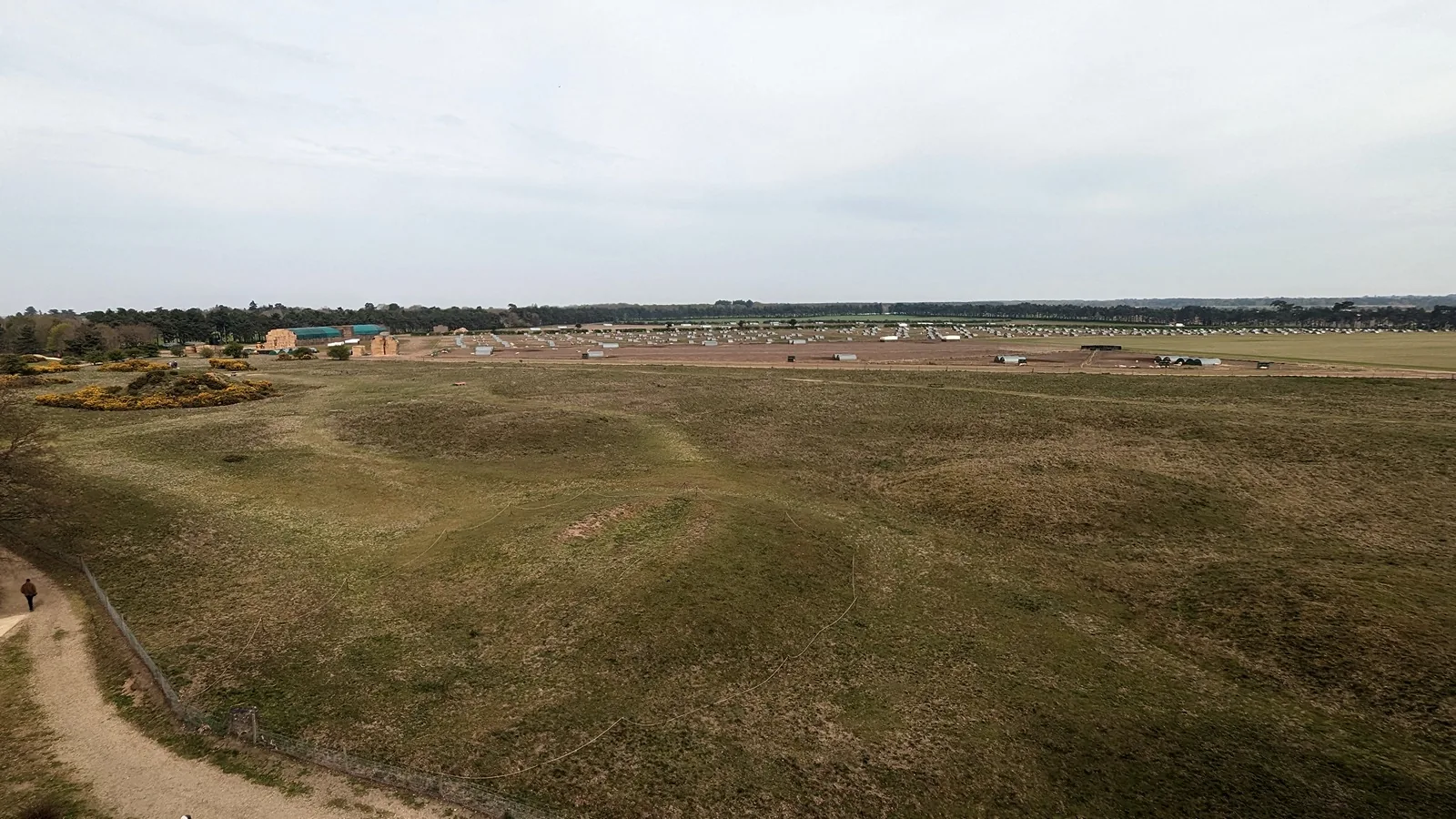
The Sutton Hoo Society’s account states Pretty commissioned Brown in 1938 “to excavate three of the burial mounds on her property.” All three had been robbed in earlier centuries, but what survived pointed to wealth and contacts reaching the eastern Mediterranean. Mound two held the second Anglo-Saxon ship burial known in England, after one excavated at nearby Snape. In 1939 Brown returned to open mound one, the largest on the site, where the wood of a much bigger ship had rotted away but its iron rivets remained where the planking had stood. A 2016 study in PLOS ONE, from the British Museum’s science department, found the vessel had been a 27.3-meter clinker-built boat with a 4.5-meter beam and nine strakes a side, rowed by “up to forty oarsmen”; repairs on the hull showed it had sailed before burial. It had been dragged about 700 meters inland from the Deben to a trench dug for it, then covered by an earthen mound. By July, Charles W. Phillips of Selwyn College, Cambridge, had taken charge, and the Society, citing archaeologist Martin Carver’s 1998 account, describes what followed: “in an exhilarating seventeen days Phillips’s team emptied the burial chamber of 263 objects of gold, garnet, silver, bronze, enamel, iron, wood, bone, textiles, feathers and fur. There was even a ladybird and the crushed remains of a flowering plant.”
August 14, 1939: an inquest denies treasure trove
Nature’s report of August 19, 1939, gave the coroner’s verdict: “the verdict of the jury at the coroner’s inquest, which took place on Aug. 14, on the Anglo-Saxon ship-burial . . . [u]nless the matter is carried further in the High Court, as Mr. L. H. Vulliamy, the coroner, indicated as a possibility, the Sutton Hoo treasure now becomes legally the property of Mrs. E. M. Pretty, the owner of the land upon which the burial was found by Mr. Guy Maynard of the Ipswich Museum.” The article gave the reasoning: a find counted as treasure trove only if hidden with intent to recover it, and “it would be more than difficult to argue convincingly that a royal burial . . . could have taken place with that secrecy and intention to resume possession” the law required. It also listed silver among the goods, including “a large platter, 28 inches across, . . . made at Constantinople, and [bearing] marks of the reign of Anastasius I,” and “forty Merovingian coins” found with it. On September 2, Nature reported Pretty, “declared their owner by the verdict of the Coroner’s inquest of August 14,” had given the whole find to the British Museum, on condition it first go on loan to Ipswich.
A gilded helmet and a buckle inlaid with niello
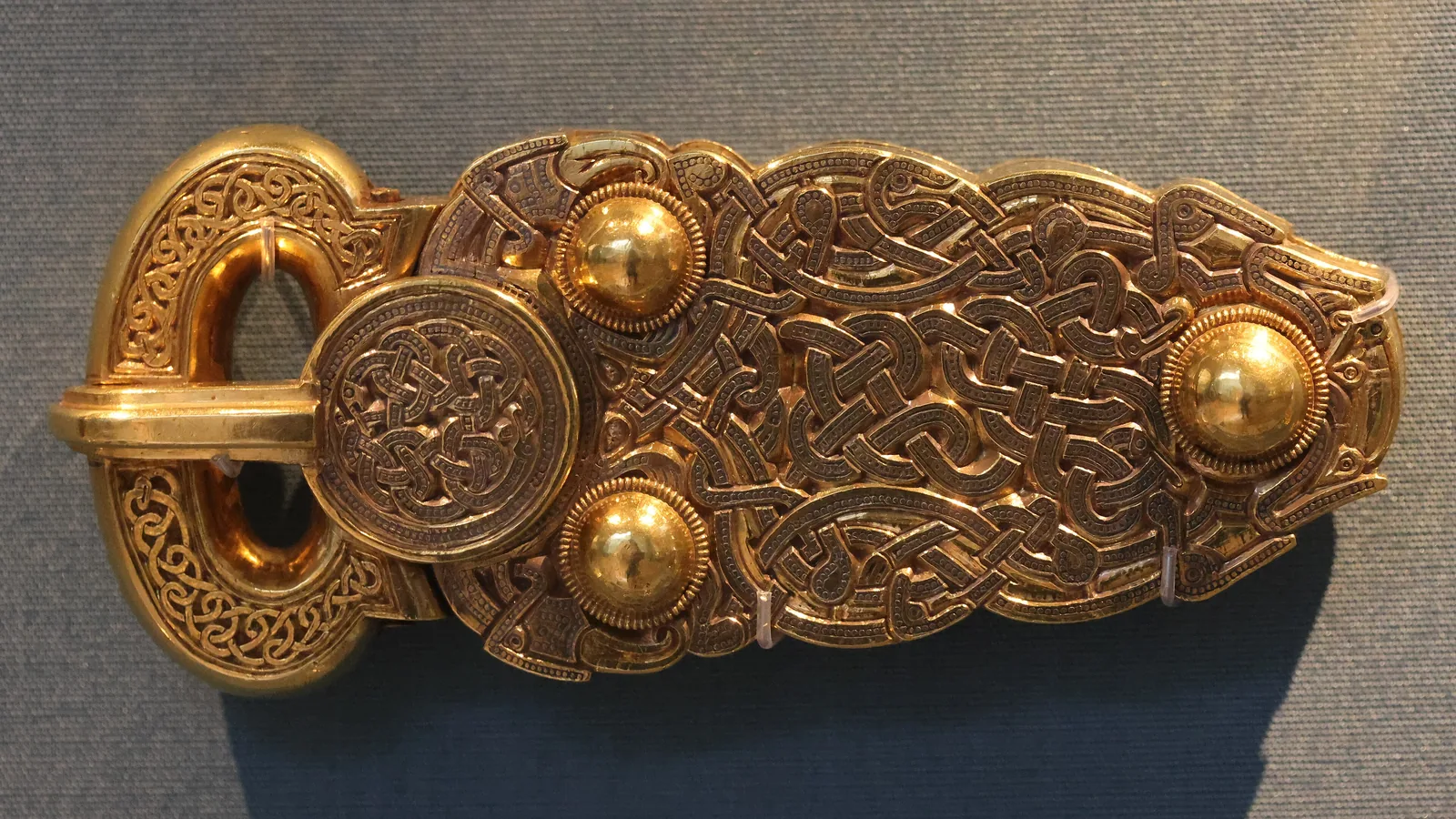
When the helmet fragments reached the British Museum’s laboratory, the metalworker Herbert Maryon recalled in a 1947 article in Antiquity that they “covered a good-sized table” and “appeared to consist of a gilded bronze nose and mouth piece, two gilded bronze dragon heads, parts of what once had been a silver crest, and three or four hundred fragments of sand-encrusted rusty iron.” No photograph had been taken during the dig, Maryon wrote, because its importance was not recognized at the time. The archaeologist T. D. Kendrick, writing in Antiquity in 1940, judged the burial’s chief find, by weight of gold alone, to be “a huge and heavy buckle, inlaid with niello,” alongside twenty-eight other harness pieces set with garnets and blue and white mosaic glass.
"Who was he?": a missing body and phosphate
No skeleton lay in the chamber. PLOS ONE states excavators first proposed the burial was a cenotaph, until analysis during the British Museum’s 1966-71 excavation found phosphate enrichment in the soil at the grave’s west end, evidence, the study says, that a body had dissolved in the acidic ground. That reading came decades after the dig. In 1940, the philologist H. Munro Chadwick wrote in Antiquity, under the heading “Who Was He?,” that he had not attended the inquest but understood “no satisfactory evidence of identity was offered,” and that “the prevalent view now seems to be that the tomb never contained a body—that it was constructed as a cenotaph,” a view an editor’s footnote said was shared by everyone in the excavation. The Sutton Hoo Society links the burial to Raedwald, a king of East Anglia who became overlord of the southern English kingdoms after Aethelberht of Kent died in 616, and who himself died in 624 or 625; the reign’s length, the grave’s wealth and the coins’ dating together “suggests that it was Raedwald who was buried in Mound One,” the Society writes, an inference, not a name recorded at the time.
Eleven mounds become sixteen, 1965-71
Between 1965 and 1971, R. L. S. Bruce-Mitford led a second British Museum excavation whose first aim, he wrote in Antiquity in 1968, was “to complete the study of the largest of the mounds,” since its original shape, height and possible ditch were still unknown. The number of recognized barrows rose during that work from eleven to sixteen. Among the finds from 1939 was an unlabeled black lump, registered as museum objects 1939.1010.250 and 1939.1010.251, whose identity changed with each study: a 1940 plan called it manganese oxide, on an analysis by F. E. Zeuner; a 1970 examination renamed it Stockholm tar; and an unpublished 1971 report raised bitumen without resolving the question. In 2016, PLOS ONE reported that renewed analysis overturned the Stockholm-tar identification, showing the fragments to be bitumen whose isotopic signature pointed to a Middle Eastern source, the first material proof, the study says, of Middle Eastern bitumen reaching the British Isles by trade.

Key facts
- In 1938 Edith Pretty commissioned Basil Brown to dig three mounds on her Sutton Hoo estate (Sutton Hoo Society).
- In 1939 Brown opened mound one and exposed iron rivets from a ship later measured at 27.3 meters long with a 4.5-meter beam (PLOS ONE, 2016).
- Charles W. Phillips’s team cleared the burial chamber of 263 objects in seventeen days (Martin Carver, 1998, cited by Sutton Hoo Society).
- On August 14, 1939, a coroner’s jury ruled against treasure trove, making the find the property of Edith Pretty (Nature, August 19, 1939).
- On September 2, 1939, Nature reported that Pretty had given the whole find to the British Museum, first on loan to Ipswich.
- Herbert Maryon found the helmet in “three or four hundred fragments” on its arrival at the museum (Antiquity, 1947).
- Phosphate enrichment found during the 1966-71 excavation indicated a body had dissolved in the acidic soil (PLOS ONE, 2016).
- A black lump misidentified in 1940 and 1970 was shown in 2016 to be Middle Eastern bitumen (PLOS ONE).
FAQ
Who excavated Sutton Hoo in 1939?
Basil Brown excavated mound one for the landowner, Edith Pretty, joined from July by Charles W. Phillips of Selwyn College, Cambridge. Nature's 1939 report instead credited the discovery to "Mr. Guy Maynard of the Ipswich Museum."
Was a body found in the Sutton Hoo ship burial?
No skeleton was found. Excavators first proposed the grave was a cenotaph; phosphate enrichment found in the soil during the 1966-71 British Museum excavation was later read as evidence that a body had dissolved in the acidic ground.
Who is buried at Sutton Hoo?
The Sutton Hoo Society links the grave to Raedwald, a king of East Anglia who died in 624 or 625, on the basis of his reign, the grave's wealth and the dating of its coins. The Society states this only as a suggestion; no inscription or contemporary record names the occupant.
Sources
- Sutton Hoo Society, "History of Sutton Hoo."
- Pauline Burger, Rebecca J. Stacey, Stephen A. Bowden, Marei Hacke and John Parnell, "Identification, Geochemical Characterisation and Significance of Bitumen among the Grave Goods of the 7th Century Mound 1 Ship-Burial at Sutton Hoo (Suffolk, UK)," PLOS ONE 11(12):e0166276 (December 1, 2016).
- "Ship-Burial and Treasure Trove in Suffolk," Nature 144:318-319 (August 19, 1939).
- "Gift of Sutton Hoo Antiquities to the Nation," Nature 144:410-411 (September 2, 1939).
- Herbert Maryon, "The Sutton Hoo Helmet," Antiquity 21(83):137-144 (September 1947).
- T. D. Kendrick, "The Sutton Hoo Ship-Burial. II. The Gold Ornaments," Antiquity 14(53):28-30 (March 1940).
- H. Munro Chadwick, "The Sutton Hoo Ship-Burial. VIII. Who Was He?," Antiquity 14(53):76-87 (March 1940).
- R. L. S. Bruce-Mitford, "Sutton Hoo Excavations, 1965-7," Antiquity 42(165):36-39 (March 1968).
Cite this article
- APA
- LETTER. (2026, September 28). A ship in a mound, 1939: Basil Brown at Sutton Hoo. Our Earth's History. https://ourearthshistory.com/europe/medieval/sutton-hoo-1939-basil-brown-edith-pretty-mound-1-ship-burial/
- Chicago
- LETTER. “A ship in a mound, 1939: Basil Brown at Sutton Hoo.” Our Earth's History, September 28, 2026. https://ourearthshistory.com/europe/medieval/sutton-hoo-1939-basil-brown-edith-pretty-mound-1-ship-burial/.
- MLA
- LETTER. “A ship in a mound, 1939: Basil Brown at Sutton Hoo.” Our Earth's History, 28 Sep. 2026, https://ourearthshistory.com/europe/medieval/sutton-hoo-1939-basil-brown-edith-pretty-mound-1-ship-burial/.
Text licensed CC BY-NC-ND 4.0. Found an error? Tell us.