Act No. 39 of 2010 and the Nalanda that Xuanzang described

TL;DR — Xuanzang described Nalanda’s debates and entrance test; the ASI excavated its ruins from 1915; a 2010 Act of Parliament revived the name as a university.
On September 21, 2010, the President of India gave assent to the Nalanda University Act, No. 39 of 2010, and the Gazette of India printed it the next day. Its second section declared the new university “an institution of national importance.” The name belonged to a monastery and school in Bihar, about 95 kilometers southeast of Patna, which the Archaeological Survey of India (ASI) says Kumaragupta I of the Gupta dynasty founded and which ended around 1200. The Chinese pilgrim Xuanzang left a detailed description of its rules and teachers. The ASI excavated the ruins in two campaigns between 1915 and 1982, and UNESCO inscribed them as a World Heritage site on July 15, 2016.
Quick facts
- When
- Kumaragupta I, founder by the ASI's account, reigned 413–455 · Xuanzang's journey dated AD 629 in the English edition of 1884 · end around 1200 by the ASI's account · ASI excavations 1915–37 and 1974–82 · Tentative List January 9, 2009 · World Heritage inscription July 15, 2016 · Nalanda University Act assented September 21, 2010, published September 22 · first students enrolled September 2014
- Where
- Nalanda, about 15 kilometers south of Biharsharif and 95 kilometers southeast of Patna in Bihar, India, by the ASI's figures; the village of Baragaon, seven miles north of Rajgir, in Samuel Beal's footnote
- Who
- the pilgrim Xuanzang (Hiuen Tsiang); the kings Sakraditya, Buddhagupta, Tathagatagupta, Baladitya and Vajra in his record; Bakhtiyar Khalji; the chronicler Minhaj-i Siraj Juzjani; Sir Francis Buchanan; the Archaeological Survey of India; A. P. J. Abdul Kalam
- Outcome
- The ASI dates the monastery's end to around 1200 and names Bakhtiyar Khalji; the chronicle usually cited for that raid describes the capture of a fort at Behar and does not use the name Nalanda. The excavated remains were inscribed as a World Heritage site on July 15, 2016, and a new Nalanda University, created by Act No. 39 of 2010, enrolled its first students in September 2014
Xuanzang and the keeper of the gate
Samuel Beal published the pilgrim’s record in English in London in 1884, spelling his name Hiuen Tsiang; the publisher’s listing dates the journey to AD 629. “Going north from this 30 li or so, we come to Nalanda,” the text reads, counting from the city of Rajagriha. Beal’s footnote, citing Cunningham’s Ancient Geography, identifies the place with the village of Baragaon, seven miles north of Rajgir.
Xuanzang recorded a line of builders. A king named Sakraditya chose the site by augury. His son Buddhagupta added a monastery to the south, Tathagatagupta another to the east, Baladitya one to the northeast, and Baladitya’s son Vajra one to the west. A king of Central India, whom the text leaves unnamed, built a great monastery on the north side and surrounded the buildings with “a high wall with one gate.”
The resident monks, he wrote, numbered “several thousands” and were “men of the highest ability and talent.” Their rules were severe. “The day is not sufficient for asking and answering profound questions. From morning till night they engage in discussion.” Outsiders who wanted to join met the gatekeeper first, who “proposes some hard questions; many are unable to answer, and retire.” Xuanzang put those who failed at “seven or eight to ten.” He named its famous teachers, Dharmapala and Silabhadra among them, and wrote that some persons would “usurp the name” of Nalanda students for the honor it brought them.
He gave no exact count. The modern Nalanda University’s history page states that the old institution was “believed to possess 2,000 teachers and 10,000 students,” and names no source for either number.
"Behár (vihár) means a college"
The ASI’s page dates the end plainly. Decline began in the later Pala period, it states, “but the final blow came in around 1200 A.D. by the invasion of Bakhtiyar Khalji who destroyed it by fire.”
The raid is known from the Tabakat-i Nasiri of Minhaj-i Siraj Juzjani, in the English of H. M. Elliot and John Dowson. Minhaj did not see it. He wrote that he met Samsamu-d din, one of two brothers in Bakhtiyar’s service, at Lakhnauti “in the year 641 H. (1243 A.D.), and heard the following story from him.” In that story Bakhtiyar came to the gate of the fort of Behar with 200 horsemen and “rushed in at the gate of the fort and gained possession of the place.” Minhaj went on: “Most of the inhabitants of the place were Brahmans with shaven heads. They were put to death.” The victors found many books and no one left alive to explain them. “It was discovered that the whole fort and city was a place of study (madrasa). In the Hindí language the word Behár (vihár) means a college.”
The passage names a fort and a city at a place called Behar. The word Nalanda does not appear in it, and the passage gives no year for the raid. The Ministry of Culture’s release of July 15, 2016, did not name Bakhtiyar either; it attributed the decline to a “number of factors spread over centuries” and listed Vikramshila and Odantpuri as later schools in the same region.
Monasteries on the east, temples on the west
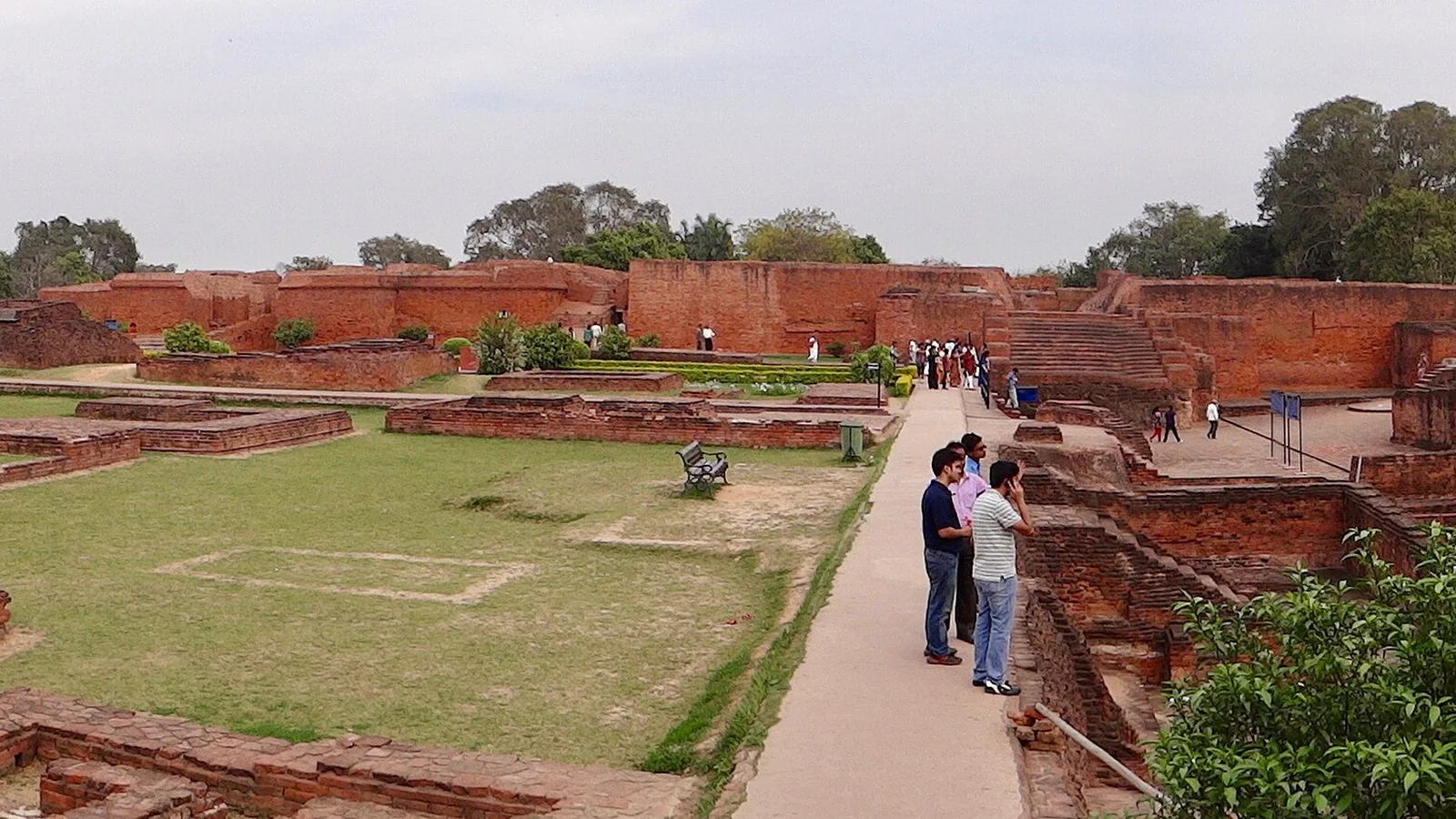
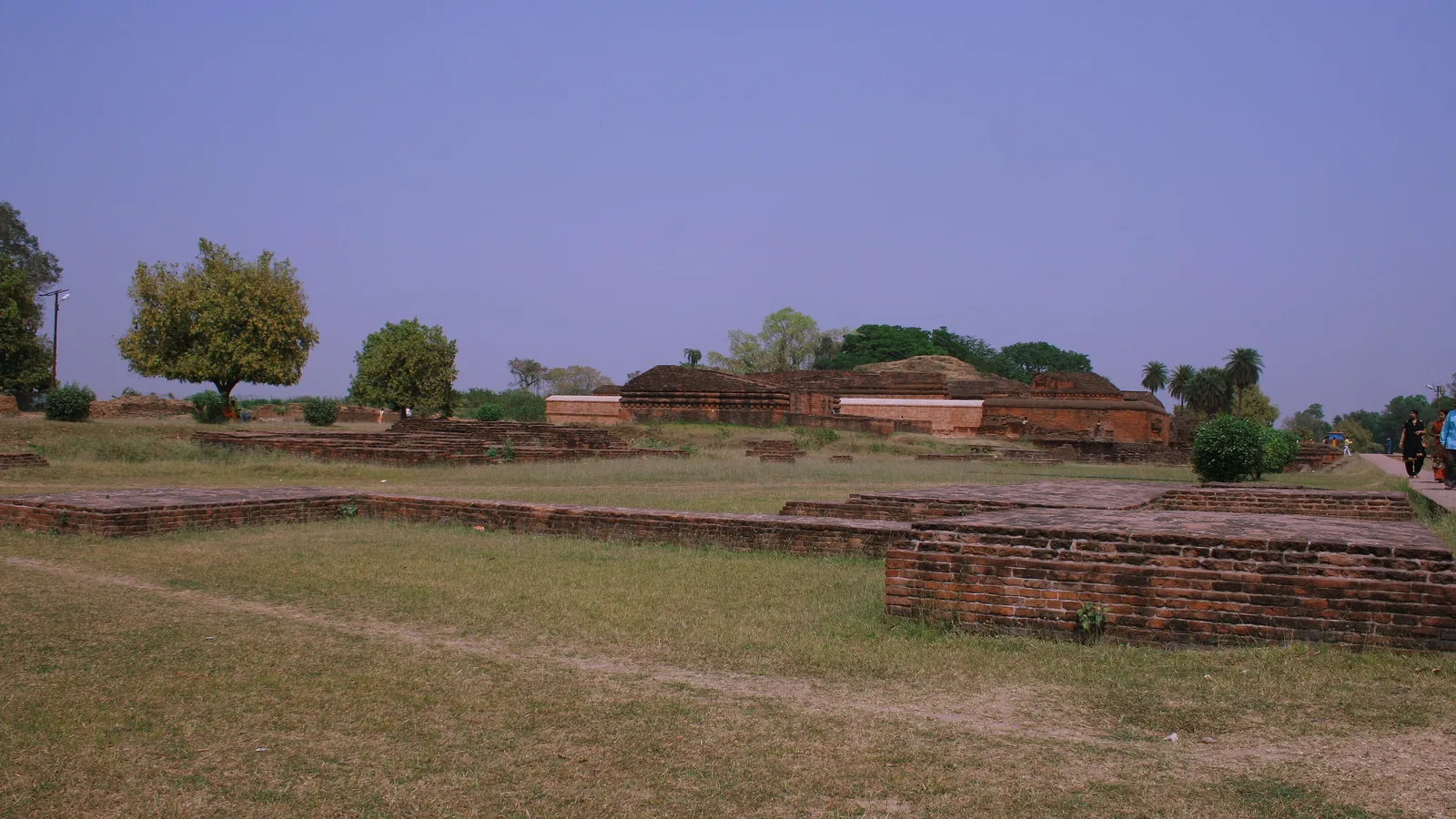
About six centuries after the decline, the same release states, Sir Francis Buchanan first found and reported the site. The ASI dug it from 1915 to 1937 and again from 1974 to 1982. Its page lists what those seasons exposed: six major brick temples and eleven monasteries, spread over more than a square kilometer, on either side of a north-south passage about a hundred feet wide.
The monasteries follow one plan: cells around a central courtyard behind a common veranda, a secret chamber for valuables, a granary beside the kitchen and well, and a single entrance. Temple site 3, at the southern end of the row, is the largest structure, ringed by votive stupas; two of its four corner towers survive. Temple site 2 stands apart from the general layout and carries a dado of 211 carved panels above its plinth. On a mound called Sarai Tila, next to the monastery complex, excavators found a temple with murals.
Copper plates, sealings and coins from the digs went to a site museum run by the survey. Inscriptions among the finds, the ASI states, show that rulers granted the revenue of particular villages to keep the institution running.

July 15, 2016: "Excavated Remains of Nalanda Mahavihara"
The site entered the Tentative List for World Heritage on January 9, 2009, as “The Excavated Remains at Nalanda.” The ASI prepared a nomination dossier under the title “Excavated Remains of Nalanda Mahavihara” and submitted it to the World Heritage Committee in January 2015. The Ministry of Culture announced the inscription on the evening of July 15, 2016.
The ministry’s release called Nalanda “the earliest planned university of the Indian subcontinent” and wrote that students “were admitted after rigorous evaluation only,” the point Xuanzang had made about the gatekeeper. Its list of subjects ran from logic and grammar to science and medicine.
Two East Asia summits and a university
The modern university’s history page traces the revival to March 2006, when A. P. J. Abdul Kalam proposed it to a joint session of the Bihar legislature. The Act’s preamble names two meetings: the Second East Asia Summit at Cebu in the Philippines on January 15, 2007, which backed “the revival of the Nalanda University,” and the Fourth, at Hua Hin in Thailand on October 25, 2009. The long title calls the new body “an international institution” for intellectual, philosophical, historical and spiritual studies. Section 3 defines a Nalanda Mentor Group, formed by a Ministry of External Affairs communication dated June 28, 2007.
Bihar allotted 455 acres for the campus. The university’s page gives 427 as the old Nalanda’s founding year, where the ASI gives only Kumaragupta’s reign, 413 to 455. The new university’s first students enrolled in September 2014.
Key facts
- The ASI places Nalanda about 15 kilometers south of Biharsharif and about 95 kilometers southeast of Patna, and credits its founding to Kumaragupta I (reigned 413–455).
- Xuanzang’s record, in Beal’s 1884 translation, lists five royal builders by name and a wall “with one gate” around the monasteries.
- Xuanzang wrote that failed applicants at the gate stood to successful ones “as seven or eight to ten.”
- The ASI states that the “final blow came in around 1200 A.D.” with Bakhtiyar Khalji’s invasion and a fire.
- Minhaj-i Siraj heard the story of the fort of Behar at Lakhnauti in 641 H. (1243); his account does not use the name Nalanda.
- The ASI excavated the site in 1915–37 and 1974–82, exposing six major brick temples and eleven monasteries over more than a square kilometer.
- The excavated remains were inscribed as a World Heritage site on July 15, 2016, after entering the Tentative List on January 9, 2009.
- The Nalanda University Act, No. 39 of 2010, received assent on September 21, 2010; the university enrolled its first students in September 2014.
FAQ
Who destroyed Nalanda?
The Archaeological Survey of India attributes the end to the invasion of Bakhtiyar Khalji around 1200 and a fire. The Tabakat-i Nasiri of Minhaj-i Siraj, written from the story of a man in Bakhtiyar's army, heard in 1243, describes Bakhtiyar's capture of a fort and city of study at Behar but does not name Nalanda.
What did Xuanzang write about Nalanda?
He described a walled group of monasteries built by a succession of kings, resident monks numbering "several thousands," debates from morning till night, and a gatekeeper whose hard questions turned away most outside applicants. He named teachers including Dharmapala and Silabhadra.
When was the Nalanda University Act passed?
The Act, No. 39 of 2010, received the President's assent on September 21, 2010, and appeared in the Gazette of India on September 22. It declared Nalanda University an institution of national importance, and the first students enrolled in September 2014.
Sources
- Archaeological Survey of India, "Excavated Site, Nalanda" (Ticketed Monuments, Bihar).
- Hiuen Tsiang (Xuanzang), Si-yu-ki: Buddhist Records of the Western World, translated by Samuel Beal (London: Trübner, 1884), vol. 2, Book IX, pp. 167–171; full text at the Internet Archive.
- Minhaj-i Siraj Juzjani, Tabakat-i Nasiri, in H. M. Elliot and John Dowson (eds.), The History of India, as Told by Its Own Historians, vol. II; Packard Humanities Institute, Persian Literature in Translation, text 080201012, part 3.
- Press Information Bureau, Government of India, Ministry of Culture, "Archaeological Site of Nalanda Mahavihara (Nalanda University) Gets Inscribed in World Heritage List," July 15, 2016.
- The Gazette of India, Extraordinary, Part II, Section 1, No. 48, New Delhi, September 22, 2010: The Nalanda University Act, 2010 (No. 39 of 2010), scanned copy hosted by Nalanda University.
- Nalanda University, "History" (About Us).
Cite this article
- APA
- Song Letter. (2026, September 29). Act No. 39 of 2010 and the Nalanda that Xuanzang described. Our Earth's History. https://ourearthshistory.com/south-asia/medieval/nalanda-xuanzang-asi-excavation-1915-university-act-2010/
- Chicago
- Song Letter. “Act No. 39 of 2010 and the Nalanda that Xuanzang described.” Our Earth's History, September 29, 2026. https://ourearthshistory.com/south-asia/medieval/nalanda-xuanzang-asi-excavation-1915-university-act-2010/.
- MLA
- Song Letter. “Act No. 39 of 2010 and the Nalanda that Xuanzang described.” Our Earth's History, 29 Sep. 2026, https://ourearthshistory.com/south-asia/medieval/nalanda-xuanzang-asi-excavation-1915-university-act-2010/.
Get the week in history
One email a week: the new articles, and what was happening elsewhere at the same moment. Free, no ads, unsubscribe any time. How we handle your email.
Text licensed CC BY-NC-ND 4.0. Found an error? Tell us.